Residing in Jiaozhi and Ordination
Grew up in Jiaozhi following his father's merchant migration, lost both parents in youth, and entered the monastic order to study Indian scriptures and Chinese classics.
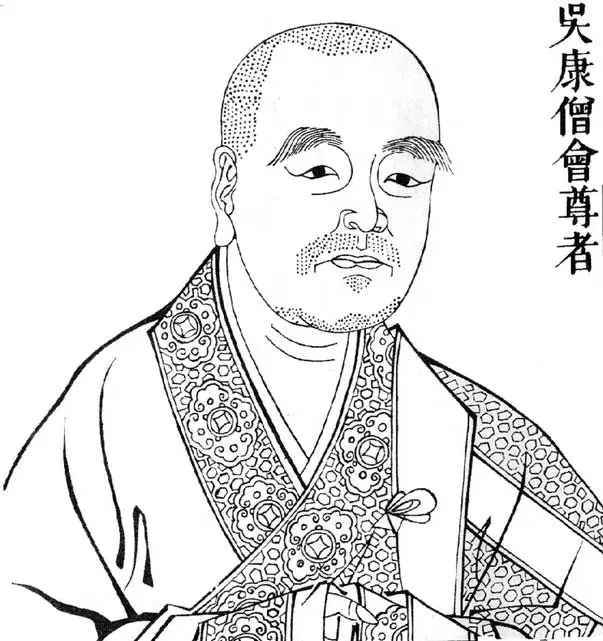
康僧会
Kang Senghui (康僧会, d. 280) was a prominent Buddhist master, translator, and doctrinal commentator during the Three Kingdoms period in Eastern Wu, widely recognized as the founding patriarch of Buddhism in the Jiangnan region. His ancestors originated from Sogdia and resided in India for generations before his merchant father relocated the family to Jiaozhi (modern northern Vietnam). Orphaned in his teens, Kang Senghui entered…
Kang Senghui (康僧会, d. 280) was a prominent Buddhist master, translator, and doctrinal commentator during the Three Kingdoms period in Eastern Wu, widely recognized as the founding patriarch of Buddhism in the Jiangnan region. His ancestors originated from Sogdia and resided in India for generations before his merchant father relocated the family to Jiaozhi (modern northern Vietnam). Orphaned in his teens, Kang Senghui entered the monastic order upon completing traditional mourning rites. Characterized by profound erudition and rigorous monastic discipline, he mastered the Buddhist Tripitaka while studying the Confucian Six Classics and traditional divination texts. In 247, the tenth year of the Chiwu era, he journeyed to Jianye (modern Nanjing), the capital of Eastern Wu, to establish a thatched hermitage and propagate Buddhist teachings. When summoned by Emperor Sun Quan, Kang Senghui prayed for and miraculously obtained a five-colored sacred relic (sarira) that shattered bronze basins and withstood heavy hammer blows. Profoundly awed, Sun Quan ordered the construction of Jianchu Temple and a pagoda, establishing the first formal Buddhist monastery in southern China. Later under Emperor Sun Hao, Kang Senghui defended Buddhism through articulate philosophical debates reconciling Confucian ethics with Buddhist karmic retribution, eventually inspiring the tyrant to repent and receive the five lay precepts. Residing in Wu for over three decades, he translated the Liudu Ji Jing, produced foundational commentaries on meditation treatises, and standardized Buddhist liturgical chanting, standing as a pivotal figure in the sinicization of Buddhism.
Grew up in Jiaozhi following his father's merchant migration, lost both parents in youth, and entered the monastic order to study Indian scriptures and Chinese classics.
Traveled across southern provinces, studying meditation and Abhidharma doctrines under Chen Hui, a prominent disciple of An Shigao.
Reached the Eastern Wu capital of Jianye, erected a thatched hermitage, and began open missionary work, drawing the attention of imperial officials.
Prayed for a sacred sarira that demonstrated indestructible supernatural resilience, prompting Sun Quan to build Jianchu Temple, the first Buddhist monastery in Jiangnan.
Directed translation collegia at Jianchu Temple, producing the Liudu Ji Jing and Xiaopin Prajnaparamita, while instructing disciples in liturgical chanting.
Authored seminal commentaries and prefaces for the Anban Shouyi Jing and Fajing Jing, pioneering native Chinese scriptural exegesis.
Overcame scholar-official Zhang Yu in debate and articulated karmic retribution before the court, preventing the destruction of Buddhist temples.
Preached the five precepts to Sun Hao after the emperor suffered illness from defiling a statue, securing imperial patronage for Jianchu Temple.
Witnessed the fall of Eastern Wu to Western Jin in April, passing away peacefully in September at Jianchu Temple.
Kang Senghui's ancestral home was in Sogdia, an ancient Iranian trading civilization in Central Asia. His forebears had lived in India for generations before his father, engaged in maritime and overland Silk Road trade, moved the family to Jiaozhi Commandery in the southernmost region of the Han empire. Kang Senghui was born and raised in this culturally diverse hub where Chinese, Indian, and Southeast Asian traditions intersected. In his early adolescence, both of his parents died in close succession, confronting him with the stark impermanence and suffering of human existence.
After observing three years of rigorous filial mourning according to Chinese propriety, Kang Senghui formally renounced secular life and took monastic vows. He was widely recognized for personal integrity, magnanimity, and strict observance of the Vinaya. Demonstrating extraordinary intellectual talent, he immersed himself not only in the Buddhist Tripitaka across various foreign tongues but also in classical Chinese heritage, including the Confucian Six Classics, Daoist philosophical texts, and cosmological divination theories. His dual mastery of Indic Buddhist doctrine and classical literary Chinese equipped him with rare rhetorical agility and cross-cultural insight.
During the Three Kingdoms period, the Sun family established the regional kingdom of Eastern Wu, making Jianye its political center. Although Buddhism had begun taking root in northern China through translation centers in Luoyang, the regions south of the Yangtze River had seen little public institutional development. While lay devotees like Zhi Qian had fled south and translated texts privately for the educated elite, there were neither recognized public monastic communities nor free-standing Buddhist monasteries in Jiangnan.
In 247, the tenth year of the Chiwu era, Kang Senghui arrived in Jianye carrying his pilgrim staff. He erected a simple thatched hermitage on the outskirts of the capital, placed an image of the Buddha, and practiced morning and evening devotion, circumambulation, and public exposition. Encountering a foreigner with shaven head and monastic robes, the local populace reacted with suspicion, viewing him as a practitioner of outlandish customs. Protocol officers promptly petitioned Emperor Sun Quan, warning that a foreign man claiming to be a monk in abnormal dress had entered the capital and required official investigation.
Sun Quan recalled Emperor Ming of Han's dream of the golden deity and summoned Kang Senghui to court, inquiring into what divine efficacy Buddhism possessed. Kang Senghui replied that more than a millennium after the Buddha's parinirvana, his sacred relics (sarira) continued to radiate miraculous spiritual power, noting that King Ashoka had built eighty-four thousand stupas to honor this living legacy. Sun Quan, skeptical yet intrigued, issued a test: if Kang Senghui could obtain a genuine relic within a set period, the state would erect a pagoda; if fraudulent, he would face execution under state law. Kang Senghui requested seven days, leading his companions in strict fasting and incense prayer before a bronze jar in a purified room.
When no sign appeared after fourteen days, Sun Quan grew angry, threatening punishment. Kang Senghui requested a third week, declaring to his followers that the survival of the dharma in the south depended entirely upon this trial. In the fifth watch before dawn on the twenty-first day, a resonant metallic sound echoed from the vessel. Kang Senghui discovered a radiant five-colored relic within the jar. The following morning, Sun Quan personally poured the relic onto a copper tray; upon impact, the tray shattered instantly while the relic remained unblemished. When placed on an iron anvil and struck with heavy hammers by royal guards, the anvil was deeply indented while the relic was unharmed. Deeply astonished and converted, Sun Quan commanded the construction of a grand pagoda and monastery named Jianchu Temple, signifying the inaugural Buddhist monastery of Jiangnan, and designated the surrounding district as Fotuoli.
Decades later, the despotic Sun Hao ascended the throne of Eastern Wu. Enforcing harsh laws, Sun Hao launched an aggressive campaign to abolish local shrines and resolved to demolish Buddhist monasteries, demanding proof of their doctrinal validity. While court ministers dared not resist, Palace Attendant Zhang Yu, noted for exceptional eloquence, was dispatched to interrogate Kang Senghui. Throughout an entire day of intense philosophical sparring, Kang Senghui countered every challenge with razor-sharp reasoning, leaving Zhang Yu completely outmatched. Zhang returned to court and advised the emperor that the monk's wisdom was beyond normal measurement.
Sun Hao subsequently summoned Kang Senghui to a full imperial audience, asking why Buddhism was necessary if the Duke of Zhou and Confucius had already articulated moral principles. Kang Senghui explained that Confucian texts outlined immediate societal manifestations of virtue, whereas Buddhist teachings fully illuminated the deep, tripartite cycle of karmic retribution spanning past, present, and future existences. Later, imperial guards uncovered a golden Buddha statue while digging in the palace gardens; Sun Hao placed it in a latrine and poured filth over it for amusement. Shortly afterward, the emperor suffered excruciating bodily swelling and severe pain in his groin. After divination revealed the displeasure of a great deity, a devout palace lady urged him to seek forgiveness from the Buddha. Terrified and penitent, Sun Hao had the statue cleansed with fragrant water, bowed repeatedly, and summoned Kang Senghui. Following Kang Senghui's compassionate exposition of moral cause and effect, Sun Hao experienced sudden relief, accepted the five lay Buddhist precepts, and renovated Jianchu Temple.
Throughout his residence at Jianchu Temple, Kang Senghui directed translation assemblies and mentored generations of scholars, producing graceful translations that resonated with southern literati. In April 280, Western Jin forces crossed the Yangtze River, forcing Sun Hao's unconditional surrender and ending the Eastern Wu dynasty. Having witnessed the collapse of the kingdom, Kang Senghui fell ill and passed away peacefully at Jianchu Temple in September 280. During the reign of Emperor Cheng of Jin, when the rebel Su Jun burned the temple pagoda, Minister of Works He Chong rebuilt it. Distinguished Jin literati, including Sun Chuo, composed panegyrics celebrating Kang Senghui's enduring role as the pioneer of southern Buddhism.
Prior to Kang Senghui's arrival in 247, the southern regions lacked dedicated Buddhist monastic compounds and formal communal monastic life. By securing the profound patronage of Emperor Sun Quan through the miraculous manifestation of the sacred sarira, Kang Senghui established Jianchu Temple and its accompanying pagoda in the Wu capital of Jianye. The name Jianchu explicitly commemorated this site as the beginning of institutional Buddhism in the south. This monastic foundation established the structural framework for regular liturgical services, translation bureaus, and clerical training, making Jianye the primary nursery for six dynasties Buddhist scholarship and culture.
At Jianchu Temple, Kang Senghui supervised a comprehensive translation collegium tailored to the aesthetic and philosophical sensibilities of Jiangdong intellectuals. His most renowned achievement was the compilation and translation of the fourteen-fascicle Liudu Ji Jing (Compendium of the Six Perfections). This monumental work structured early Buddhist birth stories (Jataka) and parables around the six Mahayana virtues: generosity, moral discipline, patience, vigorous effort, meditation, and wisdom. He also translated the Xiaopin Prajnaparamita along with narrative collections such as the Zapiyu Jing, A'nan Nianmi Jing, and Fahuang Jing. His translations blended fidelity to original concepts with elegant literary prose, significantly enhancing the literary standing of Buddhist canonical literature in China.
Kang Senghui is celebrated in Chinese intellectual history as the very first monk to systematically author exegeses and prefaces for Buddhist scriptures in the Chinese language. Inheriting the meditation and analytical traditions of An Shigao through Chen Hui, he composed profound commentaries and introductory essays on the Anban Shouyi Jing, Fajing Jing, and Daoshu Jing. His commentaries combined technical Buddhist terminology with contemporary metaphysical discourse. Renowned 20th-century historian Tang Yongtong emphasized that Kang Senghui's historical significance lay primarily in his original compositional exegesis rather than mechanical translation, marking the decisive transition of Chinese Buddhism from passive foreign reception to active indigenous theoretical development.
Possessing deep fluency in both Indic scriptures and Chinese canonical literature, Kang Senghui initiated the systematic theoretical reconciliation between Buddhism, Confucianism, and Daoism. In his dialogues with Eastern Wu monarchs and scholars, he correlated Buddhist karmic causation with the ethical principles of the Book of Changes and Book of Documents. He argued that while Confucian sages addressed proximate sociopolitical governance, the Buddha elucidated the ultimate metaphysical realities of existence, demonstrating that the two traditions were mutually complementary. His commentaries also integrated Daoist notions of non-action and natural spontaneity to illuminate Mahayana emptiness, establishing the conceptual bridge for the emergence of Six Dynasties Buddhist-Daoist philosophical synthesis.
Beyond textual translation and scholastic commentary, Kang Senghui paid meticulous attention to the ritual culture of the monastic community. At Jianchu Temple, he established and standardized the liturgical chant known as the Niyuan Bai (Nirvana Chant), adapting traditional Indian Buddhist chanting methods to the tonal qualities of southern Chinese musical systems. Characterized by serene melodic resonance and solemn gravity, this liturgical standard became the official model for monastic assemblies throughout the Six Dynasties, profoundly enriching medieval Chinese sacred music.
FIGURES ASSOCIATED WITH THIS DYNASTY