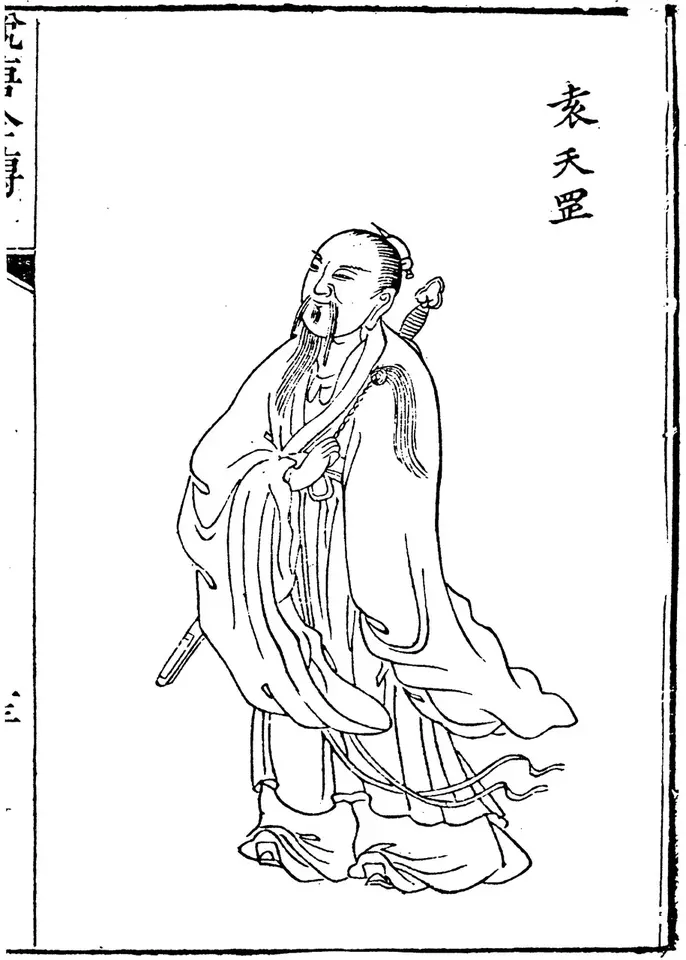
袁天罡
Related historical visual for 袁天罡
Image creditsUnknown authorUnknown author · Public domainImage source

Historical figure

Yuan Tiangang (袁天罡)

袁天罡

Yuan Tiangang (袁天罡, ?–645), also written as Yuan Tiangang (袁天纲), was a native of Chengdu in Yizhou. He was a preeminent astronomer, astrologer, prognostication scholar, and grand master of physiognomy during the late Sui and early Tang dynasties. Orphaned and impoverished in his youth, Yuan dedicated himself to Daoist spiritual cultivation and the esoteric mathematics of celestial movements. He attained deep insight into…

Era not stated

PROFILE

Yuan Tiangang (袁天罡, ?–645), also written as Yuan Tiangang (袁天纲), was a native of Chengdu in Yizhou. He was a preeminent astronomer, astrologer, prognostication scholar, and grand master of physiognomy during the late Sui and early Tang dynasties. Orphaned and impoverished in his youth, Yuan dedicated himself to Daoist spiritual cultivation and the esoteric mathematics of celestial movements. He attained deep insight into astronomy, mathematics, calendar formulation, and the subtle resonance of wind divination and voice diagnosis, rising to nationwide fame for his unerring predictions. In the late Daye era of the Sui Dynasty, he entered officialdom as Magistrate of Ziguan in Zizhou; upon the founding of the Tang Dynasty, he transferred to serve as Magistrate of Huojing in Yizhou. Yuan Tiangang enjoyed legendary renown for his uncanny ability to divine human fates and cosmic omens, with historical annals recording numerous astonishing prophecies that were fulfilled without exception. In his early career at the mansion of Wu Shihuo, Commander-in-Chief of Lizhou (modern Guangyuan, Sichuan), he was presented with the infant Wu Zetian, who had been deliberately dressed in boys' clothing. Examining her bone structure and vital radiance, Yuan gasped in astonishment: "With the features of a sun-horn and a dragon face, the eyes of a dragon and the neck of a phoenix, if this child were female, she would possess an unfathomable destiny and rule the entire realm as sovereign!" This prophecy was completely verified when Wu Zetian founded the Wu Zhou Dynasty. Moreover, he foretold that the young scholar Du Yan would gain renown through literature and become an Investigating Censor, that Wang Gui would attain fifth-rank office within a decade, that Ma Zhou possessed the physiognomy of an eminent grand chancellor, and that Cen Wenben would reach the position of Director of the Chancellery but suffer a shortened lifespan—all of which unfolded exactly as predicted. Emperor Taizong of Tang held his extraordinary talents in high esteem and summoned him to Chang'an in the eighth year of the Zhenguan era (634), granting him the title of Gentleman in Waiting for Imperial Audiences and consulting him repeatedly on celestial anomalies and the dynastic destiny. In the late Zhenguan era, tradition credits him and Grand Astrologer Li Chunfeng with authoring the prophetic work Tuibei Tu (Back-Pushing Pictures). In 645, foreseeing the end of his days, Yuan retired to the mountains of Huojing in Sichuan, where he peacefully passed away.

Native Place
Chengdu, Yizhou (present-day Chengdu, Sichuan Province)
Date of Death
645 (19th Year of the Zhenguan Era, Tang Dynasty)
Highest Office
Magistrate of Ziguan, Magistrate of Huojing, Gentleman in Waiting for Imperial Audiences
Historical Role
Renowned astronomer, astrologer, and master of physiognomy and prognostication in the late Sui and early Tang dynasties

LIFE TIMELINE

Relationship graph

BIOGRAPHY

Chronology

  • 605 (1st Year of the Daye Era, Sui) | Dedicated Esoteric Study | Lived in poverty during youth, devoted himself to Daoist metaphysics, and mastered the Book of Changes, astronomical calendars, and wind-reading physiognomy.
  • 616 (12th Year of the Daye Era, Sui) | Official Service in Ziguan | Served as Magistrate of Ziguan in Zizhou, predicting prestigious official careers for Du Yan, Wang Gui, and Wei Ting.
  • 618 (1st Year of the Wude Era, Tang) | Allegiance to Tang | Joined the Tang Dynasty and was appointed Magistrate of Huojing in Yizhou.
  • 624 (7th Year of the Wude Era, Tang) | Prophesying the Empress | Examined the infant Wu Zetian in Lizhou, declaring that she possessed dragon eyes and phoenix neck and would become sovereign of the world.
  • 631 (5th Year of the Zhenguan Era, Tang) | Divining Ma Zhou's Fate | Met the destitute scholar Ma Zhou in Chang'an, identifying his exceptional physiognomy and predicting his rapid elevation to grand chancellor.
  • 634 (8th Year of the Zhenguan Era, Tang) | Imperial Summons to Court | Summoned to Chang'an by Emperor Taizong, appointed Gentleman in Waiting for Imperial Audiences, and consulted on celestial portents.
  • 636 (10th Year of the Zhenguan Era, Tang) | Reading Cen Wenben | Read the physiognomy of Cen Wenben, predicting his rise to the chancellorship alongside an early death, which materialized precisely.
  • 640 (14th Year of the Zhenguan Era, Tang) | Prophesying Dynastic Fortune | Served in the inner palace alongside Li Chunfeng, collaboratively calculating dynastic fortunes into the prophetic Tuibei Tu.
  • 644 (18th Year of the Zhenguan Era, Tang) | Requesting Retirement | Perceived his impending physical demise, petitioned Emperor Taizong for retirement, and returned to Huojing in Shu.
  • 645 (19th Year of the Zhenguan Era, Tang) | Peaceful Demise | Passed away serenely in his retreat at Huojing, leaving an enduring legacy in prognostication and Daoist scholarship.

Life and Career

Early Impoverishment and Prophecy for Three Luminaries

Yuan Tiangang was born into a commoner family in Shu. Having lost both parents early in life, he grew up in severe hardship and poverty. Nevertheless, he possessed a tranquil and detached disposition, showing little interest in worldly honors or wealth while demonstrating an intense passion for Daoist longevity cultivation. He exhaustively studied hexagram principles from the Book of Changes, ancient architecture treatises, astronomical calendar treatises, and astronomical star canons. In particular, he mastered the art of wind-reading and vocal evaluation, which allowed him to assess human fortunes based on atmospheric colors, celestial winds, and vocal resonance.

Near the close of the Daye era of the Sui Dynasty, Yuan entered official service through his scholarly renown, taking office as Magistrate of Ziguan in Zizhou. At that time, unrest engulfed the realm, and Sui scholars Du Yan, Wang Gui, and Wei Ting took refuge in Shu in straitened circumstances. Hearing of Yuan's repute, the three men visited his magistrate office to inquire about their future careers.

Yuan examined their bone structures and facial auras with great care. Turning first to Du Yan, he declared: "Your intellectual halls are rich and full; you will certainly achieve eminence through fine literary scholarship and be selected by the emperor as an Investigating Censor." Pointing next to Wang Gui, he remarked: "The ridge of your nose and nasolabial folds are prominent and plump; within ten years you will ascend to a fifth-rank post and sit in the imperial ministerial bureaus." Finally, addressing Wei Ting, he stated: "You bear the countenance of a fierce tiger and possess deep loyalty toward friends; you will make your career in military service and attain the rank of General of the Militant Guard."

Yuan then added a cautionary counsel: "After the three of you attain high position, you will advance and retreat together as allies; however, in a few years you will all be demoted on account of shared involvement in a single catastrophe, only to be reinstated soon thereafter to positions of even greater distinction." When the Tang Dynasty established its rule, Du Yan became an Imperial Censor, Wang Gui rose to Chancellor as Vice Director of the Imperial Chancellery, and Wei Ting became General of the Militant Guard. In 624, because of their association with Crown Prince Li Jiancheng during the Yang Wangan incident, all three were banished to Xizhou, only to be recalled and restored to honor under Emperor Taizong, fulfilling Yuan's predictions in every detail.

Miraculous Diagnosis in Lizhou and Wu Zetian's Destiny

During the Wude era, Yuan Tiangang served as Magistrate of Huojing in Yizhou. In the seventh year of Wude (624), Wu Shihuo, Commander-in-Chief of Lizhou, invited Yuan to his official residence to evaluate the physiognomy of his family members.

Wu Shihuo first brought forward his wife, Lady Yang. Yuan observed her facial complexion and remarked: "Madam's countenance shows bone structure belonging to nobility; you will undoubtedly bear an illustrious child." Next, Wu's sons Wu Yuanqing and Wu Yuanshuang were presented. Yuan glanced at them and said: "These two gentlemen may reach official posts of the third rank and preserve the ancestral estate, but they will not attain supreme honors." When Wu's elder daughter (later Lady of Han) was brought out, Yuan remarked: "This young lady will marry into wealth and nobility, yet her fortune carries adverse omens for her spouse."

Finally, a nurse carried out the infant Wu Zetian, who had been deliberately dressed in boys' garments. Yuan Tiangang stepped forward, scrutinized her infant features, and felt a profound shock. He studied her facial contours and walked around her, gasping: "With the features of a sun-horn and a dragon face, the eyes of a dragon and the neck of a phoenix! How tragic that this is a boy—if this child were a daughter, her destiny would be truly unfathomable, and she would reign over the entire realm as sovereign!" Wu Shihuo and his household were stunned and kept the prediction strictly secret. Decades later, Wu Zetian ascended the throne as the female emperor of the Wu Zhou Dynasty, validating Yuan's prophecy beyond dispute.

Imperial Inquiries and Zhenguan Consultations

As his fame spread across the empire, stories of his divination reached Emperor Taizong of Tang. In the eighth year of the Zhenguan era (634), Emperor Taizong dispatched imperial emissaries to summon Yuan to Chang'an. Receiving him warmly in the inner palace, Taizong remarked: "In antiquity, the Han Dynasty had Yan Junping and Xu Fu, who were famed for their divination and physiognomy. Now that I have met you, how is it that your insight surpasses theirs to such a miraculous degree?"

Yuan bowed respectfully and replied: "Yan Junping lived in an era of political decay and had to close his doors to divine fortunes in private markets; your servant has met an enlightened sovereign and gained office under an illustrious court. What your servant relies upon is simply observing the waxing and waning of the Five Elements, calculating the movements of the Eight Trigrams, and aligning human affairs with the laws of heaven; I dare not claim any supernatural abilities." Taizong was immensely pleased with his reply and granted him the position of Gentleman in Waiting for Imperial Audiences, keeping him in the forbidden palace for continuous counsel.

During this period, Cen Wenben, then a Secretariat Drafter, sought Yuan's counsel regarding his political future. Yuan gazed at his forehead and sighed: "Your complexion is lustrous and your cranial bone is exceedingly rare; your scholarship will dazzle the realm, and you will eventually ascend to the chancellorship as Director of the Secretariat. However, your flesh does not fully support your sharp bone structure, which portends a brief life span under such supreme honors." In the nineteenth year of Zhenguan, Cen Wenben accompanied the eastern expedition against Goguryeo and was appointed Chancellor, but collapsed from exhaustion and died in camp at the age of fifty, exactly fulfilling Yuan's words.

Prognostication at Deyang and Astuteness with Dignitaries

During his stay in Chang'an, countless prominent ministers and military grandees sought Yuan's counsel. When the young scholar Ma Zhou arrived in the capital in extreme poverty, dwelling in obscurity, Yuan met him at a tavern. Looking intently at Ma Zhou, Yuan pulled him aside and whispered: "The rhinoceros bone atop your head pierces through to the crown, and the bridge of your nose rises straight toward heaven; you bear the countenance of an eminent statesman who will assist an emperor within days. Do not abandon your ambition." Shortly thereafter, Ma Zhou submitted an insightful state memorial through General Chang He, deeply impressing Emperor Taizong, and was elevated directly to the imperial secretariat, eventually becoming Chancellor.

Similarly, when Dou Gui, Commander-in-Chief of Yizhou, was plagued by military setbacks, Yuan examined his features and assured him: "Your jawline is resolute and your temples carry auspicious redness; within three years you will crush your adversaries and be rewarded with high provincial governance." Dou Gui subsequently achieved great victories in pacifying regional rebellions, confirming Yuan's reputation throughout the southwestern regions.

Retirement to Langzhong and Mountain Hermitage

Yuan Tiangang was profoundly versed in geomancy and landscape topography. In his later years, he spent extensive time exploring Langzhong in Sichuan. He observed the undulating mountain ridges surrounding Langzhong and noted that the mountain veins formed the shape of coiled dragons and crouching tigers, concluding that the area harbored potent spiritual energies. He composed several foundational texts on environmental observation and mountain vein circulation.

Recognizing that worldly fame brought perilous entanglements, Yuan continually sought an opportunity to sever his ties with the capital court. In the eighteenth year of Zhenguan (644), he observed the movements of Mars and the Lunar Mansions, perceiving that his allotted years on earth were drawing to a close. He presented a formal petition to Emperor Taizong requesting permission to retire to his native region in Shu. Taizong, moved by his sincere desire for spiritual tranquility, reluctantly granted his request and bestowed generous imperial farewell gifts.

Celestial Computation and Peaceful Passing at Huojing

According to enduring historical traditions, during the Zhenguan era, Emperor Taizong, concerned about the long-term fortune of the Tang Dynasty, commanded Grand Astrologer Li Chunfeng and Yuan Tiangang to collaboratively compute future dynastic successions. Li Chunfeng calculated astronomical cycles while Yuan provided supplementary interpretations. Commencing from the Zhenguan era, their calculations extended through the Wu Zhou usurpation, the An Lushan Rebellion, the Huang Chao Uprising, the Five Dynasties period, and subsequent imperial dynasties, compiling sixty prophetic diagrams with accompanying verses, collectively known as Tuibei Tu.

When Li Chunfeng became so absorbed in his divination that he showed no sign of stopping, Yuan gently pushed his back and uttered a cautionary verse: "Boundless heavenly numbers are sought within, yet worldly rise and fall cannot be controlled; endless thousands of words cannot exhaust the mystery, so let us push the back and retire in peace." They sealed the manuscript and presented it to Emperor Taizong, creating one of the most influential prophetic classics in Chinese history.

Returning to his homeland in Chengdu, Yuan established a modest thatched hermitage in the tranquil valleys of Huojing, spending his days chanting the Daodejing. In the nineteenth year of the Zhenguan era (645), Yuan Tiangang sat upright in meditation and passed away without illness or suffering.
Major Achievements

Supreme Astrological Foresight and Prophesying the Female Emperor

Yuan Tiangang occupies an exalted position in the annals of traditional Chinese prognostication and physiognomy. His most historically astonishing achievement was his precise prediction of Wu Zetian's eventual rise to the imperial throne while she was still an infant in swaddling clothes. In an era dominated by strict patriarchal norms, forecasting that a woman would become emperor represented an extraordinary and dangerous revelation of dynastic destiny. His parallel predictions regarding Du Yan, Wang Gui, Wei Ting, Ma Zhou, and Cen Wenben constitute the most methodically documented physiognomic accounts in official dynastic histories. Rather than merely examining external facial features, Yuan pioneered an approach that integrated cosmic atmospheric currents, vocal resonance, and internal moral integrity, elevating physiognomy into a sophisticated philosophical inquiry into the relationship between human character and celestial patterns.

Esoteric Scholarship and Cosmological Frameworks

Beyond his practical divination, Yuan Tiangang was a prolific astronomical theorist and Daoist philosopher. He integrated cosmological movements, climatological wind divination, and human destiny into a unified theoretical framework. He authored influential works including Taibai Huiyun Nizhao Tongdai Jitu (Records and Diagrams of Venusian Celestial Alignments Across Dynasties), Jiutian Xuannü Liuren Ke (Six-Ren Divination Manual of the Mysterious Maiden), and Yijing Xuanyao (Esoteric Essentials of the Mirror of Changes). Collaborating with Li Chunfeng, he helped establish the golden age of Tang astrology, wind prognostication, and prophetic scholarship, exerting an enduring influence on subsequent Song, Yuan, Ming, and Qing cosmological thought.

Personal Relationships

  • Prophetic Colleague: Li Chunfeng (Director of the Grand Astrological Bureau and renowned mathematician, legendary co-author of Tuibei Tu)
  • Foretold Empress: Wu Zetian (Empress of the Tang Dynasty and female Emperor of Wu Zhou, whose ascension he predicted during her infancy)
  • Honored Sovereign: Emperor Taizong of Tang (Emperor who summoned Yuan to Chang'an, granted him court titles, and sought his counsel)
  • Foretold Chancellor: Ma Zhou (Director of the Secretariat and famed chancellor, whose potential Yuan identified during his days of poverty)
  • Foretold Chancellor: Wang Gui (Early Tang chancellor and Minister of Rites, whose fifth-rank advancement Yuan foretold a decade in advance)
  • Foretold Chancellor: Cen Wenben (Director of the Secretariat whose high political office and premature death Yuan precisely divined)

Historical Evaluation

  • The Old Book of Tang (Volume 191) records: "Yuan Tiangang was exceptional in wind-reading and physiognomy, possessing profound insight into the subtlest matters. From swaddling clothes, he recognized that a female ruler would oversee the realm; amid dust and obscurity, he discerned the illustrious bearing of chancellors. Not a single word he uttered failed to come true, and his mastery surpassed both antiquity and modern times. Even the hermit divination of Yan Junping and the supernatural discernment of Xu Fu could not exceed his stature!"
  • The New Book of Tang (Volume 204) assesses: "Tiangang deeply investigated the principles of Yin and Yang and attained the utmost subtlety in cosmic calculations. Reading people and judging events was as clear to him as looking at the palm of his hand. Though heavenly destiny is difficult to fathom, his divine insight penetrated the unseen. Since the beginning of mankind, no one has matched Tiangang in the mastery of physiognomy."
  • Southern Song scholar Huang Zhen noted in his Richao: "Yuan Tiangang and Li Chunfeng were the extraordinary men of the Tang. In wind prognostication, musical harmonics, and calendar computation, they silently communed with mysterious cosmic mechanics. Though the way of heaven is subtle and human affairs ephemeral, these two were able to fathom the hidden operations of creation; they surely grasped the most spiritual principles of heaven and earth!"

Related Entries

  • Li Chunfeng
  • Wu Zetian
  • Tuibei Tu
  • Emperor Taizong of Tang
  • Ma Zhou
  • Cen Wenben
  • Book of Changes

FIGURES ASSOCIATED WITH THIS DYNASTY

Bibliography

  • Old Book of Tang, Volume 191, Liezhuan 141 (Fangji: Biography of Yuan Tiangang)
  • New Book of Tang, Volume 204, Liezhuan 129 (Fangji: Biography of Yuan Tiangang)