Historical Backdrop
The expansion of urban commercial markets and citizen culture during the late Ming fosters popular storytelling and vernacular ballad arts.
兰陵笑笑生
Lanling Xiaoxiaosheng (兰陵笑笑生), a pseudonym meaning "The Laughing Scholar of Lanling," was an eminent novelist of the Ming Dynasty and the pseudonymous author of The Golden Lotus (Jin Ping Mei), the foremost of the "Four Masterworks of Ming Fiction." Active during the Jiajing and Wanli eras of the middle-to-late Ming Dynasty, his true identity, ancestral home, and exact lifespan remain one of the most celebrated literary…
Lanling Xiaoxiaosheng (兰陵笑笑生), a pseudonym meaning "The Laughing Scholar of Lanling," was an eminent novelist of the Ming Dynasty and the pseudonymous author of The Golden Lotus (Jin Ping Mei), the foremost of the "Four Masterworks of Ming Fiction." Active during the Jiajing and Wanli eras of the middle-to-late Ming Dynasty, his true identity, ancestral home, and exact lifespan remain one of the most celebrated literary enigmas in classical Chinese scholarship. The place name Lanling historically referenced either northern Lanling in Yixian (modern Zaozhuang, Shandong) or southern Lanling in Wujin (Changzhou, Jiangsu); given the ubiquitous and authentic Shandong colloquialisms throughout the text, consensus among literary historians suggests he was an author native to southern Shandong, living along the Grand Canal corridor, or thoroughly versed in regional vernacular culture. Lanling Xiaoxiaosheng stands as the first author in Chinese literary history to compose an independent, full-length vernacular novel. Prior monumental sagas such as Romance of the Three Kingdoms, Water Margin, and Journey to the West evolved from centuries of oral folk storytelling and theatrical cycles, representing collective editorial compilation. Lanling Xiaoxiaosheng shattered this reliance on dynastic history and mythology, drawing material directly from mundane urban life and gentry households of the mid-Ming era. Through the tragic rise and fall of merchant-official Ximen Qing's domestic compound, the novel exposes official corruption, commercial greed, and unchecked human appetite. In doing so, he inaugurated the grand tradition of the "novel of manners" (shiqing xiaoshuo), attaining unprecedented psychological subtlety and social realism that directly laid the creative foundation for later masterpieces such as Dream of the Red Chamber.
The expansion of urban commercial markets and citizen culture during the late Ming fosters popular storytelling and vernacular ballad arts.
Writing under the pen name Lanling Xiaoxiaosheng, he completes the hundred-chapter domestic masterpiece Jin Ping Mei, critiquing contemporary society under the guise of Song history.
Hand-copied manuscripts circulate among prominent literati including Dong Qichang, Yuan Hongdao, and Shen Defu, sparking literary admiration.
The Newly Carved Jin Ping Mei Cihua, with a preface by Xinxinzi and postscript by the Pearl-Player of Dongwu, is formally published in woodblock edition.
Early Qing literary critic Zhang Zhupo publishes his monumental commentary The First Extraordinary Book, standardizing analytical evaluation of the work.
Lanling Xiaoxiaosheng lived and wrote during the Jiajing and Wanli eras of the Ming Dynasty. Under the dual constraints of autocratic imperial rule and Neo-Confucian moral orthodoxy, the author mounted a devastatingly candid exposure of bureaucratic collusion, mercantile debauchery, and aristocratic excess, containing unmistakable satires of contemporary court grandees. To escape political persecution, literary inquisitions, and societal ostracism, the author deliberately concealed his real family name, adopting the enigmatic nom de plume "Lanling Xiaoxiaosheng."
Scholars have advanced numerous hypotheses regarding the literal derivation of the pseudonym. In traditional Chinese administrative geography, "Lanling" has two historical connotations: Northern Lanling in the ancient Commandery of Lanling (located around modern Yixian in Zaozhuang, Shandong), and Southern Lanling, established in Wujin (Changzhou, Jiangsu) during the Eastern Jin and Southern Dynasties. Because the dialogue in Jin Ping Mei is saturated with the dialect, idioms, and colloquial phonology of western and southern Shandong, the mainstream academic view holds that the author hailed from Northern Lanling or lived for years along the northern Grand Canal route. Other scholars suggest that "Lanling" alludes to ancient Lanling vintage wine, while "Xiaoxiaosheng" (The Laughing Scholar) embodies an aloof, satirical posture laughing at the vanity of human existence.
The vast scope of administrative and economic knowledge embedded within Jin Ping Mei demonstrates that Lanling Xiaoxiaosheng was an exceptionally erudite scholar possessing profound insight into every layer of Ming society. He was intimately familiar with the bureaucratic paperwork, legal codes, imperial guard protocols, and courier systems of Ming governance, while displaying equally encyclopedic mastery over pawnshops, commercial contracts, broker conventions, underworld slang, and mercantile practices along the Grand Canal.
Literary historians widely surmise that the author received rigorous classical Confucian education in his youth, possibly serving in government office or working as a confidential private secretary within aristocratic households before experiencing dramatic political disgrace or economic downfall. Falling from bureaucratic prominence into mundane urban obscurity endowed him with acute sensitivity to the hypocrisy of moralist platitudes, the cruelty of official corruption, and the tragic vulnerability of common folk. Rejecting rigid moralizing, he articulated his profound grief and scathing social critique from an unvarnished plebeian perspective.
Following its completion, Jin Ping Mei circulated initially as private handwritten manuscripts among late Ming cultural luminaries. In the 1590s, cultural masters such as Dong Qichang, the Yuan brothers (Yuan Zongdao and Yuan Hongdao), and scholar Shen Defu acquired manuscript installments, expressing boundless astonishment at its narrative genius and incisive portrayal of human nature. Yuan Hongdao eagerly petitioned friends for access to the remaining chapters, declaring the pages dazzling and unforgettable, while Shen Defu recorded in Random Gatherings of the Wanli Era that it was undoubtedly the masterwork of a preeminent scholar of the Jiajing era.
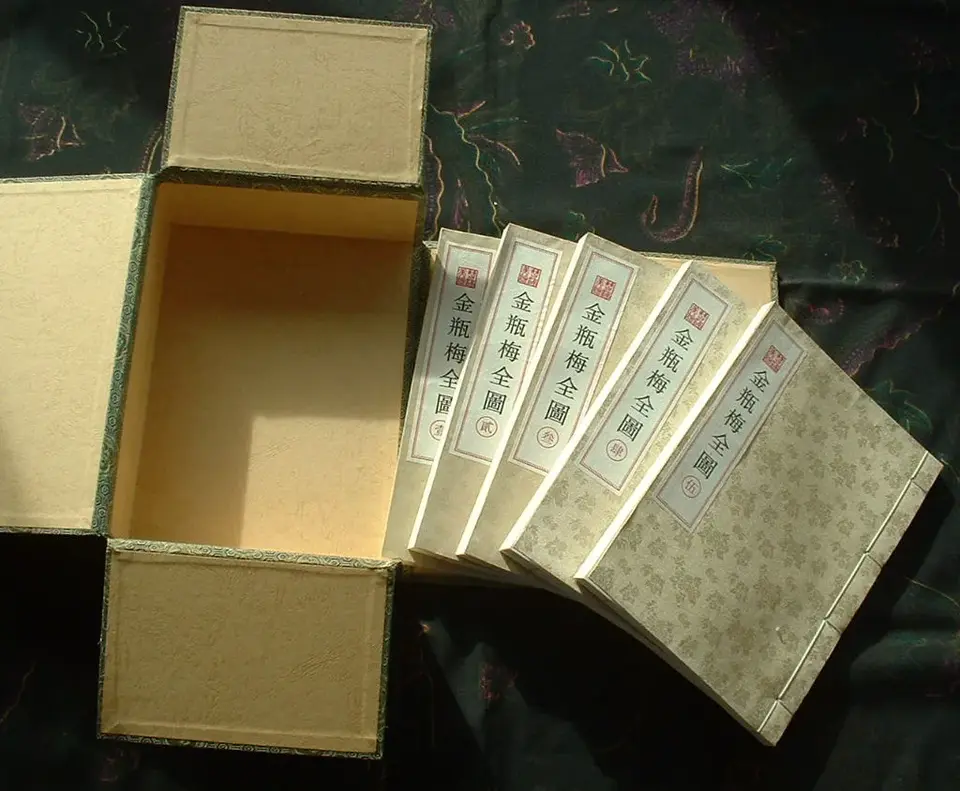
In 1617, the earliest extant woodblock imprint, The Newly Carved Jin Ping Mei Cihua, was published with a preface by Xinxinzi and a postscript by the Pearl-Player of Dongwu, cementing its status as an epochal masterpiece. Despite facing censorship and condemnation from conservative moralists due to its explicit naturalistic sexual descriptions, perceptive scholars recognized its cold, unflinching realist power. The novel was repeatedly reprinted in diverse commentary editions throughout the Ming and Qing dynasties, immortalizing Lanling Xiaoxiaosheng in the annals of world literature.
Lanling Xiaoxiaosheng's foremost milestone in the history of Chinese fiction was liberating the full-length novel from historical chronicle and folk myth, marking the transition from collective traditional storytelling to independent authorial creation. Prior widely popular masterpieces such as Romance of the Three Kingdoms and Water Margin were products of centuries of oral performances and playhouse dramas gradually compiled and polished by literati like Luo Guanzhong and Shi Nai'an.
Lanling Xiaoxiaosheng broke entirely free from the conventional mold of martial heroics and dynastic succession. Although he borrowed the episode of Wu Song slaying Pan Jinlian and Ximen Qing from Water Margin as a structural prologue, he immediately embarked on an entirely original narrative course. He single-handedly invented a sprawling, hundred-chapter sociological panorama populated by over a hundred vividly individualized urban characters. This monumental innovation firmly established the mechanism of independent authorial fiction in China, inaugurating the mature era of the classical novel.
While ostensibly set during the Xuanhe reign of the Northern Song Dynasty in the fictional county of Qinghe, The Golden Lotus is fundamentally a searing dissection of mid-to-late Ming society during the sixteenth century. Utilizing microscopic realist description, Lanling Xiaoxiaosheng portrayed the total collapse of traditional moral structures under the onslaught of monetary commercialization and rampant consumer desire.
The novel traces the rise and ruin of Ximen Qing, an unscrupulous apothecary turned merchant-official, unmasking the corrupt symbiotic alliance between political tyranny and commercial wealth. Bureaucrats provided imperial protection in exchange for massive bribery, while merchants bought official rank to monopolize trade and evade taxation. From parasitic courtiers and matchmakers to prostitutes and household servants, every figure in this world is motivated primarily by fiscal calculation and sensual appetite. Lanling Xiaoxiaosheng stripped away the veneer of Confucian propriety, exposing the moral bankruptcy of an empire in terminal decline.
Through Jin Ping Mei, Lanling Xiaoxiaosheng established the aesthetic conventions of the Chinese "novel of manners" (shiqing xiaoshuo). Departing from the stark moral dichotomies of early heroic sagas, his characters possess complex, multidimensional psychological depth. Ximen Qing is simultaneously a ruthless predator and an energetic entrepreneur who displays moments of genuine domestic affection; Pan Jinlian is both a murderous adulteress and a tragic victim of marital commodification whose fierce defiance springs from patriarchal oppression; Li Ping'er undergoes a moving psychological evolution from a calculating concubine into a devoted, grief-stricken mother.
Furthermore, the author crafted dozens of unforgettable supporting figures, including Pang Chunmei, Meng Yulou, Wu Yueniang, Ying Bojue, and Dai'an, constructing the first comprehensive portrait gallery of urban civilian life in Chinese literature. The dramatic tension unfolds not on grand battlefields, but within claustrophobic courtyard chambers, detailed through interior furnishings, banquets, textile wardrobes, seasonal festivals, and funerary rituals. This extraordinary commitment to the texture of everyday existence provided the direct narrative prototype for the domestic realism of Dream of the Red Chamber.
The Jin Ping Mei Cihua showcases Lanling Xiaoxiaosheng's seamless integration of popular oral performance traditions into written prose. The novel preserves the characteristic features of Song and Yuan storytelling manuals, incorporating introductory poems, moralizing verses, and narrator addresses that establish an immediate rapport with the reading audience.
Stylistically, the author wove hundreds of contemporary northern popular tunes, narrative ballads, romantic songs, and street ditties directly into the narrative fabric. Dialogue is rendered in crisp, authentic vernacular speech, enlivened by colorful proverbs, sarcastic puns, and regional expressions. By elevating earthy urban vernacular idioms into sophisticated prose literature, Lanling Xiaoxiaosheng vastly expanded the expressive capabilities of classical Chinese vernacular writing.
The true identity of Lanling Xiaoxiaosheng has generated one of the most enduring debates in Chinese literary history, with scholars proposing over a hundred historical candidates over the past four centuries. Among these hypotheses, five major theories have received the widest attention: literati leader Wang Shizhen, Zhejiang dramatist Tu Long, Shandong playwright Li Kaixian, Suzhou scholar Wang Zhideng, and cultural icon Xu Wei. Additionally, official Jia Sanjin of Yixian, border poet Xie Zhen, and scholar Cai Rongming have found scholarly proponents.
Proponents of the Wang Shizhen theory relied on the legend that Wang composed a poisonous book to assassinate Yan Shifan in revenge for his father Wang Yu, though Lu Xun and modern scholars demonstrated that the heavy Shandong dialect renders southern scholar Wang Shizhen an improbable author. The Li Kaixian hypothesis rests on Li's familiarity with northern drama, his Shandong roots, and his prolonged retirement in rural obscurity, while the Jia Sanjin theory highlights Jia's native origin in ancient Lanling and his intimate knowledge of court administration. Because all existing attributions rely on stylistic parallels and circumstantial evidence without direct documentary proof, the mystery remains unresolved, continuing to fuel dynamic research within the field of Jin Ping Mei studies.
Lanling Xiaoxiaosheng's artistic breakthrough transformed the trajectory of Chinese narrative prose, providing direct nourishment for Cao Xueqin's Qing dynasty masterpiece Dream of the Red Chamber. Scholars universally acknowledge that without The Golden Lotus, Dream of the Red Chamber could never have emerged. Cao Xueqin's depiction of the Rongguo mansion, polygamous rivalries, culinary customs, and the tragic trajectory from aristocratic opulence to inevitable doom directly adopted and refined the structural techniques pioneered by Lanling Xiaoxiaosheng.
In the seventeenth century, literary critic Zhang Zhupo hailed the work as "The Foremost Book of Wonders Under Heaven," extolling its structural symmetry, foreshadowing devices, and subtle psychological insight. In the modern era, literary titan Lu Xun summarized his legacy in A Brief History of Chinese Fiction, noting that the author possessed unparalleled insight into worldly human nature, combining breadth, trenchant irony, and flawless observation to create a work unsurpassed among contemporary novels. Lanling Xiaoxiaosheng remains an immortal pioneer of world realist fiction.
FIGURES ASSOCIATED WITH THIS DYNASTY