Purge of Yang Jun
Participated in Empress Jia's overthrow of Yang Jun, granted noble rank and military commands.
司马越
Sima Yue (died April 23, 311), courtesy name Yuanchao, was a native of Wen County, Henei Commandery. He was a dominant imperial prince, grand chancellor, and regent of the Western Jin dynasty. As the eldest son of Prince Wenxian of Gaomi (Sima Tai) and grandson of Sima Kui (younger brother of Sima Yi), he was the final major protagonist and ultimate victor in the catastrophic internecine conflict known as the War of the Eight…
Sima Yue (died April 23, 311), courtesy name Yuanchao, was a native of Wen County, Henei Commandery. He was a dominant imperial prince, grand chancellor, and regent of the Western Jin dynasty. As the eldest son of Prince Wenxian of Gaomi (Sima Tai) and grandson of Sima Kui (younger brother of Sima Yi), he was the final major protagonist and ultimate victor in the catastrophic internecine conflict known as the War of the Eight Princes (Ba Wang Zhi Luan). Entering official service as a distant imperial clansman, he was initially noted for modest personal conduct and cautious deference, serving as Cavalier Regular Attendant and Commander of the Left Guard. In 291, he participated in the purge of Regent Yang Jun, receiving a five-rank noble title. During the bloody climactic phase of the dynastic civil war, Sima Yue navigated court factions through ruthlessness and tactical opportunism. In 304, while Prince of Changsha Sima Ai was defending besieged Luoyang against overwhelming rebel forces, Sima Yue executed a palace coup, arrested Sima Ai, and handed him to rebel general Zhang Fang to be burned alive. Subsequently defeated at the Battle of Dangyin, he fled to his regional fief of Donghai. In 305, he formed a coalition with eastern regional commanders, captured Chang'an, and escorted Emperor Hui of Jin back to Luoyang in 306, bringing the sixteen-year War of the Eight Princes to an end and seizing supreme imperial power. As regent, Sima Yue exercised despotic authority. Widely suspected of poisoning Emperor Hui to enthrone Emperor Huai of Jin, he purged political rivals, dismantled imperial palace guards, and allied closely with the aristocratic Langya Wang clan, setting the precedent wherein "the Wang and Sima clans share the realm." Paralyzed by the rising Han Zhao invasions under Liu Yuan and Shi Le, and locked in a bitter feud with general Gou Xi, Sima Yue abandoned Luoyang in late 310, leading over one hundred thousand elite troops and high courtiers south to Xiangxian. In April 311, consumed by terror and disease upon learning of an imperial edict condemning him as a traitor, Sima Yue died in his encampment. Weeks later, his entire retinue was encircled and massacred by Shi Le at Ningping City, and his corpse was exhumed and incinerated, precipitating the catastrophic fall of Luoyang in the Disaster of Yongjia.
Participated in Empress Jia's overthrow of Yang Jun, granted noble rank and military commands.
Reassigned as Right Guard General following Sima Lun's coup, commanding imperial palace troops.
Appointed Director of the Imperial Secretariat, dispatched to garrison Ye and subsequently Xuchang.
Betrayed Sima Ai to Zhang Fang in Luoyang; took Emperor Hui on campaign against Sima Ying, suffering disaster at Dangyin.
Formed an alliance with Wang Jun and Sima Xiao, acclaimed Supreme Leader of the anti-Sima Yong coalition.
Recaptured Chang'an, restored Emperor Hui to Luoyang, and concluded the War of the Eight Princes; enthroned Emperor Huai following Hui's sudden death.
Granted Grand Chancellor, establishing a duopoly with the Langya Wang clan; dispatched Sima Rui and Wang Dao to govern Jiangnan.
Established his administrative office at the Imperial Academy, slaughtering Palace Secretariat heads Miao Bo and Gao Tangchong.
Fractured relations with Emperor Huai and Gou Xi, evacuating the entire court and elite army to Xiangxian.
Died of sudden illness in camp on April 23; his funeral train was annihilated by Shi Le at Ningping City.
Sima Yue was a distant scion of the Western Jin imperial house, tracing his lineage to Sima Kui, the fourth younger brother of the dynasty's founding progenitor Sima Yi. His father Sima Tai held the noble title Prince of Gaomi and served as Grand Commandant. In his youth, Sima Yue earned widespread admiration throughout capital circles for his affable demeanor, self-effacing manners, and unpretentious character, which led contemporaries to praise him as possessing the modesty of a commoner. He commenced his bureaucratic ascent through standard aristocratic appointments, serving as Commandant of Equerries, Cavalier Gentleman-in-Waiting, and Yellow Gate Gentleman-in-Waiting.
In 291, Empress Jia Nanfeng orchestrated a palace coup that eliminated the regent Yang Jun. For his cooperative participation in securing palace gates, Sima Yue was elevated to a five-rank peerage, advancing to Cavalier Regular Attendant and Commander of the Left Guard. Following Prince of Zhao Sima Lun's usurpation in 300, Sima Yue was reassigned as General of the Right Guard. Throughout the opening stages of the civil war, Sima Yue's low-profile prudence shielded him from the bloody purges that destroyed closer imperial princes, steadily elevating his influence among capital aristocrats.
In late 303, Prince of Hejian Sima Yong and Prince of Chengdu Sima Ying mobilized hundreds of thousands of troops to encircle Luoyang. Prince of Changsha Sima Ai commanded the capital garrisons, repelling multiple assaults with fierce valor. However, by early 304, the siege had dragged on for months, exhausting Luoyang's grain reserves. Terrified that Sima Ai's eventual defeat would result in his own destruction, Sima Yue engineered a treacherous internal coup. Leading conspirators into the inner palace by night, he seized Sima Ai, stripped him of command, and imprisoned him at Jinyong Fortress. To curry favor with the besiegers, Sima Yue secretly contacted rebel general Zhang Fang, who had Sima Ai burned to death over a slow fire.
With Sima Ai eliminated, Sima Ying established an arrogant regency at Ye, alienating court grandees. Capitalizing on this outrage, Sima Yue proclaimed himself Commander-in-Chief, abducted Emperor Hui of Jin, and led over one hundred thousand imperial guards and allied soldiers on a campaign against Ye. In the ensuing Battle of Dangyin, Sima Yue's tactical ineptitude resulted in utter rout when Sima Ying's vanguard ambushed the imperial columns. Emperor Hui was wounded by three arrows in the face and captured, while Sima Yue abandoned the sovereign, fleeing south to Xiapi and ultimately retreating to his principality of Donghai.
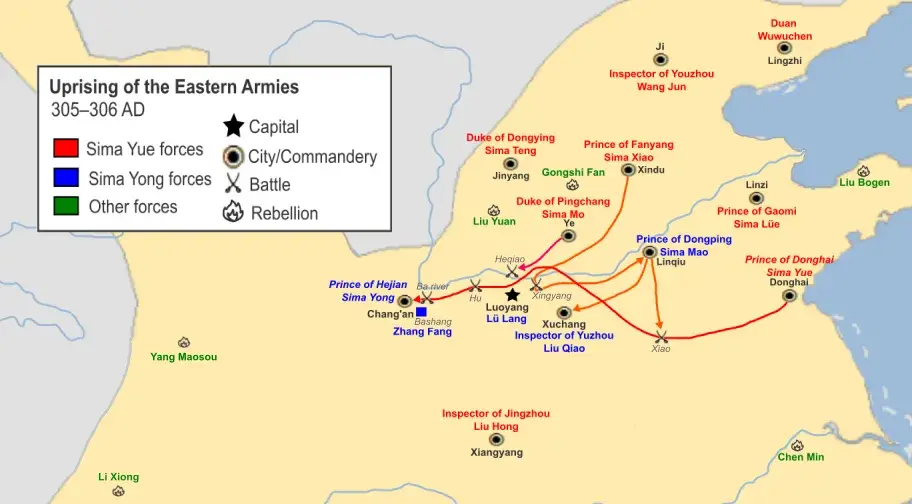
In winter 304, Sima Ying was routed by northern general Wang Jun and Xianbei cavalry, while Zhang Fang abducted Emperor Hui westward to Chang'an. Seizing upon eastern aristocratic outrage against the Guanzhong military junta, Sima Yue unfurled the banner of imperial restoration from Donghai. He stationed his three younger brothers—Sima Teng, Sima Lue, and Sima Mo—at Youzhou, Qingzhou, and Xuchang, establishing a strategic perimeter encircling the central plains. Prominent princes, including Prince of Fanyang Sima Xiao and general Wang Jun, rallied to his standard, acclaiming Sima Yue supreme coalition leader.
In 305, Sima Yue launched a massive multi-pronged offensive westward. Reinforced by Wang Jun's formidable Xianbei horsemen, Sima Yue's coalition shattered opposing forces at Qiao County. In summer 306, coalition vanguard commander Qi Hong stormed Chang'an, subjecting the city to brutal pillage. Qi Hong placed the traumatized Emperor Hui in an ox-cart and escorted him east to Luoyang, where Sima Yue orchestrated a grand reception. With this triumph, the devastating sixteen-year War of the Eight Princes drew to an end, leaving Sima Yue in undisputed possession of the imperial government.
In November 306, Emperor Hui died abruptly in the Xianyang Palace, widely suspected of having been poisoned by Sima Yue. Sima Yue installed the deceased emperor's younger brother Sima Chi as Emperor Huai of Jin, assuming the exalted posts of Grand Tutor and Manager of the Affairs of the Masters of Writing. Establishing his administrative headquarters at the Imperial Academy, Sima Yue governed with autocratic ruthlessness. When Emperor Huai sought to exercise direct imperial authority, Sima Yue grew paranoid. In 309, he falsely accused the emperor's closest advisers—including Director of the Imperial Secretariat Miao Bo and Chief Astrologer Gao Tangchong—of treason, executing them within palace precincts and replacing the imperial bodyguards with his personal provincial troops.
Concurrently, the northern geopolitical situation disintegrated rapidly as the Xiongnu Han Zhao state under Liu Yuan and Shi Le repeatedly battered Luoyang's outer defenses. Simultaneously, general Gou Xi denounced Sima Yue's tyranny, declaring military opposition. Paralyzed by strategic panic, Sima Yue made the disastrous decision in late 310 to abandon the capital. Under the pretext of campaigning against Shi Le, he coerced over one hundred thousand elite imperial soldiers, high officials, and imperial princes to march south to Xiangxian, leaving the defenseless Emperor Huai in an abandoned, starving imperial city.
In March 311, Emperor Huai issued a secret decree appointing Gou Xi Supreme Commander and broadcasting an empire-wide indictment declaring Sima Yue a traitor. Reaching the encampment at Xiangxian, the news struck Sima Yue like a thunderbolt. Overcome by terror, fury, and severe back ulcers, he collapsed and died on April 23, 311. Fearing mutiny, his generals concealed his death, electing Grand Commandant Wang Yan to lead the funeral procession back to Donghai.
In April 311, as the unwieldy column choked with civilian carriages reached Ningping City in Ku County, Shi Le's elite cavalry caught up with them. Trapped on open ground without coherent leadership, the imperial army collapsed into total pandemonium. Shi Le's mounted archers encircled the mass, slaughtering over one hundred thousand princes, courtiers, and soldiers in heaps of corpses. Denouncing Sima Yue as the arch-villain who destroyed the realm, Shi Le smashed his coffin and burned his corpse to ashes. In June 311, Han Zhao forces stormed undefended Luoyang, capturing Emperor Huai and bringing about the fall of the Western Jin in the Disaster of Yongjia.
Sima Yue's foremost historical significance lies in his role as the ultimate victor who brought the sixteen-year War of the Eight Princes to a bloody conclusion. Rising from a peripheral branch of the imperial clan, he exploited the mutual exhaustion of closer royal contenders, mobilizing eastern aristocratic clans and frontier cavalry to eliminate rivals Sima Ai, Sima Ying, and Sima Yong. By 306, he had centralized military, administrative, and fiscal authority within his private Grand Tutor office.
However, this victory did not revitalize the dynasty; instead, it accelerated its terminal collapse. Sima Yue possessed no grand vision for administrative reconstruction, directing his energy solely toward factional preservation and the elimination of competitors. By replacing imperial bodyguards with private retainers, he crippled the institutional structure of the central government, leaving Western Jin utterly incapable of resisting foreign tribal invasions.
Lacking the prestigious lineage prestige of closer imperial princes and facing imminent military threats from northern tribes, Sima Yue relied heavily on prominent eastern gentry clans to legitimize his regency. In this political bargain, the Langya Wang clan—represented by Wang Yan, Wang Dao, and Wang Dun—became his principal partners, creating a regime where the Wang and Sima clans shared imperial governance.
To safeguard their lineage, the Langya Wang clan formulated a strategic contingency plan. Prompted by Wang Yan, Sima Yue appointed Sima Rui (the future Emperor Yuan of Jin) as Military Commander of the Jiangnan region, dispatching him to Jianye alongside chief counselor Wang Dao and commander Wang Dun. This crucial redeployment created a political and military sanctuary south of the Yangtze River, laying the direct institutional and clan foundations for the founding of the Eastern Jin dynasty and a century of aristocratic oligarchy.
Sima Yue's domestic governance was characterized by extreme paranoia and arbitrary judicial slaughter. When Emperor Huai exhibited signs of political independence, Sima Yue executed more than a dozen trusted imperial confidants without judicial process, terrorizing the civil administration and alienating upright literati.
Furthermore, Sima Yue orchestrated the murder of Qinghe Prince Sima Tan to eliminate rival claimants to the succession, systematically liquidating capable imperial relatives. This reign of terror destroyed moral authority and political solidarity within the court. When nomadic armies advanced upon the capital, the emperor and his chancellor were locked in mutual denunciations rather than orchestrating a unified national defense.
The most disastrous strategic blunder of Sima Yue's career was his decision in winter 310 to evacuate Luoyang for Xiangxian. Paralyzed by the threat of Shi Le and political encirclement by Gou Xi, he chose selfish personal flight over civic duty, stripping the national capital of its remaining garrison forces and transporting the entire administrative elite into the field.
This decision produced catastrophic results. Luoyang descended into catastrophic famine, reduced to cannibalism and total vulnerability. Concurrently, his undisciplined army was surrounded and annihilated by Shi Le at Ningping City, eradicating the last operational army of the Western Jin. Within two months of Ningping, Han Zhao forces captured Luoyang, slaughtered thirty thousand citizens, and abducted Emperor Huai, plunging northern China into three centuries of division and devastation during the Sixteen Kingdoms period.
FIGURES ASSOCIATED WITH THIS DYNASTY