Birth in Huangpi
Born into a military family in Huangpi, Hubei, later moving north with his father.
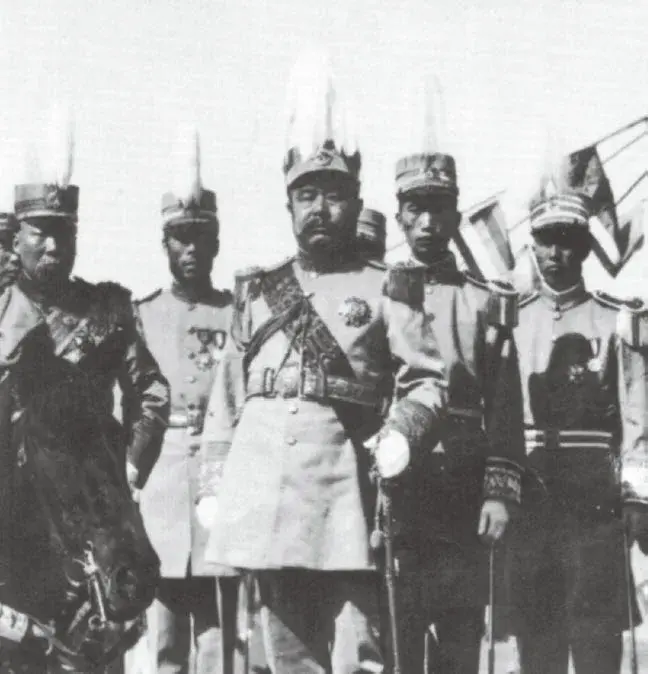
黎元洪
Li Yuanhong (黎元洪, 1864–1928), courtesy name Songqing, was a native of Huangpi, Hubei, and a prominent statesman and military commander during the late Qing Dynasty and the Republic of China. Having graduated in naval engineering from the Beiyang Naval Academy and survived the naval battle of the Yellow Sea during the First Sino-Japanese War, he joined the staff of Viceroy Zhang Zhidong. He played a pivotal role in training…
Li Yuanhong (黎元洪, 1864–1928), courtesy name Songqing, was a native of Huangpi, Hubei, and a prominent statesman and military commander during the late Qing Dynasty and the Republic of China. Having graduated in naval engineering from the Beiyang Naval Academy and survived the naval battle of the Yellow Sea during the First Sino-Japanese War, he joined the staff of Viceroy Zhang Zhidong. He played a pivotal role in training the Hubei New Army and inspecting modern military systems across multiple missions to Japan. Following the outbreak of the Wuchang Uprising in October 1911, Li was thrust into historical prominence when the revolutionary army elected him Governor of the Hubei Military Government. He presided over the defense of Hankou and Hanyang and negotiated the North-South peace accords, laying the institutional cornerstone for the founding of the Republic. Li subsequently served as the first Vice President and twice as President of the Republic of China. Renowned for his staunch defense of constitutional legality, his refusal to accept monarchical titles under Yuan Shikai, and his substantial post-retirement contributions to modern Chinese industry and higher education, Li remains an enduring symbol of constitutional transition in modern Chinese history.
Born into a military family in Huangpi, Hubei, later moving north with his father.
Admitted with top honors to the engineering department of the Beiyang Naval Academy.
Served aboard the cruiser Guangjia; survived swimming ashore after the warship sank during naval combat.
Joined Viceroy Zhang Zhidong in Hubei to oversee rapid-fire artillery fortifications.
Undertook the first of three study tours to Japan to inspect modern armaments and field training.
Elevated to Commander of the 21st Mixed Brigade of the Hubei New Army.
Chosen by revolutionary forces as Governor of the Hubei Military Government; proclaimed the Republic.
Inaugurated as Provisional Vice President of the Republic of China in Nanjing.
Relocated to Beijing under Yuan Shikai's surveillance; confined to Yingtai in Zhongnanhai.
Flatly rejected Yuan Shikai's decree conferring the peerage of Prince of Wuyi.
Assumed the Presidency following Yuan Shikai's demise; restored the Provisional Constitution and National Assembly.
Clashed with Premier Duan Qirui over World War I entry; forced from office amid Zhang Xun's monarchical restoration attempt.
Reassumed the Presidency under constitutional restoration advocacy, before being ousted by the Zhili clique.
Passed away from illness in Tianjin at age 63; honored with a state funeral by the National Government.
Li Yuanhong was born in Huangpi, Hubei, into a traditional military household. His father, Li Chaosong, was an officer in the Qing Green Standard Army who campaigned across northwestern and northern provinces. During his youth, Li accompanied his family to Zhili and received a rigorous classical education alongside foundational mathematics. In 1883, he earned admission to the engineering division of the Beiyang Naval Academy in Tianjin. Over five years of rigorous academic training, Li mastered marine engineering, artillery ballistics, and English technical nomenclature, graduating with outstanding academic accolades in 1888.
Upon graduation, Li was assigned to the Beiyang Fleet and stationed at Weihaiwei and Lushun to oversee naval engine repairs and defensive gun emplacements. During the First Sino-Japanese War in 1894, he served as a naval engineering officer aboard the protected cruiser Guangjia. During the Battle of the Yalu River, the warship engaged enemy vessels before sustaining severe damage and running aground near Talienwan. As the ship broke apart amid torrential waters, Li plunged into the icy sea, relying on supreme endurance and swimming skill to survive for over three hours before washing ashore, an ordeal that shaped his lifelong resilience.
In 1896, Li traveled south to Nanjing and Wuchang to join the personal staff of Viceroy Zhang Zhidong. Recognizing Li's modern technical expertise, Zhang placed him in charge of constructing coastal fortifications and mounting Krupp rapid-fire artillery batteries at Wusong and along the Yangtze River. Between 1898 and 1902, Zhang dispatched Li to Japan three times to inspect modern garrison engineering, army maneuvers, and officer academies. Li observed modern Western and Japanese combined-arms doctrines closely, compiling extensive military training curricula upon his return.
Upon returning to Wuhan, Li was entrusted with overseeing the formation and modern drill of the Hubei New Army. Through his steady administrative acumen and fair discipline, he earned the loyalty of common soldiers and non-commissioned officers. In 1906, he was promoted to Commander of the 21st Mixed Brigade of the Eighth Division, while concurrently commanding the Yangtze River defense flotilla. While maintaining imperial military discipline, Li treated intellectual recruits with leniency, unwittingly shielding numerous underground revolutionary cadres within his ranks.
In autumn 1911, the Railway Protection Movement erupted in Sichuan, causing Qing authorities to dispatch part of the Hubei New Army westward and leaving Wuhan lightly garrisoned. On October 10, revolutionary soldiers in Wuchang fired the opening shots of the 1911 Revolution, seizing the viceregal headquarters by dawn. With revolutionary leaders Sun Yat-sen abroad and Huang Xing absent, the insurgent commanders converged on Li's quarters, insisting that an officer of his preeminent military standing and clean reputation lead the provincial administration to reassure the populace and foreign consulates.
On October 11, 1911, Li was formally proclaimed Military Governor of the Hubei Military Government of the Republic of China at the former provincial consultative bureau. Recognizing the inexorable collapse of imperial autocracy and the resolute courage of the revolutionary ranks, Li embraced the republican banner. He promptly issued proclamations abolishing imperial titles, maintaining civic order, safeguarding diplomatic legations, and appealing to other provinces to declare independence, which catalyzed a nationwide chain reaction dismantling Qing rule.
As the Qing court mobilized the veteran Northern Beiyang divisions under Feng Guozhang to crush the rebellion, Li rallied the insurgent units and local volunteers to wage fierce resistance in Hankou and Hanyang. For nearly two months, the revolutionary forces contested every street and hill, absorbing the full weight of the imperial assault. This resolute resistance bought indispensable time for over a dozen southern and central provinces to sever ties with Beijing and coordinate a unified republican government.
Following the capture of Nanjing by republican forces, Li dispatched delegates to participate in peace negotiations with northern representatives in Shanghai. When the Provisional Government of the Republic of China was established in Nanjing on January 1, 1912, Sun Yat-sen was elected Provisional President, while Li was unanimously elected Provisional Vice President. After Yuan Shikai secured the abdication of the Xuantong Emperor, the provisional capital shifted north, with Li remaining in Wuhan to oversee central army reorganization and regional stabilization.
In late 1913, wary of Li's independent military base along the Yangtze, Yuan Shikai enticed and pressured Li into relocating to Beijing. Accompanied by close aides, Li was housed at Yingtai in Zhongnanhai under strict surveillance. When Yuan initiated his monarchical restoration movement in late 1915, creating the Empire of China, he issued an imperial decree ennobling Li as the Prince of Wuyi to purchase his complicity. Li adamantly rejected the edict, maintaining complete silence, refusing all palace audiences, and steadfastly declining imperial pensions.
Following Yuan Shikai's sudden death in June 1916 amid the National Protection War, Li assumed the Presidency pursuant to the Provisional Constitution. He immediately proclaimed the restoration of the 1912 Provisional Constitution, reconvened the dissolved National Assembly, and appointed Duan Qirui as Premier. Throughout his first term, Li championed civilian authority and constitutional rule against the high-handed military encroachment of the Beiyang warlord establishment.
In early 1917, fierce controversy erupted between President Li and Premier Duan regarding China's formal declaration of war against the German Empire. While Duan sought immediate war entry to secure foreign loans and expand his personal military power, Li insisted on constitutional legislative deliberation and parliamentary oversight. When Duan attempted to bulldoze parliament using intimidation, Li exercised his presidential prerogative to dismiss Duan from the premiership, triggering a major rebellion among Beiyang provincial warlords.
In an effort to arbitrate the standoff, Li summoned General Zhang Xun to Beijing with his forces. Instead of mediating, Zhang marched into the capital and launched a brazen attempt to restore the deposed Qing emperor Puyi on July 1, 1917. Betrayed and surrounded, Li sought refuge in the Japanese legation, firmly refusing to endorse the restoration decree. After Duan defeated Zhang Xun's troops, Li accepted political responsibility for the catastrophe and resigned from the presidency, retiring to the concession territory in Tianjin.
In June 1922, following the defeat of the Fengtian clique in the First Zhili-Fengtian War, the dominant Zhili warlords Cao Kun and Wu Peifu pressured incumbent President Xu Shichang to step down. Seeking constitutional legitimacy, they invited Li to resume the presidency under the banner of legal continuity. Li conditioned his acceptance on the dismantling of regional military governorships and disarmament. However, once installed in Beijing, Cao Kun coveted the presidency himself, cutting off government revenues and staging police mutinies. In June 1923, Li was coerced into resigning a second time and fled south.
Having permanently withdrawn from active statecraft, Li dedicated his remaining years to economic modernization and higher education. Residing in Tianjin and Shanghai, he invested extensively in modern mining, textile mills, machine manufacturing, and commercial banking, including the Zhongxing Coal Mining Company and Huaxin Textile Mills. Furthermore, Li donated vast sums to found and endow Nankai University, Wuhan University's predecessor institutions, and numerous primary schools, asserting that national salvation rested fundamentally upon popular enlightenment and domestic industry. In June 1928, Li passed away in Tianjin at age 63. The newly formed National Government in Nanjing decreed a state funeral, interring him with high republican honors near Mount Luojia in Wuhan.
By assuming the position of Governor of the Hubei Military Government at the pivotal juncture of October 11, 1911, Li provided instant institutional authority and military credibility to the revolution. His prestige helped persuade foreign powers to declare neutrality, prevented catastrophic urban panic, and mobilized regional resources to defy imperial suppression.
Li directed the frontline defense during the grueling two-month Battle of Yangxia against overwhelming Qing imperial artillery and infantry forces. His stubborn resistance preserved the revolutionary base in Hubei and allowed neighboring provinces the operational space required to sever allegiance to the Qing Dynasty.
As head of the Hubei government and later Vice President, Li acted as the indispensable mediator between the southern revolutionary coalition and the northern Beiyang military machine, ensuring the peaceful abdication of the Qing monarchy and preventing the fragmentation of China.
Li repeatedly demonstrated extraordinary personal courage and political ethics by refusing Yuan Shikai's monarchical peerage of Prince of Wuyi in 1915, upholding the dignity of the young republic while under house arrest at Yingtai.
Upon assuming the presidency in 1916, Li took decisive action to reinstate the 1912 Provisional Constitution and reconvene the National Assembly dissolved by Yuan Shikai, defending parliamentary legitimacy against warlord encroachment.
Recognizing the primacy of economic self-reliance, Li invested heavily in domestic industrial enterprises across coal mining, textile manufacturing, banking, and shipping, serving as a pioneer of China's modern national bourgeoisie.
Li consistently championed public education, donating hundreds of thousands of silver dollars to establish and support modern schools and universities, most notably contributing essential foundational funding to Nankai University and regional colleges in central China.
FIGURES ASSOCIATED WITH THIS DYNASTY