Birth in Haozhou
Tang He is born into an impoverished farming family in Zhongli, developing martial prowess.
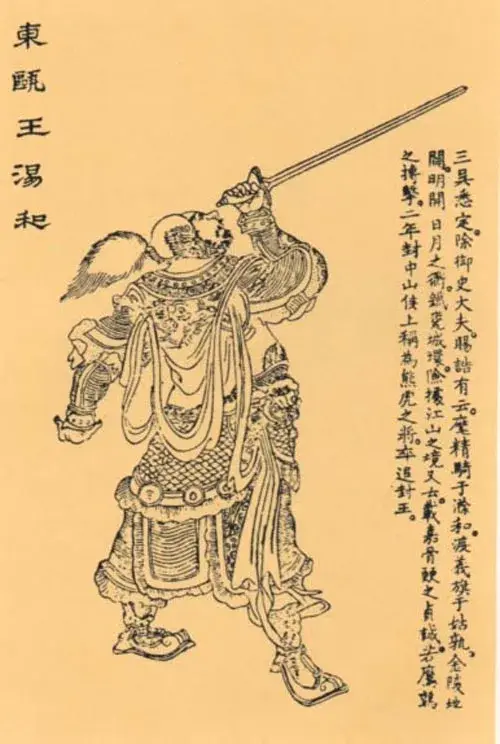
汤和
Tang He (汤和, 1326–1395), courtesy name Dingchen, was a native of Zhongli in Haozhou (modern Fengyang County, Anhui Province). He was one of the foremost founding generals of the Ming dynasty and a premier figure among the legendary "Twenty-Four Generals of Huaixi." Recognized in his youth for his steady composure, tactical sagacity, and charismatic leadership, Tang He took up arms against the Mongol-led Yuan dynasty in 1352…
Tang He (汤和, 1326–1395), courtesy name Dingchen, was a native of Zhongli in Haozhou (modern Fengyang County, Anhui Province). He was one of the foremost founding generals of the Ming dynasty and a premier figure among the legendary "Twenty-Four Generals of Huaixi." Recognized in his youth for his steady composure, tactical sagacity, and charismatic leadership, Tang He took up arms against the Mongol-led Yuan dynasty in 1352 by joining Guo Zixing's Red Turban uprising. In an act of profound historical significance, Tang He sent a personal letter to his childhood companion Zhu Yuanzhang, inviting him to join the rebellion and laying the bedrock for the future imperial enterprise. During the crossing of the Yangtze River, Tang He accompanied Zhu Yuanzhang in capturing Caishi, Taiping, Jiqing (Nanjing), and Zhenjiang. Appointed General Marshal of the Army, Tang He was dispatched to command the vital defensive frontline at Changzhou. For seven grueling years, he repelled relentless assaults launched by Zhang Shicheng's massive armies, securing the capital's eastern gateway and allowing Zhu Yuanzhang to achieve decisive victory against Chen Youliang in the west. Following this, Tang He commanded massive naval and land campaigns, extinguishing Fang Guozhen's maritime regime in eastern Zhejiang and subduing Chen Youding in Fujian. Following the proclamation of the Ming dynasty in 1368, Tang He campaigned alongside Xu Da and Chang Yuchun to drive Yuan remnants beyond the Great Wall, subdued the rebel Ming Xia regime in Sichuan, and pacified volatile borderlands across Shaanxi and Shanxi. In 1388, keenly anticipating Zhu Yuanzhang's desire to consolidate imperial control over military authority, Tang He voluntarily relinquished his command seals and retired to his native Fengyang. Recalled to inspect southeastern coastal defenses against escalating Wokou piracy, he supervised the construction of fifty-nine coastal fortresses across Zhejiang, establishing an enduring coastal guard system. Living in quiet retirement and prudent humility, Tang He was one of the exceptionally few founding marshals to survive the purges of the Hongwu era. He died peacefully in 1395 at the age of seventy and was posthumously enfeoffed as the Prince of Dong'ou and granted the posthumous title Xiangwu.
Tang He is born into an impoverished farming family in Zhongli, developing martial prowess.
Joins Guo Zixing's uprising in Dingyuan and writes to invite Zhu Yuanzhang into the army.
Defers to Zhu Yuanzhang's leadership, establishing solid loyalty among Huaixi veterans.
Crosses the river to capture Caishi and Taiping, elevated to General Marshal.
Appointed to defend Changzhou against fierce assaults by Zhang Shicheng for seven years.
Appointed General Pacifying the South, forcing maritime warlord Fang Guozhen to surrender.
Captures Fuzhou and Yanping, capturing Yuan commander Chen Youding and pacifying Fujian.
Triumphs in the Northern Expedition at Dingxi, awarded the title Marquis of Zhongshan.
Appointed General Pacifying the West, advancing up the Yangtze to compel Ming Sheng's surrender.
Pacifies northwestern border tribes, promoted to Duke of Xin with highest honors.
Participates in Northern Expedition under Xu Da, routing Mongol forces at the Northern Yellow River.
Serves as General Suppressing Rebels, defeating Miao tribal rebellions and securing Guizhou.
Voluntarily petitions to retire and returns his military seals to Emperor Taizu.
Oversees the construction of 59 fortresses along the Zhejiang coast to repel Japanese pirates.
Passes away in Fengyang at age seventy, posthumously honored as Prince of Dong'ou.
Tang He was born in 1326 in Zhongli of Haozhou during the closing decades of the Yuan dynasty. Sharing the same village and age with Zhu Yuanzhang, the two spent their childhood herding cattle and forging an enduring bond. Possessing a tall and robust physique, Tang He was deliberate in thought, swift in action, and skilled in organizing his peers. In village games, he frequently brandished bamboo stalks as lances and commanded groups of children with natural authority.
As catastrophic droughts, locust plagues, and onerous Mongol levies devastated the Huai River valley, widespread insurgencies erupted. In 1351, Liu Futong raised the standard of revolt in Yingzhou. In the following year (1352), Guo Zixing and Sun Deya seized Haozhou in open rebellion. Tang He realized that the Yuan dynasty was collapsing and gathered ten valiant companions from his home district to enlist in Guo Zixing's force, where his battlefield prowess earned him prompt elevation to chiliarch.
Despite his rapid rise, Tang He grew disillusioned by the petty rivalries and plundering habits of the local commanders. Convinced that his boyhood companion Zhu Yuanzhang possessed extraordinary strategic vision and courage, Tang He sent a private message to Huangjue Monastery, imploring him to join the rebellion.
Convinced by Tang He's appeal, Zhu Yuanzhang burned down his quarters and arrived at the Haozhou camp. Guo Zixing was impressed by Zhu's bearing and appointed him a close personal guard, steadily increasing his duties. While many older Huaixi veterans grew envious of Zhu's sudden promotions, Tang He, who was older and had entered service earlier, set an invaluable example by bowing before Zhu Yuanzhang and executing every command with profound respect. Witnessing Tang He's total submission, other commanders followed suit, establishing Zhu Yuanzhang's undisputed authority over the Huaixi military core.
In 1353, Tang He marched south alongside Zhu Yuanzhang to capture Dingyuan, securing appointment as General Chief of Armies. In early 1355, Tang He assisted Zhang Tianyou in capturing Hezhou, forcing the Yuan general Yesun Temur to flee by night. Following Guo Zixing's death and the arrival of Chao Lake naval commanders Yu Tonghai and Liao Yong'an with a thousand war junks, Zhu Yuanzhang finalized plans to cross the Yangtze River.
Yuan naval forces under Imperial Censor Manzi Haiya had heavily blockaded Tongchengzha and the Machang River. Fortunately, torrential summer downpours caused the river levels to swell dramatically, allowing Ming naval vessels to maneuver through a shallow canal directly into the Yangtze. Tang He spearheaded the river assault at Niuzhuji, routing Yuan land and river outposts and capturing the city of Taiping.
When several commanders sought to load their boats with looted goods and retreat across the river to Hezhou, Zhu Yuanzhang convened the generals and reprimanded them fiercely. Tang He stood firmly by Zhu's side, enforcing strict discipline and solidifying the army's resolve to push forward toward Jinling.
In March 1356, Tang He took part in the capture of Jiqing (modern Nanjing), which was promptly renamed Yingtian Prefecture. He then joined Xu Da and Liao Yong'an in conquering Zhenjiang, defeating Yuan general Duanwu Dingding. In Zhenjiang, Zhu Yuanzhang established the Huaixing Zhenjiang Wing Marshal Office, designating Tang He and Xu Da as General Marshals of the Army.
Later that year, Tang He captured Jintan and cleared out hostile outposts around Mount Jiashan. In July, eastern warlord Zhang Shicheng launched a naval attack on Zhenjiang, but Tang He and Xu Da confronted the fleet at Longtan, inflicting a severe defeat on the invaders. Advised by Zhu Yuanzhang to seize the offensive against Zhang Shicheng, the commanders laid siege to Changzhou, eventually breaching the ramparts in spring 1357 when the enemy commander Lyu Zhen fled under cover of darkness.
Situated between Lake Tai and the Yangtze River, Changzhou formed the indispensable eastern shield protecting Yingtian from invasion. Following its capture, Zhu Yuanzhang elevated Tang He to Associate Military Commissioner and entrusted him with supreme authority over the Changzhou defense perimeter. In early 1358, Zhang Shicheng dispatched over ten thousand cavalry and infantry to retake the fortress, but Tang He led his garrison in a fierce counterattack, killing over a thousand enemy soldiers and capturing hundreds.
In 1359, Zhang Shicheng launched another massive multi-pronged offensive against Changzhou. Tang He deployed hidden squadrons along the waterways and struck the enemy's flanks, routing their main force. He subsequently joined Xu Da in taking Wuxi and dismantling enemy outposts at Benniu, Xin'an, and Wangting. In 1363, Tang He attacked the Niupixiang stronghold at Xishan, slaying enemy general Lu and driving off the ferocious warlord Mo Tianyou, earning promotion to Left Vice Chancellor of the Secretariat.
Throughout his seven-year stewardship of Changzhou, Tang He fortified the city walls, erected double ramparts, and established an extensive network of watchtowers and river barriers. In 1364, during a naval clash at Mount Huangyang, Tang He intercepted Zhang Shicheng's fleet, using fire weapons to destroy enemy sails and capturing six large warships along with forty-nine commanders.
Later that year, when Zhang Shicheng's brother Zhang Shixin besieged Changxing with heavy forces, Tang He and Chang Yuchun rushed to the rescue. Engaging the enemy from morning until late afternoon, Tang He coordinated with garrison commander Geng Bingwen, who charged out from the gates to launch a devastating pincer attack that captured over eight thousand enemy soldiers and five hundred horses. Tang He's impenetrable defense of Changzhou protected Yingtian from eastern assault for seven years, giving Zhu Yuanzhang the freedom to win the decisive naval campaign at Lake Poyang against Chen Youliang.
In 1365, Tang He was dispatched to pacify rebel strongholds across Jiangxi, capturing former Han commander Zhou An at Yongxin after an arduous mountain campaign. In autumn 1366, Zhu Yuanzhang launched his grand offensive to extinguish Zhang Shicheng's kingdom, appointing Xu Da as Supreme Commander and Tang He as a principal field general.
Marching from Longjiang, the army captured the Lake Tai water redoubts at Jiuguan, forcing enemy general Lyu to surrender two thousand troops. Tang He then participated in the encirclement of Huzhou and joined the grand siege of Suzhou, taking up positions outside the Changmen gate. Directing the construction of siege towers, earthen ramps, and artillery batteries, Tang He pressed the assault day and night. When the city walls were breached in autumn 1367, Zhang Shicheng was taken captive, completely extinguishing the Eastern Wu kingdom.
Immediately following the victory at Suzhou, Zhu Yuanzhang appointed Tang He as General Pacifying the South, directing him and Vice General Wu Zhen to subdue Fang Guozhen, who held the coastal ports of eastern Zhejiang from Qingyuan (Ningbo). Gathering his followers, Fang Guozhen retreated into the Zhoushan archipelago. Tang He sailed his battle fleet into Xiangshan Harbor and confronted Fang's armada off the Cao'e River.
Deploying swift fire-rafts and naval rockets, Tang He incinerated hundreds of enemy vessels, routing Fang Guozhen's maritime forces. Realizing his position was hopeless, Fang Guozhen surrendered his remaining four hundred war junks and twenty thousand troops, fully securing the Zhejiang seaboard. Tang He then sailed directly south to Fujian, forcing Yuan general Chen Wenhai to surrender Fuzhou without a fight.
Advancing up the Min River, Tang He laid siege to Yanping, where loyalist Yuan chancellor Chen Youding had resolved to die defending the city. Tang He constructed scaling ladders, leveled the outer trenches, and breached the ramparts within days, capturing Chen Youding alive and escorting him in a cage to Nanjing for execution. With this campaign, the entire southeastern coastal theater was fully integrated into the Ming realm.
In early 1368, Zhu Yuanzhang ascended the imperial throne in Nanjing as the founding emperor of the Ming dynasty. In 1369, Tang He was recalled to the capital and commissioned as Vice General, marching west through Tongguan alongside Xu Da to clear Yuan remnants from Shanxi and Shaanxi. Tang He advanced rapidly to secure Taiyuan, supported the capture of Datong, and pacified several counties including Hunyuan, Lingqiu, Dingxiang, and Yuanping.
Moving across the Yellow River into Shaanxi, Tang He engaged former Yuan commander He Zongzhe, who had fortified Qingyang in alliance with steppe nomadic chieftains. Tang He encircled the city, constructing deep perimeter trenches to cut off the garrison's food and water supply while repelling several desperate breakout attempts. When Xu Da's main force arrived in July, Tang He led the final assault that breached the walls and restored imperial control over the region.
In 1370, during the grand imperial bestowal of aristocratic titles, Emperor Taizu enfeoffed Tang He as the Marquis of Zhongshan with an annual stipend of 1,500 shi. Later that year, Tang He took part in the decisive Battle of Shen'eryu near Dingxi against the northern Yuan chancellor Koke Temur.
When a severe desert dust storm darkened the battlefield, Tang He recognized that the blinding winds disoriented the enemy cavalry. Leading his heavy cavalry from the right wing, Tang He charged directly into the center of the Mongol formation, shattering their lines and capturing tens of thousands of enemy soldiers and horses, while Koke Temur escaped into the northern steppes with only a handful of family members.
In early 1371, Emperor Taizu resolved to eliminate the secessionist Ming Xia state in Sichuan. Tang He was commissioned as General Pacifying the West to command the river armada advancing up the Yangtze River, while Fu Youde led the northern army through Gansu. Arriving at the entrance of Qutang Gorge in May, Tang He encountered massive iron chains stretched across the river rapids, flanked by fortified cliff batteries raining artillery fire on the channel.
Tang He devised an ingenious tactical plan: he ordered Vice General Liao Yong'an to lead a detachment of several hundred elite volunteers overland, carrying light craft across mountain trails to emerge behind the enemy's cliff bastions. When Liao's men set fire to the rear encampments, Tang He unleashed his heavy warships down the current, severing the three massive iron chains with great battleaxes.
With the gorge breached, the Ming fleet sailed swiftly past Wushan, Guizhou, and Zhongzhou, arriving before the walls of Chongqing. Caught in a hopeless pincer between Tang He's armada and Fu Youde's victorious army advancing from the north, the young Xia monarch Ming Sheng formally surrendered, bringing all of Sichuan into the Ming empire.
Tang He remained in Chengdu for several months to stabilize civil administration, restore fortifications, and enforce strict military discipline. In 1372, Emperor Taizu summoned him back to the capital and commended his exceptional achievements, dispatching him to supervise military agricultural colonies and garrison outposts across Zhangde and Zhending. In winter 1375, Tang He led light cavalry deep into the steppes at Chaghan Na'or, chasing the nomadic chieftain Bayan Temur and capturing thousands of livestock.
In 1376, Emperor Taizu appointed Tang He and Fu Youde to command the strategic frontier post of Yan'an, urging them to construct deep ramparts and guard against nomadic raids. Tang He inspected frontier beacons and enforced rigid patrol regulations, leading to the submission of nomadic chieftain Bayan Temur at Suide later that summer.
In 1378, in recognition of more than two decades of distinguished service across every major military theater, Emperor Taizu elevated Tang He to Duke of Xin, appointing him Left Commissioner-in-Chief of the Chief Military Commission and granting him an annual stipend of 3,000 shi. The imperial edict praised him for his early allegiance and unmatched campaigns across Zhejiang, Fujian, Sichuan, and the northern frontiers.
In 1381, following nomadic incursions along the northern borders, Tang He served as Left Vice General under Xu Da during a sweeping steppe expedition. Reaching the Northern Yellow River in April, Tang He and Fu Youde selected two thousand elite cavalrymen and executed a daring nighttime raid against the enemy camp at Mount Hui, capturing the northern Yuan dignitaries Bielige and Jiutong.
In 1382, Tang He inspected defense works at Yongning Guard in southern Sichuan, constructing stone walls to prevent tribal unrest. In 1385, when Miao tribes led by Wu Mian'er staged a major insurrection in Sizhou and Guzhou, Tang He was appointed General Suppressing Rebels. Venturing into rugged and malarial mountains, Tang He ambushed the insurgent chieftain outside Guzhou, captured Wu Mian'er alive, and pacified forty thousand tribal captives, securing lasting tranquility across the southwestern frontiers.
As the Ming dynasty consolidated its borders, Emperor Taizu grew increasingly wary of senior military aristocrats wielding vast influence over the armies. The emperor frequently dropped pointed hints during court audiences, suggesting that aging generals should consider relinquishing their duties to preserve their reputations.
Tang He possessed deep political foresight and understood the lethal perils of clinging to power. In 1388, Tang He sought an imperial audience and formally petitioned: "Your humble subject is sixty-three years of age; my strength declines and my energy wanes. I pray Your Majesty will allow me to return to my native village to live out my remaining days." Delighted by his voluntary withdrawal, Emperor Taizu granted the petition immediately, presenting him with lavish gifts of gold and silks and commissioning the construction of a palatial residence in Fengyang.
Between 1387 and 1389, severe Japanese pirate raids ravaged coastal communities across Zhejiang and Fujian. Knowing that Tang He was uniquely qualified in coastal defense, Emperor Taizu recalled him from retirement to oversee the maritime borders. Tang He set out immediately, surveying thousands of li along the Zhejiang coast to design an impenetrable coastal defense network.
Tang He supervised the construction of fifty-nine stone fortresses along the coastline, including Dinghai, Haining, Guanhai, and Shipu. He conscripted nearly sixty thousand soldiers from local families to garrison these strongholds, established an integrated network of beacon towers, and organized coastal watch squadrons. His fortification system suppressed pirate incursions for decades and served as the standard coastal defense model throughout the Ming dynasty.
Upon concluding the coastal works, Tang He promptly surrendered his military seals and returned to Fengyang. He dismissed his domestic attendants, distributed his imperial gifts and agricultural lands among his relatives and neighbors, and spent his remaining years enjoying wine, chess, and literature. He strictly avoided discussing military or political affairs and refused visits from local officials. This consummate prudence enabled him to remain entirely unscathed during the violent purges that destroyed nearly all his peers. In August 1395, Tang He died peacefully at age seventy. Emperor Taizu mourned his passing deeply, suspending court for three days and posthumously honoring him as the Prince of Dong'ou with the posthumous title Xiangwu.
In 1352, Tang He joined Guo Zixing's Red Turban uprising in Haozhou, quickly rising to chiliarch through valor in combat. Recognizing that the rebellion required an exceptional leader, Tang He wrote a personal letter to his childhood companion Zhu Yuanzhang at Huangjue Monastery, urging him to take up arms.
When Zhu Yuanzhang arrived in camp, Tang He voluntarily deferred to Zhu's leadership despite his own seniority. This humble submission set an invaluable political precedent, quelling early factional jealousy among the proud Huaixi captains and establishing Zhu Yuanzhang's unchallenged supreme authority over the founding army.
From 1357 onward, Tang He held the forward bastion of Changzhou against relentless assaults launched by Zhang Shicheng for seven grueling years. Donning heavy armor day and night, he repelled massive armies and conducted aggressive counter-raids at Benniu and Wuxi, destroying enemy supplies.
In 1364, Tang He rushed to relieve the siege of Changxing, collaborating with Geng Bingwen to crush Zhang Shixin's army and capture over eight thousand troops. His steadfast defense of Changzhou transformed the city into an impenetrable shield, safeguarding Yingtian and enabling Zhu Yuanzhang to concentrate his full strength on annihilating Chen Youliang at Lake Poyang.
In 1366, Tang He served as a principal general in the campaign against Zhang Shicheng, participating in the capture of Huzhou and the final siege of Suzhou, where his forces breached the Changmen gate to extinguish the Eastern Wu regime.
Elevated to General Pacifying the South in 1367, Tang He mobilized naval squadrons against Fang Guozhen, incinerating hundreds of pirate junks off the Cao'e River and compelling Fang's complete surrender. He then sailed south to Fujian, capturing Fuzhou and storming Yanping to capture loyalist Yuan commander Chen Youding, fully securing the southeastern coast for the Ming dynasty.
Following the founding of the Ming dynasty in 1368, Tang He campaigned tirelessly across northern and western China. In 1369, he pacified key districts across Shanxi and starved out the rebel garrison at Qingyang. At the decisive Battle of Shen'eryu in 1370, Tang He led his cavalry through a blinding dust storm to shatter Koke Temur's northern Yuan army.
Commissioned as General Pacifying the West in 1371, Tang He led his river fleet up the Yangtze, severing the defensive chains of Qutang Gorge and capturing Chongqing to compel the surrender of the Ming Xia kingdom. He later conducted successful cavalry raids across the northern steppes and pacified forty thousand tribal insurgents in Guizhou in 1385.
Recalled from retirement in 1389 to confront escalating Wokou piracy, Tang He conducted an exhaustive survey of the rugged Zhejiang coast and formulated a permanent maritime strategy.
He oversaw the construction of fifty-nine coastal fortresses, organized nearly sixty thousand garrison troops, and established an interconnected beacon-tower alert network. This comprehensive defense infrastructure suppressed piracy for generations and became the cornerstone of Ming coastal warfare.
In 1388, perceiving Emperor Taizu's growing apprehension regarding veteran commanders, Tang He proactively requested retirement and returned his military command seals.
Upon finishing his coastal defense duties, he retired quietly to Fengyang, dispersing his lands and wealth among his neighbors and avoiding all contact with political affairs. Through this profound modesty and foresight, Tang He preserved his family and legacy through the bloody purges of the Hongwu era, dying peacefully at age seventy as the preeminent model of an elder statesman who finished well.
FIGURES ASSOCIATED WITH THIS DYNASTY