Birth in the Steppe
Born in the Mongolian steppe into the core Borjigin lineage as a son of Tolui and Sorghaghtani Beki.
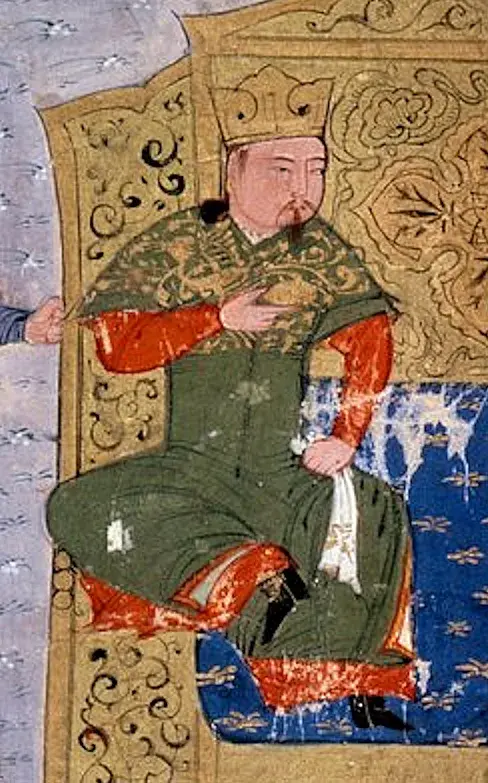
旭烈兀
Hulagu Khan (旭烈兀, 1218–February 8, 1265) was a prominent Mongol imperial prince, military supreme commander, and the founding ruler of the Ilkhanate in Southwestern Asia. A grandson of Genghis Khan and the sixth son of Tolui and Sorghaghtani Beki, he was the younger brother of Möngke Khan, Kublai Khan, and Ariq Böke. In 1252, Möngke Khan appointed Hulagu to lead the massive Third Mongol Western Campaign to conquer West Asia.…
Hulagu Khan (旭烈兀, 1218–February 8, 1265) was a prominent Mongol imperial prince, military supreme commander, and the founding ruler of the Ilkhanate in Southwestern Asia. A grandson of Genghis Khan and the sixth son of Tolui and Sorghaghtani Beki, he was the younger brother of Möngke Khan, Kublai Khan, and Ariq Böke. In 1252, Möngke Khan appointed Hulagu to lead the massive Third Mongol Western Campaign to conquer West Asia. Crossing Central Asia with an enormous multi-ethnic coalition force equipped with advanced siege engines, Hulagu eradicated the formidable Nizari Ismaili state (the Assassins) at Alamut, besieged and captured Baghdad in 1258 to extinguish the Abbasid Caliphate, and advanced into Syria, permanently transforming the geopolitical and cultural landscape of the Middle East. Following the death of Möngke Khan, Hulagu supported his elder brother Kublai in the imperial succession struggle, receiving imperial recognition and investiture over the vast territories stretching from the Amu Darya to the borders of Egypt and Anatolia. As the first Ilkhan, he instituted tolerant religious policies, extended protection to Christians and Buddhists, engaged Persian scholars and administrators to reconstruct civil governance, and patronized science through the construction of the Maragheh Observatory under Nasir al-Din al-Tusi. Hulagu died near Lake Urmia in 1265, leaving behind an established regional power that bridged East and West for nearly a century.
Born in the Mongolian steppe into the core Borjigin lineage as a son of Tolui and Sorghaghtani Beki.
His elder brother Möngke was acclaimed as the Great Khan, and Hulagu assisted in imperial administration west of Karakorum.
Möngke convened an imperial Kurultai and appointed Hulagu as supreme commander of the Third Western Campaign.
Hulagu set out from Karakorum with a grand expeditionary force including Chinese siege engineers led by Guo Kan.
Crossed the Oxus River, captured Alamut and Maymun-Diz, and completely liquidated the Nizari Ismaili Assassin state.
Besieged and captured Baghdad, executed Caliph Al-Musta'sim, and brought a definitive end to the Abbasid Caliphate.
Marched west into Syria, capturing Aleppo and Damascus, precipitating the flight of the Ayyubid rulers.
Received news of Möngke Khan's death and withdrew his main army to Azerbaijan; his vanguard under Kitbuqa fell at Ain Jalut.
Endorsed Kublai Khan as Khagan and received official investiture over Southwestern Asia, establishing the Ilkhanate.
Clashed with Berke of the Golden Horde along the Terek River in the Caucasus over territorial and religious disputes.
Died of illness near Lake Urmia at the age of forty-eight and was entombed on Shahi Island.
Hulagu was born in 1218 on the Mongolian Plateau into the ruling Borjigin clan of the Mongol Empire. His father, Tolui, was the fourth son of Genghis Khan and the commander of the imperial core guards; his mother, Sorghaghtani Beki, was a Kereit princess celebrated for her political acumen and statesmanship. Within the household, Möngke demonstrated stern military discipline, Kublai engaged deeply with Chinese administrative and philosophical traditions, while Hulagu displayed remarkable gifts for cavalry tactics, strategic planning, and siege warfare. Hulagu grew up witnessing the consolidation of Northern China and the internal administrative operations of the expanding empire.
Following Tolui's death in 1232, Sorghaghtani Beki skillfully protected the family appanages and raised her sons to be prominent leaders. Hulagu received comprehensive martial education, mastering traditional nomadic archery, composite mounted formations, and encirclement strategies. During the reigns of Ögedei and Güyük, the Toluid faction preserved its core military strength. Hulagu proved himself an efficient organizer of troops and logistics, forging valuable relationships with commanders across the nomadic and sedentary sectors of the empire.
In the summer of 1251, backed by Batu Khan of the Golden Horde, Möngke was elected Khagan at the Kurultai along the Onon River. Möngke swiftly consolidated central control and initiated an ambitious grand strategy of two-pronged imperial expansion: Kublai was tasked with pacifying Southern China and Yunnan, while Hulagu was entrusted with the supreme command of the expedition to subdue the Islamic powers of Southwestern Asia.
In the autumn of 1252, Möngke Khan formally promulgated the decree for the western expedition. Under imperial directives, two out of every ten warriors across the entire empire were mobilized into Hulagu's army. The expeditionary force was augmented by Chinese infantry and siege corps commanded by General Guo Kan, along with Central Asian engineers, siege specialists, catapult masters, and sappers. Equipped with advanced trebuchets, heavy cross-bow batteries, naphtha projectors, and siege towers, Hulagu assembled one of the most formidable multi-ethnic fighting forces of the medieval world.
The logistical preparations for this continental march took over a year. Hulagu organized continuous supply chains, pasturage rotations, and postal relay networks across the vast steppes and arid plateaus. Pioneer units were dispatched ahead to level mountainous passes and bridge broad rivers across the Tian Shan and Pamir ranges. In the autumn of 1253, Hulagu departed Karakorum at the head of over one hundred thousand soldiers. Passing through the Chagatai territories of Samarkand and Bukhara in 1255, he replenished his herds and secured auxiliary cavalry from allied princes before advancing toward the Persian frontier.
In early 1256, Hulagu crossed the Amu Darya on broad pontoon bridges and entered Northern Persia. His initial primary target was the Nizari Ismaili state, known in contemporary records as the Hashashin or Mulahidah, which had terrorized Middle Eastern rulers for more than a century from hundreds of seemingly impregnable mountain redoubts in the Alborz Mountains.
The Nizari Ismailis had constructed sophisticated stone citadels perched atop sheer cliffs, among which Maymun-Diz and Alamut were the most formidable. They employed systematic assassination to strike down hostile kings, grand viziers, and crusader counts, and had even planned assassinations against Mongol governors. Recognizing that advancing further south would leave his rear dangerously exposed, Hulagu initiated a comprehensive encirclement of the Ismaili strongholds in Mazandaran and Qazvin.
Hulagu deployed his Chinese and Muslim engineers to haul disassembled siege machinery up precipitous ridges, establishing commanding artillery positions overlooking the mountain fortresses. From these vantage points, counterweight trebuchets poured heavy boulders and incendiary projectiles upon the defenders day and night. Under relentless bombardment and severed water lines, the newly invested Nizari Imam, Rukn al-Din Khurshah, surrendered unconditionally at Maymun-Diz in November 1256.
Hulagu required Khurshah to issue orders of surrender to all remaining Ismaili fortresses across the region. Citadels such as Alamut and Gerdkuh capitulated, and Alamut's famous mountain bastion was systematically demolished, though Hulagu permitted the scholar Nasir al-Din al-Tusi to salvage its valuable scientific treatises and astronomical apparatus. Khurshah was subsequently sent toward Karakorum but was executed en route by order of Möngke Khan, bringing a definitive end to the Nizari state in Persia.
With northern Persia secure, Hulagu turned his forces toward Mesopotamia and the historical seat of the Abbasid Caliphate in Baghdad. The reigning sovereign, Caliph Al-Musta'sim, presided over a five-hundred-year-old imperial and religious institution. In late 1257, Hulagu sent envoys from Hamadan demanding the caliph dismantle the city fortifications, render personal submission, and pay regular tribute. Overestimating his military strength and expecting regional Muslim princes to march to his relief, Al-Musta'sim rejected the summons with defiant rhetoric.
Hulagu executed a textbook encirclement strategy. He divided his forces into three converging columns: the right wing advanced through the Kurdish hills, the left swept along the lower Euphrates, and the center column led by Hulagu marched directly upon eastern Baghdad. By January 1258, the Mongol forces had surrounded the sprawling metropolis, erecting wooden palisades, digging concentric trenches, and throwing pontoon bridges across the Tigris to trap the caliph's garrison.
Bombarded incessantly by siege batteries and undermined by sapping operations, the outer defensive towers crumbled within days. On February 10, 1258, Al-Musta'sim surrendered together with his court and municipal notables. The city was subjected to thorough looting and destruction, during which ancient palaces, grand mosques, and the renowned House of Wisdom suffered catastrophic damage. On February 20, adhering to the Mongol custom of spilling no royal blood upon the earth, Hulagu ordered Al-Musta'sim rolled in heavy felt carpets and trampled to death by cavalry horses, marking the definitive collapse of the Abbasid Caliphate.
The annihilation of Baghdad shocked the Islamic and Christian worlds. Establishing order in Mesopotamia and retaining the vizier Ibn al-Alqami to administer civil revenue, Hulagu crossed the Euphrates in late 1259 to launch a full-scale campaign against the Ayyubid domains in Syria. The citadel of Aleppo mounted stubborn resistance, but the sophisticated counterweight artillery overseen by Guo Kan breached the walls within a week, resulting in the subjugation of the city.
Damascus surrendered without resistance shortly thereafter, admitting Mongol contingents. Mongol scouts pushed southwest into Palestine, reaching Gaza and threatening the Nile Delta, placing the Mamluk Sultanate of Cairo in immediate jeopardy. However, just as Hulagu contemplated crossing the Sinai Peninsula to conquer Egypt, an urgent courier arrived from East Asia bringing momentous news: Möngke Khan had died of illness during the siege of Diaoyu Fortress in Sichuan.
Möngke's unexpected demise triggered an immediate succession dispute between Kublai in Northern China and Ariq Böke in Karakorum. As a senior prince of the realm, Hulagu could not afford to remain on the distant Mediterranean frontier while the empire's core was divided. He withdrew his main army northeastward to the fertile pastures of Azerbaijan, leaving his trusted lieutenant Kitbuqa with a modest force of less than twenty thousand troops to garrison Syria.
This strategic redeployment provided the Mamluk Sultanate with a crucial opening. In September 1260, Sultan Qutuz and Commander Baybars marched north with their full army and engaged Kitbuqa's forces at the Battle of Ain Jalut in the Jezreel Valley. The Mongols were decisively routed and Kitbuqa was killed. Ain Jalut set the permanent southwestern frontier of Mongol expansion and enabled the Mamluks to reclaim Syria, proving that the Mongol armies were not invincible.
After consolidating his position in northwestern Iran, Hulagu decided not to travel directly to Mongolia. Evaluating the geopolitical realities, he threw his full diplomatic and economic weight behind his elder brother Kublai. He remitted extensive shares of western tribute to Kublai's court in northern China. In return, upon ascending the throne in 1260, Kublai officially invested Hulagu as ruler of all conquered lands west of the Amu Darya down to the Syrian border, conferring upon him the hereditary title of Ilkhan.
The new state faced severe external threats from its northern Mongol neighbor, the Golden Horde. Berke Khan, ruler of the Kipchak Steppe and a convert to Islam, was outraged by Hulagu's execution of the Abbasid Caliph and disputed the possession of the grazing lands of Azerbaijan and Shirvan. Berke concluded an alliance with Baybars of Egypt, creating a hostile ring around the Ilkhanate. In 1262, Berke launched an invasion across the Caucasus Mountains. Hulagu personally commanded the counteroffensive, culminating in a fierce winter clash on the frozen Terek River. Heavy ice broke under the combatants, inflicting immense casualties on both sides, but Hulagu successfully checked the invasion and secured the Caucasian frontier.
Within his realm, Hulagu established his capital at Maragheh and later Tabriz, building a centralized civil administration staffed primarily by experienced Persian bureaucrats. Although he practiced Tibetan Buddhism, he maintained benevolent policies toward Nestorian Christians, largely influenced by his mother and his chief wife Doquz Khatun. Hulagu took a profound interest in scientific inquiry, funding the construction of the renowned Maragheh Observatory and patronizing a galaxy of scholars led by Nasir al-Din al-Tusi. On February 8, 1265, Hulagu died of illness on the shores of Lake Urmia at the age of forty-eight. He was interred in a stone tomb on Shahi Island, succeeded by his eldest son Abaqa.
Hulagu's leadership of the Third Western Campaign demonstrated extraordinary mastery of large-scale military logistics, multi-branch warfare, and continental coordination. Overcoming immense logistical barriers across thousands of miles of deserts, steppes, and alpine passes, he organized auxiliary transport, bridge building, and regional supply depots with methodical precision. By integrating Chinese artillery specialists, Persian administrators, and nomadic cavalry corps, Hulagu created an integrated military machine capable of subduing heavily fortified stone fortresses and vast imperial metropolises, forever reshaping the political landscape of Eurasia.
By reducing the fortress network of Alamut and Maymun-Diz, Hulagu eradicated the Nizari Ismaili state that had functioned as an intractable military and psychological menace to Middle Eastern states for more than a century and a half. His tactical application of heavy counterweight siege artillery against cliffside bastions overcame natural geographic barriers previously deemed impenetrable. The dismantling of the Ismaili castles eliminated a persistent source of clandestine regional destabilization and cleared the way for the emergence of an integrated territorial empire in Persia.
The capture of Baghdad and the overthrow of the Abbasid Caliphate in 1258 stood as one of the definitive turning points in Islamic and Middle Eastern history. By terminating more than five centuries of Abbasid religious and secular hegemony centered on the Tigris, Hulagu fundamentally disrupted the traditional caliphal framework of Sunni Islamic civilization. This cataclysm shifted the demographic and cultural gravity of the Islamic world toward Cairo and Anatolia, while establishing direct Mongol secular rule across Mesopotamia and Iran.
Hulagu successfully transitioned from a conquering general into an imperial monarch, founding the Ilkhanate which ruled Iran and adjacent regions until the mid-fourteenth century. His patronage of Persian administrative elites laid the groundwork for the administrative revival of the Persianate world. By founding the Maragheh Observatory and commissioning Nasir al-Din al-Tusi to construct state-of-the-art astronomical instruments and compile the Zij-i Ilkhani, Hulagu fostered an international center of scientific scholarship that drew scholars from China, Central Asia, and the Islamic world, facilitating cross-cultural technological diffusion.
FIGURES ASSOCIATED WITH THIS DYNASTY