Birth in Tsang
Born into the noble Khon clan of Sakya; studied exoteric and esoteric teachings under his father and uncles from early childhood.
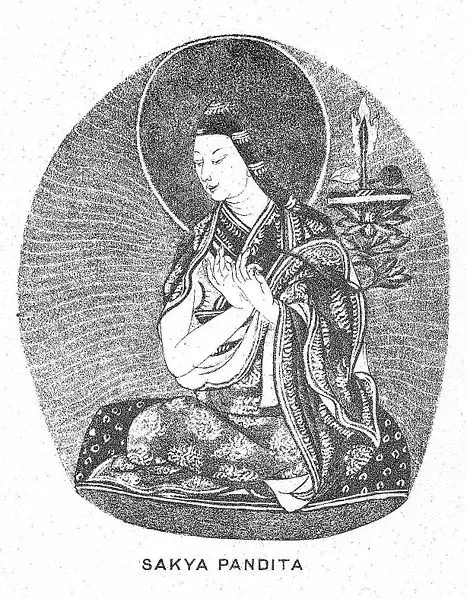
萨迦班智达
Sakya Pandita (萨迦班智达, 1182 – 1251), born Palden Dondrup and ordained as Kunga Gyaltsen (rendered in Chinese chronicles as Gongge Jianzan), was the Fourth Forefather of the Sakya school of Tibetan Buddhism, a transcendent Buddhist philosopher, logician, writer, and statesman. He was the first scholar in Tibetan history to earn the prestigious title of "Pandita" (denoting an erudite scholar who mastered both the greater and…
Sakya Pandita (萨迦班智达, 1182 – 1251), born Palden Dondrup and ordained as Kunga Gyaltsen (rendered in Chinese chronicles as Gongge Jianzan), was the Fourth Forefather of the Sakya school of Tibetan Buddhism, a transcendent Buddhist philosopher, logician, writer, and statesman. He was the first scholar in Tibetan history to earn the prestigious title of "Pandita" (denoting an erudite scholar who mastered both the greater and lesser five sciences of Buddhist learning), gaining renown across the Tibetan plateau and neighboring realms for his profound understanding of both exoteric and esoteric Buddhist doctrines. At a momentous geopolitical turning point during the thirteenth century, Sakya Pandita displayed extraordinary statesmanship and universal compassion. In 1244, confronting the westward expansion of the Mongol Empire and the prolonged fragmentation of local Tibetan polities, the sixty-three-year-old master answered the summons of the Mongol prince Godan Khan, embarking on a northward journey accompanied by his young nephews Phags-pa and Chagna Dorje. In 1247, Sakya Pandita and Godan held the historic "Liangzhou Talks" in Liangzhou (modern Wuwei, Gansu) and issued the renowned Letter to the Tibetans from Sakya Pandita, urging Tibetan spiritual and secular leaders to submit peacefully to the Mongol central court. This initiative established systems of tribute, official appointment, and census registration, sparing Tibet from devastation and inaugurating its formal administrative incorporation into the Chinese dynastic realm. Spending his final years preaching in Liangzhou, Sakya Pandita produced seminal works in logic, monastic discipline, and aphoristic literature, including Treasury of Valid Cognition, Clear Distinction of the Three Vows, and A Treasury of Elegant Sayings (Sakya Legs Bshad), making an enduring contribution to cultural integration and national unity.
Born into the noble Khon clan of Sakya; studied exoteric and esoteric teachings under his father and uncles from early childhood.
Studied under Shakyashribhadra, the last abbot of Nalanda; mastered the five sciences and was honored as "Pandita".
Received full bhikshu vows from Shakyashribhadra, appending "Palzangpo" (Auspicious Goodness) to his dharma name.
Succeeded his uncle Dakpa Gyaltsen as the Fourth Patriarch and abbot of Sakya Monastery.
Received imperial decree from Prince Godan; departed for Liangzhou with his young nephews Phags-pa and Chagna Dorje.
Arrived in Liangzhou after an arduous two-year journey, studying regional governance and facilitating diplomatic understanding.
Held historic talks with Godan Khan, issuing Letter to the Tibetans from Sakya Pandita to achieve peaceful Tibetan integration.
Stationed at Huanzhua Temple, teaching multi-ethnic communities and curing Godan's illness, honored as Master of Imperial Rituals.
Entered parinirvana at Huanzhua Temple at age seventy; Godan constructed a monumental stupa complex to enshrine his relics.
Sakya Pandita was born in 1182 into the aristocratic Khon clan in the Sakya valley of Tsang (central-western Tibet). The Khon lineage held hereditary spiritual and temporal authority over the Sakya tradition, boasting deep intellectual roots. Originally named Palden Dondrup, the youth displayed extraordinary analytical acumen and spiritual comprehension. His father Pelchen Opo and his uncle Dakpa Gyaltsen personally instructed him in Tibetan script, liturgical rituals, and exoteric and esoteric Buddhist treatises. By age ten, he could recite complex tantric liturgies from memory and demonstrated piercing debate abilities that astounded senior scholars.
In 1204, Shakyashribhadra, the final abbot of the famed Indian Buddhist university of Nalanda, arrived in Tibet to propagate the dharma. The eager young scholar became his devoted disciple, spending several years mastering the "Five Major Sciences" (logic, grammar, arts and crafts, medicine, and inner Buddhist doctrine) as well as the "Five Minor Sciences" (poetics, rhetoric, prosody, drama, and astronomy). Because of his encyclopedic command of Sanskrit texts and peerless debate skills, Indian masters and Tibetan scholars unanimously conferred upon him the reverent epithet "Pandita" (Sanskrit for an erudite scholar of the five sciences), establishing his historical renown as Sakya Pandita.
In 1206, Sakya Pandita received full monastic ordination (bhikshu) from Shakyashribhadra, adopting the formal ordination name Kunga Gyaltsen (Banner of Universal Joy) combined with the Tibetan translation of his preceptor's honorific, "Palzangpo" (Auspicious Goodness). Following the passing of his uncle Dakpa Gyaltsen in 1216, Sakya Pandita ascended the vajra throne of Sakya Monastery as its fourth patriarch. He reorganized monastic discipline, instituted rigorous philosophical curricula, and attracted seekers from throughout the Himalayas, making Sakya the preeminent intellectual capital of the Tibetan plateau.
During the 1240s, Mongol cavalry swept across the Eurasian continent. Following the accession of Ogedei Khan, the territories of the former Western Xia state and adjacent regions in Gansu, Qinghai, and Sichuan were granted as an appanage to his second son, Prince Godan. Stationed at Liangzhou, Godan dispatched his commander Dorda Darqan on an exploratory reconnaissance mission into central Tibet. At that time, since the ninth-century collapse of the Yarlung Tibetan Empire, Tibet had endured more than three centuries of localized fragmentation, divided among rival monastic orders and chieftains incapable of resisting the unified military apparatus of the Mongols.
Upon returning to Liangzhou, Dorda Darqan delivered a comprehensive report on Tibetan factions, noting that while the Kadampa held the largest monasteries, the Drigungpa wielded significant regional influence, and the Taglungpa were renowned for ascetic discipline, the figure possessing the greatest prestige, worldly wisdom, and moral authority across the plateau was Sakya Pandita. Convinced by this assessment, Godan issued a golden imperial edict in 1244, conveying rich gifts and inviting Sakya Pandita to Liangzhou to negotiate the political future of Tibet.
Recognizing that this invitation carried the destiny of Tibet and the survival of Buddhist culture, the sixty-three-year-old master resolved to accept the mission despite formidable physical hardships and unpredictable political perils. Selecting his ten-year-old nephew Phags-pa and six-year-old nephew Chagna Dorje to accompany him, and entrusting monastery governance to his younger brother Sonam Gyaltsen, he set forth on the northward journey. Traveling through Tibetan valleys and regional chieftains' territories, he advocated peaceful accommodation with the emergent world empire, finally reaching Liangzhou in August 1246.
When Sakya Pandita reached Liangzhou, Prince Godan was attending the Kurultai in Karakorum that enthroned Guyuk as Great Khan. Sakya Pandita used this interlude to study Mongol institutional practices and Chinese frontier culture. Early in 1247, upon Godan's return to Liangzhou, the two leaders convened the epochal negotiations known as the "Liangzhou Talks."
Godan received Sakya Pandita with extraordinary respect. Beyond discussions on administrative governance, Godan suffered from a chronic, debilitating malady and requested Sakya Pandita's spiritual intercession and medical treatment. Utilizing profound Tibetan medical expertise and ritual blessings, Sakya Pandita successfully cured Godan's illness. Overwhelmed with gratitude and respect, Godan revered Sakya Pandita as his personal root guru and spiritual chaplain, formally concluding a political compact. They agreed that Tibet would submit peacefully to the Mongol Khanate, while the imperial court would refrain from military devastation, preserving monastery properties and local authority.
To implement this historic covenant, Sakya Pandita authored his famous epistle, Letter to the Tibetans from Sakya Pandita (Sakya Pandita's Epistle to the Clergy and Laity of U-Tsang), distributing it to spiritual and secular leaders across the plateau. In this profound document, Sakya Pandita analyzed the geopolitical reality of Eurasian unification, arguing that military resistance against the Mongol armies would bring ruin upon Tibet, whereas willing submission would guarantee religious preservation, peace, and prosperity. He detailed the administrative terms agreed upon with Godan: registering population households, paying regulated tributes, and accepting coordinated imperial oversight. This manifesto removed apprehension throughout Tibet, prompting leaders across all sects to submit voluntarily, establishing a peaceful precedent for Tibet's formal incorporation into Chinese imperial governance.
Following the talks, Sakya Pandita remained in Liangzhou to build durable cultural and spiritual bridges among Mongols, Chinese, and Tibetans. Prince Godan expanded Huanzhua Temple (later known as the Temple of Hundred Pagodas) outside Liangzhou as Sakya Pandita's primary residence. There, the master delivered teachings on Buddhist logic and esoteric tantras not only to Tibetan monks but also to Mongol nobility and local Chinese scholars, using vernacular explanations to communicate core Buddhist ethics.
Observing the lack of an official script suited to Mongol imperial administration, Sakya Pandita devised an experimental forty-letter alphabet modeled on Old Uyghur script to transcribe Mongolian phonology. Although this phonetic script was later superseded by the Phags-pa script created under Kublai Khan, it underscored Sakya Pandita's linguistic genius and foresight.
In the winter of 1251, Sakya Pandita passed away peacefully at Huanzhua Temple at the age of seventy. Mourning his loss, Prince Godan led civil and military officials in performing elaborate funeral rites. Godan ordered the construction of a thirty-five-meter relic stupa encircled by ninety-nine subsidiary shrines, giving rise to the celebrated Temple of Hundred Pagodas. Prior to his demise, Sakya Pandita formally bequeathed the lineage and administrative responsibility to his eldest nephew Phags-pa, who subsequently advised Kublai Khan, founded the imperial preceptor system of the Yuan Dynasty, and completed the institutional integration of Tibet into the unified Chinese state.
Sakya Pandita's preeminent achievement was the orchestration of the 1247 Liangzhou Talks. Facing the devastating force of Mongol expansion, Sakya Pandita traversed thousands of li to negotiate directly with Prince Godan, reaching a historic consensus for peaceful political integration. His Letter to the Tibetans from Sakya Pandita averted catastrophic military conflict, established regulatory systems for census registration and official appointment, and laid the institutional and juridical foundation for Tibet's permanent incorporation into the sovereign administrative framework of China.
In Buddhist philosophy, Sakya Pandita's magnum opus Treasury of Valid Cognition (Tshad-ma rigs-pa'i gter) marks an epochal breakthrough in Tibetan epistemology and logic (Pramana). Synthesizing the profound traditions of Dignaga and Dharmakirti, the text structured Tibetan logical inquiry across eight comprehensive treatises, clarifying epistemology, perception, and inference while clearing away contemporary misconceptions. Adopted as a foundational curriculum by the Sakya tradition, it was subsequently revered as an indispensable masterwork across the Gelug, Nyingma, and Kagyu traditions.
Sakya Pandita's A Treasury of Elegant Sayings (Subhashitaratnanidhi, known as Sakya Legs Bshad) is a masterpiece of classical Tibetan literature. Skillfully blending profound Buddhist ethics with indigenous proverbs and folklore, Sakya Pandita pioneered the aphoristic quatrain genre in Tibetan letters. With vivid imagery, concise verse, and accessible wisdom on moral rectitude, social harmony, and discernment, the work achieved widespread acclaim. It was translated into Mongolian during the Yuan Dynasty and subsequently rendered into Chinese, Manchu, English, and other global languages.
As the first Tibetan scholar to attain the title of Pandita, Sakya Pandita served as an intellectual and cultural bridge across Eurasia. During his years in the Hexi Corridor, he fostered mutual respect and cultural exchange among Chinese, Mongols, Tibetans, and Uyghurs. By introducing Buddhist ethical concepts and advanced medical knowledge to the Mongol ruling elite and training successors like Phags-pa, he cultivated enduring spiritual cohesion and political allegiance within the multi-ethnic Chinese commonwealth.
FIGURES ASSOCIATED WITH THIS DYNASTY