Birth into Ministerial House
Born in Chang'an into the prominent Jingzhao Han clan; his father Han Xiu was renowned for unyielding rectitude as chancellor.
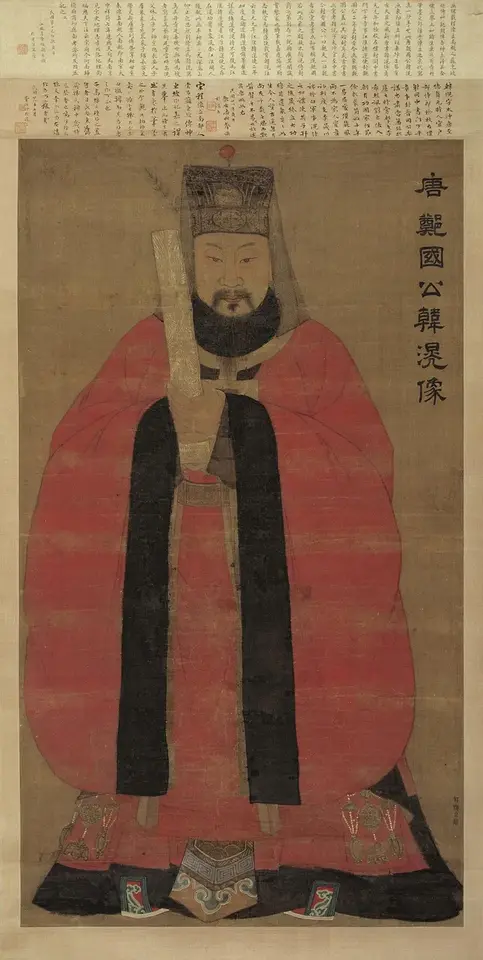
韩滉
Han Huang (韩滉, 723–787), courtesy name Taichong (太冲), posthumously honored as Zhongsu (忠肃), was a native of Chang'an, Jingzhao (modern Xi'an City, Shaanxi Province). He was an outstanding statesman, military commander, financial reformer, and master artist of the mid-Tang dynasty. The son of Han Xiu, an upright chancellor and Junior Preceptor to the Crown Prince during the reign of Emperor Xuanzong, Han Huang entered…
Han Huang (韩滉, 723–787), courtesy name Taichong (太冲), posthumously honored as Zhongsu (忠肃), was a native of Chang'an, Jingzhao (modern Xi'an City, Shaanxi Province). He was an outstanding statesman, military commander, financial reformer, and master artist of the mid-Tang dynasty. The son of Han Xiu, an upright chancellor and Junior Preceptor to the Crown Prince during the reign of Emperor Xuanzong, Han Huang entered bureaucratic service through hereditary privilege (yin) in the Tianbao era as assistant magistrate of Tongguan County. During the An Lushan Rebellion, he took refuge in the Shannan circuit, serving under Li Xian's military headquarters before advancing to palace censor and right vice director of the Department of State Affairs. Under Emperor Daizong, he managed state revenues as vice minister of revenue in charge of the National Expenditure Bureau (Duzhi), dividing fiscal supervision with Liu Yan and replenishing the depleted state treasury through unyielding administrative discipline. In the early Jianzhong era of Emperor Dezong, Han Huang was appointed prefect of Suzhou, surveillance commissioner of East and West Zhejiang, and subsequently military commissioner of Zhenhai Circuit. When the Jingyuan mutiny erupted in 783, rebel commander Zhu Ci occupied Chang'an, forcing Emperor Dezong to flee to Fengtian. Cut off from western agricultural supplies and threatened by Li Xilie's rebellion, the dynasty faced imminent collapse. Han Huang fortified Zhenhai, assembled a formidable naval and infantry force, secured the Yangtze River corridor, and organized a massive river transport fleet that delivered millions of bushels of grain and bolts of silk to imperial forces in Shan Prefecture and the capital region. This vital supply line enabled General Li Sheng to recapture Chang'an. Promoted to Chancellor in 785 and ennobled as Duke of Jin, Han Huang served as chief councillor until his death in 787 at age sixty-five, receiving posthumous honors as Grand Guardian. Renowned for personal austerity, he was also an artistic visionary whose masterpiece Five Oxen (Wu Niu Tu) is China's earliest surviving paper painting and one of its ten greatest classical masterpieces.
Born in Chang'an into the prominent Jingzhao Han clan; his father Han Xiu was renowned for unyielding rectitude as chancellor.
Began public service as county assistant in Tongguan; fled south to Shannan when the An Lushan Rebellion engulfed the capital.
Recalled to the central court as palace censor, gaining promotion to vice director in the Ministry of Civil Personnel and right vice director of State Affairs.
Appointed vice minister of revenue managing national expenditures, dividing empire-wide tax management with Liu Yan and balancing state finances.
Appointed court consultant, prefect of Jinzhou, and subsequently prefect of Suzhou and surveillance commissioner of East and West Zhejiang.
Transferred to Runzhou as military commissioner of Zhenhai Circuit, constructing fortifications, training troops, and managing waterways.
When Emperor Dezong fled during the Jingyuan mutiny, Han dispatched transport fleets carrying millions of bolts of silk and grain to sustain loyalist forces.
Elevated to Joint Manager of Affairs with the Secretariat-Chancellery and transport commissioner of the Huai and Yangtze rivers.
Promoted to Grand Minister of Works (Situ), Vice Director of the Secretariat, and ennobled as Duke of Jin, directing the central administration.
Passed away in Chang'an on March 19 at age sixty-five; Emperor Dezong suspended court for three days and conferred the posthumous title Grand Guardian.
Han Huang hailed from the Jingzhao Han lineage, whose ancestors included illustrious statesmen. His father, Han Xiu, was revered during Emperor Xuanzong's Kaiyuan era for fearless remonstrance and uncompromising moral integrity. Raised under strict family discipline, Han Huang was solemn, rarely displayed emotional agitation, and practiced personal frugality. During the late Tianbao era, he commenced his career through hereditary privilege as assistant magistrate of Tongguan County.
When the catastrophic An Lushan Rebellion erupted in 755, Chang'an and Luoyang fell to rebel forces. Han Huang accompanied regional authorities fleeing southward into Shannan, entering the headquarters of Military Commissioner Li Xian as an administrative judge. Demonstrating remarkable efficiency in managing wartime logistical details, he was summoned to the imperial court in 759 under Emperor Suzong to serve as palace censor. Through his unswerving enforcement of administrative law, he earned consecutive promotions to vice director of evaluations and right vice director of the Department of State Affairs.
In 771 (the 6th year of the Dali era), Emperor Daizong appointed Han Huang vice minister of revenue in charge of the National Expenditure Bureau (Duzhi), dividing state fiscal jurisdiction with the famous reformer Liu Yan. Han inspected taxation registers with meticulous precision, eradicating clerical embezzlement and consolidating revenue streams. Despite severe fiscal depletion caused by endless military campaigns against autonomous regional warlords, Han replenished the central treasury, ensuring adequate provisions for the imperial armies.
At the accession of Emperor Dezong, Han Huang served briefly as minister of the Court of Imperial Sacrifices before being appointed prefect of Suzhou and surveillance commissioner of East and West Zhejiang. In 781 (the 2nd year of the Jianzhong era), his administrative jurisdiction was reorganized, establishing his headquarters at Runzhou (modern Zhenjiang, Jiangsu Province) as military commissioner of Zhenhai Circuit.
Upon assuming command, Han recognized the strategic importance of the lower Yangtze region. He reinforced city fortifications, deepened defensive moats, accumulated millions of bushels of grain, constructed hundreds of naval transport vessels, and recruited disciplined infantry and riverine units. Maintaining absolute personal austerity, he imposed strict obedience to the law, transforming Zhenhai into an unassailable bastion of imperial resources.
In the winter of 783 (the 4th year of the Jianzhong era), the mutiny of the Jingyuan army compelled Emperor Dezong to flee Chang'an for Fengtian. Rebel general Zhu Ci usurped the throne in Chang'an, while regional warlords Li Huaiguang and Li Xilie revolted in the central plains. Cutting off traditional grain transport through the Yellow River and Huai River basins, the insurgencies caused catastrophic famine in the capital region, leaving the imperial court without rations.
In this supreme dynastic crisis, Han Huang mobilized the entire logistical and military capacity of the southeastern provinces. He deployed naval flotillas to blockade the Yangtze River against Li Xilie's advance, safeguarding the rich agricultural delta. Simultaneously, he marshaled over one thousand transport vessels, dispatching millions of bushels of grain and bolts of silk along hazardous waterways directly to Shan Prefecture and imperial command posts. These vital shipments sustained General Li Sheng's army, enabling the historic recapture of Chang'an and saving the Tang dynasty from collapse.
In 785 (the 1st year of the Zhenyuan era), following the suppression of Li Xilie's revolt, Emperor Dezong rewarded Han Huang's extraordinary contributions by naming him Joint Manager of Affairs with the Secretariat-Chancellery and river transport commissioner of the Huai and Yangtze rivers.
In 786, Han was summoned to Chang'an to serve in the capital. Emperor Dezong elevated him to Vice Director of the Secretariat, Grand Minister of Works (Situ), and ennobled him as Duke of Jin with extraordinary ceremonial honors. In the central administration, Han tackled bureaucratic slackness and enforced strict laws. While his uncompromising temperament drew criticism from certain factions, his devotion to the state remained unchallenged.
On March 19, 787 (the 25th day of the 2nd lunar month of the 3rd year of the Zhenyuan era), Han Huang succumbed to chronic illness caused by relentless overwork, dying in his Chang'an residence at sixty-five. Emperor Dezong mourned his passing deeply, suspending court audiences for three days, conferring the posthumous title Grand Guardian (Taibao) and the posthumous name Zhongsu. Beyond his bureaucratic and military achievements, Han achieved everlasting renown as a painter of agrarian life, horses, and water buffaloes. His masterpiece Five Oxen (Wu Niu Tu) captures the anatomical strength and gentle temperament of working oxen, celebrated as an unparalleled treasure of Chinese painting.
During the chaos following the Jingyuan mutiny, Emperor Dezong was stranded in exile while prices in the capital region soared to tens of thousands of copper coins per peck of rice. Imperial forces under Li Sheng faced imminent starvation. Recognizing that the fate of the dynasty hung by a thread, Han Huang utilized Zhenhai's economic surplus to assemble massive river convoys.
Braving logistical hazards and roving rebel units, he supervised the transport of millions of bushels of rice and bolts of silk to the northern front. This monumental logistical triumph preserved military cohesion, enabled the recapture of Chang'an, and earned Emperor Dezong's profound gratitude, who declared that the dynasty's survival rested entirely upon Han Huang.
As military commissioner of Zhenhai, Han faced the mortal threat of Li Xilie's rebellion expanding into the affluent Yangtze delta. He took vigorous measures to construct high walls, dig deep moats, build massive multi-decked warships, and train specialized riverine combat forces.
His rigorous administrative oversight and zero-tolerance approach toward sedition dissuaded rebel warlords from attempting crossings. Zhenhai stood as an impenetrable shield, safeguarding the revenue-producing heartland of the empire during decades of widespread rebellion.
Han Huang was an accomplished calligrapher following the cursive style of Zhang Xu, but his greatest artistic triumph lay in painting. Focusing on agrarian life, herdsmen, and draft animals, he depicted rural scenes with extraordinary realism and psychological depth.
His surviving masterpiece Five Oxen (Wu Niu Tu), preserved in the Palace Museum in Beijing, depicts five distinct oxen in varying poses—grazing, looking back, walking, bellowing, and standing. Rendered with powerful brushstrokes and subtle earthy colors, the work immortalized the vital role of farming in dynastic stability, standing as China's oldest surviving paper painting and a national treasure of classical art.
FIGURES ASSOCIATED WITH THIS DYNASTY