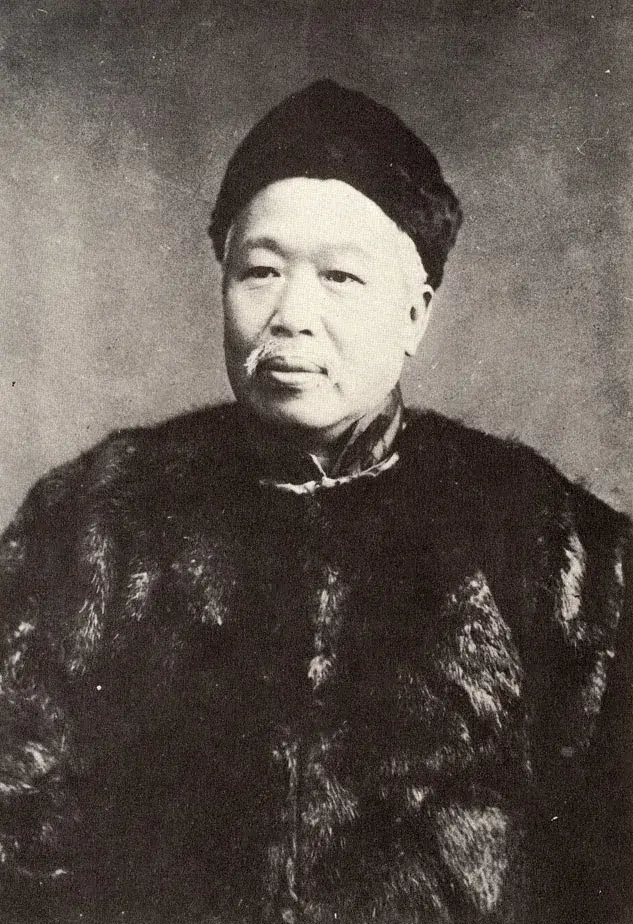
Biography
Distinguished Lineage and Early Education
Kang Youwei, originally named Zuyi and bearing the courtesy name Guangsha, was born on March 19, 1858 (the fifth day of the second lunar month in the eighth year of the Xianfeng reign), in Su Village, Danzao Town, Nanhai County, Guangzhou Prefecture, Guangdong Province. The Kang lineage was an eminent family of scholar-officials in Lingnan with generations of classical learning. His great-grandfather Kang Jianchang was a county licentiate; his grandfather Kang Zanxiu served as educational instructor (xundao) in Lianzhou, possessing deep mastery of Confucian classics, Neo-Confucian philosophy, and calligraphy; and his father Kang Dachu served as expectant magistrate in Jiangxi, widely known for his erudition and classical verse. Under this disciplined domestic tradition, Kang received an exceptionally rigorous grounding in orthodox Confucian learning from earliest childhood.
Precociously gifted, Kang memorized hundreds of classical Tang and Song poems by the age of five. At six, he began studying the Great Learning, the Doctrine of the Mean, the Analects, and Zhu Xi's commentary on the Classic of Filial Piety under clan tutor Jian Fengyi, demonstrating uncommon intellectual agility and philosophical curiosity. In 1868, when Kang was eleven years old, his father passed away suddenly from illness. Following this loss, his grandfather Kang Zanxiu personally assumed direction of his education, instructing him in the Thirteen Classics and the Twenty-Four Dynastic Histories, while training his character through the quiet contemplation methods of Chen Baisha, instilling in him a conviction that he was destined for moral leadership.
In 1874, at seventeen, Kang encountered Xu Jiyu's groundbreaking world geography treatise, A Short Account of the Maritime Circuit (Yinghuan Zhilve), along with modern world maps. The detailed descriptions of global geography, diverse political institutions, and modern Western technology deeply shook the young scholar. For the first time, he realized that beyond the boundaries of the traditional Chinese realm lay a vast, rapidly evolving modern world, opening an essential intellectual portal toward global enlightenment.
Enlightenment at Mount Xiqiao and Global Awakening
In 1876, at nineteen, Kang formally enrolled under Zhu Ciqi in Jiujiang, Nanhai. Zhu was one of Lingnan's foremost Neo-Confucian scholars, demanding that students practice "Four Virtues and Five Branches of Learning": the virtues of filial piety, honor, self-cultivation, and solemn demeanor; and the branches of classical studies, literature, institutional history, moral philosophy, and composition. Zhu rejected empty metaphysical banter, emphasizing practical application to human affairs. Under Zhu's tutelage for over three years, Kang immersed himself in Song and Ming philosophy, historical administration, and geography, building a comprehensive scholarly foundation.
However, Kang possessed an assertive, independent spirit that resisted conventional bounds. In the winter of 1879, at twenty-two, feeling that Zhu's teachings could not resolve his deep existential questions regarding the cosmos and human destiny, Kang departed the academy and retreated to Baiyun Cave on Mount Xiqiao. There he devoured practical statecraft treatises, including Gu Yanwu's Strategic Advantages and Disadvantages of the Prefectures and Commanderies of the Empire and Gu Zuyu's Essentials of Historical Geography, alongside Mahayana Buddhist sutras and Daoist texts. Through solitary meditation, he experienced a profound intellectual transformation, vowing to dedicate his life to the salvation of humanity.
At the end of 1879, Kang left Mount Xiqiao and visited British-administered Hong Kong for the first time. Standing on the streets of Victoria Harbor, observing modern multi-story stone architecture, orderly paved avenues, disciplined police administration, and the precision of steamships and telegraphs, he experienced profound cultural shock. In 1882, after failing the Shuntian provincial examination in Beijing, he deliberately traveled through the international concessions of Shanghai, staying for several months. There he purchased extensive collections of Western scientific treatises published by the Jiangnan Arsenal Translation Bureau, devouring acoustics, optics, chemistry, electricity, mathematics, and Western political histories. In 1883, he drafted regulations for the Society Against Footbinding in his hometown, pledging that his family would abandon footbinding and forming China's earliest anti-footbinding organization. Through these formative experiences, Kang abandoned conventional scholarly isolation and forged an integrated reformist philosophy combining Western sciences with Chinese classical wisdom.
Wanmu Caotang and Institutional Reform
In the autumn of 1888, at thirty-one, motivated by deep alarm over imperial decline and Russian encroachment along the northwestern border, Kang traveled to Beijing for the provincial examinations and submitted his First Memorial to Emperor Guangxu. In this impassioned memorial, Kang warned: "Japan is watching us from the east, and Russia is roaring from the west; surrounded by aggressive neighbors, the empire faces imminent ruin!" He urged the twenty-year-old monarch to break with hidebound precedent and enact systemic institutional reforms. However, conservative officials in the Grand Secretariat and Directorate of Education obstructed the memorial, preventing it from reaching the throne.
Recognizing that reform required broader intellectual mobilization and a new generation of educated leaders, Kang returned to Guangzhou. In 1891, he opened the Thatched Cottage Among Ten Thousand Trees (Wanmu Caotang) in Changxing Lane. Rejecting rote memorization geared toward the imperial civil examinations, Kang established a curriculum integrating classical philosophy, Chinese institutional history, international law, and modern natural sciences. The academy attracted brilliant young minds from Lingnan, including Liang Qichao, Mai Menghua, and Xu Qin. Moving successively to Kuang Clan Ancestral Hall and the Yanggao Shrine, the academy's enrollment surpassed one hundred students by 1893, when Kang achieved eighth place in the provincial examinations, establishing Wanmu Caotang as the intellectual crucible of the reform movement.
During this period, Kang authored two seminal theoretical works: A Study of the Forged Classics of the Xin Period (Xin Xue Wei Jing Kao) in 1891 and A Study of Confucius as a Reformer of Institutions (Kongzi Gai Zhi Kao) in 1897. In the former, Kang boldly asserted that ancient-script classics like the Rites of Zhou and Zuo Zhuan, revered for two millennia as imperial orthodoxy, were fabrications forged by Liu Xin to legitimate Wang Mang's usurping Xin dynasty. In the latter, he argued that Confucius was not a passive antiquarian who merely transmitted ancient lore, but a visionary institutional reformer who composed the Six Classics to promote evolutionary social progress. These works exploded across the late-Qing intellectual world like an ideological earthquake, stripping traditional classics of their conservative infallibility and providing an unassailable classical mandate for modern institutional reform.
Joint Petition of Examination Candidates and Qiangxuehui
In 1894, the First Sino-Japanese War erupted, culminating in the total destruction of the Qing Beiyang Fleet. In April 1895, the court's plenipotentiary Li Hongzhang signed the humiliating Treaty of Shimonoseki, ceding Taiwan and the Penghu Islands to Japan while agreeing to pay an indemnity of 200 million taels of silver. News of the treaty provoked fury among examination candidates gathered in Beijing for the metropolitan examinations.
Confronting this national humiliation, Kang and his disciples drafted an 18,000-character petition. Gathering scholars at the Songyun Nunnery near Xuanwu Gate, Kang organized over 1,300 provincial graduates from eighteen provinces to endorse the petition submitted to the Censorate, an event immortalized as the Joint Petition of Imperial Examination Candidates to the Emperor (Gongche Shangshu). The memorial advanced four foundational policies: issuing imperial edicts to galvanize public spirit, relocating the capital to ensure strategic depth, modernizing military forces, and enacting comprehensive institutional reforms in fiscal, judicial, and educational administration. The petition shattered centuries of imperial prohibitions against scholar associations, transforming reformist philosophy into a nationwide civic movement.
Shortly after the petition, Kang passed the metropolitan examinations, earning the jinshi degree (second class, rank 46) and appointment as Secretary in the Ministry of Works. To sustain public momentum, Kang and Liang founded the Society for the Study of Self-Strengthening (Qiangxuehui) in Beijing in July 1895, alongside the reformist gazette Zhongwai Jiwen, collaborating with imperial officials like Shen Zengzhi and Western figures like Timothy Richard. Kang subsequently traveled to Shanghai to establish a sister branch and the Qiangxue Bao. These institutions marked the birth of China's earliest modern political societies and independent press.
Formulating Comprehensive Reform Plans
By late 1895, conservative court factions grew alarmed by the rapid expansion of the reform societies. Censor Yang Chongyi memorialized Empress Dowager Cixi, accusing the society of seditious conspiracy, leading to the dissolution of the Beijing branch and its conversion into a government translation bureau. Nevertheless, the reform movement had ignited minds across provincial administrations, with enlightened governors like Chen Baozhen in Hunan adopting modern administrative initiatives.
In November 1897, German naval forces seized Jiaozhou Bay in Shandong, triggering an aggressive scramble for concessions among imperialist powers. Russia occupied Port Arthur and Dalian, Britain leased Weihaiwei and the Kowloon Peninsula, and France claimed Guangzhouwan. Horrified by the imminent partition of China, Kang rushed to Beijing and submitted his Fifth and Sixth Memorials to the Emperor. Drawing upon international precedent, he submitted his Memorial on Overall Planning (Yingzhao Tongchou Quanju Zhe), proposing the creation of a specialized Bureau of Institutions (Zhiduju) to manage national reforms, bypassing obstructionist ministries.
To furnish Emperor Guangxu with concrete historical models of modernization, Kang prepared two historical studies: A Study of the Political Reforms of the Meiji Era in Japan (Riben Meizhi Bianzheng Kao) and Record of the Reforms of Peter the Great of Russia (Eluosi Da Pide Bianzheng Ji), alongside A Bibliography of Japanese Books. The emperor studied these texts with admiration, resolving to overcome entrenched resistance and implement national reform. In May 1898, Kang organized the Society to Protect the Nation (Baoguohui) in Beijing, rallying hundreds of patriotic officials under the banner of "protecting the nation, the people, and the sacred teaching," propelling the reform campaign to its zenith.
The Hundred Days' Reform and the Palace Coup
Responding to Kang's appeals and supported by imperial tutor Weng Tonghe, Emperor Guangxu resolved to launch the reforms. On June 11, 1898, the emperor issued the "Edict on Ding Guoshi," formally inaugurating the Hundred Days' Reform.
On June 16, 1898, Emperor Guangxu granted Kang Youwei a private audience in the Hall of Diligent Government (Qinzheng Dian) at the Summer Palace. They conferred for hours on the mechanics of state transformation. Facing intense opposition from conservative grandees, the emperor appointed Kang to serve as Walking in the Zongli Yamen with the sixth rank, granting him the critical privilege of submitting memorials directly to the throne. Over the next 103 days, Kang served as chief architect of an unprecedented legislative program: abolishing the eight-legged essay in favor of policy essays; eliminating redundant offices and sinecures; authorizing private subjects to submit direct memorials; founding the Imperial University of Peking and modern primary and secondary schools; establishing the Bureau of Agriculture, Industry, and Commerce; protecting private commercial enterprise; building national trunk railways; and overhauling the military on modern lines.
However, the rapid pace of reform threatened the core privileges of the Manchu nobility and conservative grandees. When junior official Wang Zhao submitted a reform memorial, conservative ministers Huai Tabu and Xu Yingkui suppressed it. In response, Emperor Guangxu dismissed six senior ministers of the Ministry of Rites and promoted four reform leaders—Tan Sitong, Yang Rui, Lin Xu, and Liu Guangdi—to serve as secretaries in the Grand Council. Terrified by their loss of authority, conservative officials conspired with Governor-General of Zhili Ronglu to launch a military coup during a planned imperial troop review in Tianjin.
Coup and Overseas Exile
Realizing the extreme danger facing the throne, Emperor Guangxu issued a secret imperial edict in early September, instructing Yang Rui to consult urgently with Kang Youwei. In desperation, Kang and Tan Sitong resolved to approach Yuan Shikai, commander of the modern Newly Created Army. Tan visited Yuan's quarters at Fahua Temple, urging him to deploy his forces to neutralize Ronglu and secure the Summer Palace. However, Yuan feigned support while immediately betraying the plan to Ronglu.
On September 21, 1898 (the sixth day of the eighth lunar month), Empress Dowager Cixi returned from the Summer Palace and seized power in a coup. She placed Emperor Guangxu under strict house arrest at Yingtai in Zhongnanhai, declared her resumption of the regency, and ordered the arrest of Kang and his associates. Warned of the impending crackdown, Kang slipped out of Beijing to Tanggu, where he boarded the British naval vessel Fly with assistance from British diplomats, escaping south to Shanghai and Hong Kong.
Qing authorities arrested and executed the "Six Gentlemen of Wuxu"—Tan Sitong, Kang Guangren (Kang's younger brother), Yang Rui, Lin Xu, Yang Shenxiu, and Liu Guangdi—and rescinded virtually all reform decrees with the exception of the Imperial University of Peking. Facilitated by British authorities, Kang traveled to Japan, where he was welcomed by Prime Minister Okuma Shigenobu, beginning an odyssey of sixteen years in overseas exile.
The Baohuanghui and Global Travels
Recognizing that Japanese diplomatic calculations constrained political action against the Qing court, Kang departed Yokohama in the spring of 1899, crossing the Pacific to Victoria, British Columbia. Greeted with enthusiasm by North American Chinese immigrants, Kang officially established the Society to Protect the Emperor (Baohuanghui, formally the Society to Save the Great Qing Emperor) on July 20, 1899. Kang assumed the presidency, with Liang Qichao as vice president. Pledging to restore Emperor Guangxu and institute constitutional monarchy, the organization expanded across North America, Latin America, Southeast Asia, Australasia, and Europe, establishing hundreds of chapters and enlisting hundreds of thousands of members, becoming the largest and wealthiest Chinese overseas political network of its era.
In 1900, amidst the Boxer Uprising, the Baohuanghui mobilized significant funds to finance Tang Caichang's Independent Army uprising along the Yangzi River. The insurrection was brutally suppressed by Qing authorities, resulting in the martyrdom of Tang and over twenty reformers. Following this tragedy, Kang utilized the society's commercial capital to establish joint-stock trading enterprises, real estate investments, and Chinese-language newspapers across the Pacific. From 1904 onward, Kang embarked on extensive travels across more than thirty countries, including Britain, France, Germany, Italy, the United States, Canada, Mexico, and Sweden. He met with prominent world statesmen, including United States President Theodore Roosevelt, examined Western parliamentary systems, and inspected industrial factories, railways, financial institutions, and naval academies.
During his European travels, Kang composed extensive travelogues and sociological essays. In Sweden, he purchased an islet residence off Stockholm, styling it "Beihai Caotang," praising Scandinavian social welfare and municipal cleanliness. In these years of retreat, he synthesized his lifetime philosophical ideas, completing the final manuscript of his utopian masterwork, Book of the Great Unity (Datong Shu). Concurrently, as revolutionary republicanism gained momentum under Sun Yat-sen, Kang adhered adamantly to constitutional monarchism. He engaged in prolonged ideological debates against revolutionaries like Zhang Binglin and Zou Rong in the overseas press, defending his reformist principles while drifting toward political conservatism.
The 1911 Revolution and Loyalist Defiance
In October 1911, the Wuchang Uprising shattered the Qing dynastic order. Within months, southern provinces declared independence, culminating in the abdication of the child emperor Puyi in February 1912 and the founding of the Republic of China. Observing the demise of the Qing from abroad, Kang was grief-stricken. Refusing to recognize the legitimacy of the republican government, he continued to style himself a loyal subject of the fallen Great Qing.
In the winter of 1913, concluding sixteen years in exile, Kang returned to China and settled in Xinjia Garden, Shanghai. He founded the cultural and political journal Buren (Compassion), advocating constitutional monarchy and cultural preservation. He argued that China's vast territory and low literacy rendered an unmediated American-style republic vulnerable to warlord fragmentation, contending that an institutional constitutional monarch remained essential to anchor national cohesion.
Concurrently, resisting the wholesale iconoclasm of modern intellectuals, Kang founded the Confucian Religious Society (Kongjiaohui) alongside his student Chen Huanzhang, establishing chapters across China and assuming the presidency. He campaigned vigorously to designate Confucianism as the constitutional state religion, believing that traditional moral tenets were necessary to resist materialistic decadence. However, his royalist and religious advocacy drew severe condemnation from leaders of the New Culture Movement, including Chen Duxiu, Lu Xun, and Li Dazhao.
The Restoration of 1917 and Demise of Imperial Dreams
Following Yuan Shikai's failed attempt to establish an imperial dynasty and his death in 1916, Northern warlord factions plunged Beijing into chaotic power struggles. As President Li Yuanhong and Premier Duan Qirui clashed, Duan summoned General Zhang Xun, the commander of the "Braided Army," to intervene. Zhang, who remained fiercely loyal to the Qing house, secretly plotted a royalist restoration with Qing loyalists.
Summoned by Zhang Xun's coded telegram, the sixty-year-old Kang traveled in disguise by train to Beijing in June 1917, arriving at Zhang's military headquarters in Fengtai. At dawn on July 1, 1917, Zhang's troops occupied the Forbidden City and restored twelve-year-old Puyi to the Dragon Throne, proclaiming the resumption of the Xuantong reign. Appointed President of the Deliberative Council (Bideyuan), Kang dressed in traditional imperial robes to assume office in the cabinet.
However, the restoration provoked nationwide condemnation. Duan Qirui mobilized an army at Machang outside Tianjin, launching an offensive against Beijing, while Liang Qichao issued public denunciations of his mentor's actions. Republican aircraft dropped bombs on the Forbidden City, and the royalist forces collapsed within days. On July 12, after twelve days, the restoration disintegrated. Zhang Xun fled to the Dutch Legation, and Kang sought asylum in the United States Legation, where he remained sheltered for six months. With this defeat, Kang's lifelong vision of a restored constitutional Qing monarchy was extinguished forever.
Final Years in Shanghai and Qingdao
Following the collapse of the restoration, the Beijing government issued a warrant for Kang's arrest, which was rescinded shortly thereafter. Disillusioned by politics, Kang withdrew permanently from public life, devoting his final decade to classical philosophy, epigraphy, and calligraphic creation. In 1923, at sixty-six, he relocated to the coastal city of Qingdao, purchasing the former German governor's residence, which he named "Tianyou Garden" and adopted the sobriquet "Tianyou Huaren."
In Qingdao, Kang enjoyed a tranquil life overlooking the sea, completing revisions on scholarly manuscripts, including Subtle Meanings of Mencius (Mengzi Wei), Commentary on the Analects (Lunyu Zhu), and Exegesis of Esoteric Meanings in the Spring and Autumn Annals. He received aspiring scholars, lecturing on Confucian classics and epigraphic aesthetics. His distinctive calligraphic style reached artistic maturity during this period, generating widespread demand for his inscriptions.
On the evening of March 29, 1927, the seventy-year-old Kang attended a dinner banquet with fellow Guangdong natives in Qingdao. After consuming a beverage, he suffered sudden, excruciating abdominal pain and persistent vomiting. Despite emergency medical intervention, his condition deteriorated, showing symptoms of acute food poisoning. At 5:30 a.m. on March 31, 1927, Kang Youwei passed away at Tianyou Garden at the age of seventy. He was laid to rest on the southern slopes of Xiang'er Mountain in Licang, Qingdao. Spanning five imperial and republican eras, Kang concluded a momentous, heroic, and controversial life at the crossroads of modern Chinese history.
Major Achievements
The Joint Petition and Mobilization of the Reform Movement
At the darkest hour of national peril in late-nineteenth-century China, Kang Youwei organized the historic Joint Petition of Imperial Examination Candidates to the Emperor (Gongche Shangshu), launching China's modern political reform movement.
News of the territorial and financial concessions of the 1895 Treaty of Shimonoseki outraged scholars and citizens across China. Recognizing that dispersed traditional intellectuals must be mobilized into a civic political force, Kang drafted an 18,000-character petition, mobilizing over 1,300 provincial graduates from eighteen provinces to endorse it at the Songyun Nunnery. The memorial boldly diagnosed China's defeat not merely as a military failing, but as the consequence of obsolete political and educational institutions, presenting a systematic program of structural modernization.
The Joint Petition shattered the Qing court's longstanding ban on intellectual association and political assembly, transforming reformist philosophy into a nationwide movement. In its wake, Kang founded the Society for the Study of Self-Strengthening and launched modern journals, establishing China's earliest civic political societies and independent press.
Reforming Institutions under Ancient Sanction and New Text Scholarship
In classical philosophy, Kang Youwei executed the most revolutionary intellectual assault of modern Chinese thought, constructing a reformist system founded upon the Gongyang New Text classical tradition and the concept of "reforming institutions under the sanction of antiquity" (tuogu gaizhi).
To dismantle the conservative dogma that ancestral dynastic statutes were inviolable, Kang published A Study of the Forged Classics of the Xin Period and A Study of Confucius as a Reformer of Institutions. In the former, he mobilized meticulous philological arguments to claim that orthodox ancient-script texts were fabrications manufactured by Liu Xin to legitimate Wang Mang's usurpation, undermining the scriptural foundations of imperial conservatism. In the latter, he depicted Confucius as an evolutionary reformer who authored the Six Classics to advance institutional progress.
Kang ingeniously used the supreme moral authority of Confucius to legitimize modern Western notions of civil rights and constitutional monarchy. Drawing upon the Gongyang theory of the "Three Ages" (san shi)—the Age of Disorder (Juluan Shi), the Age of Approaching Peace (Shengping Shi), and the Age of Universal Peace (Taiping Shi)—he demonstrated that absolute monarchy must inevitably evolve into constitutional democracy, providing an unshakeable classical foundation for the Hundred Days' Reform.
Formulating Concrete Modernization Plans and the Bureau of Institutions
On the eve of the 1898 reforms, Kang demonstrated sophisticated administrative design capabilities, formulating practical blueprints for institutional transformation.
To furnish Emperor Guangxu with actionable models, Kang composed detailed monographs, including A Study of the Political Reforms of the Meiji Era in Japan and Record of the Reforms of Peter the Great of Russia. He analyzed how Peter I transformed Russia through westernization and how Emperor Meiji preserved Japanese sovereignty through constitutional reform, warning that failure to modernize would leave China partitioned like Poland.
Crucially, in his Memorial on Overall Planning, Kang proposed creating a specialized central administrative organ, the Bureau of Institutions (Zhiduju). Recognizing that the Grand Council and Six Ministries were dominated by entrenched conservatives, he proposed staffing this bureau with reform-minded intellectuals directly subordinate to the emperor, alongside provincial bureaus to promote local self-government. This proposal stood as modern China's earliest administrative structural reform plan.
Directing the Hundred Days' Reform
In 1898, Kang Youwei guided Emperor Guangxu in launching the 103-day Hundred Days' Reform, marking modern China's first state-led attempt at institutional transformation.
Appointed Walking in the Zongli Yamen, Kang served as principal advisor to the emperor, helping draft over one hundred reform decrees. These encompassed abolishing the eight-legged essay, establishing modern schools and the Imperial University of Peking, creating modern administrative bureaus, fostering private industrial enterprise, laying trunk railways, and overhauling the military.
The Hundred Days' Reform represented modern China's first attempt to construct a constitutional monarchy through legal, top-down institutional reform. Although crushed by conservative reaction, the movement awakened civic consciousness, established modern educational prototypes, and laid the ideological groundwork for subsequent revolutions and modern state-building.
Utopian Social Philosophy and the Book of the Great Unity
In philosophy and social ethics, Kang Youwei produced modern China's most profound and original utopian socialist treatise, Book of the Great Unity (Datong Shu).
Drafted over decades of reflection and global travel, the work drew upon Buddhist compassion and Confucian benevolence (ren) to analyze the nine categories of human suffering arising from divisive boundaries: national borders, class divisions, racial classifications, gender inequalities, private families, and private property.
Kang envisioned an egalitarian global society where national borders are eliminated under a unified democratic world government; private property is replaced by public ownership of land and industry; nuclear families are dissolved in favor of absolute gender equality; and universal public institutions care for individuals from birth to death through public nurseries, schools, hospitals, and retirement homes. Book of the Great Unity represented a dazzling vision of human liberation that deeply inspired thinkers like Liang Qichao and Mao Zedong.
Promoting Constitutionalism and Local Self-Government
Kang was a pioneering theorist of modern constitutional democracy and local autonomy in China, introducing concepts of constitutional governance and the separation of powers.
Rejecting absolute autocracy, Kang argued that constitutional monarchy provided the optimal balance between stability and popular sovereignty. He advocated establishing a national parliament and an independent judiciary, emphasizing that fundamental constitutions must limit executive power.
Furthermore, Kang championed local self-government, criticizing the centralized bureaucratic system for stifling civic initiative. He advocated direct elections at the prefectural, county, and village levels to empower citizens to oversee education, public works, and local police. These theories directly shaped late-Qing constitutional preparations and modern Chinese administrative law.
Pioneering Female Emancipation and Social Reform
Beyond political philosophy, Kang was a courageous pioneer of modern social reform and women's rights in China.
In 1883, at twenty-six, Kang established the Society Against Footbinding in Guangdong, drafting regulations that required members to forbid footbinding among female relatives. He subsequently submitted official memorials urging the imperial court to issue nationwide bans on footbinding.
Kang linked female physical emancipation to national health and dignity, arguing that healthy mothers were essential to a strong society. His initiatives catalyzed the establishment of girls' schools and the emergence of modern Chinese feminist activism.
Epigraphic Theory and the Creation of the Kang Style Calligraphy
In the fine arts, Kang Youwei achieved lasting renown as a paramount theorist and master of Chinese calligraphy.
In 1889, at thirty-two, Kang published his monumental treatise on calligraphic theory, Dual Oars of the Art Boat (Guang Yizhou Shuangji). Expanding the epigraphic theories of Ruan Yuan and Bao Shichen, Kang mounted an eloquent defense of the Northern Dynasties stele tradition, fiercely criticizing the delicate mannerisms of late imperial copybook styles (tiexue). He championed the archaic strength, monumental gravitas, and asymmetrical energy of Northern Wei stone inscriptions.
In his own calligraphy, Kang translated these theories into the celebrated "Kang Style" (Kangti), characterized by circular brush attacks, sweeping lateral extensions, and dense monumental balance. His calligraphic theories reshaped modern Chinese art, influencing twentieth-century masters such as Sha Menghai and Xu Beihong.
Global Industrial Inquiries and Cultural Exchange
During his sixteen years of overseas exile, Kang traveled across thirty nations, becoming one of modern China's earliest thinkers to conduct comprehensive firsthand investigations of modern Western civilization.
Kang inspected industrial assembly plants, steel mills, shipyards, railway hubs, and banking centers. Recognizing the limitations of early Self-Strengthening slogans, he authored On Material Salvation (Wuzhi Jiuguo Lun), advocating industrialization and scientific modernization as prerequisites for national survival.
Concurrently, utilizing the Baohuanghui's international network, Kang established Chinese-language schools, newspapers, and financial institutions among overseas Chinese communities, strengthening their economic independence while introducing Chinese classical culture to Western scholars.