Biography
Youth and Insurrection at Mount Changbai
Du Fuwei, originally named Du Yao, was born into a destitute family in Zhangqiu County, Qi Province. His grandfather Du Xing and father Du Yi held neither land nor official rank. Energetic and unconstrained by convention in his youth, Du Fuwei found it impossible to sustain himself through traditional labor and occasionally engaged in minor thefts to survive.
From early childhood, he formed an inseparable bond with his fellow townsman Fu Gongshi. Fu Gongshi's maternal aunt operated a pastoral sheepfold. Witnessing Du Fuwei's frequent starvation, Fu Gongshi repeatedly stole sheep from his aunt's flocks to feed him. Discovering the recurring losses, the aunt lodged a formal complaint with the county authorities. Facing immediate arrest by county bailiffs, the sixteen-year-old Du Fuwei fled into the wilderness with Fu Gongshi, gathering dozens of dispossessed vagrants and bandits into an armed band.
In 613, widespread drought and locust plagues struck Shandong, igniting armed revolts against the Sui dynasty. Du Fuwei led his followers to Mount Changbai to join a local insurgent force. Although he initially enrolled as an ordinary infantryman, Du Fuwei distinguished himself by charging at the very front during assaults and holding the rear during retreats. His fearless conduct earned the unreserved respect of his comrades, who elevated him to supreme commander. This marked the starting point of his military ascent in Jianghuai.
Expansion in the Huai Basin and Subjugation of Rivals
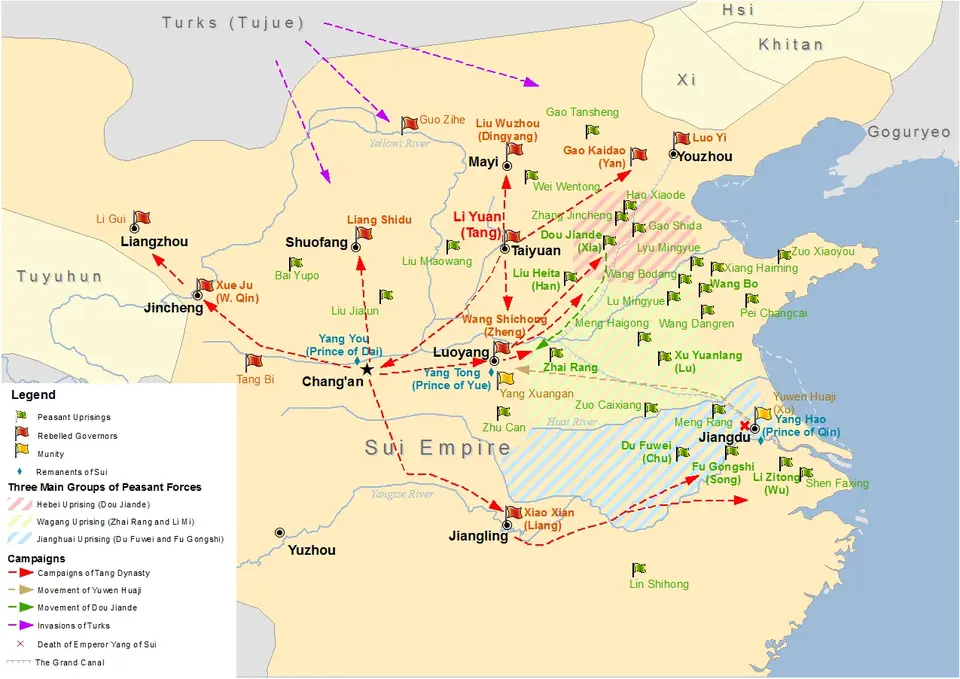
Aware that the imperial government maintained formidable garrisons in Shandong, Du Fuwei calculated that the canal-crossed geography of the Huai River basin offered superior tactical advantages. Leading his troops southward across the Huai River, he recognized that isolated small bands would inevitably be crushed by imperial armies unless rapidly consolidated.
At that time, another insurgent leader named Miao Haichao held several thousand troops at Xiapi. Du Fuwei dispatched Fu Gongshi to Miao Haichao's encampment, presenting a candid strategic ultimatum: both forces had rebelled against Sui oppression, yet their fragmented strength left them vulnerable to piecemeal destruction. If Miao Haichao possessed the capacity to command the joint host, Du Fuwei would cheerfully serve under him; if not, Miao should submit to unified command rather than perish separately. Persuaded by the military cohesion of Du's army, Miao Haichao surrendered his forces without resistance.
Conversely, another rebel chieftain named Zhao Pozhen at Hailing held superior numbers and viewed Du Fuwei with condescension, demanding his immediate submission. Anticipating treachery, Du Fuwei instructed Fu Gongshi to conceal the main army outside Zhao's perimeter while he personally entered the camp accompanied by only ten retainers carrying roast beef and wine. Delighted by what appeared to be total compliance, Zhao Pozhen convened all his captains in the command tent for a banquet. As the drinking reached its height, Du Fuwei drew his dagger and assassinated Zhao Pozhen on his seat, while his retainers secured the tent entrances. Fu Gongshi's concealed troops stormed the camp on signal, absorbing the entire force. Strengthened by these acquisitions, Du Fuwei took the title of General, captured Liuhe and Anyi, and directly threatened the southern imperial capital at Jiangdu.
Alarmed by his rapid proximity, the imperial command at Jiangdu dispatched Officer Song Hao with several thousand elite cavalry to suppress him. Du Fuwei deployed feigned retreat tactics, luring Song Hao deep into extensive reed marshes before igniting fires from all directions. Song Hao's troops were trapped and incinerated, and Song Hao was decapitated in the marsh. Du Fuwei's forces swelled to over ten thousand veterans.
Reversals, Recovery, and the Stronghold of Liyang
In the tenth month of 615, rival northern insurgent Li Zitong led over ten thousand followers south across the sea to seek refuge under Du Fuwei. Du welcomed him hospitably. However, Li Zitong harbored sovereign ambitions and launched a sudden midnight mutiny against Du Fuwei's headquarters. Taken completely unawares, Du Fuwei was thrown from his horse with serious wounds. At this critical juncture, his teenage adopted son Wang Xiongdan fought through the melee, lifted the wounded commander onto his back, and concealed him in the deep reed thickets for days, evading cavalry searches.
Compounding the disaster, the imperial army from Jiangdu attacked simultaneously. Incapacitated by wounds, Du Fuwei could not direct his men, and his scattered army suffered heavy casualties. The wife of his commander Ximen Junyi, renowned for her immense physical strength, hoisted Du Fuwei upon her back and broke through the encirclement while Wang Xiongdan led a rearguard of suicide fighters, enabling Du Fuwei to escape with his life.
These consecutive near-fatal catastrophes failed to break Du Fuwei's resolve. Regrouping scattered remnants and enrolling thousands of starving refugees, he rebuilt his army to several tens of thousands within six months. In 617, Emperor Yang dispatched Right Guard General Chen Leng with eight thousand imperial Xiaoguo guards to eradicate the insurgents. At Gaoyou, Du Fuwei concealed ambush units in marshy terrain, feigned defeat to lure Chen Leng's cavalry into the quagmire, and launched a coordinated fire assault. Chen Leng's army was annihilated, and Chen Leng barely escaped alone.
The victory at Gaoyou cemented Du Fuwei's mastery over the region. He promptly stormed Liyang, establishing it as his administrative capital and assuming the title of Area Commander, with Fu Gongshi as his chief administrator. At Liyang, Du Fuwei selected over thirty exceptional warriors to be his adopted sons, foremost among them Wang Xiongdan and Kan Leng. Kan Leng stood over eight feet tall and wielded a two-bladed broadsword twelve feet long with devastating effect. In battle, Du Fuwei spearheaded the assault in heavy armor, Wang Xiongdan led the shock vanguard, and Kan Leng commanded the rearguard, executing any soldier who retreated. Under this uncompromising discipline, the army achieved unbroken battlefield success.
In civil governance, Du Fuwei enforced strict laws against banditry. When an officer took a peasant's bamboo hat to shelter from rain, Du Fuwei executed him on the spot. Crimes of theft or assault against civilians were punished by public execution regardless of rank. Simultaneously, he distributed granary grain to famine-stricken communities and employed traditional scholar-officials to administer registers and revenue, winning the enduring affection of the Jianghuai population.
Submission to Tang and Pacification of the Southeast
In 618, Yuwen Huaji assassinated Emperor Yang at Jiangdu and marched north with the imperial guards. Prince Yang Tong in Luoyang formally appointed Du Fuwei as Grand Commander of the Southeastern Circuit and Prince of Chu. Following Yuwen Huaji's annihilation and the usurpation of Wang Shichong in 619, Du Fuwei recognized that the Mandate of Heaven belonged to the House of Tang in Chang'an and dispatched envoys across the lines to surrender his territory.
Emperor Gaozu of Tang was overjoyed and conferred upon him the offices of President of the Southeastern Branch Department of State Affairs, Pacification Commissioner, and Area Commander of Hezhou, elevating him to Prince of Wu and granting him the imperial surname Li. In 620, the Tang court further appointed him Area Commander-in-Chief of Military Affairs South of the Jianghuai and Governor of Yang Province, granting him comprehensive authority over the entire southern theater.
At that time, Li Zitong had proclaimed himself Emperor of Wu at Jiangdu and subsequently marched south to destroy Shen Faxing, taking Danyang and the Lake Tai basin. In 621, Du Fuwei launched a final offensive to eradicate Li Zitong, ordering General Wang Xiongdan to strike Jiangdu. Wang Xiongdan smashed Li Zitong's field army at Taicang and laid siege to Jiangdu for six months until its granaries were exhausted. Li Zitong abandoned the city and fled south, but Wang Xiongdan pursued him to Yuhang, captured him in his camp, and sent him in a cage cart to Chang'an for execution. Du Fuwei's armies then swept through Hangzhou, Shezhou, and Xuanzhou, conquering all territories south of the Huai River to the sea and north of the Nanling Mountains.
To consolidate the southern perimeter, Du Fuwei dispatched emissaries to secure the surrender of the remnants of Lin Shihong in Poyang and negotiated the submission of the powerful Cantonese chieftain Feng Ang, successfully integrating eight southern provinces into the Tang realm without bloodshed.
Strained Relations and Residence in Chang'an
Du Fuwei treated his sworn brother Fu Gongshi with profound outward deference, addressing him as elder brother and entrusting him with all civil affairs while he focused on military operations. However, as their territory expanded, profound rifts emerged. Fu Gongshi cultivated deep factional ties among the provincial bureaucracy, arousing Du Fuwei's suspicion. To neutralize Fu Gongshi's military authority, Du Fuwei elevated him to the honorific position of Right Pushe without military command, transferring direct military authority to his trusted adopted son Wang Xiongdan. Fu Gongshi deeply resented this marginalization and conspired secretly with the Daoist master Zuo Youxian.
In 622, after Prince Li Shimin decisively eliminated Wang Shichong and Dou Jiande, the Tang empire achieved undisputed hegemony over the Central Plains. Aware of the peril that supreme military prestige posed to a regional warlord, Du Fuwei resolved to travel to Chang'an in person to demonstrate unreserved loyalty. Prior to his departure, he left Fu Gongshi in charge of civil governance at Danyang, but strictly instructed Wang Xiongdan to garrison the main army inside Danyang citadel and never heed unauthorized commands from Fu Gongshi.
Upon his arrival in Chang'an, Emperor Gaozu accorded Du Fuwei an extraordinary reception, descending from his carriage to embrace him and elevating him to Grand Protection of the Crown Prince, ranked above Prince Li Yuanji of Qi, with lavish gifts of mansions and jade treasures. Du Fuwei spent his days hunting and dining with the imperial family, meticulously avoiding military involvement.
Fu Gongshi's Treason, Untimely Death, and Posthumous Exoneration
In the autumn of 623, seeing Du Fuwei detained at the imperial court, Fu Gongshi launched an armed rebellion at Danyang. Fabricating an imperial edict from Du Fuwei, Fu Gongshi claimed that the Prince of Wu had commanded him to raise southern armies against Tang. Proclaiming himself Emperor of Song, Fu Gongshi treacherously murdered Wang Xiongdan when he refused to rebel, and launched attacks into Huainan.
When the news reached Chang'an, Emperor Gaozu dispatched Prince Li Xiaogong and General Li Jing to lead the suppression forces, while placing several of Du Fuwei's retainers under interrogation. In the capital, Du Fuwei was shattered by the realization that he was hopelessly implicated by his former comrade's treason. Overcome by intense anxiety, grief, and terror, Du Fuwei died suddenly in his Chang'an residence on the twenty-eighth day of the second month of 624 (March 23, 624) at the age of forty-one.
In the third month of 624, Li Xiaogong crushed Fu Gongshi's revolt. Prior to his execution, out of lingering hatred toward Du Fuwei for stripping his military power, Fu Gongshi falsely swore that the entire plot had been orchestrated by Du Fuwei from Chang'an. Enraged and unapprised of the full truth, Emperor Gaozu post-mortem stripped Du Fuwei of all ranks and fiefdoms, confiscated his properties, and enslaved his wife and children.
This injustice remained unredressed until 627, when Emperor Taizong ascended the throne and ordered the judicial organs to re-examine the Jianghuai rebellion records. The investigation verified that Fu Gongshi had forged all treasonous communications and that Du Fuwei had remained entirely faithful to the Tang house. Emperor Taizong immediately issued an imperial edict clearing Du Fuwei's name, restoring his titles as Prince of Wu and Grand Protection, releasing his family from servitude, and ordering an imperial commission to recover his remains and perform an honorable princely reburial.