Uprising in Wagang and Strategic Expansion
Led regional youths alongside Xu Shiji to join Zhai Rang at Wagang; captured supplies in Xingyang and Liangjun, expanding to ten thousand men.
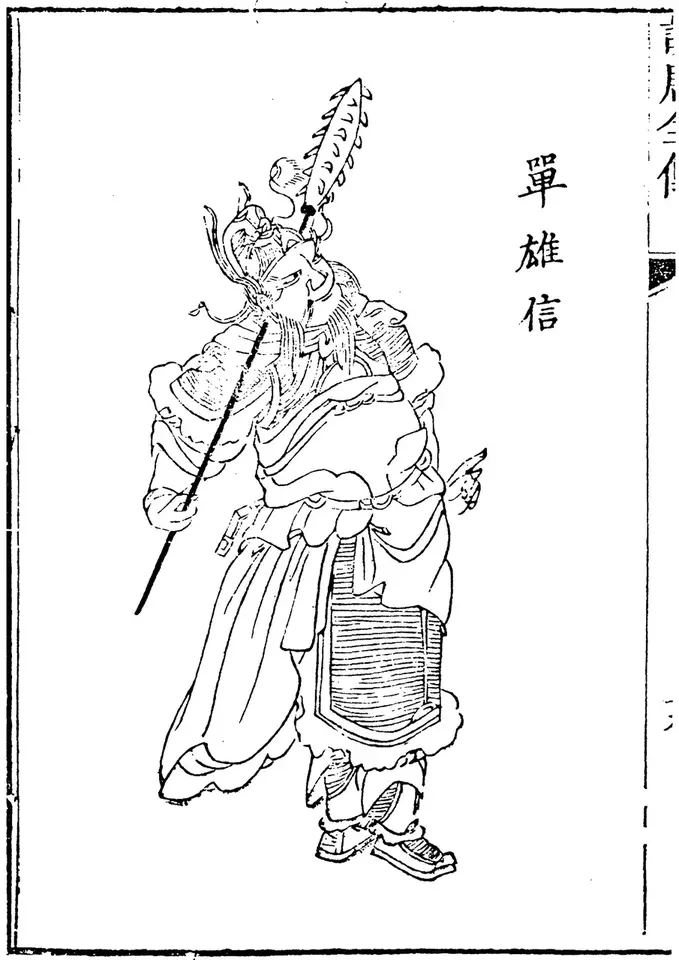
单雄信
Shan Xiongxin (单雄信, ?–621) was a native of Jiyin in Caozhou (modern Dongming County, Heze, Shandong Province). A preeminent rebel leader and formidable military commander during the transition from the Sui to the Tang dynasty, he served successively under the Wagang army of Zhai Rang and Li Mi, and subsequently under Wang Shichong's Great Zheng regime, rising to the rank of Grand General. From his youth, Shan Xiongxin was…
Shan Xiongxin (单雄信, ?–621) was a native of Jiyin in Caozhou (modern Dongming County, Heze, Shandong Province). A preeminent rebel leader and formidable military commander during the transition from the Sui to the Tang dynasty, he served successively under the Wagang army of Zhai Rang and Li Mi, and subsequently under Wang Shichong's Great Zheng regime, rising to the rank of Grand General. From his youth, Shan Xiongxin was celebrated for his agility and extraordinary valor, mastering equestrian archery and the heavy cavalry lance with such peerless skill that the entire Wagang army hailed him as the "Flying General." In 613, Shan Xiongxin and his fellow county youth Xu Shiji (later known as Li Ji) led their retainers to join Zhai Rang at Wagang fortress, launching an armed insurrection against the Sui dynasty. By raiding the strategic commanderies of Xingyang and Liangjun along the Bian River canal, their force expanded to over ten thousand warriors, establishing the Wagang army as a premier insurrectionary power in central China. Following Li Mi's accession as Lord of Wei, Shan Xiongxin was appointed Left General of the Martial Guard, commanding the elite outer cavalry. During the fatal internal purge in which Li Mi ambushed and slew Zhai Rang while wounding Xu Shiji, Shan Xiongxin bowed to submit, taking command of Zhai Rang's former troops to continue campaigning across Henan. In 618, Li Mi suffered a crushing defeat in a nocturnal surprise attack launched by Wang Shichong during the Battle of Yanshi north of Mangshan, compelling the encircled Shan Xiongxin to surrender his cavalry units to Wang Shichong, who appointed him Grand General. Between 620 and 621, when Prince of Qin Li Shimin led the Tang armies to encircle Luoyang, Shan Xiongxin repeatedly charged out of the city gates, once riding forward alone with his lance leveled directly at Li Shimin, nearly slaying the future emperor before being checked by Xu Shiji's desperate shouts. Following the fall of Luoyang and Wang Shichong's capitulation, Li Shimin ordered Shan Xiongxin's execution. Despite Xu Shiji offering to surrender all his newly granted Tang noble titles to redeem his sworn brother's life, the plea was rejected. On the execution grounds at the banks of the Luo River, Xu Shiji sliced off a piece of his own thigh flesh and fed it to Shan Xiongxin to fulfill their blood oath of shared death, after which Shan Xiongxin calmly met his end. His tragic valor inspired centuries of poetic eulogies, evolving in popular folklore and martial romances into the consummate model of an honorable, chivalric outlaw chieftain.
Led regional youths alongside Xu Shiji to join Zhai Rang at Wagang; captured supplies in Xingyang and Liangjun, expanding to ten thousand men.
Joined Zhai Rang and Li Mi in ambushing the formidable Sui general Zhang Xutuo, slaying him and establishing Wagang supremacy.
Participated in elevating Li Mi as Lord of Wei; appointed Left General of the Martial Guard, co-directing the army with Xu Shiji.
Flanked Wang Shichong's counteroffensive at Luokou with Li Mi, rescuing Zhai Rang's wavering vanguard and routing Sui forces.
Li Mi assassinated Zhai Rang at a banquet; Shan Xiongxin kowtowed for survival and was retained by Li Mi to co-lead the remaining forces.
Camped north of Yanshi commanding the outer cavalry; overrun by Wang Shichong's night assault and surrendered following Li Mi's rout.
Appointed Grand General after Wang Shichong usurped the throne to establish the Great Zheng dynasty, training elite shock cavalry.
Confronted the Tang siege of Luoyang; charged his lance directly at Li Shimin, withdrawing only after Xu Shiji intervened.
Battled Wang Junkuo at Luokou before being repelled by Li Shimin's five thousand cavalry, retreating into the inner defenses of Luoyang.
Following Wang Shichong's surrender, sentenced to death by Li Shimin; consumed Xu Shiji's sliced flesh and died serenely at the Luo River.
Shan Xiongxin was born into an influential, martial family in Jiyin of Caozhou. From early childhood, he displayed remarkable physical prowess, a fierce temperament, and extraordinary agility in wielding heavy weapons, earning wide renown for his skill in maneuvering the heavy horseman's lance while riding at full gallop. During the closing years of the Daye era of the Sui dynasty, Emperor Yang's triple expeditions against Goguryeo and massive construction projects exhausted the empire, driving the populace into widespread revolt. In 613, Zhai Rang, a former judicial officer of Dong Commandery, fled persecution to gather outlaws in Wagang fortress in Hua County.
Upon hearing of the rising, Shan Xiongxin mobilized thousands of spirited youths from Jiyin and Dong Commandery to join Zhai Rang. Simultaneously, seventeen-year-old Xu Shiji (later known as Duke of Ying Li Ji) also joined the encampment. Xu Shiji advised Zhai Rang that because Dong Commandery was their native home, they should refrain from pillaging local kin; instead, they should exploit the Bian River canal passing through Xingyang and Liangjun, intercepting imperial grain fleets and wealthy merchants to finance the uprising. Zhai Rang and Shan Xiongxin enthusiastically endorsed this strategy. Moving into the two commanderies, they seized government cargo boats and accumulated massive provisions, attracting dispossessed peasants and armed outlaws, swiftly expanding their ranks to over ten thousand fighters.
That same year, following the abortive rebellion of Yang Xuangan at Liyang, Li Mi, one of the most prominent strategists of the era, arrived to seek refuge at Wagang. Shan Xiongxin and Zhai Rang welcomed Li Mi as an honored strategist. In 616, the Sui court dispatched its premier counter-insurgency general, Zhang Xutuo, leading elite troops from Luoyang to crush Wagang. Li Mi laid a masterly ambush at Dahai Monastery; Zhai Rang drew the enemy forward, while Shan Xiongxin and Xu Shiji led heavy cavalry crashing into the Sui flank, slaying Zhang Xutuo on the field and utterly dismantling the last effective imperial army in Henan, propelling Wagang to the leadership of the nationwide rebellion.
In the second month of 617, the Wagang insurgents seized Xingluo Granary (Luokou Granary), opening its vast grain reserves to relieve millions of starving refugees and swelling their ranks by hundreds of thousands within weeks. Urged by Xu Shiji and Wang Bodang, Zhai Rang voluntarily stepped aside, championing Li Mi as supreme leader. Li Mi constructed an altar south of Gong County, assuming the title Lord of Wei and organizing his expeditionary headquarters. Distributing commands among his captains, Li Mi appointed Zhai Rang Minister of Education, while naming Shan Xiongxin Left General of the Martial Guard and Xu Shiji Right General of the Martial Guard, positioning the two sworn brothers at the apex of military command.
In the seventh month of that year, Sui general Wang Shichong marched out of Luoyang with elite foot and cavalry to challenge Wagang along the banks of the Luo River. Zhai Rang engaged the enemy vanguard and suffered initial tactical setbacks. At the critical hour, Li Mi and Shan Xiongxin personally led several thousand heavy cavalry sweeping across the rear of the Sui formations. Shan Xiongxin rode deep into the melee, skewering enemy officers, re-energizing Wagang forces to shatter Wang Shichong's army, decapitating thousands of imperial troops.
However, rapid expansion sharpened internal factional friction. Zhai Rang's close officer Wang Ruxin urged him to reclaim executive authority as Grand Chancellor, while Zhai Rang's elder brother Zhai Kuan openly declared that the throne should be taken rather than conceded. Li Mi grew deeply suspicious. In the eleventh month of 617, Zhai Rang visited Li Mi's headquarters for a feast, accompanied by Shan Xiongxin, Xu Shiji, and Wang Bodang. Li Mi concealed armed assassins while offering an exceptional composite bow for Zhai Rang to examine. As Zhai Rang leaned back to draw the bowstring, Li Mi's henchman Cai Jiande struck from behind with a broadblade, cutting Zhai Rang down. Assassins swarmed the banquet floor, butchering Wang Ruxin and Zhai Kuan.
In the ensuing panic, Xu Shiji was slashed across the neck and back by confused guards, suffering grievous wounds before Li Mi intervened. Caught completely unprepared, Shan Xiongxin recognized that resistance was impossible and dropped to his knees before Li Mi, kowtowing to plead for his life. Li Mi's chief adviser, Fang Yanzao, argued that Shan Xiongxin was too fickle in his loyalties and urged his immediate liquidation. Li Mi, deeply admiring Shan Xiongxin's peerless martial brilliance, overruled Fang Yanzao, personally raising Shan Xiongxin from the floor and dividing command of Zhai Rang's former troops among Xu Shiji, Shan Xiongxin, and Wang Bodang, thereby restoring calm to the shaken army.
In early 618, Yuwen Huaji strangled Emperor Yang in Jiangdu, leading more than one hundred thousand elite Xiaoguo guards north toward the Central Plains. The imperial remnants in Luoyang, backed by Wang Shichong, enthroned Yang Tong and appointed Li Mi Grand Commandant, ordering him to intercept Yuwen Huaji. Li Mi committed the full strength of the Wagang army to brutal battles at Huatai and Liyang, suffering staggering casualties while successfully destroying Yuwen Huaji's main force.
Capitalizing on Wagang's exhaustion, Wang Shichong mobilized over twenty thousand fresh cavalry and infantry from Luoyang, advancing eastward to Yanshi. Li Mi stationed Wang Bodang at Jinyong Fortress while leading his remaining troops to camp upon Mount Mang, assigning Shan Xiongxin to command the elite outer cavalry stationed north of Yanshi. Recognizing Wagang's disarray, Wang Shichong launched a full-scale nocturnal assault against Shan Xiongxin's camp.
Shan Xiongxin and his cavalry resisted fiercely against overwhelming numbers. Li Mi dispatched Cheng Yaojin and Pei Xingyan from Mount Mang to relieve the camp, but Pei Xingyan was unhorsed by a stray arrow, and Cheng Yaojin was impaled through the torso while rescuing his comrade, forcing the relief column to fall back. Wang Shichong encircled Yanshi, completely collapsing the Wagang front and driving Li Mi to seek refuge in Guanzhong under the Tang dynasty. Isolated and outmatched, Shan Xiongxin surrendered his outer cavalry to Wang Shichong. Knowing Shan Xiongxin's immense renown among Central Plains warriors, Wang Shichong rejoiced, erecting an altar to commission him as Grand General, entrusting him with vital command responsibilities. Meanwhile, his comrade Xu Shiji surrendered the strategic granary at Liyang to the Tang dynasty.
In 619, Wang Shichong deposed Emperor Yang Tong and proclaimed himself Emperor of the Great Zheng dynasty. Shan Xiongxin trained imperial cavalry and restored military discipline, earning the profound respect of Zheng forces. In the seventh month of 620, Emperor Gaozu of Tang ordered Prince of Qin Li Shimin to lead one hundred thousand troops east through Tongguan to wage a decisive war against Luoyang.
As Li Shimin established fortified siege works across Mount Mang and Qingcheng, Wang Shichong sent forth his foremost cavalry champions. Shan Xiongxin, serving as Zheng's premier vanguard general, spearheaded attacks with his eighteen-foot lance, cutting through opposing ranks. In one fierce engagement, Shan Xiongxin spotted Li Shimin personally surveying frontline outposts in black armor. With a deafening roar, Shan Xiongxin charged his steed forward, thrusting his iron spear straight at Li Shimin's chest. The spearpoint came within inches of piercing the prince's armor before Xu Shiji galloped into view, shouting desperately: "Brother, hold your weapon! That is the Prince of Qin of the Great Tang!" Startled by his sworn brother's voice, Shan Xiongxin reined in his horse and withdrew, sparing Li Shimin's life.
In the second month of 621, Shan Xiongxin and Pei Xiaoda clashed with Tang general Wang Junkuo at Luokou, before being driven back by Li Shimin's surprise counterattack. In the fourth month, Shan Xiongxin and Yang Gongqing launched another cavalry sortie, battling Prince of Qi Li Yuanji and slaying Tang commander Lu Jun'e. However, in the fifth month, Li Shimin executed a brilliant envelopment at the Battle of Hulao Pass, annihilating Dou Jiande's relief army of one hundred thousand men and capturing Dou Jiande alive. Completely demoralized, Wang Shichong opened the gates of Luoyang in unconditional surrender.
Following the capture of Luoyang, Tang high command initiated sweeping purges. Viewing Shan Xiongxin as a dangerously capable warrior who had inflicted heavy casualties on Tang armies and whose loyalties were unpredictable, Li Shimin ordered his execution alongside Wang Shichong's senior commanders.
Xu Shiji, now Duke of Cao in the Tang service, wept bitterly and petitioned Li Shimin and Emperor Gaozu, offering to forfeit all his titles, official ranks, and wealth to ransom Shan Xiongxin's life. Li Shimin flatly refused.
Xu Shiji went to the execution grounds at the Luo River bank, weeping inconsolably. Shan Xiongxin smiled calmly and sighed: "I knew well that you could not accomplish this matter!" Xu Shiji sobbed: "I swore to die with you, my brother! Yet having committed my body to the state, duty cannot be reconciled. If I follow you in death, who will care for your widow and orphans?" Drawing his dagger, Xu Shiji carved a piece of flesh from his own thigh and offered it to Shan Xiongxin, crying: "Let this flesh follow you into the soil, so that our ancient oath of shared death may not be broken!" Shan Xiongxin consumed the flesh without hesitation and smiled: "Farewell in death, my true brother!" He then extended his neck to the blade, meeting his death with supreme composure in his early forties. True to his word, Xu Shiji reared Shan Xiongxin's children as his own, ensuring the continuity of his lineage.
Throughout the chaotic civil wars of the late Sui dynasty, Shan Xiongxin stood out as one of the most feared cavalry commanders in China. Both the Old Book of Tang and Zizhi Tongjian explicitly record that he "was agile and courageous from youth, exceptionally skilled in fighting with a lance on horseback, known throughout Li Mi's army as the Flying General."
Tang scholar Duan Chengshi documented in Miscellaneous Morsels from Youyang that Shan Xiongxin planted a date tree in his courtyard in his youth, felling it at age eighteen to fashion a lance shaft fitted with a seventy-pound steel blade named "Cold White Bone." Whether smashing Zhang Xutuo, routing Wang Shichong's cavalry, or clashing with Yuwen Huaji, Shan Xiongxin fought in the vanguard, playing an indispensable role in Wagang's ascent as the foremost rebel army in China.
During the Battle of Luoyang in 620, Shan Xiongxin demonstrated individual martial courage that stunned the Tang high command. Facing Li Shimin, the supreme commander who would establish the Zhenguan reign, Shan Xiongxin charged alone through thick melee to strike at the prince.
This dramatic confrontation was meticulously recorded in dynastic histories. Qing historian Zhao Yi composed a poem celebrating the deed: "Shan Xiongxin of the false Zheng charged his lance at the Prince of Qin... they were champions of ten thousand men, whose glare none dared oppose!" Forcing the future emperor into mortal danger with a single mount and spear remains an enduring legend of personal combat in medieval Chinese military history.
From their early days in Caozhou, Shan Xiongxin and Xu Shiji were bound by an unbreakable bond of brotherhood. Even as dynastic factions fractured their paths and placed them on opposite sides of the battlefield, their mutual devotion never wavered.
When Shan Xiongxin faced execution, Xu Shiji offered his entire fortune and rank to redeem his friend's life; facing the inevitability of political execution, Xu Shiji sliced flesh from his own thigh so that a part of him might enter the earth with his brother, subsequently adopting Shan Xiongxin's children. This tragic scene stands as one of the most celebrated exemplars of martial fidelity and sworn brotherhood in Chinese historical tradition.
Following his death, common folk across Henan and Shandong built shrines to commemorate Shan Xiongxin's valor. Song scholar Meng Yuanlao recorded in The Eastern Capital: A Dream of Splendor that Kaifeng maintained a popular "King Shan Temple" that received ceaseless sacrifices.
From the Ming and Qing dynasties onward, Shan Xiongxin was transformed in folk storytelling, theatrical plays, and classical novels into the supreme "Chieftain of the Green Forest." In Sui Shi Yiwen, Sui Tang Yanyi, and Shuo Tang, he was cast as the master of Erxian Manor, the generous patron of outlaw heroes, celebrated for his unbending loyalty and hatred of tyranny, becoming an immortal icon of chivalric honor in Chinese popular culture.
FIGURES ASSOCIATED WITH THIS DYNASTY