Birth in Donglai
Born into an illustrious imperial lineage descending from Prince Daohui of Qi; demonstrated early filial piety.
刘繇
Liu Yao (刘繇, 156–197 CE), styled Zhengli, native to Muping in Donglai Commandery (modern Muping District, Yantai, Shandong Province), was an eminent imperial kinsman, senior court minister, and regional warlord of the late Eastern Han dynasty who served as Governor of Yangzhou and General Who Inspires Martial Prowess. Descended from Prince Daohui of Qi (Liu Fei, the eldest son of Emperor Gaozu), he was the nephew of Grand…
Liu Yao (刘繇, 156–197 CE), styled Zhengli, native to Muping in Donglai Commandery (modern Muping District, Yantai, Shandong Province), was an eminent imperial kinsman, senior court minister, and regional warlord of the late Eastern Han dynasty who served as Governor of Yangzhou and General Who Inspires Martial Prowess. Descended from Prince Daohui of Qi (Liu Fei, the eldest son of Emperor Gaozu), he was the nephew of Grand Commandant Liu Chong and younger brother of Inspector of Yanzhou Liu Dai. Renowned from his youth for filial courage—famously rescuing his kidnapped uncle from bandits at nineteen—Liu Yao entered officialdom as a Gentleman-of-the-Palace. Serving as Magistrate of Xiayi, he resigned in protest when a superior pressured him with nepotistic requests, and later impeached a corrupt eunuch's son while inspecting Jinan. In 194 CE, the Han court appointed Liu Yao Inspector of Yangzhou. Because Shouchun was occupied by the warlord Yuan Shu, Liu Yao crossed the Yangtze River, establishing his seat at Qu'a with the support of Wu Jing and Sun Ben. When Yuan Shu's imperial usurpation became evident, Liu Yao broke relations, expelled Yuan Shu's officers, and garrisoned the Yangtze defensive crossings, earning promotion to Governor of Yangzhou (Yangzhou Mu) with tens of thousands of troops under his command. Intellectual luminaries including Xu Shao, Ze Rong, and Xue Li took refuge under his banner. In 195 CE, Sun Ce launched an amphibious invasion across the Yangtze under Yuan Shu's orders. Liu Yao, failing to entrust command to the brilliant general Taishi Ci, was defeated in the Shentingling campaign and withdrew to Dantu. Following the strategic counsel of Xu Shao, he retreated upriver to Yuzhang Commandery. In Yuzhang, Liu Yao assisted imperial appointee Zhu Hao in suppressing Zhuge Xuan, and subsequently eradicated the treacherous rogue commander Ze Rong. In 197 CE, Liu Yao fell ill and died in Yuzhang at the age of forty-two. Following his death, Sun Ce respectfully conveyed his remains for burial and provided generous pensions to his surviving family. Chen Shou commemorated him in the Records of the Three Kingdoms, highlighting his personal integrity while noting his lack of martial decisiveness amidst civil war.
Born into an illustrious imperial lineage descending from Prince Daohui of Qi; demonstrated early filial piety.
At nineteen, boldly infiltrated bandit territory alone to rescue his kidnapped uncle Liu Wei, gaining fame across Qi.
Served as Magistrate of Xiayi; resigned rather than yield to corrupt favoritism, subsequently impeaching a powerful eunuch's son in Jinan.
Appointed Inspector of Yangzhou; crossed the river to Qu'a and broke with Yuan Shu to establish Yangtze defenses.
Sun Ce's amphibious offensive shattered his river garrisons; retreated to Dantu and followed Xu Shao's plan to occupy Yuzhang.
Established headquarters at Pengze; assisted Zhu Hao to secure Nanchang and destroyed the treacherous rebel Ze Rong.
Local rebels delivered Zhuge Xuan's head; Liu Yao died of severe illness in Yuzhang, later buried with honor by Sun Ce.
Liu Yao descended from the foundational royal lineage of the Han dynasty, tracing his ancestry directly to Prince Daohui of Qi (Liu Fei), the eldest son of Emperor Gaozu. His ancestor Liu Xie, the Marquis of Muping, was enfeoffed in Donglai, establishing the family's hereditary seat in Muping. His paternal uncle Liu Chong served as Grand Commandant, one of the supreme Three Excellencies, celebrated for his incorruptibility; his elder brother Liu Dai attained high court office as a Regular Palace Attendant and later Inspector of Yanzhou.
When Liu Yao was nineteen years old, local brigands in Donglai seized his paternal uncle Liu Wei as a hostage. Displaying extraordinary daring and tactical cunning, Liu Yao single-handedly tracked the bandit gang, infiltrated their stronghold, and rescued his uncle without harm. This heroic exploit established his reputation for filial courage throughout the provinces of Qing and Qi.
Recommended as Filial and Incorrupt, Liu Yao was appointed a Gentleman-of-the-Palace in the imperial capital. Under Eastern Han administrative practice, gentlemen of the three secretariats were appointed to county magistracies; Liu Yao was assigned as Magistrate of Xiayi in Pei Kingdom. Serving alongside esteemed contemporary talents including Zhao Yu and Zang Hong, Liu Yao governed strictly according to statutory statutes. When the Commandery Administrator sought to exert pressure on behalf of imperial in-laws and powerful nobles, Liu Yao refused to compromise judicial impartiality, hanging up his official seal and abandoning office.
Subsequently, the regional inspectorate of Qingzhou recruited him as an inspectorate officer to audit Jinan Kingdom. The Chancellor of Jinan was the son of an omnipotent palace eunuch, infamous for embezzling state revenues and abusing commoners. Refusing to yield to imperial court favorites, Liu Yao submitted a formal impeachment that led to the corrupt chancellor's dismissal, earning wide respect across the regional gentry. The scholar Tao Qiuhong praised him to the Inspector: "Recommending Liu Dai first and elevating Liu Yao afterward is like harnessing a pair of divine dragons for a long journey and driving fine steeds across a thousand leagues!" Later summoned by the Ministry of Works and appointed an Imperial Inspector, Liu Yao declined to take office due to the catastrophic warfare sparked by Dong Zhuo's coup, fleeing southward with his family to Huaipu.
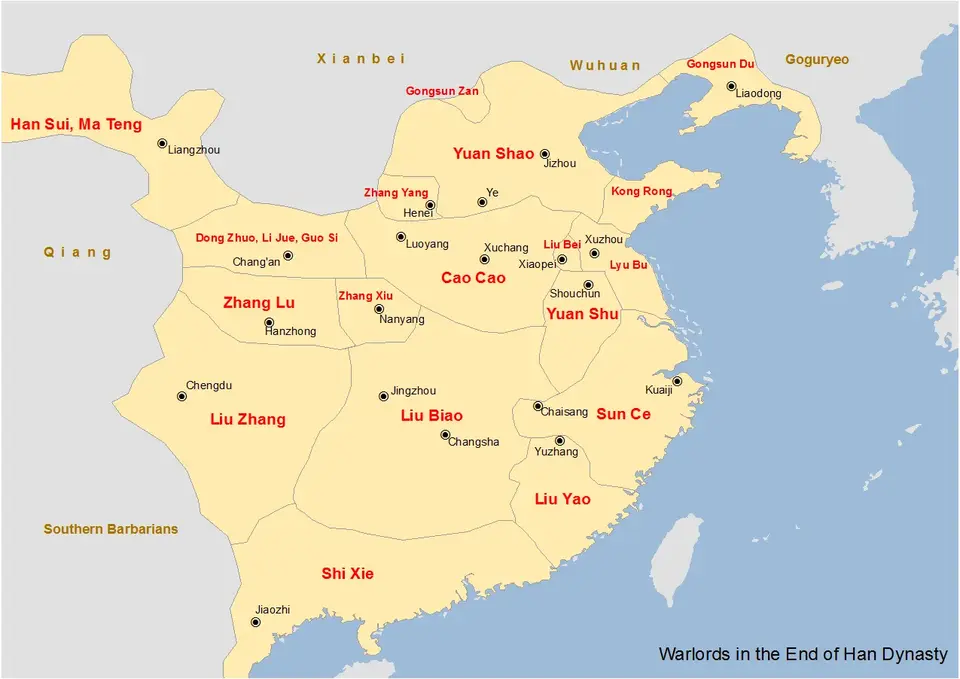
In 194 CE, the Han court issued an imperial edict appointing Liu Yao as Inspector of Yangzhou. The official provincial capital of Yangzhou was located at Shouchun, north of the Yangtze River. However, Shouchun was firmly occupied by the warlord Yuan Shu, who possessed a formidable private army and harbored transparent ambitions of imperial usurpation. Recognizing that entering Shouchun would result in his immediate subjugation or murder, Liu Yao decided to cross the Yangtze southward to establish an independent provincial administration.
At that time, Yuan Shu's subordinates Wu Jing (maternal uncle to Sun Ce) and Sun Ben (nephew to Sun Jian) served respectively as Administrator and Commandant of Danyang Commandery. Revering Liu Yao as an imperial kinsman bearing an authentic sovereign commission, Wu Jing and Sun Ben crossed the river to escort him to Qu'a (modern Danyang, Jiangsu Province), providing him with his initial territorial foothold south of the river.
However, Yuan Shu's lawless ambitions quickly destabilized the region. Yuan Shu launched aggressive campaigns against neighboring districts and ordered Wu Jing and Sun Ce to assault Lu Kang, the loyal Governor of Lujiang. Realizing that collaborating with Yuan Shu violated imperial loyalty and would ultimately lead to his own destruction, Liu Yao severed relations. He expelled Wu Jing and Sun Ben from Danyang, driving their garrisons back across the Yangtze to Liyang.
Enraged by this defiance, Yuan Shu appointed his own client Hui Qu as rival Inspector of Yangzhou, directing Hui Qu, Wu Jing, and Sun Ben to attack Liu Yao's river crossings. Liu Yao mobilized his defenses, dispatching senior commanders Fan Neng and Yu Mi to fortify Hengjiang Ford and Zhang Ying to hold Dangli Port, locking down the southern banks of the Yangtze. For over a year, Yuan Shu's forces repeatedly assaulted the crossings but failed to break through. In recognition of his staunch defense against Yuan Shu's rebellion, the Han imperial court elevated Liu Yao to Governor of Yangzhou (Yangzhou Mu) and General Who Inspires Martial Prowess, placing tens of thousands of provincial troops under his command.
During this period, numerous scholars fleeing the turmoil of northern China crossed the river to seek sanctuary under Liu Yao. Among them was Xu Shao, the celebrated intellectual arbiter and creator of the "Monthly Critique." Liu Yao welcomed these refugee elites with open arms, sharing rations and official halls with them. Concurrently, Ze Rong, the former Chancellor of Xiapi, and Xue Li, the former Chancellor of Pengcheng, led their surviving detachments southward and joined Liu Yao as allies, acknowledging him as the supreme leader of Jiangdong. Furthermore, Liu Yao's fellow townsman from Donglai, the renowned warrior Taishi Ci, also arrived in Qu'a to offer his services.
In 195 CE, the young and audacious general Sun Ce obtained over a thousand troops from Yuan Shu and gathered several thousand volunteers along the Huai River, launching an amphibious campaign across the Yangtze.
When news of Sun Ce's offensive reached Qu'a, several advisers urged Liu Yao to appoint Taishi Ci as supreme military commander to counter Sun Ce's vanguard. However, Liu Yao was overly concerned with classical aristocratic decorum and academic reputation, remarking: "If I appoint Taishi Ci to supreme military command, intellectual arbiters like Xu Zijiang (Xu Shao) will ridicule my judgment!" Consequently, he relegated Taishi Ci to minor reconnaissance duties. During a reconnaissance mission on Shenting Ridge, Taishi Ci encountered Sun Ce in single combat, resulting in a legendary duel that ended in a tactical draw.
Shortly thereafter, Sun Ce's veteran shock troops mounted a ferocious coordinated assault, overwhelming the defenses at Hengjiang, forcing the crossing at Dangli, and routing the entrenched forces of Zhang Ying, Xue Li, and Ze Rong. Liu Yao's armies crumbled under the onslaught, and Qu'a was captured. Unable to withstand Sun Ce's momentum, Liu Yao abandoned the capital and fled southward to Dantu.
At Dantu, Liu Yao contemplated sailing toward Kuaiji Commandery to seek shelter under Administrator Wang Lang. Xu Shao immediately intervened, warning: "Kuaiji is affluent and densely populated, making it Sun Ce's primary strategic objective. Moreover, it is isolated against the eastern sea, offering no strategic depth. It would be far wiser to advance upriver into Yuzhang Commandery. Yuzhang connects northward to Yuzhou and borders Liu Biao's Jingzhou to the west. If we establish ourselves there, recruit the local gentry, and dispatch tribute missions to the Han emperor, we can forge defensive alliances with Cao Cao and Liu Biao. Though Yuan Shu lies between us, he is merely a rapacious wolf who cannot endure. Holding an authentic imperial commission, you will surely receive aid from Cao Cao and Liu Biao!"
Persuaded by Xu Shao's geopolitical counsel, Liu Yao abandoned plans for Kuaiji and marched his remaining forces up the Yangtze into Yuzhang Commandery (modern Nanchang, Jiangxi Province), establishing his headquarters at Pengze. Meanwhile, Taishi Ci retreated into the hills of Wuhu, where he was subsequently captured and recruited by Sun Ce.
Upon arriving in Yuzhang, Liu Yao found the commandery consumed by a violent succession conflict. Following the death of the previous administrator, Zhou Shu, local warlords backed Zhuge Xuan (paternal uncle to Zhuge Liang and Zhuge Jin) as administrator in Nanchang. However, the imperial court had officially commissioned Zhu Hao, the son of the famous general Zhu Jun, to govern Yuzhang.
Unable to assume his post against Zhuge Xuan's garrison, Zhu Hao appealed to Governor Liu Yao for military intervention. Stationed at Pengze, Liu Yao dispatched troops under Ze Rong to support Zhu Hao's advance. Confronted by imperial forces, Zhuge Xuan abandoned Nanchang and retreated to Xicheng, allowing Zhu Hao to assume control of the commandery.
Before the campaign, Xu Shao had cautioned Liu Yao: "Ze Rong possesses neither honor nor moral restraint, while Zhu Hao is trusting and guileless. You must warn Zhu Hao to guard against Ze Rong." Xu Shao's prediction was realized with tragic precision. Shortly after entering Nanchang, Ze Rong assassinated Zhu Hao during a banquet, seizing control of the commandery for himself.
Furious at this treacherous betrayal, Liu Yao mobilized his main army from Pengze to avenge Zhu Hao. Although his initial assault was repulsed by Ze Rong's barricades, Liu Yao rallied militia from neighboring counties, launched a devastating counter-offensive, and completely shattered Ze Rong's army. Ze Rong fled into the deep mountains, where local tribesmen tracked him down, executed him, and delivered his severed head to Liu Yao. In the first month of 197 CE, rebellious villagers in Xicheng executed Zhuge Xuan and sent his head to Liu Yao, bringing total pacification to Yuzhang.
However, years of continuous military campaigns, geographic displacement, and chronic emotional strain had shattered Liu Yao's health. In 197 CE, Liu Yao succumbed to severe illness in his Yuzhang headquarters, dying at the age of forty-two.
Following Liu Yao's death, his surviving army of over ten thousand soldiers and civilian dependents found themselves without leadership. When they sought to proclaim Administrator Hua Xin as their supreme commander, Hua Xin declined out of loyalty to imperial protocol. Later, as Sun Ce returned from campaigning against Huang Zu in Jiangxia, Taishi Ci was dispatched to pacify Liu Yao's former retainers, who readily submitted. Remembering Liu Yao's status as an imperial kinsman, Sun Ce personally arranged a dignified funeral, transported his coffin for burial in Dantu, and provided generous allowances to his family. Liu Yao's eldest son, Liu Ji, later rose to become Minister of Finance and Chamberlain for the Palace Revenues in Eastern Wu, earning deep respect from Sun Quan.
Chen Shou recorded in the Records of the Three Kingdoms (Sanguozhi, Biography of Liu Yao): "Liu Yao cultivated an illustrious moral reputation and delighted in evaluating human character. Yet in times of widespread chaos, holding thousands of leagues of territory was not his true strength."
Zhuge Liang observed in the Later Memorial on Deploying the Army (Hou Chushi Biao): "Liu Yao and Wang Lang held their respective commanderies and provinces. In debating safety and calculating strategy, they constantly cited the ancient sages; yet their bellies were filled with doubts and their minds choked with hesitations. Refraining from war this year and withholding campaigns the next, they allowed Sun Ce to wax mighty until he consolidated Jiangdong."
The modern historian Tian Yuqing noted in Probing Qin, Han, Wei, and Jin History: "Liu Yao was not inherently suited for frontier warlordism. In Jiangdong, he lacked both grand strategic blueprints and formidable military foundations. His presence as a Confucian regional administrator was primarily an imperial symbol of Han moral civilization and dynastic orthodoxy; under the total collapse of the late Han empire, his tragic failure was unavoidable."
FIGURES ASSOCIATED WITH THIS DYNASTY