Birth in Hefei
Born in Taipingji, Anhui, and received early traditional and martial education in his grandfather's military camps.
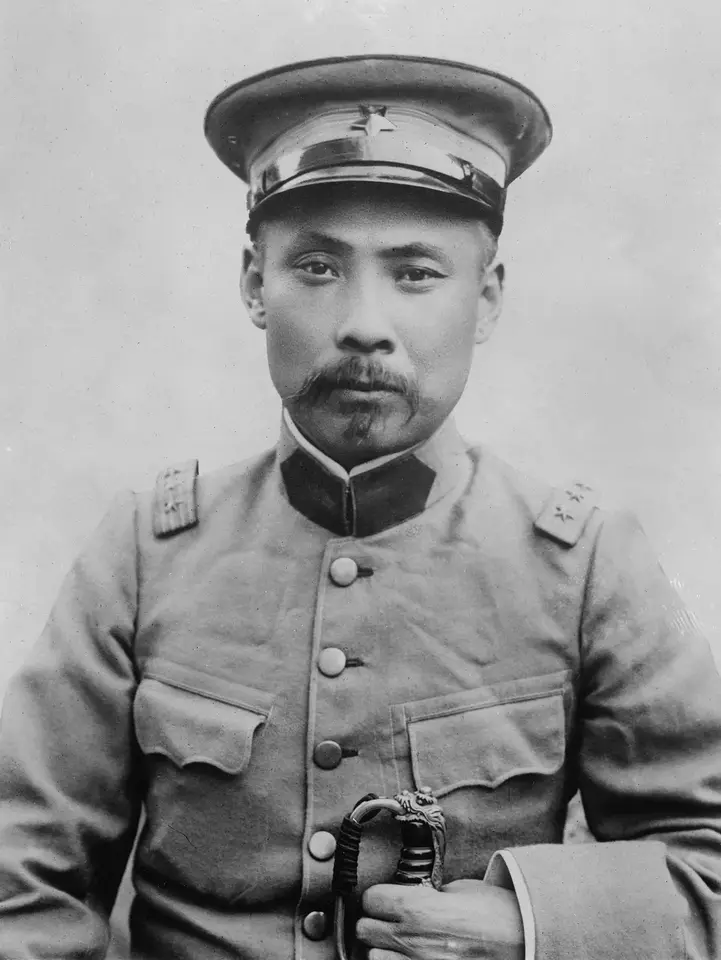
段祺瑞
Duan Qirui (段祺瑞, March 6, 1865 – November 2, 1936), original name Qirui, courtesy name Zhiquan, late pseudonym Zhengdao Jushi, was a native of Hefei, Anhui Province. He was a prominent statesman and military commander in late Qing and early Republican China, the supreme leader of the Anhui Clique (Wan faction) of the Beiyang warlords, and one of the illustrious "Three Heroes of Beiyang" alongside Wang Shizhen and Feng…
Duan Qirui (段祺瑞, March 6, 1865 – November 2, 1936), original name Qirui, courtesy name Zhiquan, late pseudonym Zhengdao Jushi, was a native of Hefei, Anhui Province. He was a prominent statesman and military commander in late Qing and early Republican China, the supreme leader of the Anhui Clique (Wan faction) of the Beiyang warlords, and one of the illustrious "Three Heroes of Beiyang" alongside Wang Shizhen and Feng Guozhang, famously designated the "Tiger of Beiyang." Duan graduated from the Tianjin Beiyang Military Academy and was subsequently selected to study military engineering and modern artillery technology at the Berlin Military Academy and the Krupp Munitions Works in Imperial Germany. Upon his return to China, he assisted Yuan Shikai in drilling the New Army at Xiaozhan and supervised the Military Officers' Retinue Academy, laying the structural foundation for modern Chinese artillery tactics and military education. In the late Qing period, he held key commands including Director of the Military Orders Department of the Commission for Army Reorganization, Commander of the Sixth Division, and Commander-in-Chief of Jiangbei. During the 1912 Xinhai Revolution, commanding the front-line forces of the Qing Empire, he recognized the inexorable trend of history and led forty-six Beiyang generals in telegraphing the imperial court to advocate a republican constitution, compelling the Qing emperor to abdicate peacefully and terminating over two millennia of imperial monarchy. Following the birth of the Republic of China, Duan served as Minister of the Army and repeatedly held the office of Premier of the State Council. When Yuan Shikai attempted to restore the monarchy during the Hongxian Emperor crisis, Duan adamantly opposed imperial ambitions, resigned his portfolios, and went into seclusion. Upon the collapse of the monarchy, he stepped forward to stabilize the central government. In 1917, he organized the Anti-Rebel Army at Machang, swiftly crushed Zhang Xun's monarchical restoration, welcomed President Li Yuanhong back to office, and led China into World War I by declaring war on Germany and Austria-Hungary. This decisive strategic move mobilized over a hundred thousand Chinese laborers to the Western Front and secured China a seat among the victorious Allied powers. Concurrently, capitalizing on the Russian Revolution, he directed troops to recover sovereignty over Outer Mongolia. However, his aggressive push for "unification by military force" triggered the Zhili-Anhui War and protracted political turmoil. In 1924, following the Second Zhili-Fengtian War, Duan was chosen by rival factions as Provisional Chief Executive of the Republic of China, attempting to reconcile regional warlords and convene a national rehabilitation conference. In March 1926, public demonstrations outside his headquarters culminated in the March 18 Massacre; faced with fierce condemnation, he soon resigned and retired to Tianjin and later Shanghai, embracing Buddhism and a vegetarian lifestyle while supporting Chinese go masters such as Go Seigen. Following the 1931 Mukden Incident, he resolutely rejected repeated Japanese overtures to lead puppet regimes in North China, moving south to Shanghai to endorse the national resistance. He died in Shanghai in November 1936 and was accorded a state funeral by the National Government.
Born in Taipingji, Anhui, and received early traditional and martial education in his grandfather's military camps.
Enrolled in the artillery division of the Tianjin Beiyang Military Academy founded by Li Hongzhang, graduating with high distinction.
Selected as the top-ranking cadet to study modern military doctrine in Berlin and complete field apprenticeships at Krupp Artillery Works.
Appointed official of the Beiyang Ordnance Bureau and instructor at Weihai Military Academy, training modern artillery personnel for five years.
Commissioned by Yuan Shikai as Artillery Commander of the Newly Created Army and Director of the Military Academy.
Promoted to Director of the Military Orders Department of the Commission for Army Reorganization, structuring modern standing army codes.
Commanded the Qing Second Army and headed the joint telegram of Beiyang commanders demanding imperial abdication in favor of a republic.
Appointed Minister of the Army in the first cabinet of the Republic of China, periodically serving as Acting Premier.
Resolutely opposed Yuan Shikai's imperial restoration, resigning all posts; returned as Premier after the abolition of the Hongxian regime.
Marshaled the Anti-Rebel Army at Machang to extinguish the Zhang Xun monarchical restoration, subsequently declaring war against Germany and Austria-Hungary.
Clashed with the Zhili Clique under Cao Kun and Wu Peifu; following defeat, resigned all offices and retired to the Tianjin concessions.
Elevated to Provisional Chief Executive of the Republic of China following Feng Yuxiang's Beijing Coup, convening national rehabilitation talks.
Stepped down after the March 18 Massacre and subsequent warlord upheavals, withdrawing to private life in Tianjin and Shanghai.
Accepted the invitation of the National Government to relocate from Tianjin to Shanghai, publicly spurning Japanese puppet collaboration.
Passed away at Hong'en Hospital in Shanghai at the age of 71; honored with state funeral rites by the National Government.
Duan Qirui was born on March 6, 1865 (the ninth day of the second lunar month in the fourth year of the Tongzhi reign) in Taipingji, Liu'an County, Anhui Province. In 1870, his father Duan Congwen relocated the household to western Hefei. Duan's grandfather, Duan Pei, had risen from organizing local anti-Nian militias to become a prominent commander in Li Hongzhang's Huai Army. From 1872 onwards, young Duan accompanied his grandfather in army garrisons at Suqian, Jiangsu, receiving basic classical schooling and military exposure until Duan Pei passed away in 1879, after which Duan escorted the coffin back to Hefei. In 1881, at sixteen, carrying merely a single silver coin, he walked hundreds of miles to Weihai, Shandong, to join his clansman Duan Congde, serving as a company clerk and sentry officer.
In 1885, Viceroy Li Hongzhang established the Tianjin Beiyang Military Academy, the first institutional modern military academy in Imperial China. Duan took the entrance examinations and enrolled in the foundational artillery department. He demonstrated exceptional talent, combining deep mastery of tactical maneuvers with western mathematics and ballistics. In 1887, he graduated at the head of his class and was assigned to oversee coastal defense fortress construction and heavy Krupp gun installations in Lushunkou (Port Arthur).
In late 1888, Li Hongzhang organized competitive examinations among top academy graduates for overseas government-sponsored study in Europe. Duan placed first. Arriving in Berlin in the spring of 1889, he enrolled in the Prussian military officer curriculum, mastering advanced continental tactical doctrine. Recognizing his promise, Li Hongzhang granted special approval for him to spend an additional six months interned at the Essen Krupp Works, where Duan worked directly in heavy foundries and ordnance testing ranges, mastering the mechanical metallurgy, rifling, and ballistics of state-of-the-art artillery.
Returning to China in autumn 1890, Duan was appointed an inspector of the Beiyang Ordnance Bureau. In 1891, he was assigned to the Weihai Military Academy as Chief Artillery Instructor, a post he held for five years until the base was overrun during the First Sino-Japanese War. Early in 1896, Yuan Shikai received imperial orders to train the Newly Created Army (Xinjian Lujun) at Xiaozhan near Tianjin and actively recruited professionally trained modern officers. Recommended for his European credentials, Duan was appointed Artillery Battalion Commander and Director of the Camp Military Academy.
At Xiaozhan, Duan implemented Prussian drill regulations, integrated advanced Krupp field artillery into combined-arms units, and trained China's earliest modern artillery corps. His technical proficiency and iron discipline won Yuan Shikai's deep confidence. In 1899, Duan accompanied Yuan to Shandong to suppress the Boxer uprisings, continuing to supervise both artillery forces and cadet instruction.
In autumn 1900, the German Governor of Jiaozhou observed the maneuvers of the Right Division in Shandong and marveled at their modern tactics and discipline, hailing Wang Shizhen, Duan Qirui, and Feng Guozhang as the "Three Heroes of Beiyang." Popular parlance subsequently designated Duan the "Tiger of Beiyang." In late 1901, Yuan Shikai rose to Viceroy of Zhili, bringing Duan to Baoding to superintend the Baoding Military Cadets Academy. When the central court established the Commission for Army Reorganization (Lianbingchu) in Beijing in late 1903, Duan was promoted to Director of Military Orders with the rank of Deputy Lieutenant-General, serving as Yuan's chief architect in standardizing modern division formations, officer examinations, and logistical codes across China. He subsequently commanded the Third and Sixth Army Divisions, and in late 1910 became Commander-in-Chief of Jiangbei.
When the Wuchang Uprising erupted in October 1911, southern provinces rapidly proclaimed independence, plunging the Qing court into crisis. The imperial government summoned Yuan Shikai as Prime Minister and placed Duan in command of the First Army (later the Second Army) to march into Hubei. In ferocious battles around Hankou and Hanyang, Duan demonstrated tactical capability; however, as peace negotiations commenced between North and South, Duan recognized that preserving monarchical despotism was futile against popular aspirations for a democratic republic.
On January 26, 1912, with Yuan Shikai's tacit assent, Duan headed a historic joint telegram signed by forty-six senior Beiyang generals addressed to the imperial cabinet and Grand Council, explicitly advocating the adoption of a republican form of government. The memorial warned that obstinate resistance would invite civil devastation and foreign partition, urging the imperial court to bow to the popular will. A second urgent appeal followed on February 3, demanding immediate proclamation of the Republic.
This unified ultimatum from the military high command shattered the resolve of Empress Dowager Longyu and conservative imperial princes. On February 12, 1912, the Qing court issued the imperial abdication edict, bringing an end to 267 years of Qing rule and over two millennia of monarchical autocracy. Duan's decisive intervention secured a bloodless transition and averted protracted nationwide conflict.
With the inauguration of the Republic of China, Duan was appointed Minister of the Army in Tang Shaoyi's premier cabinet in March 1912. Over the following years, he labored to centralize military administration, reform pay and logistical systems, and periodically served as Acting Premier of the State Council. In 1913, when the Second Revolution erupted, Duan coordinated military operations to swiftly defeat opposing Kuomintang forces, cementing central authority.
However, as Yuan Shikai's autocratic ambitions escalated toward restoring the throne, relations between the two deteriorated. Yuan resented Duan's tight institutional hold over the army and in May 1914 established the Military and Naval High Command Office under his personal direction, systematically bypassing Duan. Indignant at this usurpation of constitutional military authority, Duan requested sick leave and retreated to the Western Hills.
During the monarchical agitation of 1915, Yuan and his emissaries repeatedly offered Duan princely titles and hereditary honors in exchange for endorsing the throne. Duan unswervingly rejected these enticements, warning Yuan directly that monarchical restoration violated republican fundamentals and would provoke national fury. Throughout the imperial campaign, Duan maintained strict non-cooperation, refusing to sign petitions or attend court ceremonies. When the National Protection War erupted and Yuan was forced to annul the monarchy in March 1916, Yuan was compelled to summon Duan back as Secretary of State and Minister of the Army to salvage the situation. Following Yuan's death in June 1916, Li Yuanhong assumed the presidency, while Duan took office as Premier of the State Council, consolidating Anhui Clique dominance over the capital.
Following Yuan's death, the Beiyang military split into two major factions: the Anhui Clique led by Duan and the Zhili Clique led by Vice President Feng Guozhang. Duan, convinced of his status as the rightful heir to Beiyang leadership, clashed sharply with President Li Yuanhong over constitutional authority, cabinet appointments, and diplomatic policy, a contest known as the "Cabinet-Presidency Feud."
In early 1917, as World War I intensified, Duan championed severing relations with Imperial Germany and joining the Allied powers, calculating that war loans would finance modern army expansion. Li Yuanhong and parliamentary leaders resisted entry. In May 1917, Duan mobilized provincial military governors (the Tuchun league) to pressure parliament, prompting Li to dismiss Duan as Premier on May 23. Refusing to accept the dismissal decree, Duan relocated to Tianjin and rallied provincial warlords to renounce allegiance to Li.
Exploiting the impasse, royalist warlord Zhang Xun entered Beijing under the pretext of mediation, and on July 1 proclaimed the restoration of the boy-emperor Puyi, dissolving parliament and ousting Li. In response, Duan organized the Anti-Rebel Army (Taoni Jun) at Machang near Tianjin on July 3, assuming supreme command. His modernized forces marched swiftly on Beijing, routed Zhang Xun's "braided soldiers" at Fengtai, and breached the Forbidden City. Zhang Xun fled to the Dutch legation, and the monarchical restoration collapsed within twelve days. Welcomed back as the "Triple Restorer of the Republic," Duan reassumed the premiership, with Feng Guozhang serving as Acting President.
Refusing to reinstate the old parliament or the 1912 Provisional Constitution, Duan established the Anfu Club to orchestrate elections for a new assembly and backed Xu Shichang for president. In southern China, Sun Yat-sen launched the Constitutional Protection Movement in Guangzhou, initiating North-South hostilities. Duan adopted an aggressive policy of "unification by military force."
To finance campaigns and develop a dedicated force, Duan's cabinet negotiated extensive financial packages with Japan through Nishihara Kamezo between 1917 and 1918, securing over 140 million yen known as the "Nishihara Loans." With these funds, Duan imported advanced weaponry and organized four elite divisions of the "War Participation Army" (later Frontier Defense Army). On August 14, 1917, Duan officially declared war on Germany and Austria-Hungary, deploying over 140,000 Chinese non-combatant laborers to the European front lines. This engagement successfully terminated German and Austro-Hungarian extraterritorial privileges, halted Boxer Indemnity payments, and positioned China as a victorious Allied power.
Simultaneously, taking advantage of the turmoil following the October Revolution in Russia, Duan appointed his chief strategist Xu Shuzheng as High Commissioner for Northwestern Frontier Defense. In late 1919, Xu led expeditionary forces into Outer Mongolia, compelling the Bogd Khan and local nobility to renounce independence and restoring Chinese sovereignty over Outer Mongolia and Tannu Uriankhai.
However, the secret concessions associated with Japanese loans were exposed during the 1919 Paris Peace Conference, triggering the May Fourth Movement across China. Widespread public outrage discredited the Anfu administration. Simultaneously, Zhili generals Cao Kun and Wu Peifu opposed Anhui monopoly over state affairs. In July 1920, the Zhili-Anhui War erupted near Beijing and Tianjin; the Anhui forces were swiftly routed by the combined strength of Zhili and Zhang Zuolin's Fengtian forces. Duan was forced to resign all military and civil offices, seeking refuge in the Japanese concession in Tianjin.
During his four years of quietude in Tianjin, Duan devoted himself to Buddhism and go, while remaining a pivotal political arbiter. In autumn 1924, during the Second Zhili-Fengtian War, Feng Yuxiang executed the Beijing Coup, toppled the Zhili regime of Cao Kun, and joined Zhang Zuolin in inviting Duan to assume national leadership.
On November 24, 1924, Duan assumed office in Beijing as Provisional Chief Executive (Linshi Zhizheng) of the Republic of China, assuming combined civil and supreme military commands. He issued declarations for national pacification, invited Sun Yat-sen to Beijing to deliberate constitutional reorganization, and convened the National Rehabilitation Conference in 1925. However, Sun's untimely death in March 1925 and intensifying factional rivalries between Feng Yuxiang and Zhang Zuolin undermined administrative stability.
In March 1926, international gunboats bombarded Chinese defenses at Dagu, prompting foreign ministers to issue an ultimatum. On March 18, 1926, thousands of students and citizens organized demonstrations in front of Duan's headquarters at Tieshizi Hutong. Guards fired upon the unarmed crowd, killing forty-seven individuals in the tragic March 18 Massacre. Although Duan was not in the compound and did not issue the order, he accepted political responsibility as head of state. As allied Zhili-Fengtian armies advanced toward the capital, Feng's forces besieged the executive palace. Duan escaped to the Legation Quarter and in April 1926 announced his absolute retirement from politics, returning to Tianjin.
Following his withdrawal from political life, Duan resided at his Shoujie mansion in the Japanese concession of Tianjin. Adopting the Buddhist style "Zhengdao Jushi," he observed strict daily vegetarianism and meditation. A passionate go patron, he funded lodging and stipends for rising prodigies, providing critical patronage that enabled the young Wu Qingyuan (Go Seigen) to rise to global mastery. Throughout his administrative career, Duan strictly abstained from accumulating private properties or graft, leaving him in modest financial circumstances supported primarily by former disciples and government stipends.
Following the September 18 Incident in 1931, Japanese forces occupied Manchuria and sought to engineer a puppet autonomy movement across northern China. Kenji Doihara, chief of the Kwantung Army's special service, repeatedly called upon Duan at his Tianjin residence, attempting to lure him into heading a collaborative northern regime. Duan steadfastly refused all Japanese entreaties.
To decisively sever contact with Japanese intrigue, Duan accepted Chiang Kai-shek's invitation in January 1933 and secretly relocated south to Shanghai. Upon arrival, he publicly declared his unwavering support for the National Government and called upon all Chinese to unite in resisting foreign aggression. His refusal to collaborate was widely celebrated across China. In October 1936, his chronic gastric ulcer deteriorated, culminating in severe hemorrhage. On his deathbed, he dictated his famous final political testament to the National Government, warning against internal factionalism, impractical ideological extremism, and the abandonment of foundational cultural identity.
On the evening of November 2, 1936, Duan passed away at Hong'en Hospital in Shanghai at the age of 71. The National Government issued a mandate honoring his contributions, commissioning Lin Sen, Chiang Kai-shek, and senior officials to conduct solemn state memorial services in Beijing.
Duan Qirui was among China's earliest modern military officers educated in Western scientific tactics and artillery ballistics. During his tenure at Krupp and later at Xiaozhan, he translated German drill manuals, established unified artillery inspection procedures, and introduced comprehensive staff planning. At the Commission for Army Reorganization, he drafted foundational statutes governing divisional structures, ranks, and operational doctrines, laying the groundwork for China's transition from traditional green-standard banners to modern professional standing armies.
At the climax of the 1911 Revolution, Duan leveraged his command of the Northern armies to endorse the Republican cause. His historic telegram forced the Qing court into a negotiated abdication, averting catastrophic civil war and securing a peaceful political transition. Later, when Yuan Shikai attempted to re-establish the monarchy in 1915, Duan stood firm in defense of republican principles, sacrificing rank and honors to oppose the Hongxian regime, demonstrating exceptional political conviction.
In 1917, Duan led the Anti-Rebel Army from Machang to crush Zhang Xun's monarchical restoration within two weeks, restoring republican governance. Subsequently, he overcame domestic resistance to declare war on Germany and Austria-Hungary. This strategic decision cancelled unequal treaties with Central Powers, suspended indemnity payments, and earned China a legitimate standing among the victorious Allied nations at the Paris Peace Conference.
Capitalizing on the instability following the Russian Revolution, Duan orchestrated the deployment of frontier defense units to Outer Mongolia in 1919, successfully annulling Russian-backed separatist declarations and restoring Chinese jurisdiction over Urga and Tannu Uriankhai. In his twilight years, living amidst the Japanese concession during imperialist aggression, he stood incorruptible against enemy inducements, migrating south to advocate national defense, personifying steadfast patriotic integrity.
FIGURES ASSOCIATED WITH THIS DYNASTY