Born in Tongzhou
Born on the 11th day of the 3rd lunar month into an aristocratic Manchu family; adopted by his uncle Guiqing, an Imperial Household minister.
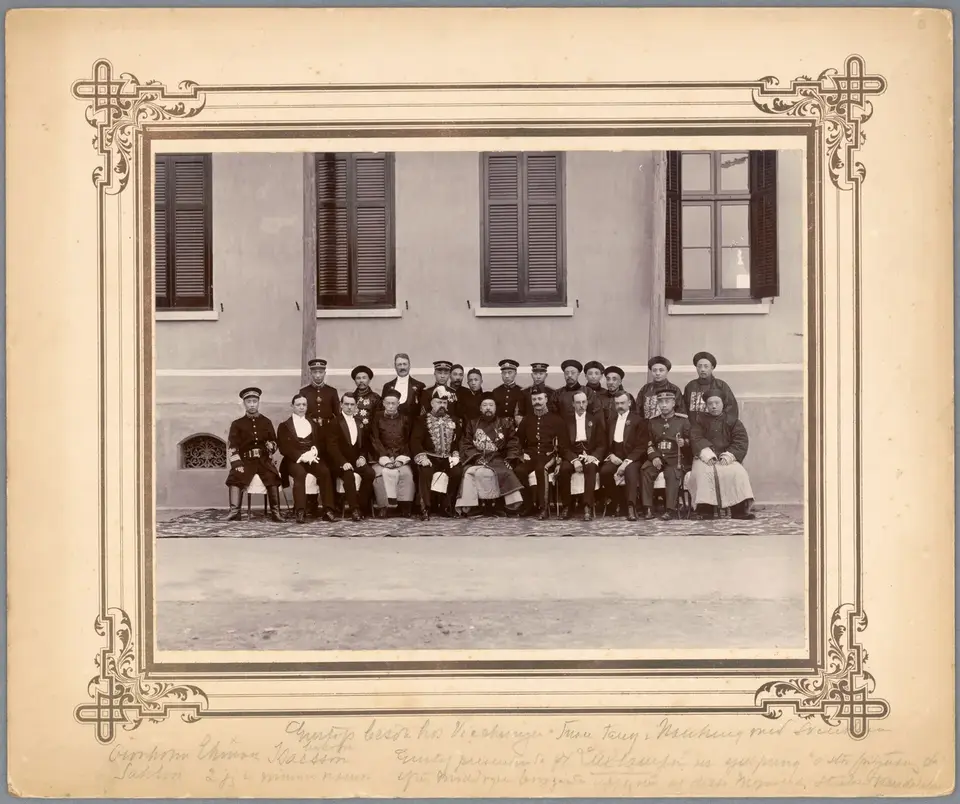
端方
Duanfang (端方, April 20, 1861 – November 27, 1911), courtesy name Wuqiao (午桥), art name Taozhai (匋斋), belonging to the Totoke clan of the Plain White Banner of the Manchu Banners, was an eminent statesman, administrative reformer, art connoisseur, and epigrapher of the late Qing dynasty. Entering officialdom through hereditary privilege, Duanfang was appointed superintendent of the Bureau of Agriculture, Industry, and Commerce…
Duanfang (端方, April 20, 1861 – November 27, 1911), courtesy name Wuqiao (午桥), art name Taozhai (匋斋), belonging to the Totoke clan of the Plain White Banner of the Manchu Banners, was an eminent statesman, administrative reformer, art connoisseur, and epigrapher of the late Qing dynasty. Entering officialdom through hereditary privilege, Duanfang was appointed superintendent of the Bureau of Agriculture, Industry, and Commerce during the Hundred Days' Reform of 1898. Following the conservative coup, he served as Provincial Administration Commissioner and Governor of Shaanxi. During the 1900 Boxer crisis, his meticulous provisioning of the fleeing imperial court in Xi'an earned Empress Dowager Cixi's enduring trust, leading to successive appointments as Governor of Hubei, Governor of Jiangsu, and Viceroy of Liangjiang. In 1905, Duanfang was commissioned as a leading envoy of the Imperial Five Commissioners dispatched to study constitutional governance across twelve nations, including the United States, Britain, Germany, and Japan. Upon returning, he submitted the seminal treatise Essential Principles of European and American Governance, serving as the foremost court champion of constitutional monarchy, legal reform, and ministerial reorganization. As Viceroy of Liangjiang, he founded Jinan Academy (modern Jinan University) and the Jiangnan Library (modern Nanjing Library), while pioneering municipal police and modern schooling. In 1911, while leading Hubei New Army units into Sichuan as Director-General of the Canton-Hankow-Sichuan Railway to resolve the Railway Protection Movement, he was murdered by mutinous troops at Zizhou following the outbreak of the Wuchang Uprising, at the age of fifty-one. Posthumously honored as Grand Guardian of the Heir Apparent with the name "Zhongmin", he was equally renowned as a master of ancient bronze epigraphy, authoring Taozhai's Record of Auspicious Metals.
Born on the 11th day of the 3rd lunar month into an aristocratic Manchu family; adopted by his uncle Guiqing, an Imperial Household minister.
Passed the provincial examinations and appointed assistant department director in the Ministry of Works.
Recommended by Weng Tonghe and Gangyi; appointed superintendent of the Imperial Bureau of Agriculture, Industry, and Commerce.
Supervised provincial supplies and court residences for the royal entourage in Xi'an; promoted to Governor of Shaanxi.
Established Shaanxi University, organized modern military academies, and pacified provincial banditry.
Served as Governor of Hubei and Acting Viceroy of Liangjiang; collaborated with Zhang Zhidong in organizing modern armies and schools.
Commissioned as leading plenipotentiary for the Five Commissioners Overseas Mission, surviving an assassination attempt by Wu Yue.
Returned to China and presented Essential Principles of European and American Governance; founded Jinan Academy and the Jiangnan Library.
Elevated to Viceroy of Zhili; dismissed from office following conservative accusations of filming Empress Dowager Cixi's funeral.
Reinstated as Imperial Commissioner for the Canton-Hankow-Sichuan Railway to suppress the Sichuan Railway Protection Movement.
Slain by mutinous Hubei troops at Zizhou on November 27 during the Xinhai Revolution at age fifty-one; posthumously named "Zhongmin".
Duanfang was born on April 20, 1861, in Tongzhou, Shuntian Prefecture, near Beijing. He belonged to the Totoke clan of the Plain White Banner of the Manchu Banners. His uncle and adoptive father, Guiqing, served as Minister of the Imperial Household Department and Lieutenant-General of the Bordered Red Mongol Banner, wielding vast influence in court circles. Under elite aristocratic instruction, Duanfang mastered classical Manchu and Chinese, while developing an insatiable passion for ancient bronze inscriptions, steles, and archaeological artifacts.
In 1882, Duanfang passed the Shuntian provincial examinations as a juren. In 1889, at twenty-eight, he was appointed assistant department director in the Ministry of Works, serving in the imperial palace repair division. In this capacity, he demonstrated meticulous administrative precision and fiscal clarity, winning the praise of Prince Chun (Yixuan) and senior ministers.
In early 1898, as the Guangxu Emperor prepared his modernizing reforms, Imperial Tutor Weng Tonghe and Grand Councillor Gangyi submitted a joint memorial commending Duanfang's practical administrative competence. The emperor granted him a personal audience, where Duanfang articulated lucid plans for agricultural bureaus, mining corporations, and railway networks. When the Hundred Days' Reform commenced, the emperor appointed Duanfang superintendent of the newly created Bureau of Agriculture, Industry, and Commerce, placing him at the helm of national economic modernization.
Following Empress Dowager Cixi's conservative coup in September 1898, Duanfang escaped execution through the protection of Grand Councillor Ronglu and his own political tact, composing loyalist hymns to reassure the throne. He was transferred outward as Judicial Commissioner and subsequently Administration Commissioner of Shaanxi.
In the summer of 1900, the Boxer uprising and Eight-Nation Alliance invasion drove Empress Dowager Cixi and the Guangxu Emperor to flee to Xi'an. Confronting an imperial entourage on the brink of starvation, Duanfang marshaled provincial granaries, renovated royal palaces in Xi'an, and established strict encampment security. His flawless organization earned Cixi's profound gratitude, and he was promoted on the spot to Governor of Shaanxi.
In Shaanxi, Duanfang founded Shaanxi University—the earliest modern collegiate institution in the northwest—retained Japanese and Western instructors, created modern military academies, and resolved complex missionary indemnities with diplomatic fairness.
In 1902, Duanfang transferred to Hubei as Governor, working in close harmony with Huguang Viceroy Zhang Zhidong. Together they developed modern ironworks, technical academies, and modern infantry divisions, turning central China into an exemplary model of late Qing self-strengthening. He went on to serve as Governor of Jiangsu and Acting Viceroy of Liangjiang, establishing municipal police forces and modern primary school systems across the lower Yangtze.
In 1905, facing nationwide demands for political reform, the Qing throne selected five high officials—Zaize, Duanfang, Dai Hongci, Xu Shichang, and Shaoying—to conduct an extensive overseas investigation of constitutional governance. On September 24, as the mission prepared to depart from Beijing's Zhengyangmen railway station, revolutionary activist Wu Yue detonated an explosive in their carriage. Duanfang sustained minor shrapnel injuries, but refused to abandon the mission, urging an immediate resumption of the tour.
Reorganized with Dai Hongci, Duanfang led the delegation across twelve countries, including the United States, Britain, France, Germany, Russia, Italy, and Japan. Throughout this global tour, Duanfang met with US President Theodore Roosevelt and German Chancellor Bernhard von Bülow, exhaustively inspecting parliaments, constitutional courtrooms, municipal utilities, and university research facilities.
Upon returning to China in the autumn of 1906, Duanfang submitted the comprehensive report Essential Principles of European and American Governance, presenting dozens of memorials advocating constitutional monarchy. He warned the throne: "Implementing constitutional governance is not merely the vehicle for national wealth and power, but the sole medicine to preserve the Qing dynasty itself. Under constitutionalism the royal house is preserved; under absolutism collapse is inevitable." His forceful advocacy directly compelled Empress Dowager Cixi to issue the imperial edict proclaiming "Preparations for Constitutional Government" in September 1906.
Following his return, Duanfang was appointed Viceroy of Liangjiang, governing Jiangsu, Anhui, and Jiangxi. In this post, his achievements in education and cultural preservation reached their zenith. In 1906, recognizing that Chinese youths living across Southeast Asia suffered from colonial discrimination, Duanfang founded Jinan Academy in Nanjing, the first state collegiate institution dedicated to educating overseas Chinese students. In 1907, he purchased the celebrated Ding family library collections and established the Jiangnan Library, creating China's first provincial public library. Furthermore, he organized the historic Nanyang Industrial Exposition in 1910.
In early 1909, Duanfang was promoted to Viceroy of Zhili and Superintendent of Northern Trade. However, in November of that year, during the grand funeral ceremonies for Empress Dowager Cixi, Duanfang permitted photographers to take official pictures of the procession and installed telegraph lines that conservative censors claimed touched palace roof tiles. Reactionary Manchus seized upon this pretext to accuse him of gross irreverence, and Regent Zaifeng dismissed him from office.
In May 1911, the Qing court's decision to nationalize private trunk railways sparked the massive Railway Protection Movement across Sichuan. To quell the crisis, the throne recalled Duanfang as Imperial Commissioner for the Canton-Hankow-Sichuan Railway, ordering him to march into Sichuan with elite units from the Hubei Eighth Division.
Duanfang proceeded west, but popular insurrections severed communications across Sichuan. While stationed at Zizhou (modern Zizhong County), news arrived that the Wuchang Uprising had erupted on October 10. The Hubei troops under his command were secretly affiliated with revolutionary organizations and mutinied on November 27, 1911. Mutinous soldiers stormed his headquarters, demanding that he surrender his seal and repudiate the Qing dynasty. Duanfang refused to yield, declaring: "I hold an imperial commission to preserve peace; I cannot betray the state!" The mutineers assassinated Duanfang and his younger brother Duanjin, severing their heads and shipping them in kerosene tins to revolutionary authorities in Wuchang. Duanfang died at fifty-one. Following the fall of the dynasty, the court posthumously honored him as Grand Guardian of the Heir Apparent with the name "Zhongmin".
Duanfang was the foremost intellectual and bureaucratic architect of late Qing constitutional governance. His global inspection tour shattered imperial complacency, providing the Qing court with detailed comparative models of Western parliamentary democracy, ministerial cabinets, and judicial independence. His memorials laid the institutional blueprint for the abolition of traditional ministries, the creation of modern legal codes, and the establishment of provincial consultative assemblies.
Duanfang left two monumental cultural legacies in Nanjing. In 1906, he founded Jinan Academy (now Jinan University) under the principle of cultivating overseas Chinese youth to bind their loyalty to the homeland, inaugurating modern overseas Chinese education. In 1907, he established the Jiangnan Library (now Nanjing Library), preserving over one hundred thousand rare Song, Yuan, and Ming woodblock volumes and establishing the institutional model for Chinese modern public libraries.
Duanfang was a towering scholar in the history of Chinese epigraphy and archaeology. Over thirty years, he amassed one of the greatest private collections of Shang and Zhou bronzes, Han-Wei stone carvings, ancient coins, and Buddhist sculptures.
At his residence "Taozhai," he collaborated with scholars such as Miao Quansun to author canonical treatises including Taozhai's Record of Auspicious Metals (Taozhai Jijin Lu) and Taozhai's Record of Inscribed Stones, pioneering modern photographic and rubbings documentation for Chinese antiquities. His celebrated Shang-Zhou bronze altar set (Fanjin) is now preserved in the Metropolitan Museum of Art in New York.
FIGURES ASSOCIATED WITH THIS DYNASTY