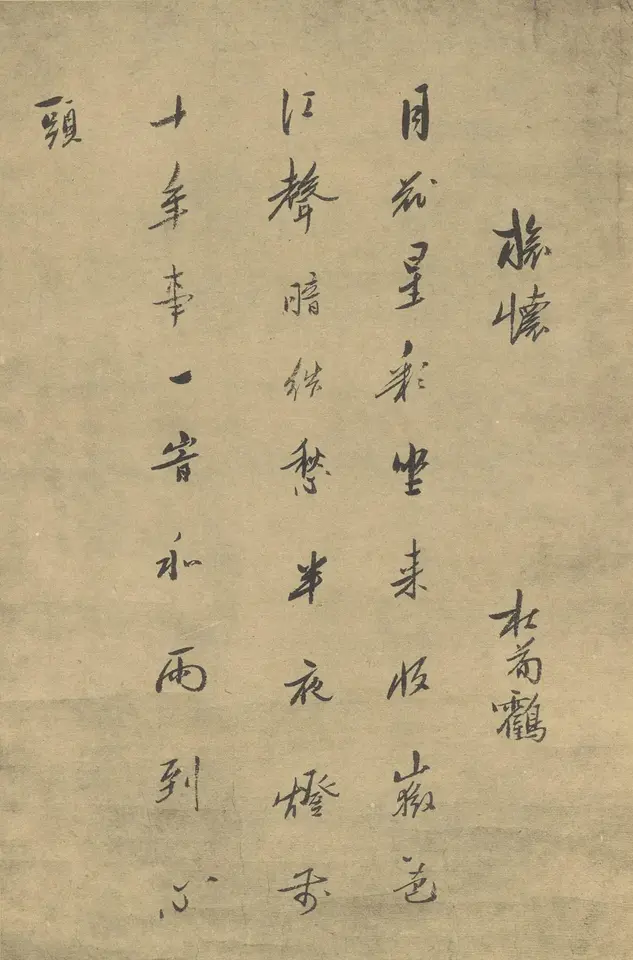
PROFILE
Du Xunhe (杜荀鹤, 846–904), courtesy name Yanzhi (彦之) and art name Hermit of Jiuhua (Jiuhua Shanren), was a native of Shidai in Chizhou (present-day Shitai, Anhui) and an outstanding realist poet of the Late Tang dynasty. Born into an impoverished scholarly family, Du studied diligently in seclusion on Mount Jiuhua in his youth. Although his literary talent was widely recognized, corruption in the examination halls and aristocratic monopolies prevented his advancement, subjecting him to decades of wandering and poverty. It was not until the second year of the Dashun era (891) during Emperor Zhaozong's reign that Du finally earned the Jinshi degree, placing eighth under Vice Minister of Rites Pei Zhi. Following his graduation, the Tang dynasty had collapsed into warlord fragmentation. Du successively served regional strongmen Tian Jun in Xuanzhou and Zhu Wen in Bianzhou. Impressed by his lucid verse, Zhu Wen recommended him to the imperial court, and Emperor Zhaozong appointed him Vice Director in the Ministry of Rites, Drafter of Decrees, and Hanlin Academician. In the first year of the Tianyou era (904), Du died of severe illness between Chang'an and Luoyang at the age of fifty-nine.
Du Xunhe was the foremost poet of social conscience and critical realism in the Late Tang. While contemporary poets retreated into aesthetic escapism or obsessive formalist craftsmanship, Du inherited the realistic traditions of Du Fu and Bai Juyi's New Music Bureau Movement, composing poetry that exposed societal corruption and championed impoverished commoners. His verse was characterized by plain, vernacular diction, swift musical momentum, and vivid dramatic tension, establishing a widely imitated aesthetic known as the "Du Xunhe Style." Masterpieces such as Widow in the Mountains, Lament of the Spring Palace, Seeing off a Friend Traveling to Wu, and Expressing Feelings in a Lodging secured his historical standing, collected in his surviving three-volume anthology Tangfeng Ji.
- Courtesy Name
- Yanzhi (彦之)
- Art Name
- Hermit of Jiuhua (Jiuhua Shanren)
- Date of Birth
- 846 (Tang Dynasty, 6th year of Huichang)
- Date of Death
- 904 (Tang Dynasty, 1st year of Tianyou)
- Age at Death
- 59
- Ancestral Home
- Shidai, Chizhou (present-day Shitai, Anhui)
- Highest Office
- Vice Director in the Ministry of Rites and Drafter of Decrees (Zhuke Yuanwailang, Zhi Zhigao)
- Identity
- Prominent Late Tang realist poet and Hanlin Academician
BIOGRAPHY
Chronology
- 846 (Tang Dynasty, 6th year of Huichang) | Humble Birth | Born into a poor family in Shidai, Chizhou, demonstrating sharp intelligence and dedication to classical learning.
- 868 (Tang Dynasty, 9th year of Xiantong) | Hermitage at Mount Jiuhua | Withdrew to deep valleys in Mount Jiuhua, building a thatched hut to study classics and poetry, styling himself Hermit of Jiuhua.
- 875 (Tang Dynasty, 2nd year of Qianfu) | Examination Frustrations | Traveled to Chang'an but failed the Jinshi examination, initiating decades of itinerant wandering across the empire.
- 888 (Tang Dynasty, 4th year of Guangqi) | Refuge in Jiangnan | Displaced by the Huang Chao rebellion and warlord warfare, wandered through the Yangtze riverlands, observing rural hardship.
- 891 (Tang Dynasty, 2nd year of Dashun) | Earning the Jinshi Degree | Passed the spring examination supervised by Pei Zhi, achieving the Jinshi degree in the eighth rank at age forty-six.
- 897 (Tang Dynasty, 4th year of Qianning) | Staff Officer in Xuanzhou | Failing to secure central court office due to humble pedigree, served as secretary in the regional administration of Tian Jun.
- 903 (Tang Dynasty, 3rd year of Tianfu) | Envoy to Bianzhou | Dispatched as envoy to Warlord Zhu Wen in Bianzhou; Zhu admired his straightforward verse and recommended him to court.
- 904 (Tang Dynasty, 1st year of Tianyou) | Hanlin Appointment and Passing | Appointed Drafter of Decrees and Hanlin Academician, falling ill and passing away in office at age fifty-nine.
Life Course
Seclusion on Mount Jiuhua and Decades of Frustration
Du Xunhe was born in the sixth year of the Huichang era (846) in Shidai, Chizhou (present-day Shitai, Anhui). His household belonged to the impoverished commoner gentry, exposing him to hardship from early childhood. Unwilling to resign himself to poverty, Du turned to academic study with extraordinary resolve. During his youth, he retreated to the secluded ravines of Mount Jiuhua, constructing a rustic hut and styling himself "Hermit of Jiuhua." For over a decade in the mountains, he studied Confucian texts, histories, and classical verse, amassing deep literary erudition.
However, during the Late Tang, the imperial examination halls were monopolized by aristocratic clans and corrupt chancellors. Commoners without patron connections rarely succeeded. From the Qianfu era onward, Du traveled north to Chang'an to sit for the exams. Over two decades, he experienced repeated rejections, entering the capital with high hopes only to leave in despair upon the posting of results. Throughout these itinerant journeys, Du traversed Shaanxi, Henan, Jiangsu, Zhejiang, and southern Anhui, witnessing the destitution of ordinary folk far more intimately than any high official.
Earning the Jinshi Degree amid Dynastic Collapse
In the second year of the Dashun era (891), Vice Minister of Rites Pei Zhi presided over the spring examinations with an aim to recruit authentic talent. Deeply impressed by Du's incisive policy essays and vigorous verse, Pei ranked him eighth among the successful Jinshi candidates. Du was forty-six years old, achieving his lifelong aspiration only after enduring decades of bitter hardship. He composed numerous reflective poems expressing the relief of graduation mingled with sorrow over wasted youth.
Yet this hard-won success yielded little political opportunity. The Tang empire was on the verge of ruin, with imperial authority shattered by warlord violence. Lacking family pedigree and refusing to flatter courtiers, Du was bypassed in ministerial postings. As famine and war engulfed Chang'an, Du left the capital once more, journeying south to seek employment as a literary secretary in regional warlord administrations.
Service under Warlords and Patronage by Zhu Wen
Returning south, Du sought patronage among regional rulers in the Huai and Yangtze river valleys. During the Qianning era of Emperor Zhaozong, Military Commissioner Tian Jun of Xuanzhou actively recruited scholars, appointing Du to his secretarial staff. Although Tian Jun was an ambitious warlord, he revered Du's poetic genius and treated him with high regard. In Xuanzhou, Du secured material stability, writing poems depicting Jiangnan landscapes while urging administrators to alleviate taxes on commoners.
In the third year of the Tianfu era (903), diplomatic tensions arose between Xuanzhou and warlord Zhu Wen in Bianzhou. Tian Jun dispatched Du as chief envoy to Bianzhou. Zhu Wen, who already wielded de facto control over the imperial court, was a ruthless military commander who nevertheless respected literati of national fame. Granting Du an audience, Zhu read his poems and admired their straightforward clarity, unmarred by academic pedantry. Zhu retained Du in his entourage and submitted an urgent memorial recommending him for high court office.
Hanlin Academician and Final Days
Backed by Zhu Wen's influence, Emperor Zhaozong issued an imperial edict in the first year of the Tianyou era (904) summoning Du to the capital as Vice Director in the Ministry of Rites, Drafter of Decrees, and Hanlin Academician. This appointment finally elevated Du to the prestigious ranks of the emperor's literary confidants. However, the Tang dynasty was on the brink of extinction, with Zhu Wen finalizing plans to depose the dynasty amid intense factional terror.
Worn down by decades of itinerant poverty and mental exhaustion, Du's physical health deteriorated rapidly. Shortly after assuming office as Hanlin Academician, he contracted a severe illness while traveling between Chang'an and Luoyang. In late 904, Du passed away in his official residence at the age of fifty-nine. Although the great realist poet was unable to halt dynastic decay, his verses remain the most honest mirror of Late Tang society.
Major Achievements
Standard-Bearer of Realism and the Du Xunhe Style
In the history of Late Tang literature, Du Xunhe was the undisputed champion of realist poetry. Amid the acute socio-political crises of the Late Tang, intellectuals frequently succumbed to escapism, producing poetry marked by narrow decadence. Writers either indulged in the fragrant eroticism of the Huajian lyric school or lost themselves in the painstaking word-polishing of the Jia Dao bitter-chanting circle. Du Xunhe broke free from these insular trends through passionate humanism and social responsibility.
Inheriting Bai Juyi's principle that literature should be composed for its time and poetry for real events, Du created the distinctive "Du Xunhe Style." This style was defined by plain, accessible language bordering on the vernacular, incisive thematic clarity, and an exceptional ability to capture dramatic snapshots of class conflict and peasant suffering. Stripping away archaic allusions and decorative ornamentation, he deployed everyday language to lay bare imperial misrule, widespread famine, and wartime devastation.
Song theorist Yan Yu explicitly categorized the "Du Xunhe Style" in Canglang Poetry Talks, noting that his verses circulated widely among common readers at the turn of the Song dynasty. Ming critic Yang Shen praised his poetry as flowing naturally without artificial carving. Du's style not only redeemed Late Tang poetry, but also blazed an aesthetic path for the unadorned realism championed by Song masters like Mei Yaochen and Su Shi.
Widow in the Mountains and Indictment of Corvee Abuses
Du's most celebrated contribution to classical Chinese realism lies in his searing denunciations of extortionate taxation and forced military labor, epitomized by his ancient-style poem Widow in the Mountains. Regarded as the Late Tang counterpart to Du Fu's Officer at Shihao, the poem reached the pinnacle of anti-tyranny literature in its ideological depth and emotional impact.
The poem starkly depicted: "My husband died on the battlefield while our child is still in my womb; though I survive, my life is as worthless as grass. The brushwood gate remains unlatched at sunrise, while the weeping of neighboring women fills the rooms. Taxation arrives urgently across layered mountain barriers; corrupt bailiffs shout and pursue us like shrieking demons. Even in the deepest recesses of the mountains, there is no way to evade forced taxes and labor." Portraying a destitute widow deep in the wilderness, Du revealed how imperial tax collectors pursued peasants even into trackless forests. The concluding lines delivered an immortal lament that exposed the ruthless exploitation inflicted upon common laborers.
Alongside Widow in the Mountains, poems such as Expressing Feelings in a Lodging, Silkworm Woman, and Meeting Village Elders after the Turmoil recorded the destitution of displaced families. Consistently adopting the perspective of impoverished laborers, Du's works attained the enduring stature of social epics.
Sublimation of Palace Grievance in Lament of the Spring Palace
Beyond broad social realism, Du achieved remarkable artistic heights in palace and boudoir grievance verse, with his seven-character quatrain Lament of the Spring Palace celebrated as an enduring masterpiece. While most Tang palace poems focused narrowly on personal melancholy, Du infused the traditional genre with incisive political allegory and social critique.
In Lament of the Spring Palace, Du penned the memorable lines: "Early on I was misled by youthful beauty; wanting to apply makeup, I feel too weary facing the mirror. Imperial favor does not depend upon physical grace; how then can I adorn my countenance? Warm breezes shatter birdsong into pieces; the high sun casts heavy flower shadows. Year after year the girls of Yue Creek remember gathering lotus blossoms together." Through delicate psychological observation, he captured the tragedy of women locked away in palace chambers, using the line "Imperial favor does not depend upon physical grace" to subtly satirize a corrupt bureaucracy where merit is ignored while sycophants flourish.
The vibrant spring scenery in the second half of the poem poignantly highlighted the inner desolation of the palace lady, while the final recollection of rural girls gathering lotus blossoms along Yue Creek contrasted palace confinement with pastoral freedom. This delicate technique of using joyous settings to evoke deep grief secured the poem's fame as an exquisite classic.
Landscapes of Jiangnan in Seeing off a Friend Traveling to Wu
Despite decades of exhausting wandering, Du harbored an enduring love for the lush waterways and vibrant customs of Jiangnan. His famous poem Seeing off a Friend Traveling to Wu remains the most widely cited and beloved depiction of Suzhou and the southern canal culture in classical Chinese literature.
In this poem, Du wrote: "When you arrive in Gusu, you will see that all houses rest pillowed against the river. In the ancient palace leisure grounds are few, while water canals and small bridges are many. Night markets sell water chestnuts and lotus roots; spring boats carry fine silks and brocades. Knowing you will gaze upon the sleepless moon from afar, your homesickness will linger in fishermen's songs." His fluid verse vividly outlined the waterlogged urban landscape of Late Tang Suzhou, where homes bordered canals, bridges spanned waterways, and night markets thrived. His phrase "all houses rest pillowed against the river" became the definitive cultural hallmark characterizing Jiangnan canal cities across subsequent centuries.
Du avoided excessive ornate language, using clean realism to blend the daily commerce of urban residents with natural river scenery, preserving an invaluable literary snapshot of southern commercial urban vitality amid dynastic decline.
Transmission of Tangfeng Ji and Historical Stature
Du compiled his surviving verse into the three-volume collection Tangfeng Ji, choosing the title from the Book of Songs to signal his dedication to the satirical and socially engaged tradition of classical folk ballads. His collection circulated extensively among literati throughout the Five Dynasties and early Song periods, exerting a profound influence upon later poetics.
Song compilations such as Taiping Guangji and Wenyuan Yinghua drew extensively from Du's works. Southern Song master Lu You praised his verse for carrying profound meaning beneath simple words. In Ming and Qing anthologies, including Gao Bing's Tangshi Pinhui and Wang Fuzhi's critical evaluations, Du was consistently honored as an essential Late Tang master. Modern literary historians recognize Du as a vital bridge linking Du Fu and Bai Juyi with the realist poetic revival of the Northern Song.
Related Figures
- Pei Zhi: Late Tang Chancellor and Vice Minister of Rites who supervised the Dashun examinations, recognizing Du's authentic talent and awarding him eighth place.
- Tian Jun: Late Tang Military Commissioner of Ningguo (Xuanzhou) who recruited Du to his administrative staff as secretary.
- Zhu Wen: Military Commissioner of Xuanwu and founder of Later Liang who admired Du's direct poetic style and recommended him for court office.
- Emperor Zhaozong of Tang: Tang emperor who formally appointed Du Vice Director in the Ministry of Rites, Drafter of Decrees, and Hanlin Academician.
- Du Mu: Celebrated Late Tang poet and clan elder whose literary achievements served as an early inspiration for Du Xunhe.
Historical Evaluations
- Yan Yu: "In the Late Tang, Du Xunhe established an independent school; his poetry was plain and accessible, known as the Du Xunhe Style, which contemporaries widely imitated." (Canglang Poetry Talks)
- Yang Shen: "Du Xunhe's words are light while his feelings run deep; flowing naturally without ornate carving, he was unique in the Late Tang. His Widow in the Mountains carries the authentic spirit of ancient music bureau verse." (Sheng'an Poetry Talks)
- Ji Yougong: "Xunhe studied diligently and possessed immense talent; eager for office, his verses frequently criticized contemporary ills, cutting straight to societal maladies in a manner unmatched by Late Tang contemporaries." (Chronicles of Tang Poetry, Volume 67)
- Lu You: "Du Yanzhi, the Hermit of Jiuhua, wrote in plain, substantial terms that touched people's inner thoughts; beneath superficial plainness lay immense emotional power." (Lao Xue An Notes)
- Ji Yun: "Tangfeng Ji is unadorned and authentic, entirely free from the delicate carving of the Late Tang; reflecting deeply upon human suffering, it firmly establishes him among the major masters of his era." (Annotated Catalog of the Siku Quanshu)
Related Entries
- Widow in the Mountains
- Lament of the Spring Palace
- Seeing off a Friend Traveling to Wu
- Tangfeng Ji
- Pei Zhi
- Zhu Wen
FIGURES ASSOCIATED WITH THIS DYNASTY