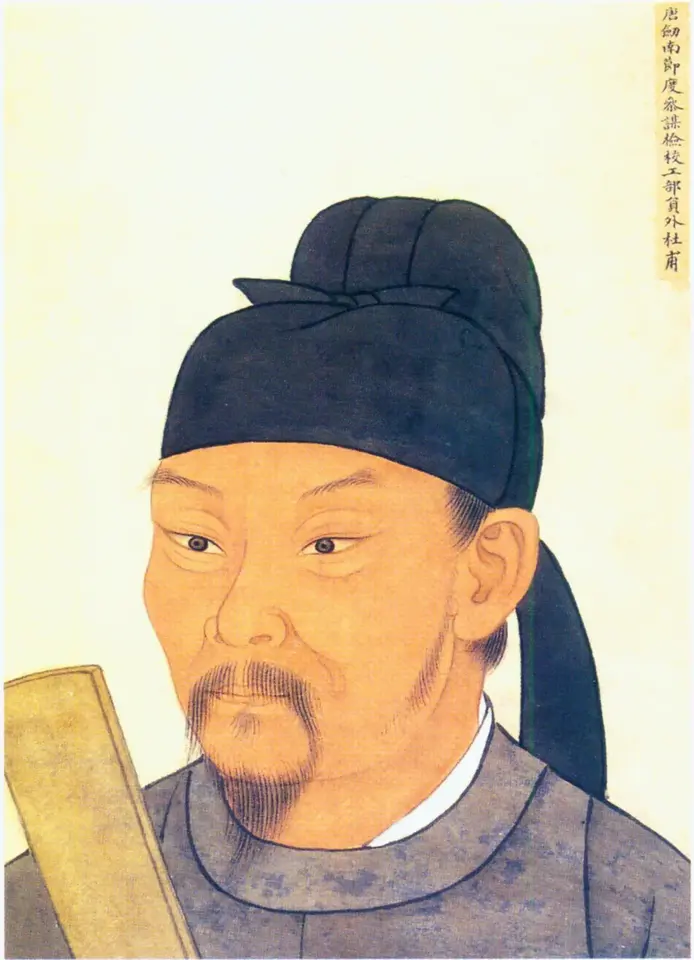
Biographical Narrative
Impartial Justice and Executing Xiao Guang
Du Shi demonstrated outstanding intellect from his youth, dedicating his talents to statecraft and practical administration. He began his official career as Merit Officer in Henei Commandery, where his discerning handling of legal disputes and unwavering impartiality earned him widespread popular acclaim. In 23 CE, when Liu Xiu opened his Grand Marshal chancellery, he recruited Du as an administrative officer.
In 25 CE, Emperor Guangwu established his capital in Luoyang. Recognized for exceptional competence, Du received three promotions within a single year, rising to Attendant Censor tasked with supervising bureaucratic discipline. At that time, the newly restored capital was crowded with arrogant military commanders and undisciplined soldiers. General Xiao Guang, relying on military merits and aristocratic patronage, permitted his troops to loot civilian markets and assault women, terrorizing Luoyang's residents. Du repeatedly cautioned Xiao to restrain his men, but the general insolently ignored the warnings.
Confronted by military arrogance, Du showed no fear. Leading judicial guards, he arrested and executed Xiao Guang on the spot. Reporting the execution immediately to Emperor Guangwu, the emperor praised him enthusiastically: "In ancient times, when the Red Eyebrows arose, rulers held swords to execute justice! Today our Attendant Censor has truly demonstrated unbending authority!" The emperor rewarded Du with ritual lances and commissioned him to tour and pacify the metropolitan region.
Pacifying Hedong and Appointment to Nanyang
In 26 CE, a military mutiny erupted in Hedong Commandery, resulting in the murder of the commandery administrator. Emperor Guangwu appointed Du as Acting General-in-Chief, granting him imperial talismans to suppress the uprising. Arriving in Hedong, Du deployed military forces against hardened ringleaders while offering lenient terms to coerced participants. Rebellion leader Yang Yi surrendered; Du executed thirty core instigators and dismissed the remaining participants to resume farming, rapidly pacifying Hedong. Subsequently, Du served as Commandant in Pei and Runan commanderies, earning stellar administrative reviews.
In 31 CE, Emperor Guangwu appointed Du Administrator of Nanyang Commandery. Known as the "imperial home," Nanyang was the ancestral birthplace of Emperor Guangwu, densely crowded with imperial relatives, founding generals, and influential aristocratic lineages. Previous administrators had frequently faltered out of fear of offending powerful families. Upon arrival, Du instituted strict administrative discipline, prosecuting lawbreaking aristocrats without hesitation, forcing powerful magnates to restrain their behavior.
Inventing the Water-Powered Bellows and Irrigation
Nanyang was not only a vital political center but also the preeminent metallurgical hub of Han China. Traditional furnace blast operations relied heavily on exhausting manual foot pedals or draft animals pulling leather bellows, which produced uneven airflow, low furnace temperatures, brittle iron farm tools, and limited output that failed to meet postwar agrarian demands.
Investigating official ironworks in Wan County, Du designed and constructed the shuipai (water-powered bellows)—a revolutionary mechanical breakthrough utilizing running water to rotate a horizontal waterwheel, converting rotary motion into reciprocating linear motion through an intricate crank-and-connecting-rod mechanism to pump furnace bellows continuously. This innovation freed thousands of laborers from brutal drudgery while providing steady, high-pressure blasts that raised furnace temperatures, drastically improving the smelting of cast iron and decarbonized steel. High-quality iron plows and agricultural implements poured forth, acclaimed across the empire: "Minimal labor expended, immense results achieved, highly convenient to the people."
Simultaneously, Du recognized that irrigation was the cornerstone of agrarian livelihood. He mobilized soldiers and commoners to restore, dredge, and expand extensive reservoir systems and water canals across Nanyang, converting arid landscapes into fertile irrigated farmland and expanding cultivated acreage by over ten thousand hectares. Agricultural yields surged, populations flourished, and grateful citizens celebrated Du alongside Western Han pioneer Zhao Xinchen, singing: "Formerly we had Father Zhao; now we have Mother Du!"
Military Talismans and Passing in Frugality
In 37 CE, observing that imperial in-laws and high generals frequently raised troops independently, Du submitted an urgent memorial asserting that ultimate military command must reside exclusively with the sovereign, recommending the complete restoration of the Western Han system of imperial golden tiger tallies (hu fu). Impressed by his strategic foresight, Emperor Guangwu immediately decreed the institutionalization of imperial tally authorizations.
Throughout his career, Du lived with monastic frugality, dedicating his salary to relieving impoverished commoners and advancing mechanical and irrigation projects. In 38 CE, exhausted by administrative labor, Du passed away in his official residence. When local clerks prepared his burial, they discovered that his quarters were completely destitute, containing no surplus silks, coins, or funds for a coffin. Deeply grieved, Emperor Guangwu decreed that the imperial government finance his funeral in Nanyang, granting one thousand bolts of fine silk to his surviving family.