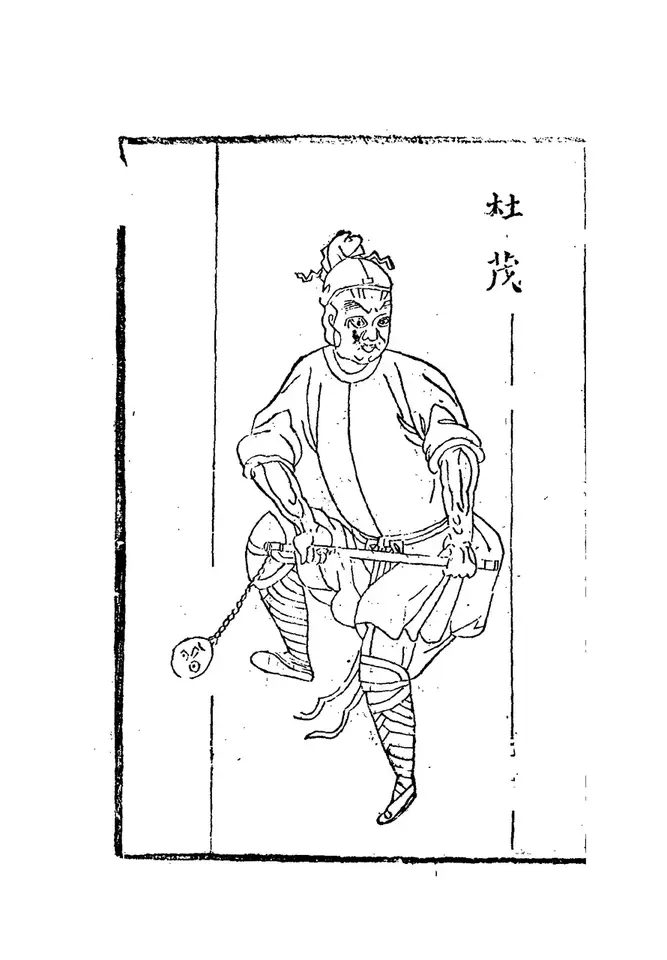
杜茂
Historical portrait of Du Mao
Image creditsUnknown authorUnknown author · Public domainImage source

Historical figure

Du Mao (杜茂)

杜茂

Du Mao (died 43 CE), courtesy name Zhugong, was a native of Guanjun in Nanyang Commandery (modern Zhangcun, Dengzhou, Henan). He was an illustrious founding general of the Eastern Han dynasty, ranked twentieth among the Twenty-Eight Generals of Yuntai. In late 23 CE, when Liu Xiu crossed the Yellow River as Acting Grand Marshal to pacify northern territories, Du journeyed north from Nanyang to pledge his allegiance, receiving…

Era not stated

PROFILE

Du Mao (died 43 CE), courtesy name Zhugong, was a native of Guanjun in Nanyang Commandery (modern Zhangcun, Dengzhou, Henan). He was an illustrious founding general of the Eastern Han dynasty, ranked twentieth among the Twenty-Eight Generals of Yuntai. In late 23 CE, when Liu Xiu crossed the Yellow River as Acting Grand Marshal to pacify northern territories, Du journeyed north from Nanyang to pledge his allegiance, receiving an appointment as General of the Core Infantry and participating in campaigns across Hebei. Following Emperor Guangwu's accession in 25 CE, Du was appointed General-in-Chief and ennobled as Marquis of Lexiang, routing the formidable Five Masters peasant forces at Zhending and securing Guangping. Later retitled Marquis of Kuxing, he fought alongside Wu Han at the Battle of the Zhang River, destroying over one hundred thousand rebel troops and clearing hundreds of entrenched aristocratic manors across Weijun, Qinghe, and Dongjun with Wang Liang. Promoted to General of Agile Cavalry in 27 CE, he seized Mang County in Pei Commandery and eliminated warlord Liu Yong's remnants at Xifang. From 31 CE onward, Du commanded frontier garrisons at Jinyang and Guangwu, instituting agricultural military colonies and watchtowers to resist northern nomadic incursions. He passed away in 43 CE.

Courtesy Name
Zhugong (诸公)
Native Place
Guanjun, Nanyang Commandery (present-day Zhangcun, Dengzhou, Henan)
Date of Death
43 CE (19th year of Jianwu, Eastern Han)
Major Offices Held
General of Agile Cavalry, General-in-Chief, General of the Core Infantry
Noble Title
Marquis of Canqu (参蘧乡侯, initially Marquis of Lexiang, later Marquis of Kuxing and Marquis of Xiu)
Identity / Historical Role
Prominent founding Eastern Han general, ranked twentieth among the Twenty-Eight Generals of Yuntai

LIFE TIMELINE

Relationship graph

BIOGRAPHY

Chronology

  • 23 CE (1st year of Gengshi) | Joins Liu Xiu | Traveled from Nanyang to Hebei to join Liu Xiu, appointed General of the Core Infantry.
  • 25 CE (1st year of Jianwu, Eastern Han) | General-in-Chief | Appointed General-in-Chief and Marquis of Lexiang upon Guangwu's accession, routing Five Masters at Zhending.
  • 26 CE (2nd year of Jianwu, Eastern Han) | Battle of Zhang River | Ennobled as Marquis of Kuxing, joined in destroying over one hundred thousand rebels on the Zhang River and pacifying three commanderies.
  • 27 CE (3rd year of Jianwu, Eastern Han) | General of Agile Cavalry | Promoted to General of Agile Cavalry, capturing Mang County and destroying Liu Yong's remaining forces.
  • 31 CE (7th year of Jianwu, Eastern Han) | Garrisoning Jinyang | Assigned to command northern defense lines at Jinyang and Guangwu, constructing border watchtowers and establishing military farms.
  • 37 CE (13th year of Jianwu, Eastern Han) | Marquis of Xiu | Ennobled as Marquis of Xiu with four counties upon the empire-wide settlement of meritorious honors.
  • 39 CE (15th year of Jianwu, Eastern Han) | Reduction to Canqu | Impeached by the Metropolitan Commandant over a subordinate's unlawful act, reduced to Marquis of Canqu; died in 43 CE.

Biographical Narrative

Northern Adherence and General-in-Chief

Du Mao originated from an established lineage in Guanjun, Nanyang, renowned for resolute courage and tactical acumen. In late 23 CE, following the establishment of the Gengshi regime, northern commanderies remained hesitant. When Liu Xiu was commissioned to cross the Yellow River to pacify Hebei, Du perceived Liu's imperial destiny and traveled north from Nanyang to join his camp. Recognizing his exceptional organizational discipline, Liu appointed Du General of the Core Infantry.

Throughout the campaigns against Wang Lang and chaotic regional forces, Du led elite vanguard units in breaching city walls and storming fortresses. In the sixth month of 25 CE, Emperor Guangwu assumed the imperial title in Hao. Acknowledging Du's battlefield merits, the emperor appointed him General-in-Chief, ennobling him as Marquis of Lexiang. At that time, although major rebel coalitions had been broken, the Five Masters forces remained entrenched near Zhending, having previously inflicted severe casualties on Han commander Jia Fu. Du marched north, ambushed the Five Masters near Zhending, and advanced to compel the capitulation of Guangping County.

The Zhang River Campaign and Clearing Commanderies

In 26 CE, Du's fief was revised to Marquis of Kuxing. Shortly afterward, surviving Five Masters forces merged with the Tanxiang rebels, raiding Weijun and Qinghe. Emperor Guangwu ordered Grand Marshal Wu Han to lead nine key generals—including Du Mao, Jian Tan, Wang Liang, and Jia Fu—in a decisive counteroffensive. The Han army engaged the rebel coalition along the Zhang River east of Ye, where Du led frontal assaults that shattered enemy lines, resulting in the slaughter and surrender of over one hundred thousand rebels.

Following this triumph, Emperor Guangwu dispatched Du Mao and Wang Liang to clear entrenched resistance across Weijun, Qinghe, and Dongjun. Fortified manors belonging to powerful local magnates and rebel commanders dotted the countryside, defying government authority. Du and Wang coordinated an extensive operational sweep, razing hundreds of fortified ramparts and compelling over thirty commissioned rebel generals to surrender. Peace was restored across the three commanderies, securing communications and providing a vital economic and logistical base for Han armies.

Southern Campaigns and Fall of Xifang

In early 27 CE, Emperor Guangwu promoted Du Mao to General of Agile Cavalry, dispatching him to break the military stalemate against warlord Liu Yong in Liang. Du led an expeditionary force into Pei Commandery, besieging Su Mao at Guangle while coordinating with Wu Han to shatter relief armies under Zhou Jian. Du then held Guangle firmly, severing enemy retreat routes and facilitating the fall of Suiyang.

Subsequently, Du advanced into Pei Commandery to attack the heavily fortified stronghold of Mang County. Utilizing siege towers and battering rams, his troops stormed the ramparts, taking the city. In 29 CE, when the pacified city of Xifang rebelled again, Du partnered with General Ma Wu to conduct a coordinated siege. They crushed Liu Yong's general Jiao Qiang, slaughtered resisting garrison forces, and pacified the entire Liang territory.

Frontier Colonies and Nomadic Incursions

In 31 CE, with internal rivals eliminated, northern warlord Lu Fang formed an alliance with the Xiongnu Chanyu, raiding Bingzhou and Liangzhou with tens of thousands of nomadic horsemen. Emperor Guangwu appointed Du to oversee northern defenses, establishing headquarters at Jinyang in Taiyuan and Guangwu in Yanmen. Over several years, Du implemented state military colonies, settling displaced refugees to cultivate hundreds of hectares of land and constructing over sixty fortified signal towers and gate fortresses along mountain ranges.

In 33 CE, Lu Fang and Xiongnu cavalry launched a massive invasion against Fanshi County. Heavily outnumbered, Du fought bravely, but finding the field disadvantageous, executed an orderly withdrawal to the mountain fortress of Loufan. Maintaining a resolute defense behind fortified ramparts, Du frustrated all enemy assaults until nomadic supplies were exhausted, preserving the northern frontier.

Final Years and State Recognition

In 37 CE, upon the final pacification of Gongsun Shu in Shu and the reunification of the empire, Emperor Guangwu settled noble ranks, promoting Du to Marquis of Xiu with four counties. In 39 CE, when an aggressive subordinate clerk committed an unlawful execution, the Metropolitan Commandant impeached Du. Respecting his founding contributions, Emperor Guangwu exempted him from corporal penalty, reducing his fief to Marquis of Canqu.

Accepting his demotion with quiet dignity, Du retired to his estates, never uttering complaints against the imperial law. He passed away peacefully in 43 CE. In 113 CE, Emperor An confirmed his family's continuity by ennobling his grandson Du Feng as Marquis of Anleting. In 60 CE, Emperor Ming depicted twenty-eight founding heroes in the Southern Palace Yuntai, placing Du Mao twentieth among the Twenty-Eight Generals of Yuntai.
Personal Relationships

  • Sovereign: Emperor Guangwu of Han, founding Eastern Han emperor who promoted Du to General of Agile Cavalry.
  • Comrade: Wang Liang, founding general who partnered with Du in clearing hundreds of fortified ramparts in Hebei.
  • Comrade: Ma Wu, founding general who joined Du in suppressing the Xifang rebellion.
  • Adversary: Lu Fang, northern warlord allied with the Xiongnu who clashed with Du on the frontier.
  • Grandson: Du Feng, ennobled under Emperor An to continue the ancestral sacrifices of Du Mao.

Historical Evaluation

  • Fan Ye, Book of the Later Han: "Du Mao was composed, brave, and strategically gifted, dedicating his core forces to imperial duty. Breaking resistance along the Zhang River and checking nomadic horsemen at Jinyang, though his fief was reduced, his glorious deeds remain immortalized on Yuntai."
  • Sima Guang, Zizhi Tongjian: "When Emperor Guangwu conquered the empire, his generals were all grand heroes of their age. Du Mao established military colonies at Guangwu, fortifying border obstacles to resist foreign threats, achieving immense merit on the frontiers."
  • Huang Daozhou, Biographies of Loyal Heroes: "Founding heroes of the Han restoration, such as Du Zhugong, established glory through a hundred battles, leaving their names celebrated for ten thousand generations."

See Also

  • Twenty-Eight Generals of Yuntai
  • Emperor Guangwu of Han
  • General of Agile Cavalry
  • Wang Liang
  • Ma Wu

FIGURES ASSOCIATED WITH THIS DYNASTY

Bibliography

  • Book of the Later Han, Volume 22
  • Dongguan Hanji, Volume 11
  • Zizhi Tongjian, Volume 40