Dungeon Torture in Luoyang
Captured alongside uncle Du Yan in Luoyang, framed and starved nearly to death, maintaining serene composure.
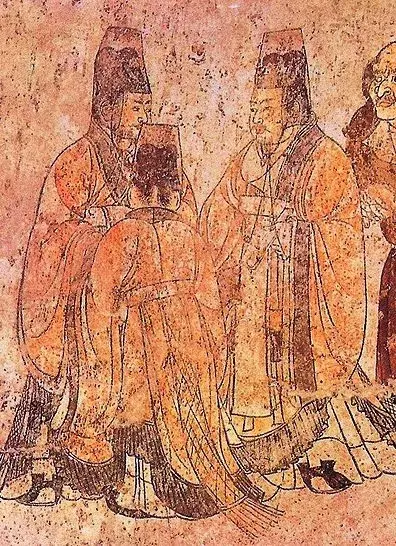
杜楚客
Du Chuke (杜楚客), a native of Duling in Jingzhao (present-day Xi'an, Shaanxi), was an influential minister during the Zhenguan reign of Emperor Taizong of Tang, serving as Minister of Works and the principal strategist for Li Tai, Prince of Wei. He was the younger brother of the founding Tang Chancellor Du Ruhui. Descended from the aristocratic Jingzhao Du lineage, his grandfather Du Hui served as Governor of Changcheng and…
Du Chuke (杜楚客), a native of Duling in Jingzhao (present-day Xi'an, Shaanxi), was an influential minister during the Zhenguan reign of Emperor Taizong of Tang, serving as Minister of Works and the principal strategist for Li Tai, Prince of Wei. He was the younger brother of the founding Tang Chancellor Du Ruhui. Descended from the aristocratic Jingzhao Du lineage, his grandfather Du Hui served as Governor of Changcheng and Governor of Huai Prefecture under the Sui, while his father Du Zha served as Governor of Changzhou. In the tumultuous twilight of the Sui dynasty, Du Chuke and his uncle Du Yan fell captive to the rebel regime of Wang Shichong in the eastern capital Luoyang. Harboring longstanding enmity toward Du Ruhui and his brothers, Du Yan slandered Du Ruhui's elder brother to Wang Shichong, causing his execution, and cast Du Chuke into a dungeon without food or water, pushing him to the brink of starvation, yet Du Chuke showed not the slightest hint of resentment. In 621, following the Tang conquest of Luoyang, Du Yan was condemned to death for treason. Du Chuke wept bitterly and implored Du Ruhui to plead before Li Shimin, Prince of Qin, attempting to slit his own throat to preserve family bloodlines. Deeply moved, Du Ruhui secured a pardon for Du Yan, and Du Chuke gained imperial renown for extraordinary filial fraternity. Subsequently, Du Chuke retired to Mount Song as a hermit, shunning worldly honors. Following Du Ruhui's premature death in 630, Emperor Taizong warmly recalled his late chancellor's loyalty and summoned Du Chuke to court as Palace Remonstrance Official, exhorting him to emulate his brother's devotion. He soon served as Prefect of Puzhou with notable administrative distinction. Recognizing his executive ability, the emperor elevated him to Administrator of the Princely Establishment of the Prince of Wei and Minister of Works, placing him in comprehensive charge of Prince Li Tai's palace affairs. In the later Zhenguan era, observing the emperor's alienation from Crown Prince Li Chengqian and favoritism toward Li Tai, Du Chuke actively orchestrated Li Tai's bid to usurp the succession. He cultivated ties with powerful central officials, secretly distributing gold bribes to assemble a political clique and arguing that Li Tai possessed the intellect suitable for imperial heir. Following the collapse of Li Chengqian's treasonous rebellion in 643, the clandestine succession intrigues were exposed. Commemorating Du Ruhui's irreplaceable foundational contributions to the realm, Emperor Taizong spared Du Chuke from capital punishment, stripping him of titles and placing him under house arrest; he was subsequently demoted to Magistrate of Qianhua, where he died in office.
Captured alongside uncle Du Yan in Luoyang, framed and starved nearly to death, maintaining serene composure.
After Tang victory, attempted self-immolation to urge Du Ruhui to secure pardon for Du Yan, acclaimed for fraternity.
Relinquished all office to study classics in Mount Song seclusion, celebrated as the Scholar of Songgao.
Recalled by Emperor Taizong to honor Du Ruhui's memory, appointed Palace Remonstrance Official and Prefect of Puzhou.
Promoted to Administrator of Prince of Wei's establishment and Minister of Works, directing Li Tai's princely court.
Exploited rift between Taizong and the Crown Prince, distributing gold bribes to court elites to advance Li Tai.
Succession conspiracy exposed, spared from execution in tribute to Du Ruhui's legacy, demoted to Magistrate of Qianhua until death.
Du Chuke belonged to the southern branch of the preeminent medieval Jingzhao Du aristocracy. His granduncle Du Gao had served as Minister of Works and Duke of Yixing under the Sui dynasty; his great-grandfather Du Jiao held the post of General of the Open Office Equal to the Three Excellencies under the Northern Zhou; his grandfather Du Hui governed Changcheng and Huai Prefecture; and his father Du Zha served as Governor of Changzhou, posthumously honored as Governor of Xiangzhou. His elder brother Du Ruhui served as chief strategist to Li Shimin, helping establish the Tang dynasty. During the collapse of the Sui dynasty, Du Chuke, while still young, accompanied his uncle Du Yan to the eastern capital Luoyang, where both were captured by the separatist warlord Wang Shichong.
Du Yan possessed a spiteful and jealous temperament, having long harbored severe animosity toward Du Ruhui and his siblings. Following Wang Shichong's usurpation of the imperial title, Du Yan sought vengeance by fabricating defamatory charges against Du Ruhui's elder brother before Wang Xingman, resulting in his execution. Du Yan then cast Du Chuke into a subterranean dungeon, depriving him of food and water to starve him to death. Enduring agonizing torment on the verge of demise, Du Chuke maintained complete dignity, showing no bitter hatred toward his uncle. In the spring of 621, Tang forces conquered Luoyang and destroyed the Zheng regime. As a collaborating official of a rebel state, Du Yan was sentenced to decapitation.
Learning of the verdict, Du Chuke dragged his emaciated body before Du Ruhui, weeping passionately and pleading for his brother to petition Prince of Qin Li Shimin to spare their uncle. Remembering his elder brother's tragic death, Du Ruhui refused to intervene. Du Chuke wept tears of blood and argued: "Our uncle previously murdered our eldest brother, which was an irreparable grief; if you now nurse vengeance and allow our uncle to be executed, our household will have slaughtered its own flesh and blood to the last man! Could anything in this world be more heart-rending?" Drawing his dagger, he prepared to slit his own throat to atone for familial sins. Deeply shaken by this profound fraternal devotion, Du Ruhui immediately rushed to Li Shimin and successfully obtained an imperial pardon, sparing Du Yan's life.
Following the salvation of his uncle, Du Chuke recognized the treachery of worldly politics, declining official rewards and retiring into the forests and gorges of Mount Song. He constructed a hermitage, immersing himself in the Confucian classics and moral philosophy for over a decade. Refusing all social vanity, he became widely venerated among regional scholars as the Scholar of Songgao.
In 630, Chancellor Du Ruhui passed away in his prime, causing Emperor Taizong profound sorrow. Cherishing the memory of his paramount advisor, and aware of Du Chuke's celebrated filial conduct, Emperor Taizong issued an imperial summons inviting Du Chuke to court, appointing him Palace Remonstrance Official. Granting him a personal audience, Taizong said: "We hear that you have dwelled in the mountains for years, cherishing haughty ambitions, with rumors claiming you would refuse to emerge unless offered the Chancellorship. How could such thinking be sound? Those who travel far must begin from nearby, and those who climb high must start from the low ground. Provided that an official performs with excellence and earns public respect, one need never worry about ranks being insufficient! Your brother shared a single heart with Us, performing monumental services for Our dynastic foundation. Remembering your brother, We resolved to meet you. You must understand Our imperial desire and perpetuate your brother's loyal dedication!" Grateful for the emperor's benevolence, Du Chuke accepted appointment as Prefect of Puzhou, where he enforced strict civil education, relieved agrarian distress, and suppressed lawless magnates, establishing an admirable reputation as a capable administrator.
Recognizing his practical administrative acumen, Emperor Taizong transferred Du Chuke back to Chang'an, elevating him to Administrator of the Princely Establishment of the Prince of Wei and conferring the title Minister of Works, placing him in executive command of Prince Li Tai's palace. Highly cultured, eloquent, and editor of the imperial geographical gazetteer Kuodizhi, Prince Li Tai was intensely doted upon by Emperor Taizong, enjoying lavish stipends and privileges that surpassed those of Crown Prince Li Chengqian. Meanwhile, Crown Prince Li Chengqian, afflicted with a chronic foot ailment and profound insecurity, turned erratic and rebellious, steadily losing the emperor's favor.
Witnessing the precarious succession and holding command over Prince Li Tai's household, Du Chuke committed his fortune to helping Li Tai usurp the heir-apparency. Acting on Li Tai's secret instructions, Du Chuke aggressively cultivated alliances with central ministers and military officers. He frequently visited high-ranking aristocrats, secretly carrying pouches of gold to distribute bribes and build a political faction. He openly lobbied courtiers, declaring: "The Prince of Wei is exceptionally intelligent, loves literature, and displays imperial filial devotion; he possesses the true nature of a holy monarch and ought to be consecrated as legitimate heir." While several ministers secretly alerted Emperor Taizong to Du Chuke's bribery, the emperor was so blinded by his affection for Li Tai that he refrained from taking punitive action.
In 643, realizing that his succession was doomed, Crown Prince Li Chengqian allied with Prince of Han Li Yuanchang and General Hou Junji to launch an armed coup d'état aimed at deposing Emperor Taizong. Following the conspiracy's collapse, Li Chengqian was stripped of his rank, and imperial inquisitors conducted an exhaustive investigation into court intrigues. During interrogations, the full extent of Prince Li Tai and Du Chuke's factional manipulation, bribery, and systematic efforts to displace the Crown Prince were laid bare before the court.
High judicial ministers unanimously declared that Du Chuke had committed high treason by subverting dynastic succession and creating illicit factions, demanding his immediate decapitation. Confronted with the sentence, Emperor Taizong grieved over the fratricidal disaster within his family, summoning his assembled ministers and proclaiming: "Du Chuke's crimes are beyond ordinary pardon. Yet remembering that his brother Du Ruhui rendered unmatched founding service to Our empire, We cannot bear to let Ruhui's lineage be extinguished without an heir!" The emperor issued a special dispensation sparing Du Chuke from death, demoting him to commoner status and placing him under house arrest. Soon afterward, the throne assigned him to serve as Magistrate of Qianhua (modern Ningdu, Jiangxi). Physically and mentally exhausted by the political tempest, Du Chuke succumbed to illness shortly after assuming his provincial post.
Enduring starvation in a Luoyang prison without harboring resentment, Du Chuke moved his brother Du Ruhui by threatening self-immolation to plead for Du Yan's life after the Tang conquest, resolving a lethal family vendetta and establishing a legendary standard of fraternal self-sacrifice.
Rejecting opportunistic rewards following the civil war, Du Chuke retired to Mount Song for a decade to cultivate classical philosophy, gaining nationwide renown as an upright scholar-recluse admired by contemporary literati.
Summoned to office by Emperor Taizong in 630, Du Chuke governed Puzhou with rigorous integrity and civil benevolence. He disciplined abusive clerks, reformed penal registers, and fostered local agriculture, earning acclaim as an exceptionally capable provincial prefect.
As Minister of Works and concurrent Administrator of the Prince of Wei's establishment, Du Chuke directed imperial engineering projects and managed Li Tai's grand princely administration with formidable efficiency, standing as a prominent central statesman of the mid-Zhenguan era.
During the factional crisis of the Zhenguan succession, Du Chuke deployed strategic foresight and diplomatic energy on behalf of Prince Li Tai, forging connections with high court ministers and coordinating the political operations of the Wei faction.
When the succession crisis erupted into treason trials, Emperor Taizong personally intervened to commute Du Chuke's death sentence out of enduring reverence for Du Ruhui's foundational contributions, cementing Du Chuke's dramatic place in Tang dynastic history.
FIGURES ASSOCIATED WITH THIS DYNASTY