Birth in Zhongling
Born into an esteemed local lineage in Zhongling, Jiangxi.
董源
Dong Yuan (董源, 934–962), courtesy name Shuda, was a native of Zhongling (modern Jinxian, Jiangxi). He was an illustrious court painter of the Southern Tang during the Five Dynasties and Ten Kingdoms period, universally acclaimed as the founding patriarch of the Southern Landscape Painting School. Serving under Emperor Yuanzong (Li Jing) and the Last Ruler (Li Yu), he held the imperial post of Vice Commissioner of the North…
Dong Yuan (董源, 934–962), courtesy name Shuda, was a native of Zhongling (modern Jinxian, Jiangxi). He was an illustrious court painter of the Southern Tang during the Five Dynasties and Ten Kingdoms period, universally acclaimed as the founding patriarch of the Southern Landscape Painting School. Serving under Emperor Yuanzong (Li Jing) and the Last Ruler (Li Yu), he held the imperial post of Vice Commissioner of the North Park, leading later generations to reverently style him Dong Beiyuan. Dong Yuan excelled in both monochrome ink-wash and richly colored landscapes, while also demonstrating remarkable skill in painting mythical beasts, water buffaloes, and dragons. Moving beyond traditional rigid line work, he captured the gently rolling hills, lush vegetation, and humid riverine atmosphere of Jiangnan through his revolutionary hemp-fiber texture strokes (pima cun) and alum-head boulders (fantou). Paired with monk Juran as Dong-Ju, he was revered by late Ming theorist Dong Qichang as the supreme ancestor of the Southern School of literati painting.
Born into an esteemed local lineage in Zhongling, Jiangxi.
Summoned to the imperial court in Jinling by Emperor Yuanzong of Southern Tang.
Created the celebrated court composition Snow Clearing for an imperial winter banquet.
Elevated to Vice Commissioner of the North Park overseeing palace parks and reservoirs.
Patronized extensively by the Last Ruler Li Yu to paint grand palace screen murals.
Passed away in office in Jinling at the youthful age of twenty-nine.
Dong Yuan was born in 934 in the water-rich region of Zhongling. The misty expanses of Lake Poyang and the winding channels of the Gan and Yangtze rivers exerted an indelible influence upon his aesthetic consciousness. From early youth, he studied the compositions of classical masters while observing directly the humid atmospheric vapor and rolling earthen topography of his homeland.
During the Baoda reign, Emperor Yuanzong established a lavishly sponsored painting academy in Jinling. Dong Yuan's dazzling versatility secured him an imperial appointment as court painter. In the academy, he handled diverse genres with ease, painting not only sweeping panoramic riverscapes but also vibrant palace animals, including dragons emerging from water and ferocious tigers.
At the Jinling court, Dong Yuan was frequently commissioned to execute massive decorative projects. On a snowy New Year's Eve, Li Jing hosted a grand banquet and commissioned court painters to record the festive assembly. Master Gao Chonggu painted the banqueting dignitaries, Zhu Cheng executed the palatial halls, and Dong Yuan was entrusted with the sprawling background of snow-covered mountains and icy waterways. His evocative handling of distance and winter light won universal acclaim from the emperor and courtiers.
In 958, Dong Yuan was promoted to Vice Commissioner of the North Park. This prestigious office supervised imperial garden architecture, water conservancy, and palace supplies. When Li Yu succeeded to the throne in 961, he held Dong Yuan in the highest esteem, regularly visiting his studio and commissioning monumental screens depicting scenic landmarks of southern China.
Through decades of artistic exploration, Dong Yuan concluded that rigid vertical outlines could never convey the gentle, rolling contours and lush moisture of southern earthen hills. He broke away from northern rock conventions by inventing the long, flexible hemp-fiber texture stroke (pima cun), combined with layered ink dots (dian tai) that captured damp vegetation.
Shen Kuo famously noted in Dream Pool Essays that Dong Yuan's brushwork appeared rough and indistinct when inspected closely, yet resolved into breathtaking atmospheric brilliance when viewed from afar. In 962, at the height of his creative vitality, Dong Yuan passed away suddenly in Jinling at the age of twenty-nine, cutting short one of the most brilliant careers in Chinese art history.
Dong Yuan's greatest achievement was formulating the canonical pictorial language for southern Chinese landscape. By using soft, interwoven linear strokes and rounded alum-head boulders, he faithfully mirrored the rolling topography and river mists of the Yangtze Delta, permanently breaking the monolithic dominance of northern craggy styles.
Classical catalogues emphasize that Dong Yuan worked in two equally brilliant modes: luminous monochrome ink-wash depicting serene marshes, fishermen, and weeping willows; and ancient mineral-color landscapes featuring lush greens, ochres, and figures dressed in vivid red and cyan robes.
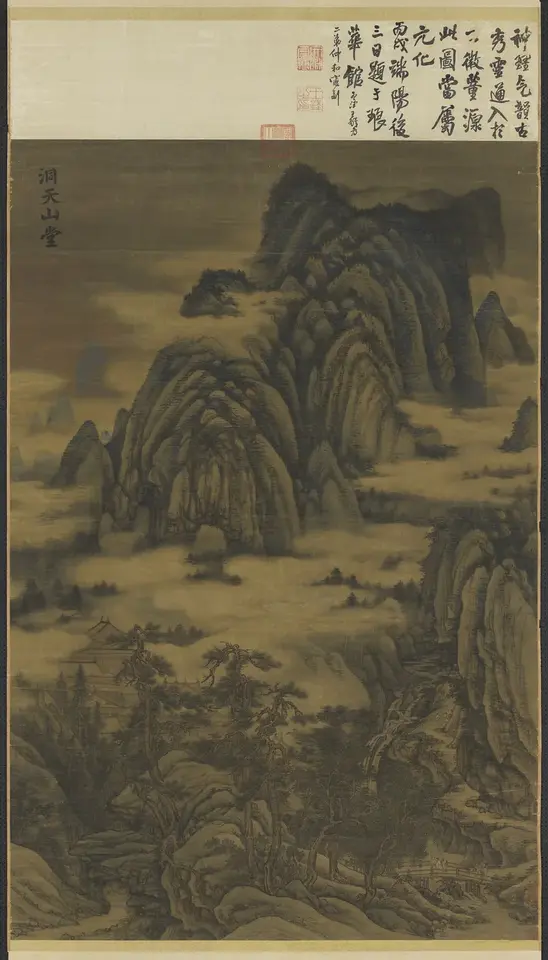
His genius survives in celebrated works including The Xiao and Xiang Rivers (Xiao Xiang Tu) and Waiting for the Ferry at the Mountain Pass in Summer in the Palace Museum in Beijing, and Summer Mountains in the Liaoning Provincial Museum. These masterpieces depict peaceful riverine shores, fishermen casting nets from bamboo rafts, and distant travelers awaiting ferriage beneath misty peaks.
Dong Yuan's impressionistic brushwork directly nurtured his disciple Juran and inspired Mi Fu and Mi Youren to develop their famous ink-cloud style. During the Yuan dynasty, the Four Great Masters—Huang Gongwang, Wu Zhen, Ni Zan, and Wang Meng—revered Dong Yuan as their ultimate spiritual model, culminating in Dong Qichang's classification of Dong Yuan as the supreme patriarch of the Southern School.
FIGURES ASSOCIATED WITH THIS DYNASTY