Birth in Nanxun
Born on the sixteenth day of the tenth lunar month into a prominent family in Nanxun, Wucheng County, Zhejiang, reading strange books and classics from childhood.
董说
Dong Shuo (November 10, 1620 – 1686), courtesy name Ruoyu and art names Mengxiang, Xi'an, and Nanxun Bingfu, later adopting the Buddhist monastic name Nanqian and courtesy name Yuejiang, was a native of Nanxun Town, Wucheng County, Huzhou Prefecture, Zhejiang (present-day Nanxun District, Huzhou City, Zhejiang Province). An outstanding novelist, scholar, and poet of the late Ming and early Qing eras, he was a pioneering…
Dong Shuo (November 10, 1620 – 1686), courtesy name Ruoyu and art names Mengxiang, Xi'an, and Nanxun Bingfu, later adopting the Buddhist monastic name Nanqian and courtesy name Yuejiang, was a native of Nanxun Town, Wucheng County, Huzhou Prefecture, Zhejiang (present-day Nanxun District, Huzhou City, Zhejiang Province). An outstanding novelist, scholar, and poet of the late Ming and early Qing eras, he was a pioneering master in the history of ancient Chinese narrative literature who demonstrated an extraordinary psychological depth and early modern consciousness. Born into a prominent aristocratic scholar-gentry lineage of Jiangnan, Dong displayed precocious brilliance, passing the county examinations as a licentiate (xiucai) during the Chongzhen reign and mastering poetry, prose, and the collection and recording of strange dreams. Following the fall of the Ming dynasty, Dong harbored profound loyalist devotion to his fallen state, adamantly refusing to take imperial examinations under the Qing dynasty. He altered his name to preserve his moral integrity, eventually shaving his head to enter the Buddhist sangha as Monk Nanqian, residing at Lingyan Mountain Temple. In literary creation, Dong achieved monumental renown through his sixteen-chapter satirical novel Xiyou Bu (A Supplement to the Journey to the West), completed in 1641. Framing the narrative around Sun Wukong's entrapment within the illusory "Green Green World" conjured by the Qingyu Fish Demon (symbolizing human desire), the work employed surreal imagery, dream inversions, psychological illusions, and stream-of-consciousness narrative techniques rare in world literature to expose and mock the political decadence, factional struggles, and moral hypocrisy of late Ming society. Lu Xun in A Brief History of Chinese Fiction praised it for satirizing mundane society and infusing demons with genuine human psychology. Dong also excelled in verse, authoring Baoyun Shiji, Fengcao'an Qianji, and Zhaoyang Mengshi.
Born on the sixteenth day of the tenth lunar month into a prominent family in Nanxun, Wucheng County, Zhejiang, reading strange books and classics from childhood.
Passed the county examination as a government student (xiucai) at sixteen, renowned across the Three Wu region for his agile literary imagination.
Formed literary societies with Jiangnan scholars to investigate the mysteries of dreams, conceiving the satirical novel Xiyou Bu.
Completed the sixteen-chapter satirical novel Xiyou Bu, utilizing grotesque dreamscapes to satirize late Ming political corruption and scholarly hypocrisy.
Beijing fell to Li Zicheng and Qing troops crossed the Great Wall; grief-stricken, Dong swore never to serve the Qing, retiring into scholarly seclusion.
Shaved his head to become a Buddhist monk at Lingyan Mountain Temple in Suzhou under the name Nanqian and courtesy name Yuejiang, meditating and copying manuscripts.
Resided along the Tiao and Zhe rivers, collating his lifelong verse and notes, authoring Fengcao'an Qianji and Sishu Zhixin Lu.
Passed away peacefully in his monastic meditation cell at sixty-seven, leaving behind voluminous poetry collections and extraordinary fictional writings.
Dong Shuo was born on November 10, 1620 (the sixteenth day of the tenth lunar month in the forty-eighth year of the Wanli reign) in Nanxun Town, Wucheng County, Huzhou Prefecture, Zhejiang. The Dong family of Nanxun was a prestigious gentry lineage possessing vast private library collections and boasting high officials across generations. Dong was frail and prone to illness from childhood, yet endowed with extraordinary brilliance and photographic memory. Before reaching adulthood, he had memorized the Confucian Six Classics and the Hundred Schools of Thought, excelling particularly in archaic five-character verse and rhapsodies (fu).
Unlike ordinary scholars obsessed with eight-legged examination essays, Dong was proud and aloof by nature, harboring a deep philosophical curiosity regarding cosmic mysteries and the causal origins of dream visions. From his early teens, he developed the unique habit of recording his dreams upon waking each morning, styling himself "Mengxiang" ("Realm of Dreams") and vowing to compile a systematic history of dreams. Surrounded by thousands of volumes in his household libraries, he absorbed Zhuangzi's butterfly dream philosophy alongside Six Dynasties anomalies and Tang romances, nurturing the imaginative foundation for his fantastic literary creations.
In 1635 (the eighth year of the Chongzhen reign), the sixteen-year-old Dong sat for local examinations, passing with top marks to become a licentiate (xiucai), which brought him widespread fame across Wu and Yue. At that time, the late Ming court was sinking into dysfunction; peasant uprisings surged, frontier threats mounted in Liaodong, and the scholar-official class remained mired in factional strife and vacuous moral posturing, while urban society sank into luxury and deceit.
Witnessing this apocalyptic scene, Dong felt profound indignation and alienation. Between 1640 and 1641, in his early twenties, Dong utilized the fantasy framework of the Journey to the West to compose his sixteen-chapter novel Xiyou Bu. The plot centered on Sun Wukong being trapped in illusions cast by the Qingyu Fish Demon (symbolizing passion and worldly desire), thrusting the protagonist into the "Green Green World," the "Tower of Ten Thousand Mirrors," and the "Ancient World." Through grotesque and fantastical satire, he excoriated the greed and incompetence of late Ming grand secretaries and the hypocrisy of pseudo-moralists.
In the spring of 1644 (the seventeenth year of the Chongzhen reign), Li Zicheng took Beijing, Emperor Chongzhen hanged himself on Coal Hill, and Qing armies entered northern China and advanced south. Jiangnan witnessed catastrophic upheaval; the southern Hongguang regime collapsed, and Qing conquerors enforced hair-shaving decrees and massacred resistant cities. Upon hearing the news, Dong wept inconsolably for the fallen Ming dynasty.
Faced with conquest and pressure to collaborate, Dong stood resolute. He shredded his examination manuscripts and adamantly refused to participate in Qing civil service examinations. He adopted pseudonyms like "Lin Hu" and "Nanxun Bingfu" ("The Sick Man of Nanxun") to demonstrate his loyalist resolve. During this time, he lived in rural seclusion, earning a modest livelihood by selling calligraphy and teaching students, while secretly maintaining ties with loyalist leaders like Gu Yanwu and Huang Zongxi, channeling grief for his lost homeland into sorrowful poetry.
Around 1656 (the thirteenth year of the Shunzhi reign), as Qing suppression of southeastern resistance intensified and southern loyalist armies dispersed, Dong realized restoration was impossible. To evade official manhunts and escape political compromises, he severed worldly ties, entering Lingyan Mountain Temple in Mudu, Suzhou, to be tonsured as a Buddhist monk. Ordained under the monastic name Nanqian and courtesy name Yuejiang, he placed himself under the spiritual guidance of eminent Chan masters.
Within the monastery, Dong resided amid cold rocks and withered trees, observing rigorous monastic rules. By day he meditated in Chan stillness, while by night he read Buddhist sutras and classical treatises by lamplight, synthesizing Yogacara philosophy on mental consciousness and dream projections with literary creation. He constructed the Fengcao Hermitage at Lingyan Mountain, collating ancient texts and compiling verse collections, leading an austere existence while refusing any social intercourse with Qing officials.
During the Kangxi reign, social stability gradually returned, and imperial decrees were repeatedly issued seeking recluse scholars. Regional governors repeatedly recommended Dong for court honors, but he remained secluded, pleading grave illness to reject official recruitment. Along the banks of the Tiao River, he built the Baoyun Hermitage to pass his final years, devoting himself to organizing his lifelong literary manuscripts.
Dong was an extraordinarily prolific writer. In addition to Xiyou Bu, he composed numerous works including Baoyun Shiji, Fengcao'an Qianji, Mengxiang Zhi, and Zhaoyang Mengshi. In 1686 (the twenty-fifth year of the Kangxi reign), this literary genius who witnessed dramatic dynastic changes passed away peacefully in meditation at sixty-seven. With his surreal literary style and uncompromising moral integrity, Dong left an indelible mark in Chinese classical fiction and late Ming loyalist history.
Dong Shuo's paramount contribution to Chinese literature was composing the sixteen-chapter satirical novel Xiyou Bu in 1641. Serving as a sequel to Wu Cheng'en's classic Journey to the West, the work discarded conventional formulas of monster-slaying, earning acclaim among modern international scholars as China's first genuine psychological symbolic novel and stream-of-consciousness narrative.
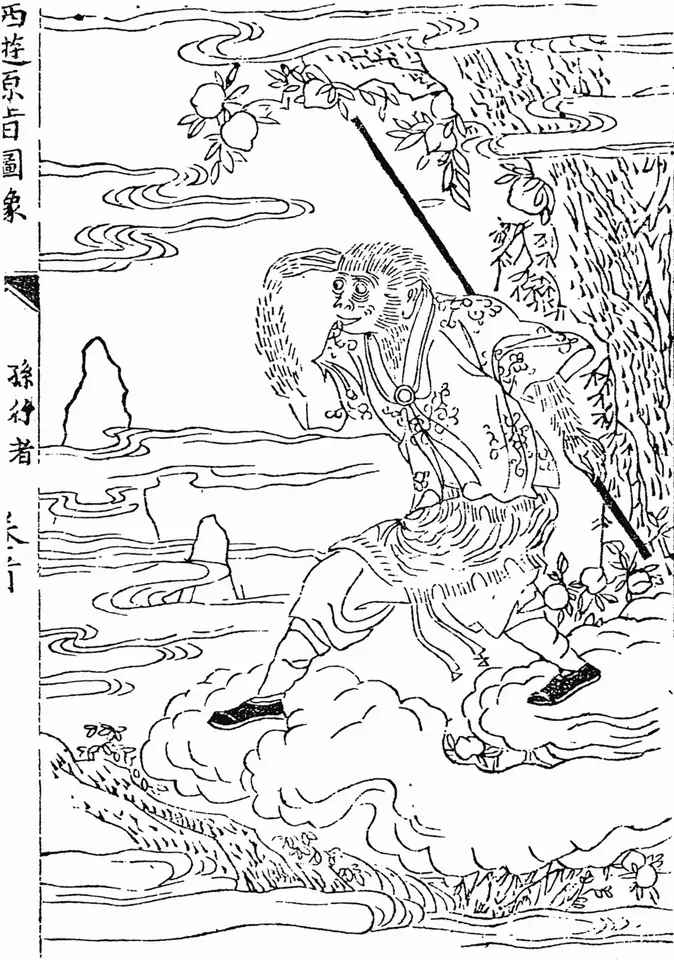
The novel begins with Sun Wukong being enchanted by the crimson mist exhaled by the Qingyu Fish Demon while begging for alms. Representing desire and delusion (qingmo), the demon traps the Monkey King within the bizarre "Green Green World." Entering the "Tower of Ten Thousand Mirrors," Sun Wukong travels across fractured times and spaces: transforming into Consort Yu to converse sorrowfully with Xiang Yu of Chu; traveling to the Song dynasty to borrow gold ropes from King Yama to flog Qin Hui for treason; and venturing into future Ming civil service examination halls to witness examinees cheating in frenzied madness. Dong dismantled linear temporal chronology, utilizing nested dreamscapes, psychological inversions, and symbolic metaphors centuries before modern Western Freudian psychology and stream-of-consciousness techniques emerged.
Xiyou Bu was not merely an artistic fantasy, but a piercing social critique of late Ming decadence. Dong recast Sun Wukong as a tragic hero grappling with internal self-doubt and mental demons, using supernatural allegory to mock the corruption of the Chongzhen era.
Through grotesque caricatures like the "Peony Count" and the "Heaven Chiselers," the novel satirized late Ming high officials who trafficked in offices and treated human lives as worthless. The dream trial of Qin Hui channeled public outrage against appeasement and the betrayal of loyal commanders, while the absurd episode of a false Sun Wukong following Tang Sanzang exposed the hypocritical opportunism of late Ming scholar-officials. Dong's satire blended carnivalistic mockery with tragic sorrow, producing one of the most penetrating psychological portraits of late Ming literati despair.
Dong's lifelong philosophical inquiry into dreams achieved unprecedented depth. Beyond deploying dreams as narrative frameworks in fiction, he sought to construct an autonomous theoretical discipline of "oneirology" (mengxue). In Nanxun, he established the "Dream Club," encouraging literati colleagues to record their daily dream phenomena.
Dong compiled Mengxiang Zhi and Zhaoyang Mengshi, investigating the psychological triggers, taxonomic categories, emotional dynamics, and subconscious desires inherent in dreams. He maintained that human life was a grand illusion where all phenomena were creations of the mind, arguing that worldly fame, fortune, and political warfare were far more absurd than nocturnal dreams. Through philosophical and literary excavations of dream psychology, Dong reflected upon existential absurdity, portraying the profound psychological struggles and spiritual self-redemption of intellectuals during the dynastic collapse of the late Ming.
Following the fall of Beijing and the Qing invasion, as countless gentry submitted and shaved their hair to serve the new regime, Dong demonstrated unshakeable ethnic pride and Confucian integrity. He cast aside scholar robes and refused to participate in Qing administrative affairs, embodying ancient loyalist principles of serving only one dynasty.
After taking monastic vows, Dong used his status as a Lingyan monk to shelter and aid Ming loyalist refugees hiding in Jiangnan mountain retreats. He corresponded with prominent loyalists like Gu Yanwu, Wu Jiaji, and Du Jun, employing allusions and symbolic imagery in verse to express longing for his fallen country. His poetry, collected in Baoyun Shiji and Fengcao'an Qianji, stood as a poignant testament to late Ming and early Qing loyalist literature.
FIGURES ASSOCIATED WITH THIS DYNASTY