Birth in Songjiang
On February 10, Dong Qichang was born into a cultured gentry lineage in Dongjiahui, Shanghai County, Songjiang.
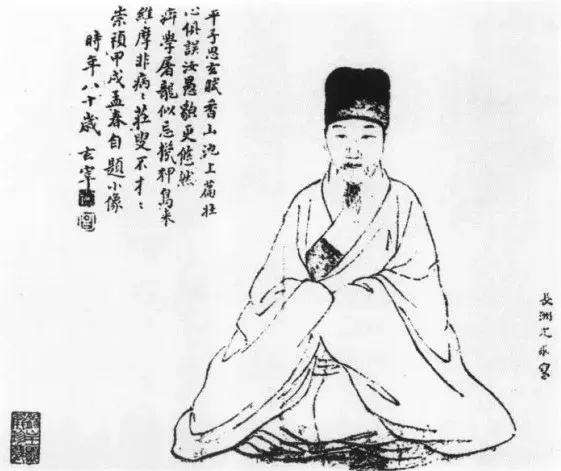
董其昌
Dong Qichang (董其昌, February 10, 1555 – October 26, 1636), courtesy name Xuanzai (玄宰), sobriquet Sibai (思白) and Xiangguang Jushi (香光居士), was a preeminent painter, calligrapher, connoisseur, art theorist, and high-ranking statesman of the late Ming dynasty from Huating, Songjiang (modern Songjiang District, Shanghai). Attaining the jinshi degree in 1589, he entered the Hanlin Academy as a bachelor, subsequently serving as…
Dong Qichang (董其昌, February 10, 1555 – October 26, 1636), courtesy name Xuanzai (玄宰), sobriquet Sibai (思白) and Xiangguang Jushi (香光居士), was a preeminent painter, calligrapher, connoisseur, art theorist, and high-ranking statesman of the late Ming dynasty from Huating, Songjiang (modern Songjiang District, Shanghai). Attaining the jinshi degree in 1589, he entered the Hanlin Academy as a bachelor, subsequently serving as Senior Compiler, lecturer to Crown Prince Zhu Changluo (the future Taichang Emperor), and Vice Surveillance Commissioner for Education of Huguang. Astutely anticipating the political storms of the prolonged succession dispute known as the Guoben Controversy, Dong practiced deliberate political detachment, taking leave under the pretext of illness to reside in his native Jiangnan for over two decades, where he amassed celebrated masterpieces and refined his art. During the Taichang, Tianqi, and Chongzhen reigns, Dong was recalled to court three times, serving successively as Vice Minister of the Court of Imperial Sacrifices, Vice Chancellor of the National University, Deputy Chief Compiler of the Veritable Records of Emperor Shenzong, Minister of Rites in Nanjing, and Supervisor of the Household of the Heir Apparent, culminating in the honorific rank Grand Guardian of the Heir Apparent. Retiring at age eighty in 1634, he passed away in Songjiang in 1636 at age eighty-one and was posthumously honored as Wenmin by the Southern Ming court. Throughout a forty-five-year bureaucratic career spent largely in reclusive artistic leisure, Dong navigated late Ming factional strife with masterful political equanimity. In artistic history and aesthetics, Dong Qichang exerted a transformative influence that defined Chinese literati painting for centuries. In painting, he drew upon Chan Buddhist paradigms to formulate the influential Theory of the Northern and Southern Schools, championing the Southern School of literati landscape painting exemplified by Wang Wei, Dong Yuan, Juran, and the Four Great Masters of the Yuan Dynasty over the Northern court academy tradition. In calligraphy, he synthesized the structural strength of Yan Zhenqing with the fluid grace of Zhao Mengfu and the spirit of Wang Xizhi and Mi Fu, formulating the classic maxim that the Jin pursued resonance, the Tang pursued law, and the Song pursued intent. As a master connoisseur, he engraved the celebrated twenty-volume Model Calligraphies of the Hall of Playing Geese and authored the seminal Notes from the Painting-Dhyana Studio, profoundly shaping the Qing imperial aesthetic and the course of East Asian literati culture.
On February 10, Dong Qichang was born into a cultured gentry lineage in Dongjiahui, Shanghai County, Songjiang.
Ranked second in the prefectural examination because of deficient calligraphy; deeply mortified, he resolved to master the calligraphic art.
Passed the metropolitan civil service examinations, entering the Hanlin Academy as a bachelor and later serving as imperial lecturer to Prince Zhu Changluo.
Appointed Vice Surveillance Commissioner for Education of Huguang; soon feigned illness to resign and retire to Huating amidst escalating court factionalism.
Expended immense private wealth to engrave twenty volumes of ancient masterpieces into the stone steles of the Model Calligraphies of the Hall of Playing Geese.
Upon his accession, the Taichang Emperor recalled Dong as Vice Minister of Imperial Sacrifices and Vice Chancellor of the National University.
Elevated to Minister of Rites in Nanjing; repelled by the rampant despotism of the eunuch Wei Zhongxian, he resigned after a single year to live in seclusion for eight years.
Recalled to the capital by the Chongzhen Emperor to supervise the Household of the Heir Apparent with the title Grand Guardian of the Heir Apparent.
In the face of renewed cabinet factional struggles under Wen Tiren, he firmly requested retirement, which the emperor granted with ceremonial gifts.
Passed away on October 26 at age eighty-one at his residence in Songjiang; buried at Yuyangwan in Wu County and posthumously honored as Wenmin.
Dong Qichang was born on February 10, 1555, in Dongjiahui, Shanghai County, Songjiang Prefecture. His family belonged to the local educated gentry who had maintained agrarian and scholarly traditions for generations. Blessed with acute intellectual gifts, Dong immersed himself in classical Confucian texts and historical chronicles from childhood, gaining early local renown for fluid rhetorical composition. In 1571, seventeen-year-old Dong sat for the Songjiang prefectural civil examination. Having composed a forceful and eloquent eight-legged essay, he felt completely confident of securing the top position.
However, when results were proclaimed, Dong was ranked second behind his younger cousin Dong Yuanzheng. The presiding prefect, Zhong Zhenji, explained that while Dong's literary prose was undeniably brilliant, his calligraphy was clumsy, stiff, and deficient in classical structure, justifying his demotion. This unexpected reprimand struck the proud youth with profound mortification. He made a vow to master the art of the brush, initiating decades of relentless calligraphic discipline.
He began by rigorously copying the Stele of the Duobao Pagoda by the Tang master Yan Zhenqing, analyzing every stroke, hook, and dot with unsparing precision. Realizing that the ultimate foundation of regular script lay further back in antiquity, he proceeded to study the ancient Wei and Jin models of Zhong Yao and Wang Xizhi. During this intense period of study, he came under the artistic mentorship of Songjiang scholars Mo Shilong and Gu Zhengyi, who encouraged him at age twenty-two to study landscape painting. Adopting the masters of antiquity as his teachers, Dong analyzed the brushwork of Huang Gongwang and Ni Zan. Over a decade of ceaseless practice transformed him from a disappointed examination candidate into a profound master of the brush and ink.
In 1589, at the age of thirty-five, Dong Qichang traveled to Beijing and attained the jinshi degree in the metropolitan examinations. Because his examination papers displayed exceptional literary grace and elegant calligraphic execution, he was selected as a bachelor in the Hanlin Academy, entering the highest intellectual cadre of the Ming state. Following his academy training, he was appointed Senior Compiler. When his beloved Hanlin teacher Tian Yijun died of illness, Dong took leave from the court and traveled thousands of miles on foot and boat to personally escort his mentor's coffin back to Datian County in Fujian for burial, winning universal acclaim for his filial devotion.
In 1594, Dong received an imperial appointment to serve as lecturer to Crown Prince Zhu Changluo (the future Taichang Emperor) in the Eastern Palace. During his lectures, Dong explicated classical Confucian statecraft with serene eloquence and elegant poise, earning the lifelong gratitude and admiration of the young heir apparent. This intimate connection with the future monarch established his elevated political standing and ensured his subsequent high promotions across three imperial reigns.
During his years in Beijing, Dong expanded his social ties across the metropolitan literati elite. He met regularly with fellow scholar-officials to examine ancient bronzes, stone inscriptions, and Song-Yuan calligraphic albums. Through the generosity of Minister of Rites Han Shineng, whose private collection of Song and Yuan masterworks was celebrated throughout Jiangnan, Dong spent nights and days copying and verifying priceless primary masterpieces, elevating his connoisseurship to an extraordinary level of discernment.
Meanwhile, the central government descended into acute factional instability. The Wanli Emperor's refusal to attend daily audiences, his infatuation with Noble Consort Zheng, and his attempt to disinherit his eldest son provoked the bitter fifteen-year Guoben Controversy. The eruption of the Mysterious Book Case and the Chu Princely Succession Case intensified factional paranoia, turning the court into a perilous battlefield. Recognizing the danger of his position as a former tutor to the embattled Crown Prince, Dong sought an honorable exit from metropolitan politics.
In 1599, Dong was dispatched from the capital to serve as Vice Surveillance Commissioner for Education of Huguang, where he presided over provincial examinations. Promoted shortly thereafter to Administrative Vice Commissioner of Henan with junior third-grade rank, he astutely pleaded illness after only a single year of service. The court granted him permission to convalesce in his hometown with his Hanlin title, allowing Dong to withdraw gracefully to Huating, where he remained in comfortable retirement for over twenty years. During this period, although he weathered local urban gentry unrest known historically as the Incident of Sacking Dong's Mansion, his deep roots within the national scholarly elite preserved his family estate.
Throughout his prolonged retirement, Dong was in his physical and artistic prime. He constructed elegant studios, including the Studio of Playing Geese, the Studio of Painting Dhyana, and the Studio of Fragrant Light, filling them with rare antiquities and classical texts. Utilizing his substantial personal fortune, he acquired ancient masterpieces that had dispersed during the late Ming turmoil. In 1603, he engraved his prized collection of calligraphy into the monumental twenty-volume Model Calligraphies of the Hall of Playing Geese. Concurrently, he painted celebrated landscape masterworks capturing the misty serenity of Jiangnan, including Visiting Antiquity at Fengjing, Spring Gathering at Helin, and Eight Views of the West Lake.
In August 1620, the Wanli Emperor passed away, and his former student Zhu Changluo ascended the throne as the Taichang Emperor. The new sovereign immediately summoned Dong back to Beijing, appointing him Vice Minister of the Court of Imperial Sacrifices, Vice Chancellor of the National University, and Deputy Chief Compiler of the Veritable Records of Emperor Shenzong. Although the Taichang Emperor died after reigning for only a single month, the succeeding Tianqi Emperor elevated Dong to Minister of Rites in Nanjing in 1625. Observing the rampant tyranny of the eunuch dictator Wei Zhongxian, Dong served for merely one year before again petitioning for medical retirement, living quietly in Huating for eight years to escape the bloody purges of the Donglin party.
Following the accession of the Chongzhen Emperor and the eradication of the eunuch clique, the seventy-seven-year-old Dong was recalled to public service for a third time in 1632, resuming his duties as Supervisor of the Household of the Heir Apparent and Senior Academician with the rank Grand Guardian of the Heir Apparent. However, renewed factional warfare between Grand Secretaries Zhou Yanru and Wen Tiren soon paralyzed the Chongzhen administration. In 1634, the octogenarian statesman insisted on submitting his resignation, which the emperor granted with honorific gifts.
Spanning forty-five years from his initial Hanlin appointment to his final retirement, Dong spent only eighteen years in active office compared to twenty-seven years in reclusive leisure. He practiced supreme political caution, maintaining amicable relations with the Donglin faction, the Gongan school, and opposing court factions alike. On October 26, 1636, Dong passed away peacefully at age eighty-one in his Songjiang residence, and was interred at Yuyangwan in Wu County. The Southern Ming court conferred upon him the posthumous title Wenmin, sharing the identical distinction bestowed upon the Yuan dynasty master Zhao Mengfu.
Dong Qichang's most monumental contribution to Chinese art history was his systematic formulation of the Theory of the Northern and Southern Schools. Drawing upon the historic schism between the Southern sudden enlightenment and Northern gradual enlightenment schools established by the Sixth Chan Patriarch Huineng, Dong classified the history of Chinese landscape painting since the Tang dynasty into two overarching artistic lineages: the Southern School and the Northern School.
In his seminal theoretical treatises, including Notes from the Painting-Dhyana Studio, Dong identified Wang Wei as the founding patriarch of the Southern School for abandoning rigid linear outlining in favor of washes of dilute ink. This tradition was subsequently transmitted through Jing Hao, Guan Tong, Dong Yuan, and Juran in the Five Dynasties, refined by Mi Fu and his son Mi Youren in the Song, and brought to perfection by Huang Gongwang, Wang Meng, Ni Zan, and Wu Zhen (the Four Great Masters of the Yuan). Dong defined the Southern lineage as authentic literati painting, emphasizing expressive calligraphy, internal brushwork integrity, untrammeled spontaneity, and spiritual transcendence. Conversely, he traced the Northern School to Li Sixun and his son Li Zhaodao, passing down through Zhao Boju, Ma Yuan, and Xia Gui, characterizing it by precise mineral colors, rigid linear definition, and mechanical craftsmanship, which Dong relegated to the status of artisan painting.
The formulation of the Northern and Southern Schools marked the definitive triumph of literati aesthetic philosophy over decorative academic painting. Strongly influenced by Chan Buddhist contemplation, Dong executed an unprecedented structural simplification of landscape art, stripping away superfluous detail to privilege internal spiritual cultivation, a historic contribution that placed him alongside Su Shi and Zhao Mengfu as a supreme architect of literati aesthetics. His theoretical framework governed late Ming and Qing art criticism, serving as the aesthetic foundation for the Four Wangs and dictating orthodox Chinese painting standards for three hundred years.
As the standard-bearer and undisputed master of the Huating School (also known as the Songjiang School), Dong rescued Chinese landscape painting from the decadent decorative mannerism of late Wu School followers and the coarse violence of late Zhe School painters, opening an era of pristine purity and sublime ink tonality. His painting practice encompassed two distinct stylistic idioms: predominant ink-wash and light ochre landscapes, and rare, elegant blue-and-green compositions executed without ink outlines (boneless painting). In his colored works, he adapted the boneless techniques of Tang master Yang Sheng alongside the delicate blue-green washes of Zhao Lingrang and Zhao Mengfu.
Dong's landscape painting was distinguished by profound musicality of brushwork and total mastery of ink tonality. Asserting that a painting should lean toward misty obscurity rather than midday clarity, he transposed the expressive rhythms of cursive and regular calligraphy directly into landscape texturing. He synthesized the splashed-ink methods of Wang Qia with the spare, dry-ink disciplines of Li Cheng, creating dynamic gradations of wet, dry, dark, and pale ink. His structural compositions rejected the rigid perspective formulas of earlier manuals, favoring dynamic spatial counterpoints where sparse foreground crags, sweeping blank waters, and faint distant horizons created an illusion of ten thousand miles within a few feet.
These technical breakthroughs were brilliantly demonstrated in his masterpiece Spattering Green over Distant Peaks, where a few sparse foreground trees, jagged boulders, and an expansive void of untouched paper evoke an immense, boundless lake surrounded by misty peaks. At age sixty-seven in 1622, he copied Fan Kuan's Travelers among Mountains and Streams using layered blue-green and dilute ink washes to achieve rich atmospheric luminescence. In his late masterpiece Clearing Snow over Mountain Passes, his thirsty brushwork, deliberate dry-ink texture strokes, and sparse dots captured the solemn silence of deep winter, realizing the poetic desolation of ancient verse and serving as an exemplar of literati expressive painting.
In the history of Chinese calligraphy, Dong Qichang represented the absolute pinnacle of late Ming model-book (tiexue) connoisseurship. Alongside Xing Dong, Zhang Ruitu, and Mi Wanzhong, he was celebrated as one of the Four Great Calligraphers of the Late Ming, while contemporaries paired him with northern master Mi Wanzhong under the honorific title Dong of the South and Mi of the North. Dong mastered ancient scripts from the Han and Three Kingdoms down to the Song and Yuan, fusing classical traditions into an independent, ethereal style.
Through extensive critical research, Dong formulated one of the most celebrated maxims in Chinese calligraphic theory: "The Jin pursued resonance, the Tang pursued law, and the Song pursued intent." This marked the first occasion in Chinese critical history where the three concepts of resonance, law, and intent were deployed to delineate the structural essence of the three golden ages of calligraphy. His surviving calligraphic masterworks include The Song of the Pipa, The Mirage Poem for Yuan Keli, Imperial Decrees for Three Generations, Cursive Poetry Album, Colophon to River and Sky in Mist, Inscription on Ni Kuan, and Red Cliff Odes.
Dong's calligraphy achieved its highest artistic glory in running and cursive scripts. His brushstrokes were supple, pure, and vibrant, distinguished by loose, unhurried character spacing and pristine ink gradations. He pioneered the expressive use of pale ink and thirsty brushwork in cursive composition, creating spacious, airy arrangements where characters seemed to drift like clouds across the paper. In regular script, he merged the robust antiquity of Jin masters with the architectural rigor of the Tang, producing small regular script of pristine dignity. He insisted on cultivating intentional awkwardness (sheng) to counteract facile slickness, purging all vulgar commercial mannerisms.
The Kangxi Emperor of the Qing dynasty revered Dong's calligraphy above all other masters, writing in an imperial colophon: "The calligraphy of Dong Qichang of Huating possesses extraordinary natural brilliance. Its lofty elegance and rounded grace flow across the paper in a manner unapproachable by other masters. In its most unstudied moments, its divine elegance is unique, like a fresh breeze blowing through floating clouds." The emperor personally practiced Dong's scripts daily and established them as the official standard for civil examinations and court documents, creating a nationwide craze for Dong's style that dominated Qing calligraphic culture for two centuries.
Possessing vast private wealth, elevated social standing, and unmatched connoisseurship, Dong was celebrated as the foremost art collector and authenticator of late imperial China. Beginning in his youth at the residence of Han Shineng, Dong examined, inscribed, and preserved thousands of foundational masterpieces. His private studio housed incomparable national treasures, including Wang Xizhi's Ping'an Tie, Wang Xianzhi's Yatouwan Tie, Huaisu's Bitter Bamboo Shoots Tie, Dong Yuan's Xiao and Xiang Rivers, Juran's Seeking the Dao in Autumn Mountains, and Huang Gongwang's Dwelling in the Fuchun Mountains.
Dong possessed an extraordinary photographic memory and an infallible eye for antiquity, able to detect modern forgeries through minuscule variations in paper weave, ink patina, collector seals, and mounting styles. Any classical work bearing his authenticating colophons and personal seals saw its market value escalate dramatically. In 1603, Dong mobilized master woodblock and stone engravers to produce the monumental twenty-volume Model Calligraphies of the Hall of Playing Geese, transcribing hundreds of ancient models from Zhong Yao and Wang Xizhi down to Song and Yuan masters with flawless precision. This compilation became the standard instructional resource for generations of scholar-calligraphers throughout the late Ming and Qing eras.
Dong was a versatile scholar whose literary essays, statecraft memorials, and aesthetic discourses filled numerous volumes. In his late years, he consolidated decades of artistic critiques, studio notes, and Chan Buddhist dialogues into the seminal art-historical masterpiece Notes from the Painting-Dhyana Studio (Huachanshi suibi) in four volumes. Classified into sections on brush technique, ink modulation, classical imitation, and pictorial philosophy, the work offered concise, profound aphorisms that unmasked the core metaphysics of Chinese visual art.
Among his celebrated observations was the famous injunction: "Read ten thousand books and travel ten thousand miles; when the mind is purged of worldly dust, the valleys and peaks of nature will arise naturally within the chest, ready to be translated by the hand into spiritual painting." He further observed: "In bizarre beauty of terrain, painting cannot match actual landscape; yet in the wondrous subtlety of brush and ink, landscape can never equal painting." These maxims established the modern philosophical understanding of the dialectic between physical nature and artistic autonomy, confirming that brushwork possessed independent aesthetic value transcending simple mimetic representation. Furthermore, his collected prose and official writings were published in the multi-volume Rongtai Ji, providing an invaluable record of late Ming cultural history that continues to inspire artists and scholars down to modern times.
FIGURES ASSOCIATED WITH THIS DYNASTY