Birth into Imperial Distaff Nobility
Born into an illustrious lineage; her father Dong Cheng was a nephew of Empress Dowager Dong.
董贵人
Dong Guiren (董贵人, ?–200), also known as Consort Dong, was an imperial consort of Emperor Xian of Han (Liu Xie) during the late Eastern Han dynasty and the daughter of Dong Cheng, the General of Chariots and Cavalry. Her maternal clan descended from Empress Dowager Dong, the biological mother of Emperor Ling of Han. During the chaotic late Han turmoil, Dong Cheng rendered distinguished military service by escorting Emperor…
Dong Guiren (董贵人, ?–200), also known as Consort Dong, was an imperial consort of Emperor Xian of Han (Liu Xie) during the late Eastern Han dynasty and the daughter of Dong Cheng, the General of Chariots and Cavalry. Her maternal clan descended from Empress Dowager Dong, the biological mother of Emperor Ling of Han. During the chaotic late Han turmoil, Dong Cheng rendered distinguished military service by escorting Emperor Xian from Chang'an east back to Luoyang. In the early Jian'an era, Lady Dong was selected into the imperial harem and formally invested as Noble Consort, deeply loved and trusted by the young sovereign. In 199 (Jian'an 4), the warlord Cao Cao held the emperor under coercive control to dictate policy to regional lords, establishing an autocratic dictatorship. Unwilling to remain a passive puppet, Emperor Xian secretly wrote an imperial decree in his own blood on a garment ribbon, concealed it within a jade girdle, and conferred it upon his father-in-law Dong Cheng, an event famously recorded as the Secret Girdle Decree (Yidaizhao). Dong Cheng formed an underground alliance with loyalist officers Wang Zifu, Chong Ji, Wu Shuo, and General Liu Bei to assassinate Cao Cao. However, in the first month of 200 (Jian'an 5), the secret leaked. Cao Cao ruthlessly executed Dong Cheng, Wang Zifu, and their associates, exterminating their three clans. Not satisfied with this bloodshed, Cao Cao personally led armored troops into the imperial private apartments demanding the execution of Consort Dong. At the time, Consort Dong was several months pregnant with Emperor Xian's unborn child. Facing the impending murder of his beloved consort and unborn heir, Emperor Xian knelt in tears and repeatedly begged Cao Cao for mercy, while Empress Fu Shou also wept and pleaded that her life be spared until after childbirth. Showing absolute ruthlessness, Cao Cao rejected all entreaties and ordered his soldiers to drag Consort Dong away, strangling her to death outside the palace halls. Her execution obliterated the last pretenses of formal monarch-minister relations, leaving the imperial court in terror, prompting Empress Fu's later secret anti-Cao resistance, and becoming one of the most mournful symbols of imperial humiliation by tyrannical chancellors in Chinese history.
Born into an illustrious lineage; her father Dong Cheng was a nephew of Empress Dowager Dong.
Her father Dong Cheng fought through rebel blockades to safely escort Emperor Xian to Luoyang, securing high honor.
Selected into the inner court following the relocation of the capital to Xu, invested as Noble Consort (Guiren).
Emperor Xian secretly issued the blood decree to Dong Cheng, initiating a conspiracy with Liu Bei and others against Cao Cao.
The conspiracy was exposed; Dong Cheng and fellow conspirators were executed alongside their three clans.
Despite Emperor Xian's weeping entreaties on his knees, Consort Dong was executed by strangulation under Cao Cao's command.
Living in constant dread after Consort Dong's murder, Empress Fu plotted against Cao Cao, resulting in her own murder and clan slaughter.
Consort Dong descended from one of the most influential consort clans of the late Eastern Han dynasty. Her father, Dong Cheng, was the nephew of Empress Dowager Xiaoren (Empress Dowager Dong), the biological mother of Emperor Ling of Han (Liu Hong). Within the Han dynastic lineage, Dong Cheng held the senior status of maternal imperial uncle to the throne, affording the Dong household immense dynastic prestige and political capital.
In 195 (Xingping 2), the warlords Li Jue and Guo Si fought fiercely within the imperial capital Chang'an, reducing the Guanzhong region to devastation and famine. Emperor Xian fled Chang'an toward the ancient capital Luoyang under the protection of loyal commanders such as Yang Feng and Dong Cheng. Throughout this harrowing expedition, Dong Cheng fought in the front ranks against rebel cavalry, holding river crossings and securing the safety of the sovereign. For these monumental protective merits, Dong Cheng was elevated to the supreme military rank of General of Chariots and Cavalry (Juji Jiangjun).
Following the transfer of the Han court to Xu (present-day Xuchang, Henan) under Cao Cao's auspices in the autumn of 196 (Jian'an 1), order was temporarily restored. Mindful of Dong Cheng's heroic protection and noble kinship, Emperor Xian summoned Dong Cheng's youthful daughter into the imperial harem, formally installing her as Noble Consort (Guiren).
In the Eastern Han court hierarchy, the rank of Noble Consort stood second only to the Empress. Consort Dong was graceful, cultured, and gentle. To the teenage emperor, who had endured constant terror under warlords and lived under suffocating surveillance, Consort Dong provided indispensable emotional comfort and profound companionship in an atmosphere of deepening palace dread.
Beneath the superficial decorum of the Xu court, severe political conflict intensified. After securing the emperor, Cao Cao concentrated civil and military authority in his own hands, establishing the Chancellor's administration as the paramount decision-making organ. Armored guards loyal exclusively to Cao Cao occupied the palace gates, turning Emperor Xian into a virtual prisoner whose every word and gesture was monitored.
Emperor Xian lamented the degradation of the four-hundred-year-old Han house and the relentless persecution of loyal retainers. Refusing to resign himself to complete subjugation, the emperor resolved to risk everything in a desperate attempt to restore sovereign authority.
In the third month of 199 (Jian'an 4), seizing a rare moment of private audience, Emperor Xian bit his fingertip and penned a clandestine decree in blood and vermilion ink onto an inner garment strip. He stitched the edict inside the lining of a jade belt and summoned Dong Cheng. Weeping bitterly, the emperor handed the girdle to his father-in-law, commanding him to assemble loyal ministers across the realm to eradicate the tyrannical minister Cao Cao.
Upon returning to his residence, Dong Cheng retrieved the hidden decree, which urged loyalists to eliminate the treacherous dictator. Moved to tears, Dong Cheng utilized his prestige as an imperial relative to forge an alliance with General Wang Zifu, Colonel of the Elite Cavalry Chong Ji, Imperial Consultant Wu Shuo, and General of the Left Liu Bei. The conspirators swore blood oaths on the edict, waiting for an opportunity to launch an armed coup in the imperial city.
Lacking sufficient independent armed forces in the capital, the conspirators struggled against Cao Cao's extensive surveillance network. In the first month of 200 (Jian'an 5), an internal leak exposed the conspiracy before the coup could be executed.
Cao Cao reacted with fury and merciless speed. Elite cavalry and judicial officers surrounded Dong Cheng's mansion, arresting Dong Cheng, Wang Zifu, Chong Ji, and Wu Shuo. Despite enduring severe torture in imperial prisons, Dong Cheng refused to recant and openly denounced Cao Cao as a usurper. Cao Cao ordered the waist-chopping execution of all leading conspirators and the extermination of their paternal, maternal, and marital clans. Hundreds of members of the illustrious Dong lineage were massacred in the market square. Liu Bei, stationed outside the capital in Xu Province, was attacked and forced to flee north to Yuan Shao.
Cao Cao did not stop with the slaughter of Dong Cheng's household. Aware that Consort Dong was Dong Cheng's beloved daughter and deeply favored by the monarch, Cao Cao viewed her continued existence as an intolerable threat to his security.
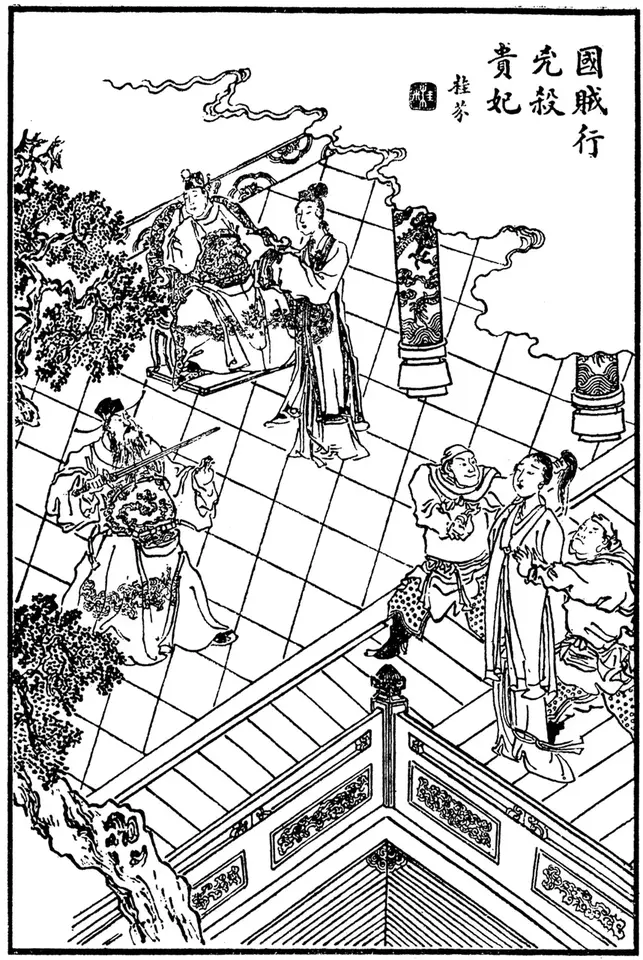
In the first month of 200, Cao Cao, fully armed with sword and armor, led troops through the inner palace gates and demanded that Consort Dong be surrendered for execution.
Consort Dong was several months pregnant with Emperor Xian's child. Terrified by the armored soldiers and the sudden news of her family's annihilation, she collapsed weeping in the emperor's arms. Shattered with grief, Emperor Xian abandoned all imperial dignity, kneeling before Cao Cao and clutching his sleeves. The emperor wept and pleaded: "Consort Dong had no knowledge of Dong Cheng's conspiracy. She carries my unborn imperial heir, the flesh and blood of the dynastic line. I do not ask for pardon for her kin, but only beg you to spare her life for the sake of the Han lineage!"
Empress Fu Shou, standing beside them, also knelt and wept, proposing that Consort Dong be stripped of her honors and placed under solitary confinement until the child was born.
Cao Cao remained unmoved, declaring that sparing the mother and child would inevitably invite future calamity upon his own clan. He barked orders to his guards, who forcibly tore Consort Dong from Emperor Xian's desperate embrace. Dragged into the courtyard, she was strangled to death with a silk cord. The young consort and her unborn infant perished together on the cold stones of Xu Palace. Emperor Xian could only bury his face against a pillar and weep inconsolably.
The horrifying murder of Consort Dong left an indelible psychological scar on Empress Fu Shou, who had witnessed the butchery firsthand. Realizing that Cao Cao could kill an imperial consort carrying royal blood with total impunity, Empress Fu knew her own family was equally vulnerable.
In profound terror, Empress Fu smuggled a secret letter out of the palace to her father, Fu Wan, detailing Cao Cao's atrocities in the inner court and begging him to organize loyalists to remove the dictator. However, Fu Wan recognized Cao Cao's overwhelming military dominance and refrained from taking open action. Fourteen years later, in 214 (Jian'an 19), Empress Fu's letter was uncovered. Cao Cao ordered the empress dragged from behind a palace wall and executed, along with over one hundred members of her clan. The tragic demises of Consort Dong and Empress Fu became the dual symbols of late Eastern Han inner court martyrdom.
Consort Dong's tragic fate evoked deep sympathy across subsequent generations of scholars and commentators. During the late Ming and early Qing dynasties, the literary critic Mao Zonggang compared Consort Dong to Consort Yang Guifei: "Yang Guifei died due to the corruption and misgovernance of her brother Yang Guozhong, yet posterity still weeps for her; Consort Dong died because of the sovereign loyalty of her father Dong Cheng, how could the righteous of the realm not weep bitter tears? Consort Dong's injustice is deeper than Taizhen's, and Emperor Xian's agony was far greater than Emperor Xuanzong's." Consort Dong remains an enduring symbol of imperial helplessness and personal sacrifice under tyrannical rule.
Descended from the prominent Dong consort clan, she entered the palace during the early Jian'an era and was formally invested as Noble Consort (Guiren).
Through her gentle character and dedication, she provided vital emotional comfort and stability to the embattled young Emperor Xian in his isolation.
In 199, Emperor Xian secretly issued the blood decree to her father Dong Cheng, linking Consort Dong's destiny inextricably to the struggle to restore imperial power.
Following the leak of the plot in 200 and the extermination of the Dong clan, Cao Cao directed his vengeance into the inner court, targeting Consort Dong directly.
Though several months pregnant with imperial lineage, Emperor Xian wept and knelt before Cao Cao seeking clemency, supported by Empress Fu's petitions.
Cao Cao mercilessly ordered her execution, having her dragged from the emperor's arms and strangled, perpetrating a grievous atrocity against the imperial household.
Her execution directly drove Empress Fu Shou to secretly urge her father to plot against Cao Cao, laying the tragic groundwork for the palace purges of 214.
Her sacrifice laid bare the violent subjugation of the Han monarchy by military dictators, becoming a lasting historical emblem of the fall of the Han dynasty.
FIGURES ASSOCIATED WITH THIS DYNASTY