Birth in Pingyuan
Born in Yanji County, orphaned in infancy and raised by his elder brother and sister-in-law.
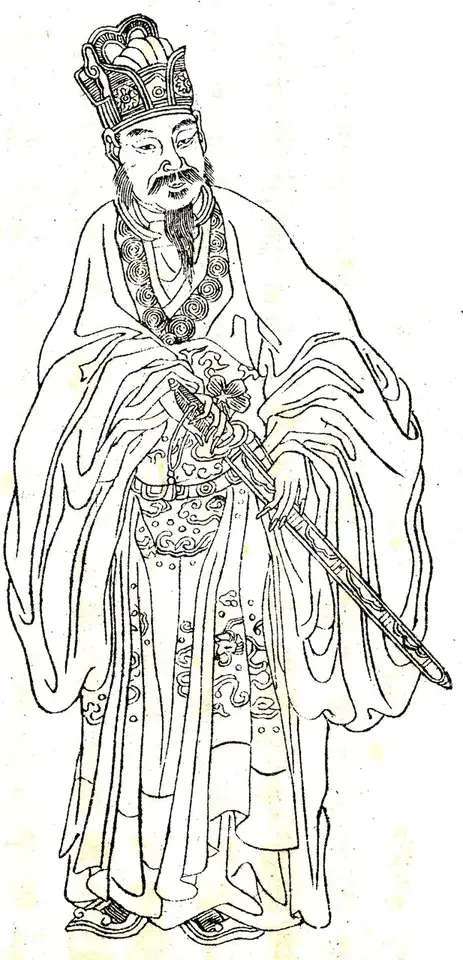
东方朔
Dongfang Shuo (161–93 BCE), courtesy name Manqian, was a native of Yanji County, Pingyuan Commandery (present-day Shentou Town, Lingcheng District, Dezhou, Shandong Province). An eminent literary figure, poet, and court intimate of Emperor Wu of Han, he was renowned throughout Chinese history for his encyclopedic learning, rhetorical brilliance, sharp wit, and daring political remonstrances delivered under the guise of humor,…
Dongfang Shuo (161–93 BCE), courtesy name Manqian, was a native of Yanji County, Pingyuan Commandery (present-day Shentou Town, Lingcheng District, Dezhou, Shandong Province). An eminent literary figure, poet, and court intimate of Emperor Wu of Han, he was renowned throughout Chinese history for his encyclopedic learning, rhetorical brilliance, sharp wit, and daring political remonstrances delivered under the guise of humor, earning him Sima Qian's praise in the Records of the Grand Historian as "the foremost of the jesters and humorists." In 140 BCE, when Emperor Wu ascended the throne seeking talent, Dongfang Shuo submitted an extraordinary self-recommendation written on three thousand bamboo slips, taking two men to carry and requiring two months for the emperor to read, securing an imperial appointment. Serving as Regular Attendant Gentleman and Grandee of the Center, he spent decades accompanying the monarch, utilizing satirical anecdotes and sharp comedy to offer candid critiques on state governance. He mounted famous objections against the expansion of the Shanglin Imperial Park, advocated pragmatic policies favoring agriculture and strategic military defense, and boldly barred imperial favorite Dong Yan from violating court etiquette. Unable to attain high policy-making executive office under Emperor Wu's autocratic and legalistic regime, Dongfang Shuo composed literary masterpieces such as Replying to a Guest's Objection (Da Ke Nan) and Discourse of Master Non-Existent (Fei You Xian Sheng Lun), articulating the profound philosophical posture of the "great hermit secluded within the imperial court." His wisdom, humor, and principled eccentricity left an enduring imprint on Chinese literary and intellectual culture.
Born in Yanji County, orphaned in infancy and raised by his elder brother and sister-in-law.
Submitted a massive three-thousand-slip self-recommendation to the newly enthroned Emperor Wu, appointed Gentleman-in-Waiting.
Staged a comedic threat to court dwarfs to obtain a direct imperial audience, securing appointment as Gentleman Attendant.
Won court divination guessing games against favorite Guo Sheren, promoted to Regular Attendant Gentleman.
Fiercely opposed the construction of the vast Shanglin Park on farmland, rewarded with gold and made Grandee of the Center.
Demoted to commoner status after intoxication at a court banquet, subsequently composing Da Ke Nan to articulate his reclusive philosophy.
Barred imperial favorite Dong Yan from entering the inner palace through the main gate, upholding dynastic propriety.
Fell critically ill and delivered a solemn final warning to Emperor Wu to reject flattering sycophants before passing away.
Dongfang Shuo was born in 161 BCE in Yanji County, Pingyuan Commandery. Bereft of his parents in early infancy, he was raised under the impoverished care of his elder brother and sister-in-law. Endowed with extraordinary memory and intellectual curiosity, he mastered the foundational classics between ages thirteen and sixteen.
He broadened his education to encompass the Classic of Poetry, the Book of Documents, and diverse philosophical schools, absorbing over two hundred thousand words of classical text. At nineteen, he undertook intensive study of Sunzi's military treatises and tactical signaling formations, acquiring a comprehensive grasp of strategy, martial arts, and classical rhetoric.
In 140 BCE, the sixteen-year-old Emperor Wu ascended the imperial throne and issued an open proclamation summoning men of worthy character, profound learning, and exceptional literary talent to the capital. Scholars throughout the empire submitted standard memorials, but Dongfang Shuo prepared a monumental submission inscribed upon three thousand bamboo slips. Because of the sheer physical bulk of the bamboo rolls, two muscular laborers were required to transport them into the palace. Emperor Wu devoted two full months to reading the submission in its entirety.
Dongfang Shuo's self-recommendation was written with breathtaking confidence and rhetorical flair. He described his towering height of nine chi and three cun, his piercing eyes like luminous pearls, his physical bravery comparable to Meng Ben, his agility matching Qing Ji, his moral frugality equaling Bao Shu, and his trustworthiness rivaling Wei Sheng. Impressed by his audacious courage and boundless erudition, Emperor Wu retained him at the Bureau of Public Chariots.
Retained alongside hundreds of aspiring scholars on meager rations, Dongfang Shuo grew frustrated by months of bureaucratic delay without securing a direct audience with the emperor. Aware that conventional petitions would never attract the busy young sovereign, he devised an ingenious psychological ruse.
Observing a troupe of palace dwarfs who tended the imperial horses, Dongfang Shuo confronted them with an austere expression, fabricating a dire warning: "The Son of Heaven considers you completely useless for farming, warfare, or administrative governance. He views you as mere consumers of public grain and has privately resolved to have you all beheaded! If you value your lives, rush to the imperial presence immediately and plead for mercy!" Terrified, the dwarfs cast themselves before Emperor Wu, weeping and begging for their lives.
Baffled, Emperor Wu interrogated the dwarfs and discovered that Dongfang Shuo had instigated the commotion. Summoning Dongfang Shuo into the audience hall, the emperor demanded an explanation. Dongfang Shuo replied with graceful composure: "Your servant speaks under pain of death, yet my circumstances left no alternative! These dwarfs stand three chi tall and receive a bag of grain and two hundred and forty coins each month; I stand over nine chi tall, well-versed in the ancient texts and military treatises of all dynasties, yet I receive precisely the same bag of grain and two hundred and forty coins. The dwarfs are bursting with food while your servant is perishing of hunger. If Your Majesty intends to employ me, grant me meaningful duties; if not, permit me to return to my home village, rather than allowing me to waste imperial grain here!" Emperor Wu burst into laughter at his quick wit and immediately appointed him Gentleman Attendant awaiting orders at the Golden Horse Gate.
Entering imperial attendance, Dongfang Shuo accompanied Emperor Wu continuously. On one occasion, the emperor concealed a gecko beneath a deep dish and challenged court diviners to identify it. None succeeded. Dongfang Shuo inspected the dish and improvised a rhythmic verse: "Neither dragon nor serpent, it climbs walls with stealth; four limbs hidden in shadow, if not a gecko, it is a house lizard!" Delighted by his accuracy, Emperor Wu rewarded him with ten rolls of fine silk.
The emperor's favored sycophant, Guo Sheren, jealous of Dongfang Shuo's sudden prestige, petitioned to challenge him to a series of riddle contests (shefu), betting that if Dongfang Shuo guessed correctly he would submit to public flogging, but if he failed the silk would be forfeited. Guo Sheren concealed obscure objects beneath wooden vessels, yet Dongfang Shuo solved every puzzle instantaneously, citing obscure classical etymologies and composing satirical couplets that left Guo Sheren humiliated. Following through with the wager, the emperor ordered Guo Sheren flogged, while Dongfang Shuo was promoted to Regular Attendant Gentleman.
During the summer festival, the court distributed butchered meat to imperial attendants. When the chief butcher delayed arriving, Dongfang Shuo drew his sword, severed a prime cut of meat, and announced to his colleagues: "In this sweltering heat, the meat will spoil rapidly; having received imperial authorization, I shall take my portion!" He wrapped the meat and carried it home to his wife.
The next day, officials impeached him for breach of protocol. Summoned to confess his faults before the throne, Dongfang Shuo bowed deeply and proclaimed: "Dongfang Shuo! Receiving a gift without waiting for the decree, how swift was your sword! Taking so little, how frugal you were! Bringing it home to present to your wife, how affectionate you are!" Charmed by his self-deprecating wit, Emperor Wu not only absolved him of guilt but bestowed an additional cask of wine and a hundred pounds of meat.
Behind his jester persona lay an unbending commitment to righteous governance. In 138 BCE, Emperor Wu resolved to expand the Shanglin Imperial Park, intending to enclose farmland stretching from the Zhongnan Mountains east to Lantian and Baling. This vast expanse would destroy tens of thousands of acres of fertile soil, demolish peasant homesteads, and disturb ancestral tombs to accommodate the emperor's passion for mounted hunting. Senior agricultural ministers remained silent out of fear.
Dongfang Shuo stood alone before the throne, delivering a blistering remonstrance detailing three primary evils: first, alienating the rich agricultural heartland of Guanzhong to create an idle playground undermined the economic foundation of the empire; second, evicting peasants and desecrating tombs stoked widespread resentment; third, galloping through mountain chasms risked imperial injury and placed the ancestral altars in jeopardy. He drew parallels with King Zhou of Shang's Deer Terrace and the First Emperor's Afang Palace. Stunned by his moral fortitude, Emperor Wu rewarded him with a hundred pounds of gold and elevated him to Grandee of the Center.
In 114 BCE, the widowed Grand Princess of Guantao (Dou Taizhu) kept a commoner paramour named Dong Yan. When Emperor Wu visited the princess's estate, she sought to escort Dong Yan directly into the imperial eastern palace to host a private banquet with the sovereign, a flagrant breach of court hierarchy.
Stationed at the entrance with halberd in hand, Dongfang Shuo barred their path. He loudly proclaimed to the emperor: "Dong Yan, as a commoner, consorts illicitly with the princess, violating the sacred boundary between the sexes; this is his first crime. He corrupts public morals and entices the sovereign into degradation; this is his second crime. If Your Majesty dignifies him within the eastern palace, how will you face the empire and posterity; this is his third crime!" Chastened, Emperor Wu canceled the banquet, shifted the gathering to the formal Xuan Chamber, and Dong Yan lost all court influence. For his unyielding defense of dynastic propriety, Dongfang Shuo was rewarded with thirty pounds of gold.
When an occult alchemist presented Emperor Wu with wine purporting to confer physical immortality, the emperor placed the chalice upon his desk awaiting ritual purification. Dongfang Shuo, observing from the side, seized the cup and drank it dry. Enraged by this audacity, Emperor Wu ordered him led away for immediate execution.
Smiling, Dongfang Shuo said: "Your Majesty, pray reflect! If this potion is genuine immortal wine, then no matter how you strike, I cannot die. But if your executioner slays me with a single blow, it proves the wine was merely a fraudulent concoction. If Your Majesty executes an innocent, loyal servant over a cup of ordinary wine, will you not become the laughingstock of the empire for being deceived by charlatans?" Realizing the piercing logic behind the comedy, Emperor Wu pardoned him.
Dongfang Shuo repeatedly petitioned the throne regarding the essential balance between agriculture and warfare (nong zhan). Observing that continuous campaigns against the Xiongnu were exhausting the treasury and driving peasants into bankruptcy, he urged the emperor to reduce penal harshness, invest in irrigation, encourage grain accumulation, and prioritize the livelihoods of ordinary citizens over territorial expansion.
When asked his opinion regarding Chancellor Gongsun Hong and harsh legalist prosecutor Zhang Tang, Dongfang Shuo warned that excessively rigid legalism created an environment where petty functionaries flourished while banditry surged, because the people lacked basic subsistence. He advocated moral benevolence as the only lasting cure for social disorder.
Despite his genius, Dongfang Shuo was never entrusted with top executive office. Emperor Wu viewed him primarily as an amusing companion whose frankness could be tolerated, yet whose eccentricities excluded him from ministerial command. Disillusioned, Dongfang Shuo experienced temporary demotion to commoner status after a drinking indiscretion in the palace hall, being ordered to wait for drafting orders at the Golden Horse Gate.
Reflecting upon his marginalization, Dongfang Shuo composed Replying to a Guest's Objection (Da Ke Nan). Structuring the work as a dialogue between himself and an inquisitive critic who mocked him for failing to match the ministerial heights of Warring States persuaders like Su Qin and Zhang Yi, Dongfang Shuo offered a profound structural analysis of imperial consolidation. In the Warring States period, competing kingdoms vied for talent, enabling itinerant rhetoricians to sway sovereign decisions; under the unified Han empire, total autocracy left little room for independent statecraft.
He famously declared his intention to "sink into the vulgar dust and dwell as a recluse at the Golden Horse Gate," asserting that true sages need not flee into isolated mountains, but can preserve moral purity within the heart of imperial administration: "The ancients hid themselves in marketplaces and courts; the greatest hermit conceals himself within the court." This foundational text created a novel existential refuge for traditional scholars. He followed this with Discourse of Master Non-Existent (Fei You Xian Sheng Lun), an allegorical defense of virtuous ministers confronting obstinate sovereigns.
In his later years, Dongfang Shuo adopted an increasingly eccentric lifestyle, using imperial financial rewards to marry young women in Chang'an, only to separate amicably within a year and distribute his assets, prompting courtiers to label him a madman. When asked about this, he replied: "If men of my talent held supreme power, opportunistic hypocrites would mimic my ways and turn the court into a bazaar; by remaining in the lower ranks, I preserve my authenticity and speak truth without endangering the state."
In 93 BCE, Dongfang Shuo fell mortally ill. Emperor Wu sent personal envoys to his bedside. The veteran courtier, who had spent a lifetime jesting with the emperor, turned solemn. He struggled to sit upright and delivered his dying plea: "I beseech Your Majesty to distance yourself from flattering sycophants and expel those who practice deceptive rhetoric! Slanderous words not only ruin households, but bring down the state!"
Receiving this final message, Emperor Wu was deeply moved, recognizing the profound loyalty hidden beneath Dongfang Shuo's lifelong satire. The emperor sighed: "Now Dongfang Shuo speaks with such solemn virtue; truly, when a man faces death, his words are noble!" Dongfang Shuo passed away shortly thereafter at age sixty-nine.
Under Emperor Wu's authoritarian and volatile rule, direct remonstrance frequently invited catastrophic retribution, as seen in the castration of Sima Qian and the dismissal of Ji An. Dongfang Shuo pioneered an alternative avenue of political dissent, clothing serious moral critique in playful absurdity and literary wit.
From deterring the construction of Shanglin Park to humiliating Dong Yan and dispelling alchemical charlatans, Dongfang Shuo successfully corrected imperial missteps while preserving his own life, embodying an unprecedented synthesis of moral courage and communicative genius.
Dongfang Shuo's Da Ke Nan established a vital philosophical tradition in Chinese intellectual history. Confronted by the suffocating weight of imperial autocracy, he rejected both total worldly capitulation and complete hermit asceticism.
By defining the Golden Horse Gate as his mountain hermitage, he demonstrated that a scholar could participate in public life while maintaining spiritual independence. This "court recluse" paradigm provided intellectual solace for generations of later luminaries, profoundly influencing Tao Yuanming, Bai Juyi, and Su Shi.
Dongfang Shuo holds a distinguished position in Han dynasty literature. His Da Ke Nan inaugurated the "hypothetical discourse" (shelunti) genre, directly inspiring Yang Xiong's Jie Chao, Ban Gu's Da Bin Xi, and Zhang Heng's Ying Jian. His Fei You Xian Sheng Lun enriched allegorical prose, bridging the gap between descriptive Han rhapsody and ideological essay writing.
FIGURES ASSOCIATED WITH THIS DYNASTY