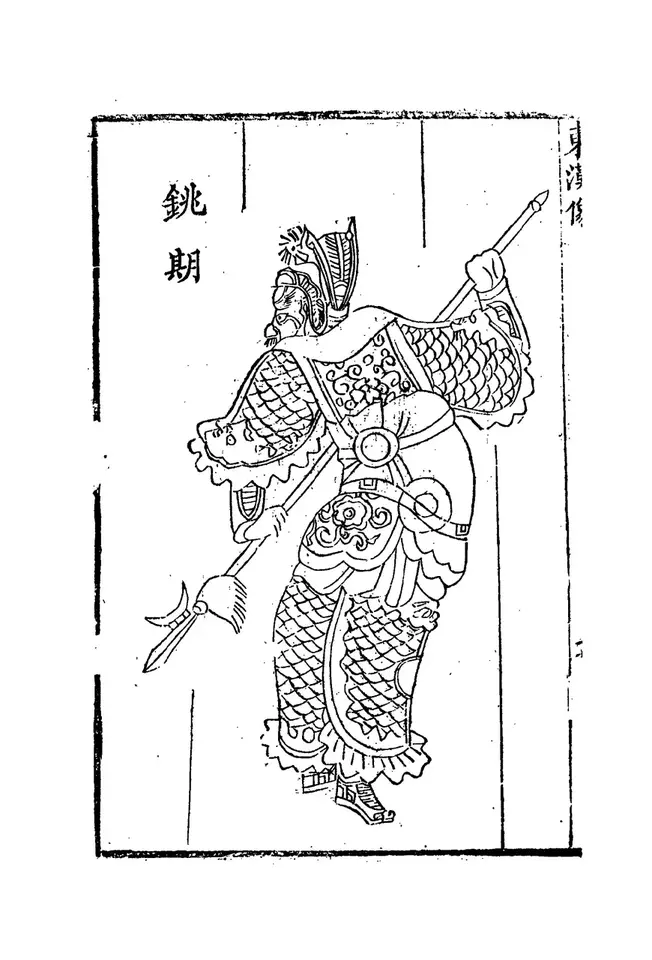
Biography
Filial Renown and Early Allegiance to Liu Xiu
Diao Qi was born into an illustrious lineage in Jia County of Yingchuan Commandery. Standing eight feet two inches tall, he possessed a commanding and dignified presence, united with an upright, sincere temperament and profound strategic vision. His father, Diao Meng, had served as Grand Administrator of Guiyang during the Western Han, celebrated among local officials and commoners for his incorruptible and equitable governance. When his father died, Diao Qi observed three years of profound mourning in a thatched hut beside the tomb, abstaining from meat and wailing at every ritual sacrifice. His immaculate filial devotion became renowned throughout Yingchuan, earning the admiration of regional gentry and heroes.
In 23 CE, Liu Xuan was crowned the Gengshi Emperor, commissioning Liu Xiu as Colonel Director of Retainers to restore the administrative palaces in Luoyang. When Liu Xiu marched through Fucheng County in Yingchuan, Feng Yi, who had already joined Liu Xiu and recognized Diao Qi's martial prowess and unyielding loyalty, warmly recommended him. Liu Xiu had long heard of Diao Qi's filial renown; upon granting him an audience, he was immensely impressed and immediately appointed Diao Qi as Clerk of Brigands (zeicao yuan), entrusting him with suppressing subversion and enforcing military discipline. Diao Qi acted with sharp decisiveness and impartial justice, establishing immaculate order throughout the army.
In October of 23 CE, the Gengshi Emperor dispatched Liu Xiu as Grand Minister of War to pacify the northern territories across the Yellow River. Facing perilous conditions with meager forces, Liu Xiu dispatched Feng Yi and Diao Qi in post carriages across the commanderies to review criminal records, pardon petty offenders, succor the vulnerable, and remit sentences for those who surrendered. Alongside these administrative duties, Feng Yi and Diao Qi carried out critical intelligence operations, covertly investigating the loyalties of local governors, colonels, and prominent clans. They compiled confidential dossiers on who was inclined to submit and who harbored rebellious designs, providing Liu Xiu with indispensable political clarity across Hebei.
The Escape from Ji and Conquests in Northern Hebei
In the spring of 24 CE, the Handan diviner Wang Lang proclaimed himself Emperor Liu Ziyu with the backing of Prince Liu Lin of Zhao, issuing warrants across the northern plains for Liu Xiu's capture. At that time, Liu Xiu was quartered in Ji, where Liu Jie, son of the Prince of Guangyang, revolted in support of Wang Lang. Rebel soldiers swarmed the city to assault Liu Xiu's headquarters.
At this mortal crossroad, Diao Qi drew his blade and spearheaded the defense, leading elite guards to cut down enemy attackers, cleave open the heavy city gates, and escort Liu Xiu safely out of the besieged city. Enduring howling blizzards and enemy pursuit, the Han contingent hastened south and safely reached Xindu, linking up with Administrators Ren Guang and Pi Tong, thereby turning the tide of the northern crisis.
Reorganizing his forces in Xindu, Liu Xiu appointed Diao Qi, Fu Kuan, and Lü Yan as Major Generals (pian jiangjun), placing them under Deng Yu's overall coordination to recruit volunteers and pacify surrounding counties. Diao Qi rode into Gaoyi County with several hundred horsemen, expounding the righteous cause to local magistrates and elders; inspired by his prestige, thousands of recruits flocked to enlist. Delighted by his swift mobilization, Deng Yu assigned Diao Qi two thousand elite troops to spearhead the vanguard.
Deng Yu reported Diao Qi's exceptional talents to Liu Xiu, who ordered Diao Qi to march north and storm Bairen and Songzi counties, subduing the local populations and securing grain reserves. Diao Qi advanced rapidly, seizing strongholds at Leyang, Feilei, and Gaocheng, shattering tens of thousands of Wang Lang's regional troops and slaying thousands. Diao Qi led every assault from the front, completely breaking Wang Lang's northern encirclement and elevating the prestige of the Han army.
Heroic Stand at Julu and Headband-Bound Combat
In the third month of 24 CE, Liu Xiu laid siege to Julu, a vital gateway protecting Handan. Recognizing its strategic importance, Wang Lang dispatched generals Ni Hong and Liu Feng with tens of thousands of elite troops to relieve the city. Liu Xiu arrayed his forces at Nanluan, concealing Jing Dan's cavalry in a forest while placing Diao Qi's infantry at the front.
When the enemy charged, the Han vanguard came under intense pressure. Diao Qi plunged into the fray, brandishing his halberd and slaying over fifty enemy combatants with his own hands. During the melee, an enemy spear struck his forehead, causing blood to stream across his face. Without flinching, Diao Qi tore off his cloth headband, bound his wound tightly, and charged back into the fight. Inspired by their general's bravery, the Han troops rallied, and Jing Dan's cavalry struck the enemy's flank, completely routing Ni Hong and Liu Feng. Following the fall of Handan in the fifth month, Liu Xiu promoted Diao Qi to General of Tiger Teeth (huya dajiangjun).
Stand at the Yellow River and Battle of Shequan
After Wang Lang's demise, massive insurgent armies posed the main threat. When hundreds of thousands of Tongma rebels approached E County, Liu Xiu marched north to intercept them. A detached rebel force moved south toward Boping, and Liu Xiu ordered Diao Qi to pursue them.
Arriving at Boping, Diao Qi found himself heavily outnumbered by the Tongma horde. After fierce fighting, the Han troops were pushed back to the banks of the Yellow River. With only several thousand men remaining and no route of escape, Diao Qi ordered his troops to fight with their backs to the water. Leading the counter-charge, Diao Qi killed dozens of foes in close combat. Just as the lines wavered, Liu Xiu arrived with cavalry reinforcements, smashing the rebel forces and pursuing them to Guantao, where the survivors surrendered.
Later, at Shequan, Qingdu rebels launched a nighttime raid against Diao Qi's baggage train. Leaping onto his horse, Diao Qi counterattacked. Though wounded three times, he fought furiously until relief units arrived and dispersed the enemy.
Executing Miao Zeng and Securing Wei Commandery
Meanwhile, Regional Governor Miao Zeng held Ji with twenty thousand troops and secretly plotted against Liu Xiu. Recognizing the strategic importance of Youzhou, Liu Xiu sent Diao Qi to serve as Magistrate of Ji.
Diao Qi approached the city gates with a small escort. Misjudging him as a harmless civilian administrator, Miao Zeng exited the gate to greet him. Diao Qi swiftly denounced Miao Zeng's treachery and had him executed on the spot. Terrified by Diao Qi's resolve, Miao Zeng's twenty thousand soldiers laid down their weapons and surrendered without resistance, bringing Youzhou firmly under Han control.
Upon ascending the throne in 25 CE, Emperor Guangwu enfeoffed Diao Qi as Marquis of Ancheng. Appointed Grand Administrator of Wei Commandery, Diao Qi crushed the rebel leader Zhuo Jing, capturing his family and slaying hundreds of insurgents. He suppressed bandits in Fanyang and Neihuang. When local magnate Li Lu conspired to admit rebels, Diao Qi pardoned his family, earning the lifelong loyalty of Wei Commandery's prominent clans.
Defense of Yecheng and Palace Command
In 26 CE, the rebel general Zhang Feng mutinied in Zhending, colluding with northern insurgent groups to encircle Yecheng. At that time, Emperor Guangwu's main field armies were operating in eastern China, while Yecheng housed the traveling court, Empress Dowager, and imperial household, creating an extremely critical situation. Diao Qi led elite Wei Commandery cavalry on a forced march to relieve Yecheng, launching surprise strikes that routed Zhang Feng's detached forces and slew dozens of rebel officers, completely lifting the siege.
Because Diao Qi had governed Wei Commandery and Youzhou over an extended period, he demonstrated mastery not only in combat tactics but also in agricultural colonies (tuntian) and military logistics, continuously forwarding remounts, weapons, and grain to sustain frontline imperial armies. Recognizing his decisive contribution to imperial supply lines, Emperor Guangwu specially issued an imperial decree enfeoffing Diao Qi's mother as Lady Dowager of Ancheng, bestowing gold seals and purple sashes to honor their distinguished household.
In 29 CE, with the broader empire pacified, Emperor Guangwu recalled Diao Qi to Luoyang to assume the prestigious position of Commandant of the Guards (weiwei), one of the Nine Ministers (jiuqing). As Commandant of the Guards, Diao Qi held overall command over the imperial garrison soldiers guarding all gates of the Southern and Northern Palaces, overseeing palace patrols and the formal opening and closing of all palace entrances.
Diao Qi was modest, upright, and deeply prudent. Holding the vital levers of imperial security, he adhered strictly to statutes, maintaining rigorous self-restraint. Whenever founding commanders such as Grand Minister of War Wu Han debated state affairs at court, they frequently vaunted their past military exploits. Diao Qi alone maintained strict silence regarding his achievements, retiring to his quarters after court sessions to study ancient military treatises without a hint of vainglory. Emperor Guangwu frequently praised him before the assembled ministers: "Diao Qi is not only foremost in martial valor, capable of felling enemy generals and capturing standards; he also possesses the grand decorum, humility, and steadfast rectitude of the ancient ministers. Would that every commander under Heaven were like Cikuang!"
Strategic Foresight and Immortal Renown
Throughout his service assisting Emperor Guangwu in reunifying the realm, Diao Qi combined extraordinary tactical valor with supreme strategic foresight. During the northern pacification when communication was cut off, he navigated between powerful warlords and insurgent bands with unflinching poise. In the breakout at Ji, he charged single-handedly through overwhelming hordes, sustaining multiple wounds while fighting on, forging a path of survival for the restoration of the Han house. During the execution of Miao Zeng, knowing that direct force was unfeasible, he feigned compliance and struck with lightning rapidity, demoralizing twenty thousand enemy troops in an instant—a feat of daring far beyond ordinary commanders.
Throughout his career, Diao Qi governed his forces with strict discipline, impartial rewards, and profound compassion. He distributed all imperial gold and silk rewards among frontline warriors and bereaved families, keeping zero private wealth. He personally attended to sick and wounded soldiers, and in every clash he placed his own body directly in the path of flying missiles, winning the boundless devotion of his soldiers.
In 34 CE, Diao Qi passed away in office as Commandant of the Guards due to chronic physical exhaustion from decades of devotion. Stricken with deep grief upon hearing the news, Emperor Guangwu visited his residence clad in plain mourning white to weep bitterly, dispatching court attendants to bestow imperial burial shrouds and the seals of General of Chariots and Cavalry, conferring the posthumous title Marquis Zhong (Zhong hou). His eldest son Diao Dan inherited the title Marquis of Ancheng, while his second son Diao Tong was created Marquis of Jianping for his filial loyalty. In 60 CE, Emperor Ming commemorated the twenty-eight founding heroes of the restoration in the Yuntai Pavilion of the Southern Palace in Luoyang, placing Diao Qi's portrait in the 18th position to receive eternal veneration in the imperial ancestral temple.