Entering Service
Recruited as Court Gentleman by Sun Quan on account of his erudition, regularly offering outspoken court counsel.
郑泉
Zheng Quan (dates of birth and death unknown), courtesy name Wenyuan, was a native of Chen Commandery (present-day Huaiyang District, Zhoukou City, Henan Province). He was an accomplished civil minister, renowned scholar-official, and diplomatic envoy of the Eastern Wu state during the Three Kingdoms Period. Renowned for his broad erudition, unusual ambitions, free-spirited temperament, and passion for wine, he possessed the…
Zheng Quan (dates of birth and death unknown), courtesy name Wenyuan, was a native of Chen Commandery (present-day Huaiyang District, Zhoukou City, Henan Province). He was an accomplished civil minister, renowned scholar-official, and diplomatic envoy of the Eastern Wu state during the Three Kingdoms Period. Renowned for his broad erudition, unusual ambitions, free-spirited temperament, and passion for wine, he possessed the witty eloquence and unrestrained character characteristic of the Wei-Jin literati. Recruited into government service under Sun Quan as Court Gentleman, Zheng Quan was celebrated for his unyielding candor, frequently rebuking the ruler directly during open court debates without regard for ceremonial niceties. When Sun Quan asked whether he feared offending the imperial dragon scales, Zheng Quan calmly answered that a wise monarch fosters outspoken ministers, winning Sun Quan's lasting respect. Following the Battle of Yiling, as Eastern Wu confronted imminent military invasions from Cao Wei, Sun Quan urgently sought to reconstruct the alliance with Shu Han. In the twelfth month of 222, Zheng Quan was dispatched as Grand Master of Palace Accord to Baidicheng to confer with Liu Bei. Facing Liu Bei's indignant questioning regarding unreturned state letters, Zheng Quan delivered a compelling defense based on dynastic legitimacy that humbled Liu Bei, successfully thawing diplomatic relations and laying the groundwork for the formal anti-Wei alliance between Sun Quan and Liu Shan.
Recruited as Court Gentleman by Sun Quan on account of his erudition, regularly offering outspoken court counsel.
Rebuked Sun Quan during court sessions; defended his boldness by citing the monarch's magnanimity.
Promoted to Grand Master of Palace Accord, participating in high diplomacy and state protocol.
Traveled as imperial envoy to Baidicheng, persuading Liu Bei and breaking diplomatic hostility with Shu Han.
Welcomed Deng Zhi's reciprocal mission to Eastern Wu following Liu Bei's death, formalizing the new alliance.
Fell gravely ill and uttered his famous humorous wish to be buried by a pottery kiln and fashioned into a wine flagon.
Zheng Quan was born in Chen Commandery in the Central Plains. From his youth, he read voraciously across classical and historical literature, displaying exceptional literary talent and harboring unique personal aspirations. In his daily conduct, he exhibited an unrestrained, eccentric disposition and developed an intense fondness for wine, viewing drinking as life's supreme joy.
During quiet hours among friends, he often remarked with passionate longing: "My greatest desire is to possess a grand vessel holding five hundred piculs of exquisite wine, with seasonal delicacies and confections arrayed at both bow and stern. I would recline within, drifting along the waters and drinking without restraint, pausing only to savor rich food when exhausted. Whenever the wine diminished by a single peck, it would be topped up immediately. What could be more delightful than that!" His expansive wit and carefree nonconformity circulated widely through the Jiangdong region, leading contemporaries to liken him to the unfettered philosophers of antiquity.
When Sun Quan established his regional administration and actively gathered gifted men, he learned of Zheng Quan's scholarly brilliance and recruited him as a Court Gentleman. In this role, Zheng Quan attended the sovereign and participated in deliberations on state policies. Possessing a naturally authentic and unbending character, he refused to mince words. Whenever state policies contained oversights or Sun Quan made arbitrary rulings, Zheng Quan stepped forward to offer direct remonstrances in front of all civil and military officials, at times speaking with sharp urgency that appeared to disregard rigid palace protocol.
Following one court assembly, Sun Quan pulled Zheng Quan aside and questioned: "You are fond of censuring me directly in the midst of the multitude, at times even failing in deference. Do you truly harbor no fear of offending the dragon's scales?" Zheng Quan answered with serene composure: "I have heard that where there is an enlightened sovereign above, there will be upright ministers below. Today, as our court enjoys uninhibited speech from top to bottom, I rely entirely on Your Lordship's boundless generosity; therefore, I fear no dragon scales." Sun Quan laughed heartily and treated Zheng Quan with even greater affection and favor.
On a later occasion during a court banquet, Sun Quan decided to play a practical jest to test Zheng Quan's courage. The sovereign feigned sudden fury and commanded palace guards to drag Zheng Quan out of the hall and deliver him to judicial officers for punishment. As he was being escorted through the palace gates, Zheng Quan looked back repeatedly toward Sun Quan. Calling him back with a chuckle, Sun Quan asked: "You claimed that you do not fear the dragon scales; why then did you turn your head so many times as you left?" Zheng Quan wittily retorted: "I rely entirely on Your Lordship's protective benevolence and know with certainty that I face no fatal peril. But as I crossed the threshold, I was so moved by the awe-inspiring majesty of Your Lordship's bearing that I simply could not refrain from looking back!" The assembled court erupted in joyful laughter, and Sun Quan marveled at his quick wit.
In 222, following his crushing defeat by Lu Xun at the Battle of Yiling, Liu Bei retreated to Baidicheng. Seeing Eastern Wu occupy the field, Emperor Wen of Wei broke the existing armistice and launched a three-pronged invasion of the south to conquer Jiangdong. Facing mortal threats on two fronts, Sun Quan recognized that repairing the alliance with Shu Han was vital to Eastern Wu's survival.
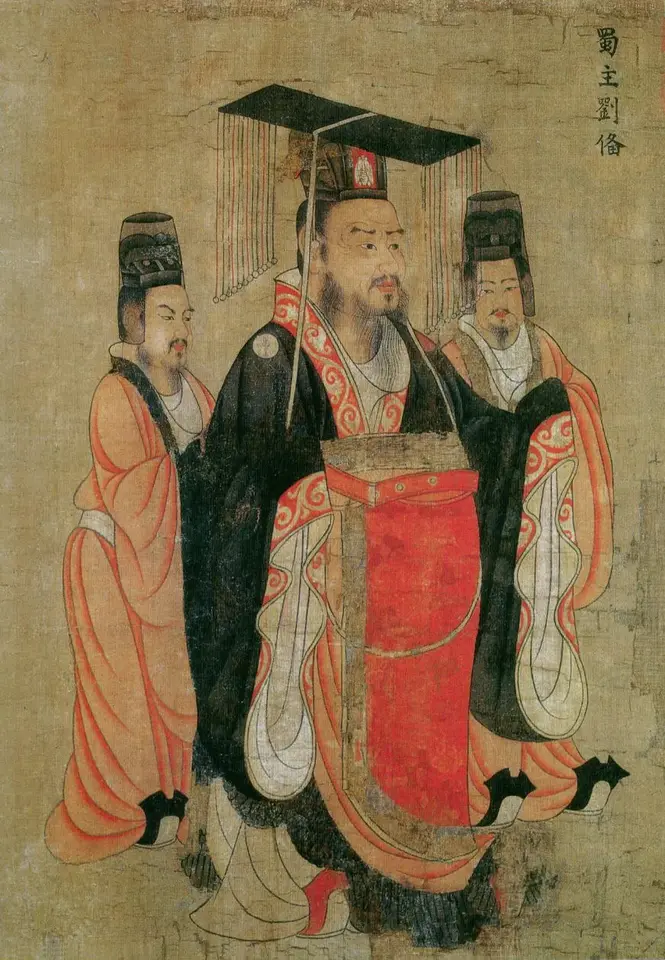
In the twelfth month of 222, Sun Quan elevated Zheng Quan to Grand Master of Palace Accord and entrusted him with the mission of traveling westward as chief ambassador to Baidicheng to reestablish diplomatic ties with Liu Bei. Still harboring bitter wrath over the loss of Guan Yu and Jing Province, Liu Bei received Zheng Quan with cold hostility, asking sternly: "Since your master Sun Quan professes an earnest desire for reconciliation, why has he failed to reply to my official state dispatches? Does he consider my assumption of the imperial dignity to be illegitimate?"
Confronting the incensed monarch, Zheng Quan replied with unyielding dignity: "Cao Cao and his son committed treason, arrogating imperial authority over the Han dynasty and ultimately usurping the imperial throne. As a royal kinsman of the House of Han, Your Majesty bore the solemn duty to rally the realm and deliver the people. Yet when the dynasty faced extinction, Your Majesty failed to lead the realm in exterminating the usurpers, and chose instead to proclaim yourself Emperor in Shu. Such conduct could hardly satisfy the public sentiment of the empire. It was precisely for this reason that my Sovereign withheld his reply." Deeply ashamed and moved by Zheng Quan's principled reasoning, Liu Bei cast aside his grievances and agreed to restore communication. Zheng Quan's diplomatic courage successfully dispelled the bitter estrangement between the two kingdoms, paving the way for the mission of Deng Zhi in 223 and the reestablishment of the anti-Wei alliance.
In his later years, Zheng Quan fell gravely ill. Sensing that his end was near, he summoned his closest companions and family members to his bedside, offering his final instructions with whimsical detachment: "After I pass away, you must bury me beside a pottery kiln. A century from now, when my body has decomposed into earth, if a potter should take that clay and bake it into a wine flagon, so that I may hold fine wine day after day, it would fulfill the ultimate wish of my life!" Even on the brink of death, he retained his poetic nonchalance, entirely unencumbered by fear or mourning.
Following his death, Zheng Quan's outspoken courage in defying the dragon scales and his lighthearted wish to become a wine vessel were celebrated across generations, securing his place as one of the most vividly memorable literati figures of the Three Kingdoms era.
Serving under the authoritative and temperamental Sun Quan, Zheng Quan championed the ideal of open political discourse. Through his famous response concerning the dragon scales, he articulated the moral duty of the scholar-official to speak truth to power, transforming dangerous confrontations into moments of enlightened mutual understanding between monarch and subject.
During the strategic crisis of 222, when Eastern Wu was threatened by Cao Wei's massive southern offensive, Zheng Quan undertook the high-stakes mission to Baidicheng. Facing an embittered and hostile Liu Bei, Zheng Quan invoked the overarching legitimacy of the Han restoration to silence royal objections, successfully dissolving the deep animosity between the two southern courts and initiating the process that forged the enduring alliance against Cao Wei.
FIGURES ASSOCIATED WITH THIS DYNASTY