Birth in Mianzhou
Born into a prominent scholarly household in Sichuan; relocated to Qiantang with his family due to wartime upheaval.
邓文原
Deng Wenyuan (邓文原) was a renowned scholar, master calligrapher, and senior statesman of the early Yuan Dynasty, hailing from Mianzhou in Sichuan (modern Mianyang), whose family relocated to Qiantang (modern Hangzhou) due to Mongol-Song warfare. Gifted with extraordinary intellect, he was versed in the classical philosophers and excelled in prose and poetry, winning immortal renown for his calligraphy. Alongside Zhao…
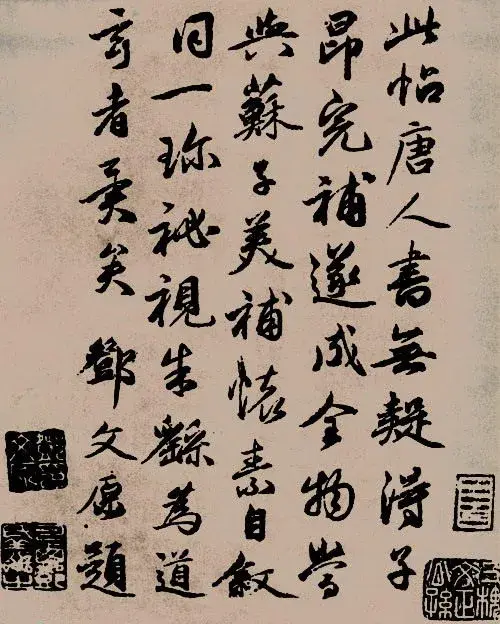
Deng Wenyuan (邓文原) was a renowned scholar, master calligrapher, and senior statesman of the early Yuan Dynasty, hailing from Mianzhou in Sichuan (modern Mianyang), whose family relocated to Qiantang (modern Hangzhou) due to Mongol-Song warfare. Gifted with extraordinary intellect, he was versed in the classical philosophers and excelled in prose and poetry, winning immortal renown for his calligraphy. Alongside Zhao Mengfu and Xianyu Shu, he was celebrated across China as one of the "Three Great Calligraphers of the Early Yuan," maintaining close intellectual friendships with literary giants such as Yu Ji and Jie Xisi. Following the fall of the Southern Song, Deng lived in scholarly seclusion. In 1290, recommended by the prominent minister Cheng Jufu, he entered public service as Education Director of Hangzhou Route. Moving to Dadu in the Yuanzhen era, he served as Directorate of Education Instructor, Hanlin Compiler, Erudite of Imperial Sacrifices, Guangxi Surveillance Commissioner, and Jiangxi Education Intendant. Under emperors Renzong and Yingzong, he rose to Hanlin Academician Expositor-in-waiting and Grand Master of Palace Accord. As Surveillance Commissioner in Guangxi, he traveled in disguise to investigate corruption, redressing countless wrongful convictions, leading grateful citizens to build shrines in his honor. In calligraphy, he championed the revival of Wei, Jin, and Tang traditions, reaching the highest mastery in regular script, running script, and draft-clerical script (zhangcao). His draft-clerical masterpiece Scroll of Jijiu Zhang is universally revered as an unequaled treasure of Chinese calligraphic art.
Born into a prominent scholarly household in Sichuan; relocated to Qiantang with his family due to wartime upheaval.
Remained in seclusion amidst the fall of Lin'an, studying ancient prose and Wei-Jin stone inscriptions.
Established intimate artistic bonds with Zhao Mengfu and Xianyu Shu in Hangzhou, exploring calligraphic revival.
Recommended by Cheng Jufu to serve as Education Director of Hangzhou Route, reforming scholarly standards.
Summoned to Dadu as Directorate of Education Instructor and subsequently Hanlin Compiler.
Appointed Erudite of Imperial Sacrifices, regulating grand imperial ceremonies and ancestral music protocols.
Dispatched as Guangxi Surveillance Commissioner, traveling in disguise to expose corruption and clear false charges.
Promoted to Hanlin Academician Expositor-in-waiting, lecturing on the classics before Emperor Yingzong.
Granted permission to retire due to advanced age and failing health, returning south to Hangzhou.
Passed away in his Hangzhou residence at age seventy-one; posthumously created Duke of Jiangxia with posthumous name Wensu.
Deng Wenyuan was born in 1258 into an illustrious scholarly clan in Mianzhou, Sichuan. As Mongol armies devastated the Sichuan basin during the late Song, his father moved the family across the country to settle in Qiantang. Growing up in genteel poverty beside West Lake, Deng dedicated himself to Confucian scholarship. By age fifteen, he had mastered the subtle meanings of the Five Classics, demonstrating precocious talent in ancient prose.
Following the Mongol conquest of Southern Song, Deng shunned bureaucratic pursuit, styling his studio "Wilderness Man of Baxi" to signify his enduring attachment to his Sichuan roots. Immersing himself in ancient rubbings, bamboo slips, and Han-Jin epigraphy, he studied through the nights. In Hangzhou, he forged an unbreakable bond with cultural titan Zhao Mengfu and cursive master Xianyu Shu. The trio spent days analyzing ancient brushwork, forming the intellectual core of the early Yuan literati calligraphic revival.
In 1290, Surveillance Commissioner Cheng Jufu toured the south to recruit neglected talents. Deeply impressed by Deng's scholarship and calligraphy, Cheng recommended him to the court. Deng was appointed Education Director of Hangzhou Route, enforcing strict academic discipline and emphasizing practical moral education.
In 1298, Deng was promoted to Instructor in the Directorate of Education in Dadu. Scholars from across the realm attended his lectures on the classics, awed by his precise textual analyses. In 1301, he was transferred to Hanlin Compiler, authoring imperial histories and state records. Later appointed Erudite of Imperial Sacrifices, he participated in formulating protocols for imperial accession and ancestral temple rites, earning the high respect of senior ministers for his ceremonial expertise.
In 1318, Emperor Renzong appointed Deng Surveillance Commissioner of the Lingnan Guangxi Circuit, tasking him with cleaning up regional governance on the empire's southern frontier. Guangxi was a remote, rugged borderland plagued by corrupt magistrates, extortionate fees, and entrenched criminal syndicates.
Refusing comfortable government hostels, Deng donned simple coarse clothes and straw sandals, traveling on horseback without retinue through mountainous villages to hear public grievances directly. Over several years, he impeached dozens of corrupt officials, suppressed oppressive clans, and cleared hundreds of innocent prisoners. Deeply moved by his justice, local residents in Guilin erected life shrines in his honor, revering him as the "Lord Bao of the Southern Seas."
In 1322, Emperor Yingzong ascended the throne and recalled Deng to the capital, elevating him to Hanlin Academician Expositor-in-waiting and Grand Master of Palace Accord. Deng lectured before the emperor on the Book of Documents and the Zizhi Tongjian, offering insightful policy advice.
In 1327, aged seventy and suffering from failing health, Deng requested permission to retire. The court granted his petition with honors, providing official carriages for his southern journey. In 1328, Deng passed away peacefully at his Hangzhou home at age seventy-one. Mourning the loss of a cultural titan, the Yuan court posthumously enfeoffed him as Duke of Jiangxia and conferred the prestigious posthumous name Wensu.
Deng Wenyuan occupies a paramount place in the history of Chinese calligraphy as one of the "Three Great Calligraphers of the Early Yuan" alongside Zhao Mengfu and Xianyu Shu. During the critical historical moment when artists sought to overturn the delicate, superficial habits of the late Song, Deng stood as a stalwart pillar of the classical revival.
His regular script drew upon Ouyang Xun and the Two Wangs, displaying lean bone structure, balanced proportions, and serene grace. His running script was gentle and aristocratic. Above all, his mastery of draft-clerical script (zhangcao) represented an unapproachable summit. His surviving handscroll, the Scroll of Jijiu Zhang, combines the austere squareness and flying tails of Han masters Huang Xiang and Suo Jing with the fluid elegance of Yuan literati. Connoisseurs across the Ming and Qing dynasties unanimously acclaimed it as the greatest masterpiece of draft-clerical script produced since the Jin Dynasty.
Although best known for his art, Deng's administrative capability and unbending honesty won equal renown. In Guangxi, he risked assassination by entrenched local syndicates to uphold the rule of law.
He cleared century-old backlog cases, liberated hundreds of falsely accused commoners, and abolished extortionate fees illegally levied by local garrisons. When he departed for the capital, thousands of weeping citizens blocked the roads to bid him farewell, building shrines where they performed annual sacrifices for generations.
Deng was a scholar of encyclopedic breadth, mastering Neo-Confucian philosophy, classical history, and ancient poetry. His prose style pursued brevity, gravity, and moral balance, emulating the ancient models of Han Yu and Liu Zongyuan.
His commemorative inscriptions, imperial edicts, and temple steles were celebrated for their stately rhythm and dignified lucidity, compared by contemporaries to "ancient bronze vessels of the Zhou and Han." Scholars such as Yu Ji and Huang Jin held his literary and moral character in the highest esteem.
FIGURES ASSOCIATED WITH THIS DYNASTY