Birth in Bailinfan
Born in the Deng Family Mansion at Bailinfan, Huaining, Anhui, into an impoverished scholarly household.
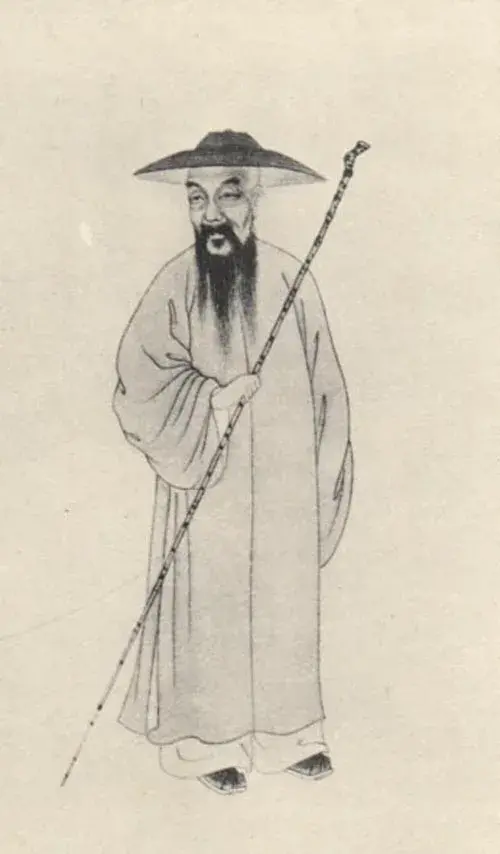
邓石如
Deng Shiru (1743–1805), originally named Yan, later adopted his courtesy name Shiru to avoid the imperial taboo of Emperor Renzong (Yongyan), using pseudonyms including Wanbo, Wanbai Shanren, Wanbai Shanmin, and Longshan Qiaozhang. A native of Bailinfan, Huaining County, Anqing Prefecture, Anhui Province, he was an internationally celebrated calligrapher, seal engraver, epigrapher, and the undisputed founding patriarch of the…
Deng Shiru (1743–1805), originally named Yan, later adopted his courtesy name Shiru to avoid the imperial taboo of Emperor Renzong (Yongyan), using pseudonyms including Wanbo, Wanbai Shanren, Wanbai Shanmin, and Longshan Qiaozhang. A native of Bailinfan, Huaining County, Anqing Prefecture, Anhui Province, he was an internationally celebrated calligrapher, seal engraver, epigrapher, and the undisputed founding patriarch of the mid-Qing Stele School revival (Beixue) and the Wan School (or Deng School) of seal cutting. Born into an impoverished scholarly family, he gathered firewood and peddled pastries in his youth to support his parents while practicing seal cutting on broken bricks. In his thirties, recommended by scholar Liang Xian, he resided in Jinling for eight years at the estate of collector Mei Liu, copying tens of thousands of rubbings of Qin, Han, and Six Dynasties stone inscriptions day and night, achieving unparalleled mastery. Visiting Beijing in late Qianlong, his monumental calligraphy astonished the capital: Grand Councilors Liu Yong and Lu Xixiong lauded his brushwork as divine, while cabinet scholar Weng Fanggang envied his renown. He served three years in the secretariat of Huguang Governor-General Bi Yuan, maintaining the upright pride of a commoner without sycophancy. In calligraphy, he broke a millennium of rigid iron-wire seal script conventions by introducing cursive brushwork into seal script and creating monumental Han-style clerical script. In seal cutting, he formulated the revolutionary principle "integrating calligraphy into seals, deriving seals from brushwork," inspiring generations of masters including Wu Rangzhi, Zhao Zhiqian, Wu Changshuo, and Qi Baishi, and was hailed by theorist Bao Shichen as the foremost calligrapher of the dynasty.
Born in the Deng Family Mansion at Bailinfan, Huaining, Anhui, into an impoverished scholarly household.
Left school due to poverty; cut firewood and sold pastries to support his family while practicing seal carving.
Taught students in Shouxian; recognized by scholar Liang Xian, who recommended him to pursue studies in Jinling.
Resided at the Jinling estate of Mei Liu for eight years, copying ancient Qin, Han, and Six Dynasties rubbings.
Concluded his studies at the Mei estate with consummate mastery of epigraphy, adopting the sobriquet "Wanbai Shanren."
Traveled to Beijing; Minister Liu Yong and Lu Xixiong praised his calligraphy as peerless, while Weng Fanggang harbored jealousy.
Joined Huguang Governor-General Bi Yuan's secretariat for three years, preserving commoner integrity and rejecting courtly flattery.
Returned to Huaining, constructed the "Tieyan Shanfang" retreat, married Lady Shen, and raised cranes.
Met young scholar Bao Shichen in Zhenjiang, imparting the inner secrets of stele brushwork; Bao became his foremost advocate.
Died of chronic exhaustion at his Tieyan Shanfang residence at age sixty-two, buried on the southern slopes of Mount Fengshui.
In 1743 (the eighth year of the Qianlong reign), Deng Shiru was born in the Deng Family Mansion at Bailinfan, outside the Jixian Pass in Huaining County, Anqing Prefecture, Anhui Province. The Deng lineage was poor yet scholarly. His grandfather Deng Shijie and father Deng Muzhai were learned men who repeatedly failed the civil service examinations. His father excelled in philology, poetry, and seal engraving, maintaining unyielding integrity amidst poverty.
Under his father's tutelage, Deng began reading classics at age nine, but mounting poverty forced him to leave school at ten. By fourteen, driven by household hardship, he joined village boys cutting firewood in the hills and peddling sesame cakes through the streets of Anqing to support his aging parents. Yet severe penury never dampened his passion for epigraphy. During pauses from labor, he gathered discarded tiles and stone fragments along riverbanks, polishing them smooth and carving Han-style seal characters with dull knives.
At seventeen, Deng presented an engraved seal to rural recluse Xiaosa Laoren and transcribed the two characters Xueke in seal script, already demonstrating archaic vigor. By twenty, he sustained himself by selling calligraphy and carving seals, wandering through Huaining, Tongcheng, and Shouxian to operate modest village schools. Tall and robust, with a long flowing beard, he possessed a fiercely independent character devoid of obsequiousness, embodying the untamed dignity of a grassroots genius.
In 1774 (the thirty-ninth year of the Qianlong reign), thirty-two-year-old Deng again established a teaching studio in Shouxian, Anhui. While there, he frequently engraved seals and inscribed fans in small seal script for students of the Xunli Academy. Academy Director Liang Xian (courtesy name Xianglin, a celebrated calligrapher renowned for emulating Tang master Li Yong) recognized Deng's monumental potential and recommended him to Provincial Graduate Mei Liu in Jinling (modern Nanjing).
Mei Liu was a scion of a prominent Jiangnan lineage descended from Song poet Mei Yaochen. The Mei estate held an extraordinary epigraphic collection encompassing tens of thousands of rubbings from Shang-Zhou bronzes, Qin imperial weights, Han monuments, Six Dynasties epitaphs, and Tang steles. Mei welcomed Deng as an honored guest, throwing open his vast library without restriction.
Throughout his eight years at the Mei estate, Deng rose before dawn and worked beneath the oil lamp late into the night. According to his methodical regimen, he devoted the first five years to copying every Qin and Han small seal monument, writing hundreds of characters daily. He spent the subsequent three years mastering Han clerical steles such as the Zhang Qian Stele, Kong Zhou Stele, Shimen Song, and Cao Quan Stele, before exploring Six Dynasties regular script and Tang running script. These eight years of concentrated study purged all provincial mannerisms, grounding his art in authentic ancient epigraphy and providing the bedrock for his future revolutions.
In 1782, at forty, Deng bid farewell to Mei Liu, adopting the title "Wanbai Shanren" (Recluse of the Pure White Mountain). In simple cotton robes, he traversed Jiangnan, Jiangxi, and Hubei, establishing widespread fame among the literati.
In 1790 (the fifty-fifth year of the Qianlong reign), during Emperor Qianlong's eightieth birthday celebrations, Minister of Revenue Cao Wenzhi accompanied Deng's works to Beijing, introducing him to Cabinet Scholar Weng Fanggang, the foremost arbiter of courtly calligraphy. Weng took immense pride in his refined Han clerical scholarship and orthodox model-book lineage. Confronted by Deng's monumental stele style that discarded courtly mannerisms, Weng perceived a mortal challenge to his authority, coldly barring his doors and circulating critiques deriding Deng's calligraphy as crude and rustic.
However, impartial masters recognized Deng's genius. Grand Councilor Liu Yong (son of Liu Tongxun and the foremost calligrapher of the era) and Siku Quanshu Chief Editor Lu Xixiong examined Deng's seal and clerical scrolls, declaring them divine brushwork unseen for two centuries. Liu Yong paid a personal visit to Deng, praising his brushwork as akin to ancient withered vines, while Lu Xixiong championed him at aristocratic banquets. Deng's fame swept the capital, and elite grandees competed to obtain his works.
In 1791 (the fifty-sixth year of the Qianlong reign), Huguang Governor-General Bi Yuan, having learned of Deng's acclaim, dispatched envoys with generous gifts inviting him to join his viceregal secretariat in Wuchang. Bi Yuan was an imperial Grand Secretary and prominent epigraphic scholar whose headquarters bustled with visiting celebrities.
Deng accepted the invitation, residing in the Wuchang yamen for three years. Bi Yuan treated him with exceptional deference, consulting him on epigraphic questions and commissioning monumental inscriptions. Yet amidst opulent officialdom, Deng preserved his humble independence, walking among dignitaries in straw sandals and coarse brown robes with unbending dignity. He disdained the fawning sycophancy of career bureaucrats, refusing to flatter power.
In artistic discussions, Deng maintained uncompromising standards, rejecting pretentious posturing. Although his stay earned handsome remuneration, he grew weary of yamen protocol. In 1794, firmly declining Bi Yuan's entreaties to remain, he boarded a boat and returned to his native rural retreat.
In the autumn of 1794, at fifty-two, Deng returned to Bailinfan, Huaining. Purchasing forty mu of fertile land to support impoverished relatives, he designed a simple residence, inscribing the plaque "Tieyan Shanfang" (Iron Inkstone Studio) above the entrance to remind descendants to pursue scholarship with unflagging resolve.
During his rustic seclusion, Deng married Lady Shen and kept a pair of long-lived cranes. He cherished the cranes as companions of scholarly hermitage. In 1796, after the female crane died of old age, Lady Shen passed away shortly thereafter. Heartbroken, Deng worried the surviving male crane would perish in winter and penned his celebrated essay Record of Entrusting the Crane, sending the bird to a monastery at Jixian Pass while regularly carrying grain up the mountain to feed it.
In his late years, Deng was renowned for benevolence, devoting earnings from his calligraphy and seal carving to repairing bridges, paving mountain roads, and providing coffins for destitute families, earning widespread veneration across Anhui and Hubei.
In 1802 (the seventh year of the Jiaqing reign), Deng encountered twenty-eight-year-old scholar Bao Shichen in Zhenjiang. Bao had long struggled within orthodox model-book conventions. Witnessing Deng write monumental seal and clerical script with effortless power, Bao was awestruck and requested to become his disciple.
Deng generously imparted the foundational mechanics of stele brushwork, explaining his core principle: "Leave wide spaces where horses can gallop, yet keep dense crossings so tight not even the wind can penetrate; count the white as black, and divine resonance will emerge." Bao adopted these dictums as supreme criteria, authoring the monumental treatise Yizhou Shuangji to champion Deng's stele doctrine.
In the autumn of 1805, Deng fell ill during his travels and returned to his studio. On October 27, 1805 (the fifth day of the ninth lunar month in the tenth year of the Jiaqing reign), Deng passed away peacefully at sixty-two, leaving behind a monumental legacy that was laid to rest on Mount Fengshui.
Prior to Deng Shiru, Chinese seal script had languished in stagnation for nearly a millennium since the Tang dynasty master Li Yangbing. Later practitioners rigidly imitated Li's iron-wire and jade-chopstick seal conventions, requiring strokes of uniform thickness with rounded beginnings and endings. This geometric uniformity transformed seal script into lifeless craft lettering, extinguishing dynamic brush vitality.
Deng initiated an unprecedented seal script revolution. Replacing traditional stiff hare or weasel-hair brushes, he boldly employed long-haired, flexible goat-hair brushes. Though notoriously difficult to govern, Deng harnessed centered brush force, creating lines resembling iron wrapped in cotton.
Crucially, Deng pioneered the practice of incorporating running and cursive brush dynamics into seal script. Infusing the rising and falling cadences of clerical and running strokes into seal lines, he created broad, soaring structures full of organic energy. Theorist Bao Shichen acclaimed his seal script as serene, majestic, and natural, surpassing ancient masters. Deng's breakthrough restored monumental Qin-Han grandeur, re-establishing seal script as a vital medium for artistic expression.
While mid-Qing evidentiary scholarship revived interest in Han clerical script, previous masters like Zheng Fu, Jin Nong, and Gui Fu tended toward mannered eccentricities or rigid archaism, failing to synthesize Han monuments into a universal system.
During his eight years at the Mei estate, having studied hundreds of Han rubbings, Deng absorbed the rustic vigor of the Kaotong Baoxiedao Inscription, the surging freedom of the Shimen Song, the heavy solidity of the Zhang Qian Stele, and the refined grace of the Cao Quan Stele, fusing them into an integrated style.
Deng's clerical script featured broad horizontal architecture, tight central nodes, and sweeping diagonal strokes. Using goat-hair brushes with centered pressure, his flared strokes resembled cracked gold and weeping rainmarks, capturing the weathered dignity of ancient stones. Scholar Ruan Yuan praised his clerical script as possessing the force to conquer ten thousand men and an antique resonance enduring through eternity, establishing the supreme aesthetic standard for Qing stele clerical calligraphy.
In the history of Chinese seal cutting, the late imperial period was dominated by the delicate, hesitant slicing strokes of the late Zhe School. Seal carvers increasingly produced fragmented, fragile cuts lacking literati vitality.
Deng formulated the transformative dictum: "Integrating calligraphy into seals, deriving seals from brushwork." He insisted that seal engraving must directly reflect the calligrapher's profound command of brushwork, transmuting ink vigor into stone.
Discarding hesitant slicing methods, Deng pioneered sweeping flush-cut and single-cut blade techniques. Handling the knife like a brush, he carved with decisive momentum, creating weathered stone incisions reminiscent of Han and Jin monuments. Furthermore, he broadened seal composition beyond Han cast bronze seals, incorporating Warring States coin scripts, Qin weights, Han bricks, and Han tile ends into seal matrices. In side-inscriptions, he introduced large-scale clerical and Northern Wei relief carvings, establishing the Wan School (Deng School) and directly inspiring masters such as Wu Rangzhi, Zhao Zhiqian, Huang Mufu, Wu Changshuo, and Qi Baishi.
Throughout the Ming and early Qing dynasties, Chinese calligraphy was dominated by the model-book orthodoxy (Tiexue) championed by Zhao Mengfu and Dong Qichang. Under imperial examination constraints, model books degenerated into glossy, lifeless court scripts (Guangeti).
Through his groundbreaking mastery of seal, clerical, regular, and running scripts, Deng shattered this monopoly as a private commoner, restructuring the entire ecology of Chinese calligraphy. His regular script integrated the angular force of Northern Wei steles like the Zhang Menglong Stele, while his running script infused stone bone into the cadence of Yan Zhenqing and Li Yong, pioneering Northern Wei running script.
Bao Shichen systematized Deng's practice in Yizhou Shuangji, establishing the Northern Stele School theoretical framework. Later statesmen and scholars, including Ruan Yuan and Kang Youwei, revered Deng as the supreme architect of the Qing calligraphic revolution, ushering in two centuries of monumental stele calligraphy that transformed East Asian aesthetics.
FIGURES ASSOCIATED WITH THIS DYNASTY