Biography
Defending the Native Soil
Kang Maocai was born into a scholarly farming family in Qichun, Qizhou. From an early age, he applied himself diligently to classical texts, mastering the lessons of past dynasties while distinguishing himself through unyielding rectitude and deep devotion to his mother. In the late Zhizheng era of the Yuan Dynasty, catastrophic famine and administrative breakdown led to widespread peasant insurrections across the Huai River basin. In 1351, when Red Turban insurgent groups overran Qizhou and local magistrates abandoned their posts, the countryside descended into widespread chaos.
Confronted by these depredations, Kang Maocai expended his family resources to recruit several thousand stalwart local men, constructing hillside forts and organizing defensive patrols. Impressed by his defense of regional order, the Yuan provincial authorities commissioned him as a local captain and soon promoted him to Pacification Commander. Over the following years, as hostilities expanded throughout the middle Yangtze, Kang fought alongside imperial commanders to recover Jiujiang and stormed the fortified insurgent base at Huanglianzhai. For these merits, he was elevated to Associate Chief of the Qizhou Superior Prefecture and deployed to garrison Yuxi and Caishi along the Yangtze River. Renowned for strict discipline and benevolence toward his subordinates, he won the steadfast loyalty of his troops and was sequentially promoted to Pacification Commissioner and Chief Marshal of Western Huai.
Holding the Crossing and Allegiance to Ming
In June 1355, Zhu Yuanzhang launched his ambitious amphibious crossing of the Yangtze from Hezhou. While the main body crossed toward Taiping, large numbers of military families and logistical supplies remained north of the river. Kang Maocai positioned his veteran contingents at the strategic cliffs of Caishi, leveraging artillery and river vessels to block the crossing. Zhu Yuanzhang dispatched units to storm his defensive line, but Kang's soldiers held fast, repelling multiple assaults.
Recognizing Kang's tenacity, vanguard commander Chang Yuchun devised an ambush. He sent small skirmishing units to execute mock charges day after day, drawing Kang into repeated counter-attacks until his defenders were thoroughly fatigued. Under cover of night, Chang concealed shock cavalry in surrounding valleys and launched a devastating dawn assault, decimating Kang's frontline forces. Undaunted by the reverse, Kang gathered his surviving soldiers and constructed an entrenched redoubt on Tianning Island. In the second month of 1356, Zhu Yuanzhang deployed heavy counterweight trebuchets to shatter the palisades, compelling Kang to flee to the regional Yuan bureau at Nanjing, where he was made an Assistant Administrator of the Huainan Branch Secretariat.
In March 1356, Zhu Yuanzhang captured Jiqing. Finding his retreat toward Jingkou severed by pursuing flotillas, Kang recognized that the mandate of heaven had shifted. He led his remaining three thousand men to lay down their arms and submitted to Zhu Yuanzhang. Bareheaded and prostrating, Kang declared that his former resistance had merely been loyalty to his prior master, but his repeated defeats confirmed the will of heaven. Zhu Yuanzhang laughed warmly, untied Kang's bonds with his own hands, and placed him back in charge of his original forces.
The Longwan Deception and Decisive Ambush
Once enlisted under Zhu Yuanzhang, Kang served with single-minded devotion. In 1357, he was commissioned Marshal of the Qinhuai Waterborne Guard, responsible for patrolling Longwan, the western water gateway to Nanjing. That same year, when the forces of Zhang Shicheng raided along the lower river, Kang led an intercepting squadron at Matuosha near Jiangyin, routing the invaders and capturing several immense multi-decked war barges. In 1358, he accompanied Liao Yong'an in seizing Chizhou and Congyang, earning praise for his maritime competence.
In the summer of 1360, Chen Youliang assembled the full naval might of the Han state, sailing hundreds of massive warships down the Yangtze to capture Taiping and bear down on Nanjing. The capital was paralyzed with dread; several advisors urged surrender while others suggested retreating to the Zijin Mountains. Aware that Kang Maocai was an old acquaintance, Chen Youliang sent a secret messenger offering extravagant rewards if Kang would act as a fifth column within the city. Without the slightest hesitation, Kang escorted the spy directly into Zhu Yuanzhang's presence. Zhu Yuanzhang recognized a rare opportunity to exploit the enemy's overconfidence and devised a master counter-ambush.
Guided by Zhu Yuanzhang, Kang sent a trusted servant with a letter to Chen Youliang, promising to surrender his post at the wooden Jiangdong Bridge. Kang instructed the Han forces to advance boldly to the bridge, where his own troops would welcome them upon hearing the prearranged password calling for their old colleague. Meanwhile, Zhu Yuanzhang instructed General Geng Bingwen to dismantle the wooden bridge under cover of night, rebuilding it as a solid stone span, while stationing elite infantry and artillery concealed in the nearby reeds and slopes. When Chen Youliang's vanguard reached the bridge, they discovered a solid stone structure instead of the promised wooden span. Calling out in vain, Chen realized the deception and cried in dismay that scholar Kang had betrayed him. At that moment, Ming cannons roared, and concealed troops surged forward from all sides. Trapped in the narrow inlet, the colossal Han galleons could neither maneuver nor turn; thousands drowned or were captured, and Chen Youliang barely escaped on a light skiff. The Battle of Longwan permanently broke the offensive power of the Han state, securing Zhu Yuanzhang's foundation in Jiangnan.
Campaigns on the Yangtze and Lake Poyang
Following the victory at Longwan, Kang participated in the riverine counter-offensive. In 1361, he spearheaded the recapture of Taiping, advanced upriver to retake Anqing, and drove deep into Jiujiang, forcing Chen Youliang to abandon his regional base and flee to Wuchang. In recognition of his valor, Kang was promoted to Assistant Commissioner of the Chief Military Commission and later elevated to Associate Commissioner, entering the highest tier of the Ming military hierarchy.
In 1363, Chen Youliang mobilized an army of over six hundred thousand men to besiege Hongdu (modern Nanchang). Zhu Yuanzhang personally led a relieving fleet, sparking the epic Battle of Lake Poyang. Throughout the multi-day naval engagement, Kang commanded forward squadrons against the towering chained vessels of the Han armada. Utilizing favorable winds, he directed fire-ships into the opposing lines, igniting the enemy armada and cutting down key commanders. Following Chen Youliang's death from a stray arrow, Kang blockaded the exit at Jingjiang, preventing the retreat of the defeated forces and compelling thousands of enemy sailors to surrender.
After the destruction of the Han regime, Ming armies turned eastward against Zhang Shicheng. In 1366, Kang accompanied Xu Da and Chang Yuchun in the massive encirclement of Pingjiang (modern Suzhou). During the ten-month siege, Kang oversaw fortifications at Yinshan Bridge and the Xu Gate, repelling numerous sorties by elite cavalry and constructing continuous siege palisades that choked off all provisions. The eventual capture of Suzhou completed the unification of southern China under Zhu Yuanzhang's banner.
The Northern Expedition and Western Operations
In October 1367, Zhu Yuanzhang appointed Xu Da as General-in-Chief and launched the grand Northern Expedition to drive the Yuan court from the Central Plains. Kang Maocai was assigned critical responsibilities encompassing both vanguard combat and rear logistics. Advancing rapidly through Shandong, Kang's forces swept into Henan, capturing Bianliang, Luoyang, and Shanzhou, before securing the vital approach to Tongguan Pass.
Following the formal establishment of the Ming Dynasty in 1368, Kang continued to operate under Xu Da in the vast northwestern theater, where formidable Mongol remnants under Koke Temur and local warlords like Li Siqi retained formidable garrisons. Kang led formations into Shaanxi and eastern Gansu, seizing Fengxiang and Gongchang and pacifying the Qiang tribes of Lintao. Recognizing the suffering inflicted by years of relentless warfare, Kang enforced absolute discipline, forbidding looting and opening granaries to distribute emergency relief to starving civilians, earning high praise from local communities.
In 1369, when Koke Temur laid siege to Lanzhou, Xu Da led the main army west toward Dingxi. Kang was detached to conduct an arduous mountain campaign into the Hanzhong basin. Negotiating rugged defiles, he outmaneuvered and forced the surrender of Jin Xingwang, an unreliable former Yuan general, firmly securing the Hanzhong gateway that linked Shaanxi with Sichuan.
Demise on Campaign and Posthumous Honors
Decades of non-stop campaigning through river marshes, mountain passes, and the dusty plains of the north took a heavy toll on Kang Maocai's health. In the spring of 1370, after pacifying major insurgent pockets in the northwest, Kang received orders to return to the capital with his victorious troops. While traveling along the cliffside plank roads of Shaanxi, his illness took a sudden turn for the worse. Even in his final days, he continued reviewing military ledgers and organizing handover procedures from his field tent, ultimately passing away on campaign at the age of fifty-six.
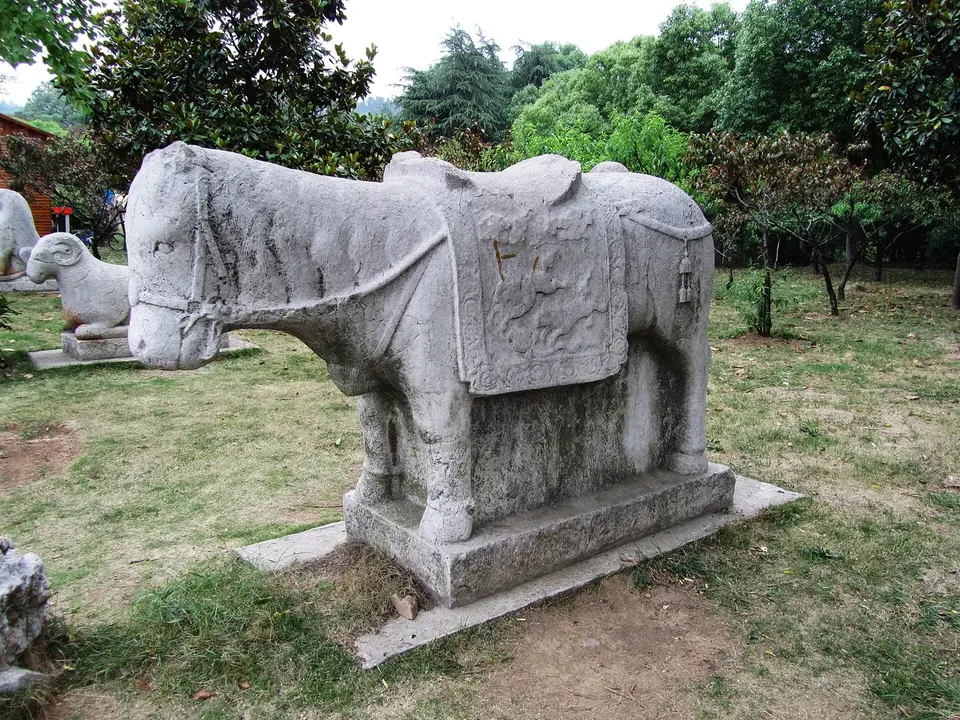
When news of his demise reached Nanjing, Zhu Yuanzhang was grief-stricken and suspended court audiences in his memory. The emperor lauded Kang as a paragon of loyalty and martial integrity whose stratagems had preserved the state at its most precarious moment. The imperial government funded an elaborate burial and Zhu Yuanzhang personally authored a solemn sacrificial eulogy, posthumously elevating him to Duke of Qi with the honorific posthumous name Wuyi.
Major Achievements
Agricultural Colonies and Logistics
Beyond his prowess in combat, Kang Maocai was one of the few founding Ming commanders endowed with strategic administrative acumen. In 1358, when Zhu Yuanzhang was hard-pressed to feed his rapidly expanding armies across southern Anhui and Jiangdong, Kang was appointed Commissioner of Agricultural Encampments. He surveyed the river basins and marshlands of Hezhou, Yuxi, and Caishi, organizing soldiers and displaced refugees into productive farming colonies.
Kang directed the excavation of irrigation networks, repaired hundreds of broken sluice gates, and enacted clear agricultural regulations granting draft oxen and grain seed to new settlers. Under his meticulous stewardship, tens of thousands of hectares of abandoned land were restored to fertility, yielding hundreds of thousands of piculs of grain annually. This self-sustaining agricultural network sustained the garrison armies without imposing crushing taxation upon the civilian population, providing the indispensable material foundation for Zhu Yuanzhang's subsequent victories.
Strategic Deception at Longwan
Kang Maocai's critical intervention during the Battle of Longwan in 1360 remains one of the most celebrated tactical deceptions in Chinese military history. With Chen Youliang's colossal armada bearing down on the young Ming capital, defeat would have meant total destruction. Kang's unflinching fidelity allowed Zhu Yuanzhang to orchestrate a double-agent operation of extraordinary precision.
By convincing Chen Youliang of his fraudulent defection while secretly coordinating the transformation of the wooden Jiangdong Bridge into stone, Kang led the entire enemy fleet directly into an inescapable bottleneck. The complete destruction of the Han vanguard shattered the enemy's momentum and saved the fledgling Ming state from catastrophe, altering the course of the fourteenth-century civil wars.