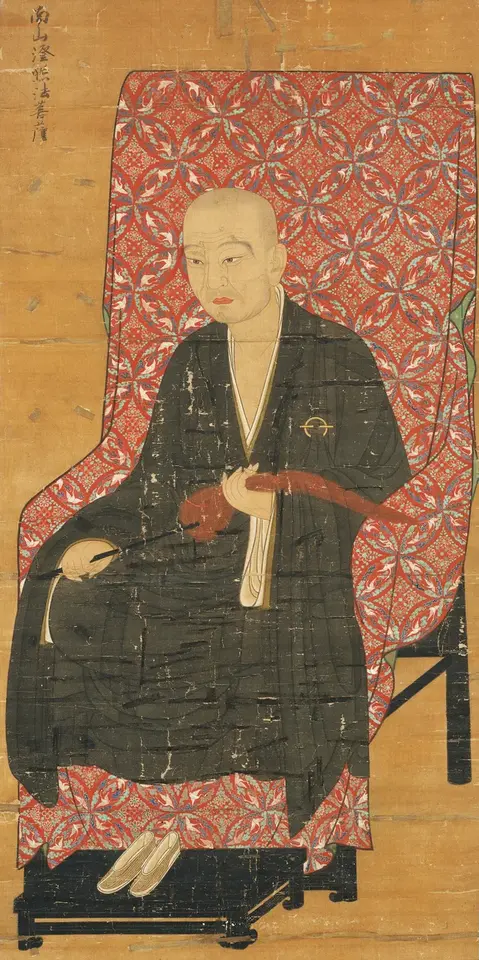
PROFILE
Daoxuan (596–667), secular surname Qian, courtesy name Fapian, was a native of Wuxing Commandery (modern Huzhou City, Zhejiang Province; alternatively attributed to Dantu in Runzhou or the capital Chang'an). He was an illustrious Tang dynasty Buddhist prelate, monastic historian, bibliographer, and the founding patriarch of the Nanshan Vinaya School (Nanshan Lüzong). Widely revered throughout East Asian Buddhism as the Nanshan Vinaya Master, he served as the senior verifier of meaning in Xuanzang's imperial translation bureau and as senior abbot (sthavira) of the grand Ximing Monastery in Chang'an. In 869, Emperor Yizong of Tang posthumously honored him with the imperial title Master Chengzhao and designated his funerary stupa Pure Radiance (Jingguang).
Born into an eminent bureaucratic scholar-official family in the capital, Daoxuan demonstrated exceptional literary talent from childhood, composing poetic rhapsodies at age nine before renouncing secular scholarship to enter Riyan Monastery at fifteen, receiving monastic tonsure under Vinaya master Zhiyun. In 615, at the age of twenty, he received full monastic ordination (upasampada) under Vinaya patriarch Zhishou at the Grand Dachanding Monastery, dedicating decades to the exhaustive study of the Dharmaguptaka Vinaya (Sifenlü). During the early Tang, Daoxuan retreated to the secluded ravines of the Zhongnan Mountains, practicing ascetic meditation, eating one meal daily, and maintaining strict monastic discipline. Synthesizing the Theravada vinaya with the Mahayana Yogacara and Tiantai doctrines, he formulated the innovative doctrine of the mental nature of the precept substance (xinfa jieti) and authored the monumental Five Major Commentaries of Nanshan, centered on his Commentary on the Sifenlü, establishing the definitive legal tradition of Chinese monastic discipline.
Daoxuan made enduring contributions to Buddhist historiography and institutional preservation. In 658, Emperor Gaozong appointed him senior abbot of Ximing Monastery, where he collaborated closely with Xuanzang on translating Sanskrit sutras and sastras. In 662, when Emperor Gaozong issued an imperial edict compelling monks and nuns to kneel and pay homage to rulers and parents, Daoxuan drafted a courageous imperial memorial defending monastic autonomy and spiritual transcendence, successfully persuading the court to rescind the decree. Over his prolific lifetime, Daoxuan authored more than two hundred and twenty volumes, including the Continued Biographies of Eminent Monks (Xu Gaoseng Zhuan), the Expanded Collection on the Propagation and Clarification of Buddhism (Guang Hongming Ji), and the Great Tang Inner Canon Catalogue (Datang Neidian Lu), which remain foundational masterworks for the study of medieval East Asian history, philosophy, and Sino-foreign cultural exchange.
- Secular Name
- Qian Fapian
- Honorific Titles
- Vinaya Master Nanshan, Master Chengzhao (posthumously conferred by Emperor Yizong of Tang)
- Native Place
- Wuxing Commandery (present-day Huzhou City, Zhejiang Province; alternatively attributed to Dantu in Runzhou or Chang'an)
- Date of Birth
- 596 (Sixteenth year of the Kaihuang era, Sui)
- Date of Death
- 667 (Second year of the Qianfeng era, Tang)
- Age
- 72
- Historical Role
- Illustrious Buddhist monk, ecclesiastical historian, bibliographer, founding patriarch of the Nanshan Vinaya School, and core verification master in Xuanzang's translation bureau
BIOGRAPHY
Chronology
- 596 (Sixteenth year of the Kaihuang era, Sui) | Birth into Official Lineage | Born into an aristocratic bureaucratic lineage in Chang'an; showed extraordinary intellectual brilliance, composing rhapsodies at age nine.
- 611 (Seventh year of the Daye era, Sui) | Monastic Tonsure | Renounced secular career aspirations, entering Riyan Monastery under Vinaya master Zhiyun to undergo monastic tonsure.
- 615 (Eleventh year of the Daye era, Sui) | Full Monastic Ordination | Received full ordination at age twenty under the preeminent Vinaya master Zhishou at the Grand Dachanding Monastery in Chang'an.
- 626 (Ninth year of the Wude era, Tang) | Authoring the Sifenlü Commentary | Completed the seminal three-volume Commentary on the Sifenlü, establishing the doctrinal foundation of the Nanshan Vinaya School.
- 630 (Fourth year of the Zhenguan era, Tang) | Seclusion in the Zhongnan Mountains | Retreated into the Zhongnan Mountains to reside at Baiquan, Fengde, and Jingye monasteries, practicing austere meditation.
- 645 (Nineteenth year of the Zhenguan era, Tang) | Completion of the Continued Biographies | Finalized the thirty-volume biographical monument Continued Biographies of Eminent Monks, chronicling centuries of Buddhist masters.
- 658 (Third year of the Xianqing era, Tang) | Senior Abbot of Ximing Monastery | Summoned by imperial decree of Emperor Gaozong to serve as senior abbot of Ximing Monastery, assisting Xuanzang's translation bureau.
- 662 (Second year of the Longshuo era, Tang) | Defending Monastic Autonomy | Led imperial protests against Emperor Gaozong's decree requiring clergy to bow before monarchs, compelling the throne to revoke the mandate.
- 664 (First year of the Linde era, Tang) | Compiling the Inner Canon Catalogue | Completed the ten-volume Great Tang Inner Canon Catalogue and the thirty-volume historical defense anthology Guang Hongming Ji.
- 667 (Second year of the Qianfeng era, Tang) | Erecting the Ordination Platform and Demise | Constructed the standard stone ordination platform at Jingye Monastery in February; passed away peacefully in October at age seventy-two.
Biography
Noble Lineage and Early Entry into the Sangha
Daoxuan was born on May 10, 596 (the eighth day of the fourth lunar month in the sixteenth year of the Kaihuang era of the Sui Dynasty). His ancestral home was Wuxing (alternatively recorded as Dantu in Runzhou), though his family had settled in the imperial capital of Chang'an, where his father Qian Shen served as Vice Minister of Personnel and court executive. Raised in an affluent, scholarly household, Daoxuan displayed extraordinary precocity, mastering classical calligraphy and composing intricate poetic rhapsodies by the age of nine.
However, as he approached adolescence, Daoxuan grew disillusioned with the fleeting nature of secular prestige and the pedantry of civil examinations. In 610, at the age of fifteen, he left his family mansion to enter Riyan Monastery in Chang'an, placing himself under the tutelage of Vinaya master Zhiyun. Zhiyun was renowned not only for strict vinaya observance, but also for his deep mastery of Nagarjuna's Madhyamaka philosophy, encompassing the Prajnaparamita sutras, the Madhyamaka Sastra, and the Satasastra. Under Zhiyun's guidance, Daoxuan underwent tonsure in 611, committing his life to the monastic sangha.
In 615, having reached the required age of twenty, Daoxuan received full monastic ordination (upasampada) at the Grand Dachanding Monastery in Chang'an under Zhishou, the foremost Vinaya scholar of the Sui-Tang transition. Zhishou's profound lectures on monastic law deeply inspired Daoxuan, who spent years analyzing the Dharmaguptaka Vinaya, recognizing that existing commentaries were fragmented and overly pedantic, resolving to create an integrated, comprehensive legal system for Chinese monasticism.
Seclusion in the Zhongnan Mountains and Founding the Nanshan School
During the chaotic transition between the Sui and Tang dynasties, warfare disrupted the capital, and Riyan Monastery fell into disrepair. In the early Wude era, Daoxuan withdrew from municipal life into the rugged Zhongnan Mountains south of Chang'an, dwelling in hermitages around Baiquan, Fengde, and Jingye monasteries, as well as the Yunshi Mountains. Within these tranquil, forested ravines, he commenced decades of rigorous asceticism and prolific scholarship.
In the Zhongnan Mountains, Daoxuan practiced the ancient austerities of the ascetic dhuta tradition. He wore coarse robes woven from rough hemp, consumed a single vegetarian meal of simple beans and wild herbs before noon, practiced continuous sitting meditation without reclining on beds, and walked with a staff to avoid crushing insects. He practiced the arduous Pratyutpanna Samadhi, remaining on his feet in circumambulation for ninety consecutive days. His ascetic rigor earned deep reverence, with later hagiographies recounting that celestial beings and guardian deities, including the celestial general Naza, secretly attended his forest sanctuary.
In 626, at the age of thirty-one, Daoxuan completed his masterwork at Fengde Monastery: the Commentary on the Sifenlü (Sifenlü Shanfan Buque Xingshichao) in three volumes (later expanded to twelve). Integrating Mahayana bodhisattva ethics into the Theravada monastic code, the text provided practical, exhaustive regulations for every dimension of monastic life, laying the unshakeable foundation of the Nanshan Vinaya School and attracting thousands of disciples.
Appointment as Sthavira of Ximing Monastery and Collaboration with Xuanzang
Following the accession of Emperor Gaozong, the imperial court expanded state patronage of Buddhism. In June 658, upon the completion of the magnificent imperial Ximing Monastery in Chang'an, Emperor Gaozong issued an imperial edict appointing Daoxuan as senior abbot (sthavira), placing him in charge of monastic discipline and institutional administration for the royal foundation.
The following month, the celebrated master Xuanzang moved his imperial translation headquarters from Da Cien Monastery to Ximing Monastery. Residing in the same monastic complex, Daoxuan and Xuanzang developed a close intellectual partnership. By imperial order, Daoxuan joined Xuanzang's translation bureau, serving in the critical roles of verifier of meaning (zhengyi) and stylist (zhuiwen). Utilizing his deep philological learning, Daoxuan reviewed and polished Chinese translations of profound Yogacara and Abhidharma treatises, ensuring that new translations adhered to both Sanskrit nuance and refined literary Chinese style.
During his tenure at Ximing Monastery, Daoxuan also cultivated a warm personal friendship with the celebrated physician Sun Simiao. Sun Simiao visited the monastery frequently, engaging in discussions on Buddhist scriptures, Daoist metaphysics, and pharmaceutical botany, forming a historic intellectual dialogue between the preeminent monk and the foremost medical scientist of the era.
Steadfast Defense of the Dharma Against Imperial Court Mandates
Throughout the early Tang, the imperial court sought to subordinate monastic communities to bureaucratic oversight. In April 662 (the second year of the Longshuo era), Emperor Gaozong, influenced by anti-clerical courtiers such as Li Yifu and Xu Jingzong, issued a decree commanding all Buddhist monks and nuns to kneel and pay physical obeisance to the emperor, state ministers, and their secular parents.
This mandate threatened the spiritual autonomy and constitutional integrity of the Buddhist order. While many court prelates hesitated, Daoxuan rose to lead the resistance. Collaborating with Xuanzang and master Yancong, Daoxuan drafted a comprehensive memorial to the throne. Citing the pre-Qin Confucian Book of Rites and dynastic historical precedents, he argued that monks had renounced secular bonds to cultivate universal spiritual salvation. He maintained that clergy wearing monastic robes were bound by transcendent vows that prohibited secular prostration, emphasizing that imperial magnanimity was demonstrated by tolerating spiritual transcendence.
Daoxuan's memorial was celebrated for its eloquent argumentation and dignified rhetoric, winning the support of prominent courtiers such as Chancellor Shangguan Yi. Confronted by Daoxuan's uncompromising stance and widespread elite sympathy, Emperor Gaozong rescinded the decree in July 662, securing the institutional independence and spiritual dignity of the Chinese sangha.
Establishing the Standard Ordination Platform and Peaceful Demise
In early 667, sensing his declining physical strength, Daoxuan resolved to complete his final institutional vision: the establishment of an authoritative, standardized ordination platform for the transmission of monastic vows. Returning to Jingye Monastery in the Zhongnan Mountains, he personally designed and supervised the construction of a permanent three-tiered stone ordination platform, based strictly on canonical vinaya dimensions. In February 667, he convened over twenty venerable monks from across China to conduct the first standard ordination ceremony, authoring the Illustrated Scripture on the Ordination Platform Established in Guanzhong to serve as an enduring architectural and liturgical blueprint.
On October 25, 667 (the third day of the tenth lunar month in the second year of the Qianfeng era), having finalized his writings and entrusted his lineage to his disciples, Daoxuan passed away peacefully in full meditation posture at Jingye Monastery at the age of seventy-two, with a monastic seniority of fifty-two years.
His passing evoked widespread grief throughout Chang'an and the monastic world. Emperor Gaozong ordered court artisans, led by master sculptor Han Botong, to model and cast an official portrait sculpture of the master. His remains were entombed in a stone chamber in the Tangu valley of the Zhongnan Mountains, marked by three memorial pagodas. In 869, Emperor Yizong bestowed upon him the posthumous title Master Chengzhao and named his pagoda Pure Radiance, ensuring that his Vinaya lineage endured across East Asia.
Major Achievements
Founding the Nanshan Vinaya School and Authoring the Five Major Commentaries
Daoxuan's crowning intellectual accomplishment was the founding of the Nanshan Vinaya School, one of the eight major traditions of Chinese Buddhism. During the Northern and Southern Dynasties, vinaya scholarship had fractured into regional disputes between the Xiangbu school of Fali and the Dongta school of Huaisu.
Daoxuan unified monastic law by authoring the Five Major Commentaries of Nanshan: the Commentary on the Sifenlü (twelve volumes), the Sifenlü Karmavaca Commentary (two volumes with two volumes of sub-commentary), the Sifenlü Pratimoksa Commentary (one volume with three volumes of sub-commentary), the Compendium of Explanations on the Sifenlü (six volumes), and the Bhiksuni Vinaya Commentary (three volumes). Centered on his Commentary on the Sifenlü, this corpus systematized complex disciplinary codes into structured operational guides for daily monastic life. During the Tang and Song eras, over sixty distinct commentaries were composed on Daoxuan's work, eclipsing all rival traditions and establishing Nanshan as the sole orthodox Vinaya lineage of China, which was subsequently transmitted to Japan by master Jianzhen (Ganjin).
Formulating the Mind-Nature Precept Substance Doctrine and Mahayana Vinaya Synthesis
In Buddhist legal philosophy and psychology, Daoxuan introduced the groundbreaking doctrine that the essence of the monastic precepts resides within the mind-nature (xinfa jieti). Traditional Theravada schools viewed the precept essence as subtle physical matter or as neither material nor mental.
Drawing upon Xuanzang's new Yogacara translations and the tathagatagarbha philosophy of the Lankavatara and Srimala sutras, Daoxuan argued that the essence of the precepts is generated in the mind during the ordination ceremony, implanting a powerful seed of moral self-regulation within the alaya-consciousness. By defining the precept substance as an active spiritual capacity rather than mechanical conformity to external rules, Daoxuan reconciled Theravada monastic rules with Mahayana bodhisattva ethics, infusing Chinese Buddhist law with a profound philosophical foundation.
Compiling the Continued Biographies of Eminent Monks as a Historical Monument
In historiography, Daoxuan ranks as one of the preeminent monastic historians of medieval China. While Huijiao of the Liang Dynasty had compiled the original Biographies of Eminent Monks in fourteen volumes, more than a century of turbulent history across the Northern and Southern Dynasties and the Sui-Tang transition remained unrecorded.
Over decades of research, examining stele inscriptions, private collections, and monastic archives, Daoxuan completed the thirty-volume Continued Biographies of Eminent Monks in 645. Adopting Huijiao's classification into ten thematic categories—translators, exegetes, meditators, vinaya masters, defenders of the dharma, miracle workers, self-immolators, reciters, benefactors, and miscellaneous figures—the work recorded primary biographies of three hundred and thirty-one masters and secondary notices for one hundred and sixty others. The text preserved vital documentation on foundational patriarchs such as Bodhidharma, Sengchou, Huisi, Zhiyi, and Jizang, serving as an indispensable historical record of medieval Chinese society, politics, and religion.
Editing the Expanded Collection on the Propagation and Clarification of Buddhism
In response to successive waves of anti-Buddhist persecution and ideological conflicts between Buddhism and Daoism from the Wei-Jin through the early Tang, Daoxuan compiled the thirty-volume Guang Hongming Ji (Expanded Collection on the Propagation and Clarification of Buddhism) as an encyclopedic continuation of Sengyou's Liang dynasty Hongming Ji.
The anthology was structured into ten thematic chapters: Rectification of Orthodoxy, Dispersing Doubts, Virtues of the Buddha, Principles of the Dharma, Monastic Dignity, Universal Compassion, Admonishing Merit, Inspiring Blessings, Ultimate Refuge, and Fasting Practices. It preserved hundreds of court debates, imperial edicts, ministerial memorials, philosophical essays, and epistolary exchanges that would otherwise have been lost. It remains an invaluable primary archive for studying intellectual debates, church-state relations, and the political struggles surrounding the suppression of Buddhism under Emperor Wu of Northern Zhou and the anti-Buddhist polemics of Fu Yi.
Authoring the Great Tang Inner Canon Catalogue and Pioneering Buddhist Bibliography
In bibliographic science, Daoxuan compiled the ten-volume Datang Neidian Lu in 664, representing a landmark in Chinese cataloguing. The catalogue reviewed the organizational successes and flaws of all imperial and private catalogues since the Han and Wei dynasties, establishing an exacting taxonomic system.
The catalogue authenticated translations across successive dynasties, recording translators, dates, lost texts, and extant manuscript scrolls. Crucially, Daoxuan instituted the historic precedent of formally cataloguing indigenous Chinese Buddhist commentaries, treatises, and essays alongside translated Indian sutras, establishing the principle that indigenous Chinese Buddhist scholarship deserved formal inclusion within the canonical Tripiṭaka. His rigorous bibliographic principles directly guided Zhisheng's celebrated Kaiyuan Shijiao Lu and formed the organizational model for all subsequent woodblock print editions of the Chinese Buddhist Canon.
Constructing the Standard Ordination Platform at Jingye Monastery
In sacred architecture and ritual practice, Daoxuan's construction of the outdoor stone ordination platform at Jingye Monastery in 667 established the standard for East Asian Buddhist transmission rites. Prior to this innovation, ordinations in Chinese monasteries were conducted on temporary wooden stages lacking standardized spatial proportions.
Drawing upon canonical vinaya scriptures, Daoxuan engineered a permanent three-tiered stone terrace: the lowest tier represented the terrestrial realm and basic discipline, the middle tier symbolized universal directions and intermediate discipline, and the top tier embodied celestial protection and supreme ordination. He detailed the seating layout for the three presiding masters and seven witness monks, codifying these designs in his Illustrated Scripture on the Ordination Platform Established in Guanzhong. This sacred architectural model spread rapidly to major monasteries across Chang'an, Luoyang, Korea, and Japan, establishing an enduring ceremonial norm.
Personal Connections
- Tonsure Master: Zhiyun: Sui dynasty Vinaya master of Riyan Monastery who was versed in Madhyamaka philosophy; tonsured young Daoxuan.
- Ordination Preceptor: Zhishou: Paramount Sui-Tang Vinaya patriarch of Dachanding Monastery; conferred full ordination upon Daoxuan and transmitted the Sifenlü.
- Translation Collaborator: Xuanzang: Founder of the East Asian Yogacara school and master translator; resided with Daoxuan at Ximing Monastery, employing him as senior verifier.
- Recluse Associate: Sun Simiao: Renowned Tang dynasty physician and pharmacologist; close friend of Daoxuan who engaged in extensive medical and spiritual exchanges.
- Imperial Patron: Emperor Gaozong of Tang (Li Zhi): Third emperor of the Tang Dynasty; appointed Daoxuan abbot of Ximing Monastery and rescinded anti-clerical edicts following Daoxuan's petitions.
- Posthumous Sovereign: Emperor Yizong of Tang (Li Cui): Tang emperor who posthumously honored Daoxuan in 869 with the title Master Chengzhao.
- Chief Successor: Wengang: Senior disciple of Daoxuan; succeeded him as Vinaya master of Ximing Monastery, transmitting the lineage to Dao'an and Hongjing.
- Lineage Successor: Jianzhen (Ganjin): Celebrated Tang Vinaya master and fourth-generation lineage descendant of Daoxuan; crossed the sea to Japan to establish the Japanese Ritsu school.
Historical Evaluations
- Zhisheng in Kaiyuan Record of Buddhist Teachings (Volume 8): "Vinaya Master Daoxuan was broadly learned in the nine secular philosophies and profoundly mastered the three spiritual trainings. His fragrance of moral discipline was pure, and his waters of meditation were limpid. Protecting the fortress of the Dharma, his writing was unceasing. Since the Han and Wei dynasties, among those who illuminated the vinaya and compiled histories, no equal can be found."
- Zanning in Song Biographies of Eminent Monks (Volume 14): "Daoxuan's renown for strict vinaya observance resounded as far as India, and his historical compilations illuminated the realm. When Tripitaka Master Subhakarasimha arrived in China, he declared that in India he had heard that Vinaya Master Daoxuan of Ximing Monastery was foremost in moral adherence. Since the Buddha entered Nirvana, among those who revitalized the Vinaya during the Semblance Dharma age, Master Daoxuan alone stands supreme!"
- Zanning et al. in Brief History of the Sangha in the Great Song: "The Nanshan Vinaya School achieved its definitive synthesis under Vinaya Master Daoxuan. When the Commentary on the Sifenlü appeared, all vinaya scholars throughout the realm took it as their standard, causing the Xiangbu and Dongta traditions to yield. He was truly an incomparable master across generations."
- Ouyi Zhixu in Lingfeng Zonglun: "Master Daoxuan utilized deep, complete wisdom to synthesize the narrow prose of the Fourfold Vinaya. His formulation of the mind-nature precept essence caused the Vinaya to harmonize with the ocean of Huayan nature—he was truly the sovereign teacher of monastic discipline for ten thousand generations."
- Liang Qichao in A Brief Account of the Rise and Fall of Buddhism in China: "Among the eminent monks of the Tang Dynasty, in terms of prolific authorship and monumental achievement, Daoxuan ranks foremost. His Continued Biographies of Eminent Monks and Guang Hongming Ji are priceless treasures of medieval Chinese historiography."
Related Entries
- Nanshan Vinaya School
- Commentary on the Sifenlü
- Continued Biographies of Eminent Monks
- Guang Hongming Ji
- Xuanzang
- Ximing Monastery
- Jingye Monastery
- Ordination Platform