Birth in Anyang
Born into an official lineage in Anyang, studious and resolute, dedicated to mastering administrative statutes.
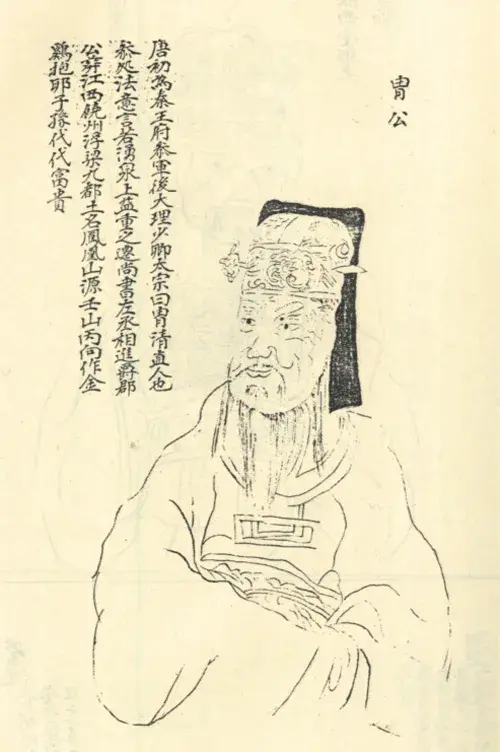
戴胄
Dai Zhou (戴胄) (573–633), a native of Anyang in Xiangzhou (present-day Anyang, Henan), was an eminent Chancellor, judicial reformer, and honored Lingyan Pavilion meritorious statesman of the early Tang dynasty. In his youth, he passed the Mingjing examination during the Sui dynasty to enter official service. In the late Sui period, he served as Recorder in the Chancellery, earning immense respect from senior statesmen Pei Ju…
Dai Zhou (戴胄) (573–633), a native of Anyang in Xiangzhou (present-day Anyang, Henan), was an eminent Chancellor, judicial reformer, and honored Lingyan Pavilion meritorious statesman of the early Tang dynasty. In his youth, he passed the Mingjing examination during the Sui dynasty to enter official service. In the late Sui period, he served as Recorder in the Chancellery, earning immense respect from senior statesmen Pei Ju and Su Wei for his profound expertise in statutory law and imperial registers. Following the fall of Sui, he was retained under the regional regime of Wang Shichong in Luoyang. Because he repeatedly admonished Wang to remain loyal to the imperial house and opposed Wang receiving the imperial Nine Bestowments, he was demoted and dispatched to serve as Aide to the Prefect of Zhengzhou, defending the strategic fortress of Hulao Pass alongside Wang Xingben. In 621, after the Tang forces captured Hulao, the famous general Li Shiji recognized his superior talent and integrity, recommending him enthusiastically to Li Shimin, Prince of Qin, who appointed Dai Zhou Assistant Administrator in his princely establishment. After Emperor Taizong ascended the throne, Dai Zhou was elevated to Vice minister of the Court of Judicial Review, becoming a vital architect of the legal framework during the Zhenguan reign. In his judicial capacity, Dai Zhou demonstrated incorruptible rectitude and unflinching adherence to statutory law, daring to contest imperial directives to safeguard legal integrity. When Chancellor Zhangsun Wuji accidentally carried a sword into the East Upper Pavilion, Dai Zhou mounted a vigorous defence of the innocent gatekeeper who had been condemned to death. In another famous case involving officials who forged genealogical credentials, he strictly adjudicated sentences of penal exile according to statutory codes, firmly turning down Emperor Taizong's impromptu imperial execution order by declaring that the law is the supreme instrument through which the state manifests faith to the realm, whereas an imperial utterance represents merely a transient burst of emotion. Taizong accepted his counsel with admiration, establishing the rule of statutory governance for the Zhenguan era. Subsequently appointed Left Assistant Director of the Department of State Affairs, Dai Zhou directed administrative affairs with remarkable speed and clarity, celebrated across the court as the finest incumbent since the founding of Tang. He established the national Relief Granaries system to combat famine, helped formulate the Zhenguan Code by eliminating extensive capital punishments, and rose to Minister of Revenue and concurrent Minister of Personnel, entering the Chancellorate as Participant in Deliberations on Court Policy. He died of illness in 633 at age sixty-one. Emperor Taizong suspended court audiences for three days in profound mourning, posthumously bestowing upon him the titles of Right Vice Director of the Department of State Affairs and Duke of Dao with the posthumous name Zhong, later including his portrait in the Lingyan Pavilion.
Born into an official lineage in Anyang, studious and resolute, dedicated to mastering administrative statutes.
Passed the Mingjing examination during the Sui dynasty, serving in the Ministry of Personnel and Chancellery.
Served as Attendant Gentleman in Luoyang, opposed Wang Shichong's usurpation, demoted to Aide in Zhengzhou.
Captured at Hulao Pass, recommended by general Li Shiji, inducted into Qin princely establishment as Assistant Administrator.
Appointed Vice minister of the Court of Judicial Review, courageously upheld statutory law; promoted to Left Assistant Director.
Proposed national Relief Granaries system against natural disasters; concurrent Grand Master of Remonstrance.
Recommended by dying Du Ruhui, became Minister of Revenue and Minister of Personnel, Participant in Deliberations on Court Policy.
Submitted memorial remonstrating against palace renovations to spare labor; ennobled as Commandery Duke of Wuchang.
Succumbed to illness at sixty-one, Emperor Taizong mourned and suspended court for three days, posthumously granted Right Vice Director.
Dai Zhou was born in the second year of the Jiande era of Northern Zhou (573), with ancestral roots in Anyang, Xiangzhou. His family had long pursued official careers; his grandfather Dai Jingzhen served as Attendant in Shizhou, and his father Dai Chengbo served as Magistrate of Jixian. From an early age, Dai Zhou was composed, dignified, and possessed exceptional mental fortitude, exhibiting a remarkable grasp of historical statutory codes and administrative registers. During the Daye era of Emperor Yang of Sui, Dai Zhou passed the civil service examination under the Mingjing category and commenced official service, initially as Commandant of Fleet-as-clouds in the Ministry of Personnel and later as Assistant Director of the Hongnong Palace. Toward the close of the Daye era, he was transferred to the Chancellery as Recorder. The Chancellery was the supreme organ responsible for imperial memorials and secretarial governance. Dai Zhou handled complicated affairs with unmatched clarity and zero backlog, mastering legal statutes and bureaucratic protocols, which earned him deep esteem from elder statesmen Su Wei and Pei Ju.
In 616, Emperor Yang traveled south to Jiangdu and instructed Yang Tong, Prince of Yue, to remain in charge of the eastern capital Luoyang. Dai Zhou remained in Luoyang and was appointed Attendant Gentleman by Yang Tong. Following Emperor Yang's assassination during the Jiangdu Incident in 618, the ministers in Luoyang acclaimed Yang Tong as emperor. However, real civil and military authority was rapidly seized by Grand Commander Wang Shichong. In the spring of 619, Wang Shichong recruited prominent scholars into his grand headquarters, appointing Dai Zhou Assistant Administrator of External Military Affairs. When Wang secretly sounded out his staff regarding plans to force the emperor to abdicate in his favor, Dai Zhou stepped forward fearlessly and admonished: "Sovereign and subject are like father and son, sharing fortune and disaster. The wisest path for your lordship is to serve the state with utmost loyalty, ensuring lasting peace for both household and realm!" Wang Shichong displayed superficial approval while harboring deep resentment. Soon afterward, Wang demanded the Nine Bestowments from Yang Tong, prompting Dai Zhou to remonstrate with unbending resolve. Enraged, Wang Shichong banished him from the capital to serve as Aide to the Prefect of Zhengzhou, ordering him to guard Hulao Pass with Wang's nephew Wang Xingben.
In 620, Li Shimin, Prince of Qin of the Tang dynasty, led imperial forces to lay siege to Luoyang. In the spring of 621, Shen Yue, an administrator of Zhengzhou, surrendered Hulao Pass to Tang forces, resulting in Dai Zhou's capture. Tang general Li Shiji had long admired Dai Zhou's exemplary integrity and administrative talents, promptly releasing him from captivity and introducing him with great praise to Li Shimin. Li Shimin engaged Dai Zhou in extensive discussions regarding statecraft, expressing profound appreciation and immediately recruiting him into his princely establishment as Assistant Administrator of the Service Corps. From that moment forward, Dai Zhou pledged allegiance to the Tang dynasty, drafting documents and advising on penal matters to aid Li Shimin's pacification campaigns.
Following the Xuanwu Gate Incident in 626, Li Shimin ascended the imperial throne as Emperor Taizong. In recognition of his loyal contributions, Dai Zhou was ennobled as Baron of Wuchang and soon named Vice Director in the Ministry of War, swiftly rising to Director. In 627, Emperor Taizong reorganized the judicial apparatus and elevated Dai Zhou to Vice minister of the Court of Judicial Review. The Court of Judicial Review served as the supreme judicial tribunal of the empire. While presiding over criminal reviews, Dai Zhou enforced statutes impartially and eradicated wrongful convictions, demonstrating unmatched clarity and eloquence. He repeatedly confronted the throne to uphold statutory supremacy during major imperial trials, transforming the judicial atmosphere and winning Taizong's complete trust.
In the winter of 627, recognizing his decisive administrative competence, Emperor Taizong transferred Dai Zhou from the judicial tribunal to Right Assistant Director of the Department of State Affairs, swiftly elevating him to Left Assistant Director. At this juncture, Chancellor Xiao Yu had been dismissed from the post of Left Vice Director, and Right Vice Director Feng Deyi had passed away from illness, leaving both supreme leadership positions of the Department of State Affairs vacant. The Department of State Affairs functioned as the supreme executive organ of the central government, supervising twenty-four subordinate bureaus and managing colossal volumes of administrative dossiers. Emperor Taizong summoned Dai Zhou and solemnly charged him: "The Department of State Affairs is the primary pillar of the realm, relied upon by all central and provincial agencies. Should a single error occur, the empire will inevitably bear the grievance. Now that the Chancellors' seats are vacant, We entrust the administrative integrity of the entire department to you. You must live up to Our expectations!"
Accepting this critical commission, Dai Zhou assumed comprehensive charge of the department's operations as Left Assistant Director. Blessed with sharp intelligence and political insight, he adjudicated state affairs with extraordinary efficiency, clearing stacks of memorials without delay while maintaining impeccable accuracy. Civil and military officials throughout the court unanimously acclaimed him, declaring that since the founding of Tang in the Wude era, no official had performed the duties of Assistant Director with greater competence. In 628, observing that ordinary granaries lacked reserves during seasonal droughts and floods, Dai Zhou submitted a memorial proposing the creation of national Relief Granaries, which Emperor Taizong enthusiastically endorsed and promulgated empire-wide. Noting Dai Zhou's austere incorruptibility and impoverished residence, Emperor Taizong personally bestowed one hundred thousand cash upon him and commanded him to concurrently serve as Grand Master of Remonstrance, alternating daily with Wei Zheng to attend imperial audiences and participate in confidential policy decisions.
In 629, Dai Zhou was promoted to Cavalier Attendant-in-ordinary and Minister of Revenue (later renamed Hubu Shangshu to observe naming taboos), while concurrently serving as Supervisor of the Household of the Crown Prince, managing nationwide household registers, tax revenues, and fiscal administration. In early 630, as Chancellor Du Ruhui lay dying, he submitted a final memorial urging Emperor Taizong to entrust the critical task of civil personnel appointments to Dai Zhou. Taizong adopted this counsel, appointing Dai Zhou concurrent Minister of Personnel while retaining his posts in the Crown Prince's household and the Remonstrance Bureau, and officially bestowing upon him the status of Participant in Deliberations on Court Policy. With this appointment, Dai Zhou formally entered the ranks of Chancellors. Although Dai Zhou possessed superior executive and legal capabilities, his background in practical jurisprudence made him less attuned to literary scholars steeped in classical prose. While directing personnel selections, he curtailed ornamental literary elites and advanced pragmatic officials versed in statutes, provoking criticism from literati circles. Emperor Taizong relieved him of the Personnel portfolio later that year, instructing him to concentrate on fiscal affairs and national policy as Minister of Revenue and Chancellor, while advancing his noble rank to Commandery Duke of Wuchang with a fief of two thousand households.
In 631, with the empire enjoying expanding tranquility, Emperor Taizong contemplated spending immense resources to renovate the Luoyang Palace. Upon learning this, Dai Zhou immediately submitted a memorial remonstrating vigorously, pointing out that military garrisons in Guanzhong and the frontier were expanding and that common households, barely recovered from war, could not endure additional corvée labor. He warned that extensive building projects would inevitably provoke widespread popular disaffection. Moved by his sincere counsel, Emperor Taizong promptly canceled the renovation and commended Dai Zhou before assembled ministers for his unreserved loyalty. In 633, exhausted from unrelenting devotion to imperial governance, Dai Zhou succumbed to illness at the age of sixty-one. Grieved by the loss, Emperor Taizong personally mourned him and suspended court business for three days. The emperor issued an imperial edict posthumously bestowing upon him the office of Right Vice Director of the Department of State Affairs and the noble title Duke of Dao, conferring the posthumous name Zhong (Loyal) and commissioning calligrapher and scholar Yu Shinan to compose his memorial stele. Noting that Dai Zhou's modest residence lacked suitable space for ancestral rites, Emperor Taizong ordered the authorities to construct a dedicated ancestral shrine using state funds to perpetuate his memory.
Following his accession, Emperor Taizong ordered Fang Xuanling and Zhangsun Wuji to revise previous legal compilations. Dai Zhou and Wei Zheng participated as chief advisors in this legislative overhaul. Dai Zhou emphasized that earlier codes preserved excessive cruelties. He and Wei Zheng argued vigorously for abolishing fifty capital offenses punishable by strangulation, replacing them with penal amputation of the right toe; subsequently, he successfully lobbied to commute such mutilating bodily punishments to three thousand li of penal exile, anchoring the Zhenguan Code on principles of judicial clemency and procedural restraint.
When Chancellor Zhangsun Wuji inadvertently wore his long sword into the palace's East Upper Pavilion, Right Vice Director Feng Deyi proposed executing the gatekeeping officer for failing to notice the weapon while merely fining the imperial in-law twenty catties of bronze. Dai Zhou contested this judgment before the throne, demonstrating that both parties had acted out of negligence. He argued that the gatekeeper's guilt arose entirely from Zhangsun Wuji's mistake and that execution could not justly be visited upon one party alone while sparing the favored relative. His uncompromising stance impelled Emperor Taizong to declare that the law belongs to the entire realm rather than the monarch alone, overturning Feng Deyi's partial verdict and commuting the innocent officer's death sentence.
During imperial personnel reviews, Emperor Taizong issued an edict commanding officials who had forged lineage credentials to confess, threatening unrepentant offenders with execution. When a fraudulent official was subsequently apprehended, Dai Zhou sentenced him to penal exile according to statutory law. Taizong angrily questioned whether reducing the punishment undermined royal credibility. Dai Zhou calmly replied: "The law is the instrument by which the state proclaims supreme faith to the realm; spoken edicts, however, are often provoked by transient emotional wrath. Your Majesty decreed execution out of temporary anger, but by placing the offender within statutory justice, you restrain minor anger to preserve great faith!" Emperor Taizong was enlightened by this argument and commended Dai Zhou for rectifying royal overreach.
During the early Tang, disaster relief depended solely on conventional state granaries, which quickly emptied during severe famines. In 628, Dai Zhou presented a memorial reviewing the community granaries of the Sui dynasty, proposing that all landholders, from imperial nobility to peasantry, contribute grain based on annual harvest yields to establish local Relief Granaries specifically reserved for catastrophic years. Emperor Taizong enacted this proposal across the empire, providing Tang society with an enduring social relief mechanism that fortified the food security of the Zhenguan reign.
During the vacancy of executive chancellors in the early Zhenguan period, Dai Zhou oversaw the twenty-four bureaus of the Department of State Affairs as Left Assistant Director. Confronted with a deluge of administrative memorials from across the realm, Dai Zhou processed state papers with sharp discernment and swift decisiveness, leaving not a single case in arrears. Contemporary scholars and historians acclaimed him as the most accomplished director since the founding of Tang, establishing a legendary administrative benchmark.
In 631, when Emperor Taizong ordered large-scale construction at the Luoyang Palace, Dai Zhou submitted a memorial delineating widespread troop mobilizations and peasant fatigue, asserting that drafting a single laborer paralyzed an entire peasant family. He warned against repeating the disastrous overtaxation of Emperor Yang of Sui. Profoundly stirred by Dai Zhou's sincerity, Emperor Taizong terminated the construction program immediately and praised Dai Zhou's public-spirited devotion.
During his tenure overseeing the Ministry of Personnel in 630, Dai Zhou challenged entrenched conventions by shifting focus away from hollow literary ostentation toward practical administrative and legal capability. He actively promoted officials well-versed in state statutes and experienced in grassroots adjudication. Although initially criticized by traditional literati, this reform revitalized the bureaucratic apparatus, supplying the Zhenguan administration with capable, incorruptible civil servants.
FIGURES ASSOCIATED WITH THIS DYNASTY