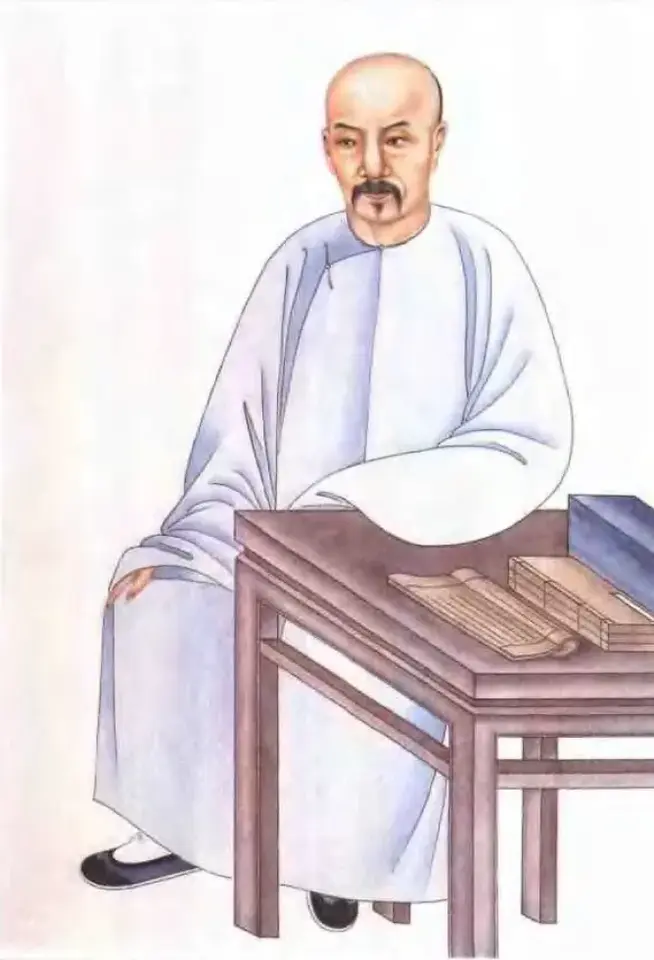
BIOGRAPHY
Chronology
- 1724 (First year of the Yongzheng era) | Birth in Xiuning | Born on January 19 into an impoverished cloth merchant family in Longfu, Huizhou.
- 1733 (Eleventh year of the Yongzheng era) | Early Critical Inquiry | At age ten, read thousands of words daily and boldly questioned his tutor regarding the textual authenticity of the Great Learning.
- 1740 (Fifth year of the Qianlong era) | Teaching in Itinerancy | Accompanied his father peddling cloth in Nanfeng and Shaowu, teaching village pupils while mastering the Shuowen Jiezi by night.
- 1742 (Seventh year of the Qianlong era) | Discipleship under Jiang Yong | Entered the academy of Jiang Yong in Wuyuan; Jiang was astonished by his genius and imparted all knowledge of phonology, ritual, and astronomy.
- 1755 (Twentieth year of the Qianlong era) | Journey to Beijing | Traveled to Beijing to escape local litigation; astonished capital scholars and joined Qin Huitian's residence to compile the Comprehensive Study of the Five Rites.
- 1762 (Twenty-seventh year of the Qianlong era) | Provincial Degree | Passed the Shunzhi-Zhili provincial civil examinations to become a juren, becoming an intellectual sensation among court ministers.
- 1768 (Thirty-third year of the Qianlong era) | Compiling Waterways of Zhili | Commissioned by the Governor-General of Zhili to survey the Hai River basin and compile the Waterways of Zhili.
- 1769 (Thirty-fourth year of the Qianlong era) | Gazetteer of Fenzhou | Invited to Shanxi by Provincial Treasurer Zhu Gui to direct the compilation of the Gazetteer of Fenzhou Prefecture and Fenyang County.
- 1773 (Thirty-eighth year of the Qianlong era) | Imperial Summons to Siku Bureau | Specially summoned by imperial edict upon the recommendation of Ji Yun to serve as compiler in the Siku Quanshu Bureau.
- 1775 (Fortieth year of the Qianlong era) | Imperial Jinshi Degree | Permitted to sit for the palace examination by special imperial grace; bestowed the jinshi degree and appointed Bachelor of the Hanlin Academy.
- 1777 (Forty-second year of the Qianlong era) | Passing in Beijing | Passed away from pulmonary illness at the Fan Estate in Beijing on July 1 at the age of fifty-five; interred at his ancestral home in Longfu.
Life and Career
Lineage Origins and Mentorship under Jiang Yong
Dai Zhen was born on January 19, 1724, in Longfu Town, Xiuning County, Huizhou Prefecture, Anhui (present-day Tunxi District, Huangshan). Legend recorded that his birth coincided with resounding winter thunder, prompting his father to name him Zhen (meaning tremor or thunder) and assign him the courtesy name Shenxiu. The Dai lineage had once been an esteemed scholar-gentry clan of Xin'an, but by the time of his father, Dai Bian, family fortunes had severely declined. Dai Bian was an honest, hardworking itinerant merchant who carried bolts of cloth across Nanfeng in Jiangxi and Shaowu in Fujian, earning meager returns that barely sustained the family.
From early childhood, young Dai exhibited exceptional intellectual agility and photographic memory. Entering the local village school at age eight, by age ten he could memorize thousands of lines of ancient classical prose daily. Beyond remarkable retention, Dai demonstrated an extraordinary critical independence that refused blind submission to established authority. When his village tutor taught Zhu Xi's Commentary on the Great Learning, ten-year-old Dai calmly asked: "How did Zhu Xi know that this chapter represented the words of Confucius transmitted by Zengzi?" The tutor replied that Song masters Cheng Hao and Cheng Yi had asserted it. Dai immediately pursued: "The Cheng brothers lived two thousand years after Confucius and Zengzi; how could they possibly know for certain?" The tutor stood dumbfounded, realizing the boy possessed an analytical mind far beyond ordinary pupils.
In 1740, eighteen-year-old Dai accompanied his father peddling cloth in Nanfeng and taught village schoolboys in Shaowu, Fujian, to augment the meager family income. Amid grueling poverty, Dai taught by day and studied Xu Shen's Shuowen Jiezi by the dim light of an oil lamp at night, investigating character composition, phonetic shifts, and pre-Qin institutional terms. Fellow townsman Cheng Xun recognized his towering potential and generously assisted his household.
In 1742, Dai returned to Huizhou and joined the Buqizhai Academy established by She County merchant Wang Wufeng. There, Dai associated with talented young scholars such as Jin Bang, Cheng Jinfang, Wang Zhaolong, and Cheng Yaotian, and formally became a disciple of Jiang Yong in Wuyuan. Jiang was the undisputed authority on the Three Ritual Classics, acoustic pitch pipes, and calendrical astronomy. When Dai submitted his research notes on phonology and ancient artifacts, Jiang was astounded by their depth, acknowledging that Dai's insights surpassed those of all senior disciples. Jiang imparted his entire knowledge of ancient phonology, pitch pipes, and astronomical computation. During this period, Dai completed early seminal monographs including Illustrations of the Artificers' Record (Kaogongji Tu), Inscribed Notes on Trigonometry and Circle Division (Gougu Gehuaji), and Annotations on Qu Yuan's Rhapsodies, earning widespread renown across Huizhou.
Flight to Beijing and Acclaim among Capital Elites
In 1755, aggressive local gentry seized ancestral properties belonging to the Longfu Dai clan and initiated legal persecutions. To escape malicious lawsuits and intimidation, thirty-two-year-old Dai fled alone to Beijing with several crates of manuscripts. Arriving in the imperial capital penniless, he lodged in an impoverished Buddhist monastery outside Xuanwumen, copying books for meager wages. Yet his peerless evidential scholarship quickly caused a sensation among the capital's intellectual elite.
At that time, eminent Hanlin scholars including Qian Daxin, Wang Mingsheng, Ji Yun, and Zhu Yun commanded the capital's scholarly circles. When they first engaged the unranked commoner Dai Zhen in debate, Dai discoursed effortlessly on pre-Qin administrative geography, ancient phonetic mutations, and dynastic astronomical calculation, citing chapter and verse from memory. The imperial academicians were stunned and humbled, immediately forging lifelong bonds of fellowship with him. Qian Daxin famously confessed to colleagues that their Beijing circle had been complacent until meeting Dai Zhen, whom he acclaimed as a universal scholar of the age.
Vice Minister of Rites Qin Huitian was then directing the imperial compilation of the colossal ritual treatise Comprehensive Study of the Five Rites (Wuli Tongkao). Learning of Dai's unmatched mastery of ancient ritual and technical calculation, Qin engaged him as an honored private guest, assigning him chief responsibility for collating ancient ritual artifacts and calendrical treatises. Over three years in Qin's residence, Dai scrutinized hundreds of ceremonial regulations, ancient measures, astronomical coordinates, and chariot vestments, elevating the work into an unprecedented model of empirical scholarship. Dai's fame reverberated across the imperial court, and high ministers vied to make his acquaintance.
During this era, Dai also established an intimate bond with Ji Yun. The two masters constantly scoured the Liulichang book markets for rare Song and Yuan block prints, debating textual authenticity and evidential criteria. Dai became an acknowledged intellectual leader of northern scholarship despite holding no imperial degree.
Examination Setbacks and Direction of Local Gazetteers
Despite his towering academic authority, Dai's path through the civil examination system was arduous and discouraging. In 1762, at age thirty-nine, Dai passed the Shunzhi-Zhili provincial examination to obtain the juren degree. Yet over the following decade, although his fame spanned the empire, he sat for the triennial metropolitan examinations six consecutive times and failed each one. Imperial examiners adhered strictly to the rigid, formulaic conventions of Song Neo-Confucian eight-legged essays, which were fundamentally incompatible with Dai's deep empirical erudition and vigorous prose.
Confronting repeated examination failures with philosophical equanimity, Dai channeled his immense energy into practical statecraft and local historical geography. In 1768, Governor-General of Zhili Yang Tingzhang invited Dai to Baoding to direct the compilation of the Waterways of Zhili (Zhili Hequ Shu). Defying severe winter frosts and summer floods, Dai surveyed the ancient channels of the Hai River system, including the Zhang, Hutuo, and Yongding rivers. Measuring water volumes and sediment flow while reviewing over a thousand local county archives, he formulated a scientific water conservancy monograph that provided crucial guidance for flood prevention and agrarian irrigation across the North China Plain.
In 1769, following another metropolitan examination failure, Dai accepted an invitation from Shanxi Provincial Treasurer Zhu Gui to travel to central Shanxi, where he directed the compilation of the Gazetteer of Fenzhou Prefecture. In 1771, he additionally compiled the Gazetteer of Fenyang County. Breaking completely with the traditional gazetteer practice of accumulating empty rhetorical flourishes, Dai verified ancient feudal borders, Northern Zhou mountain passes, military fortresses, and grain transport taxes, creating an exemplary scientific standard for regional geography.
Following these projects, Dai traveled south to Zhejiang, lecturing at the Jinhua Academy. Interacting with eastern Zhejiang literati, he synthesized his lifelong philosophical reflections and completed the draft treatise Prefatory Words (Xuyan), signaling the maturation of his humanist moral philosophy.
Imperial Appointment to the Siku Quanshu Bureau
In the autumn of 1773, the Qing court formally inaugurated the largest official editorial enterprise in imperial history: the Bureau for Compiling the Siku Quanshu. When selecting foremost editorial talent, Chief Director Grand Secretary Yu Minzhong and Associate Director Ji Yun vigorously recommended Dai Zhen to the throne. Ji Yun informed the Qianlong Emperor that among all living scholars versed in classical philology, astronomical mathematics, and phonology, none surpassed Dai Zhen. The emperor issued an extraordinary imperial decree summoning the juren Dai to the capital to serve as imperial compiler.
Among the five special scholars summoned by imperial decree (Dai Zhen, Shao Jinhan, Zhou Yongnian, Yu Ji, and Yang Changlin), Dai alone possessed comprehensive mastery of mathematics, astronomy, and technical philology. Within the Siku Bureau, Dai was assigned primary responsibility for reviewing and collating the Classics section, the Astronomical Mathematics subsection of the Masters section, and the Historical Geography subsection of the History section. Placed amidst the vast imperial libraries of the Wenyuange and Hanlin Academy, Dai combed through thousands of manuscript volumes of the Yongle Dadian, systematically recovering ancient scientific treatises that had been lost since the Song and Yuan dynasties.
In the spring of 1775, during the imperial palace examinations, the Qianlong Emperor recognized Dai's immense contributions to the Siku Quanshu. By special imperial favor, the emperor decreed that Dai be permitted to sit for the palace examination, bestowed upon him the degree of Metropolitan Graduate with Equivalent Standing (Tong Jinshi Chushen), and appointed him Bachelor of the Hanlin Academy, ordering that he be exempted from bureaucratic rotation tests to concentrate fully on the imperial library. That the son of an impoverished Huizhou peddler achieved the pinnacle of imperial academic honor through pure scholarly merit electrified the empire's intelligentsia.
Within the bureau, Dai's greatest scientific monument was his recovery and critical collation of seven lost ancient mathematical texts from the scattered leaves of the Yongle Dadian: the Nine Chapters on the Mathematical Art, Sea Island Computational Canon, Sunzi Computational Canon, Five Bureau Computational Canon, Five Classics Computational Canon, Xiahou Yang Computational Canon, and Zhoubi Suanjing. Recalculating mathematical procedures, restoring lost diagrams, and composing brilliant critical prefaces, Dai salvaged ancient Chinese mathematics from oblivion. Concurrently, he collated Li Daoyuan's Commentary on the Water Classic (Shui Jing Zhu), disentangling centuries of textual corruption. The Qianlong Emperor lavishly commended Dai's edition in an imperial six-rhyme poem, praising his meticulous critical labor.
Philosophical Climax and Passing in the Capital
Alongside his grueling duties in the Siku Bureau, Dai brought his philosophical contemplation to its ultimate fruition. In 1776, synthesizing decades of classical research, Dai finalized his immortal philosophical masterwork, the Evidential Commentary on the Meaning of Terms in the Mencius (Mengzi Ziyi Shuzheng). In this treatise, Dai mounted an uncompromising frontal assault on the Song Neo-Confucian orthodoxy of Cheng Yi and Zhu Xi, exposing the profound cruelty and hypocrisy of the doctrine that one must preserve heavenly principle and eradicate human desires.
Dai's philosophical critique reverberated like a thunderbolt through the intellectual world. Conservative Neo-Confucian colleagues in the bureau were horrified and mounted ferocious counterattacks. Scholar Weng Fanggang authored Discourse on Principle (Li Shuo) to denounce Dai, while lifelong friend Cheng Jinfang composed Discourse on Orthodox Learning (Zhengxue Lun) urging him to return to orthodox Song doctrine. Recluse Peng Shaosheng dispatched an impassioned two-thousand-word letter refuting his humanist ontology.
Yet Dai remained unyielding, declaring with courageous conviction: "I did not compose this book out of contentious pride, but because I have witnessed how deeply the world suffers under the yoke of Song Neo-Confucian principle! Oppressive magistrates murder through law, while later Confucians murder through abstract principle. When men die under the law, there are still those who pity them; but when they die under the pretext of principle, who will weep for them?" Dai firmly believed that although his ideas faced contemporary denunciation, future generations across centuries would vindicate his truth.
The decades of unceasing intellectual exertion, harsh northern winters, and intense partisan controversy catastrophically depleted Dai's health. In the spring of 1777, he developed severe diabetes, chronic pulmonary consumption, and hemoptysis, becoming bedridden. Yet even on his deathbed, he continued reviewing manuscript drafts of the Siku mathematical summaries, dictating editorial revisions.
On July 1, 1777, this peerless master of evidential scholarship and Enlightenment philosophy passed away at the Fan Estate near Chongwenmen in Beijing at the age of fifty-five. News of his death plunged the Siku Bureau and the capital's scholarly community into profound grief. Colleagues Ji Yun, Weng Fanggang, and Qian Daxin organized his funeral, and his devoted disciple Duan Yucai escorted his coffin back to Huizhou for interment at Longfu. Although Dai departed prematurely, the flame of empirical investigation and humanist critique he ignited stood as a monumental beacon in Chinese intellectual history.
Major Achievements
Founding the Wan School and Establishing the Evidential Maxim of Seeking Truth through Philology
Dai Zhen's foremost historical contribution to Chinese scholarship was his founding of the Wan School of Evidential Research, formulating the definitive methodological maxim: "From phonetic script to philological glossing, and from philological glossing to philosophic truth."
Prior to Dai, Qing evidential scholarship had seen brilliant pioneers like Gu Yanwu and Yan Ruoju, as well as the Wu School headed by Hui Dong. However, the Wu School remained constrained by an uncritical veneration of Han Dynasty commentaries, asserting that whatever Han scholars wrote was infallible. Dai resolutely discarded sectarian dogmatism, declaring that scholars must neither be blinded by others nor by their own prejudices, but must relentlessly demand empirical verification. He demonstrated that understanding pre-Qin Confucian philosophical truth required accurate semantic glossing, which in turn depended upon mastering archaic phonology and phonetics. By integrating paleography, phonology, and semantic glossing with material institutions and computational mathematics, Dai established a unified empirical scientific methodology. Under the Wan School's banner, Qian-Jia evidential scholarship attained its golden zenith, transforming traditional classical commentary into an early form of empirical humanities.
Composing Mengzi Ziyi Shuzheng to Critique the Tyranny of Abstract Principle
Among Dai's intellectual works, his three-volume Evidential Commentary on the Meaning of Terms in the Mencius (Mengzi Ziyi Shuzheng), encompassing treatises on Principle, Nature, the Dao, and Humaneness, represented the absolute philosophical apex of his life.
Since the Song Dynasty, Cheng Yi and Zhu Xi had reified "principle" (li) into an objective metaphysical entity existing prior to and above the material world, demanding the preservation of heavenly principle and the total eradication of human desire (renyu). Through rigorous pre-Qin philological excavation, Dai dismantled this dualism. He demonstrated that in ancient pre-Qin Chinese, li originally denoted grain, veins, and natural structure—the harmonious order that emerges when natural human desires are rationally fulfilled. He fiercely condemned the social brutality of Song Neo-Confucianism: "The exalted condemn the lowly in the name of principle; the elder condemn the young in the name of principle; the noble condemn the base in the name of principle. Even when entirely unreasonable, it is proclaimed principle. When the common people perish under principle, who will pity them?" His historic indictment—"Oppressive magistrates murder through law, while later Confucians murder through abstract principle"—shattered the ideological legitimacy of imperial moral oppression, leading modern thinkers like Liang Qichao and Hu Shi to celebrate him as China's eighteenth-century Enlightenment pioneer.
Formulating the Materialist Ontology of Generative Vitality and Sensory Cognition
In metaphysics and epistemology, Dai constructed a comprehensive, rigorous materialist philosophical system.
In ontology, rooted in the Yijing doctrine that the alternation of yin and yang constitutes the Dao, Dai formulated a pure monism of vital energy (qi): "Yin, yang, and the Five Phases are the physical reality of the Dao; the ceaseless generative transformation of vital energy is what we call the Dao." He adamantly rejected the existence of any disembodied, transcendent deity or metaphysical principle presiding over physical reality, demonstrating that principle (li) is merely the internal order and pattern of moving matter. In epistemology and human nature, Dai introduced the profound concept of corporeal sensory cognition (xueqi xinzhi). He emphasized that human beings possess both natural physical desires for food, drink, and sexual intimacy to sustain life (xueqi), and sensory cognitive organs capable of observing and evaluating external reality (xinzhi). True moral wisdom does not arise from introspective mystical illumination, but from the intellect's rational investigation of external empirical reality. Validating the moral legitimacy of humanity's fundamental material aspirations, Dai achieved a pinnacle of materialist sensualism in world philosophy.
Composing Yuan Shan and Xuyan to Build Humanist Ethical Foundations
To systematically elaborate his ethics and theory of human nature, Dai authored On the Good (Yuan Shan) in three volumes and Prefatory Words (Xuyan) in three volumes, establishing the theoretical foundations for Mengzi Ziyi Shuzheng.
In Yuan Shan, Dai explored the essence of moral goodness. Rejecting the concept of good as an ascetic transcendental mandate, he defined it as the cosmic generative vitality of heaven realized in human community: when an individual fulfills his natural life desires and extends that fulfillment to enable all people under heaven to fulfill theirs, that constitutes sagehood and moral goodness. In Xuyan, Dai scrutinized early debates on human nature among Mencius, Gaozi, and Xunzi, arguing that Mencius proclaimed human nature good because the human cognitive mind is endowed with the innate rational capacity to discern natural patterns and regulate desire. Through these treatises, Dai reconciled material desires with moral practice, eradicating the artificial antagonism between nature and morality and laying the cornerstone of modern Chinese humanism.
Rescuing and Restoring Ancient Mathematical Canons from the Yongle Dadian
During his tenure in the Siku Quanshu Bureau, Dai rendered an immortal service to the history of world science by single-handedly recovering, collating, and restoring the lost Seven Computational Canons.
Following the Northern Song, many of China's most profound ancient mathematical and astronomical treatises were lost to warfare, preserved only in fragmented quotations within the Ming Yongle Dadian. Combing through thousands of volumes, Dai extracted and critically collated seven ancient masterpieces: the Nine Chapters on the Mathematical Art, Sea Island Computational Canon, Sunzi Computational Canon, Five Bureau Computational Canon, Five Classics Computational Canon, Xiahou Yang Computational Canon, and Zhoubi Suanjing. Facing corrupted figures, missing calculations, and broken equations, Dai mobilized his advanced computational acumen to recalculate every problem, reconstruct lost diagrams, and append detailed evidential commentaries. He personally composed critical imperial summaries analyzing the historical development of each work. Through Dai's heroic collation, China's ancient mathematical heritage was preserved for global posterity, igniting an unprecedented renaissance of traditional mathematical sciences in the late Qing.
Investigating Celestial Motion and Spherical Geometry in Yuanxiang
Dai was not merely a textual collator of mathematical books; he was an accomplished theoretical astronomer and mathematician.
Addressing a millennium-old debate over whether the sun and moon rotated clockwise (to the left) or counter-clockwise (to the right), Dai authored the celebrated scientific treatise Yuanxiang (The Origin of Celestial Phenomena). Integrating Tycho Brahe's and Isaac Newton's astronomical theories with spherical trigonometry, Dai demonstrated the relative mechanics between the celestial sphere's diurnal motion and the sun's apparent annual motion along the ecliptic, proving that the sun moves eastward (rightward) along the ecliptic. His model swept away astrological superstitions, establishing a physical and empirical foundation for ancient calendrical studies. Additionally, Dai composed Inscribed Notes on Trigonometry and Circle Division (Gougu Gehuaji) in three volumes, Treatise on Counting Rods (Cesuan), and Records on Calculating the Solstice, providing mathematical proofs for chord-arc calculations, trigonometric expansions, and rod-computation mechanics, prompting Qian Daxin to acclaim him as the foremost mathematical genius since Mei Wending.
Reconstructing the Commentary on the Water Classic through Three Scientific Principles
Li Daoyuan's Northern Wei masterpiece Commentary on the Water Classic (Shui Jing Zhu) was China's greatest ancient geographical encyclopedia, yet by the Qing era its text was plagued by severe corruption, with the original Han text (jing) and Northern Wei commentary (zhu) hopelessly intermingled.
Directing the imperial collation of the text in the Siku Bureau, Dai assembled Song fragments, the Yongle Dadian text, and dozens of private editions. After years of rigorous critical collation, he formulated three fundamental editorial criteria: first, separating the root text from the commentary based on grammatical structure and archaic geographical context; second, correcting inverted river distances according to verified river topographies; third, emending corrupt characters by cross-referencing Han and Jin dynastic histories and stone steles. Applying this scientific method, Dai restored the entire forty volumes of the Commentary on the Water Classic, correcting thousands of textual errors and establishing the authoritative palace edition that launched a century of specialized Water Classic scholarship.
Pioneering Archaic Phonetics and Dialect Geography in Shenglei Biao and Fangyan Shuzheng
In historical linguistics and phonology, Dai stood alongside Gu Yanwu as a transformative master who revolutionized Chinese historical phonetics.
In archaic phonetics, Dai composed Tables of Sound Categories (Shenglei Biao) in nine volumes and Critical Study of Sounds and Rhymes (Shengyun Kao) in four volumes. Eradicating the vague categories of earlier scholars, he formulated the tripartite structural model of level, rising/departing, and entering tones (yin, yang, ru), discovering the phonetic laws governing correspondence and mutual alternation between entering and nasal rhymes. He categorized pre-Qin rhymes into twenty-one scientific groups, elevating Chinese phonetics to an unprecedented scientific standard. In dialectology, Dai spent decades annotating Western Han master Yang Xiong's Dialects, producing the thirteen-volume Evidential Commentary on Dialects (Fangyan Shuzheng). Utilizing phonology to trace semantic mutations and geographical distributions across ancient feudal states, Dai established the foundational landmark for modern Chinese historical dialectology and comparative linguistics.
Reconstructing Pre-Qin Material Technology in Kaogongji Tu and Annotating Chuci
In epigraphy, material archaeology, and classical literature, Dai's early works Kaogongji Tu and Annotations on Qu Yuan's Rhapsodies pioneered empirical material verification.
The pre-Qin architectural and engineering classic Kaogongji recorded Zhou dynasty manufacturing systems for chariots, palaces, weapons, and bronze bells, but its archaic descriptions were obscure. Dai composed Kaogongji Tu in two volumes, combining classical philology with geometric drawing and structural mechanics. He drew dozens of exact reconstruction blueprints for chariots, wheels, bows, and bells, specifying dimensions and mortise-and-tenon joints to bring ancient Chinese technology to life. In his annotations on Qu Yuan's Chuci, Dai deployed ancient phonetics to sweep away Han and Tang superstitious allegories, analyzing Chu flora and fauna to restore the patriotic ethos and poetic grandeur of Qu Yuan's verse.
Formulating Evidential Criteria in Mao Zheng Shi Kaocheng and Qijing Xiaoji
In the Classic of Poetry (Shijing) and the Three Ritual Classics, Dai accomplished comprehensive textual clearing in Critical Verification of the Mao and Zheng Commentaries on the Poetry (Mao Zheng Shi Kaocheng) in four volumes and Brief Notes on the Seven Classics (Qijing Xiaoji).
In his Shijing studies, Dai formulated the impartial rule: "Refute Song and Ming commentators using Han and Tang evidence; never refute Han and Tang commentators using Song and Ming conjectures." He eliminated apocryphal superstitions while rejecting arbitrary moralizing, establishing an objective philological standard. In Qijing Xiaoji, Dai examined the Zhouli, Yili, Liji, and Da Dai Liji, synthesizing ritual regulations, ancient palatial layouts, and watercourses into a coherent empirical methodology.
Compiling Fenzhou Fuzhi and Zhili Hequ Shu as Models of Practical Statecraft
Dai consistently championed practical statecraft (jingshi zhiyong), and his regional gazetteers established immortal standards for Chinese local historiography.
Directing the compilation of the thirty-four-volume Gazetteer of Fenzhou Prefecture and eight-volume Gazetteer of Fenyang County, Dai enforced the rule that gazetteers must be detailed regarding antiquity and exact regarding contemporary conditions. He conducted rigorous investigations into ancient fiefs, frontier passes, Fen River irrigation systems, and salt taxes, rectifying over a hundred chronological and geographical blunders from earlier editions. In the Waterways of Zhili, he surveyed North China's rivers, analyzing embankment breaches and formulating comprehensive dredging proposals. Master historian Zhang Xuecheng celebrated Dai's gazetteer writings as true historical artistry.
Mentoring Duan Yucai and Wang Niansun to Solidify the Wan School Legacy
Dai was not only a prolific author and thinker, but a generous, inspiring mentor who nurtured the greatest generation of philologists in Qing history.
During his lectures in Beijing and Jiangnan, brilliant scholars including Duan Yucai, Wang Niansun, Cheng Yaotian, and Kong Guansen gathered at his feet. Dai instructed them with warm generosity, imparting not merely phonological and philological techniques, but the sacred ethical responsibility of uncompromising truthfulness. Following his death, his disciples carried forward his intellectual mantle: Duan Yucai dedicated thirty years to completing the immortal Commentary on the Shuowen Jiezi; Wang Niansun and his son Wang Yinzhi authored the Guangya Shuzheng and Dushu Zazhi; Kong Guansen advanced mathematics and Gongyang scholarship. Dai's disciples became supreme masters in their own right, cementing the Wan School as the crowning achievement of traditional Chinese scholarship.
Interpersonal Relationships
- Dai Bian: Father; hardworking itinerant cloth merchant of Huizhou who sacrificed meager earnings to support Dai Zhen's education, instilling perseverance and resilience.
- Jiang Yong: Revered mentor; supreme master of Huizhou evidential learning, ritual, and astronomy who recognized Dai's genius and imparted his complete erudition.
- Qin Huitian: Patron and statesman; Vice Minister of Rites who engaged Dai to direct the collation of Comprehensive Study of the Five Rites, introducing him to capital circles.
- Ji Yun: Colleague and lifelong comrade; Chief Director of the Siku Quanshu who passionately recommended Dai to the throne and maintained profound intellectual fellowship with him.
- Qian Daxin: Scholar friend; leading historian of the Qing dynasty who revered Dai's universal erudition in mathematics and classics, collaborating on evidential research.
- Duan Yucai: Foremost disciple; premier scholar of the Wan School who inherited Dai's phonology and paleography, authoring the monumental Commentary on the Shuowen Jiezi.
- Wang Niansun: Foremost disciple; master philologist who developed Dai's evidential principles, celebrated alongside his son Wang Yinzhi as the Gaoyou Wangs.
- Weng Fanggang: Intellectual antagonist and colleague; Siku compiler and conservative Neo-Confucian who composed Discourse on Principle to attack Dai's philosophy.
- Zhu Gui: High official and patron; Provincial Treasurer of Shanxi who engaged Dai to compile the Gazetteer of Fenzhou Prefecture.
Historical Evaluation
- Qian Daxin (Qianyan Tang Wenji): "Master Dai Zhen was endowed with transcendent genius and encyclopedic learning. From the Six Classics to ancient institutions, phonology, semantic glossing, astronomy, and trigonometry, he penetrated every nuance. He is truly a universal scholar such as appears once in a millennium!"
- Ji Yun (Yuewei Caotang Biji): "Master Dongyuan's learning was vast and subtle, resembling an unfathomable ocean. His collation of ancient mathematical canons and historical geography in the Siku Bureau achieved astonishing precision that pedantic scholars could never approach."
- Duan Yucai (Preface to Dai Dongyuan Ji): "In exegesis of the classics, our master proceeded from the individual character to the phrase, and from the phrase to philosophical truth. Everything our master verified was grounded in phonology and paleography, calibrated against institutional measures; his conclusions are truly unshakeable!"
- Liang Qichao (Introduction to the Study of Qing Scholarship): "Dai Dongyuan was the founder and greatest synthesizer of orthodox Qing evidential scholarship. His philosophical work Mengzi Ziyi Shuzheng deployed scientific methods to critique Neo-Confucian dogma and courageously decried the murder of men through abstract principle, standing as the true pioneer of China's Renaissance."
- Hu Shi (The Philosophy of Dai Dongyuan): "Dai Zhen was China's greatest eighteenth-century materialist philosopher and scientific philologist. His philosophy was an anti-dogmatic, anti-ascetic humanist philosophy whose brilliant light illuminates the ages."
- Zhao Erxun (Draft History of Qing): "Dai Zhen displayed extraordinary childhood brilliance, penetrating astronomy, mathematics, phonology, and semantic glossing. Entering the Siku Bureau, he was bestowed the jinshi degree and appointed Bachelor of the Hanlin Academy. He authored Mengzi Ziyi Shuzheng, winning universal veneration across the empire as a supreme master."
Associated Entries
- Mengzi Ziyi Shuzheng
- Siku Quanshu
- Duan Yucai
- Wang Niansun
- Ji Yun
- Qian Daxin
- Shui Jing Zhu
- Ten Computational Canons