Birth and Upbringing
Born into a prominent scholarly recluse family in Jintan, gifted in learning, studied under literary master Xiao Yingshi.
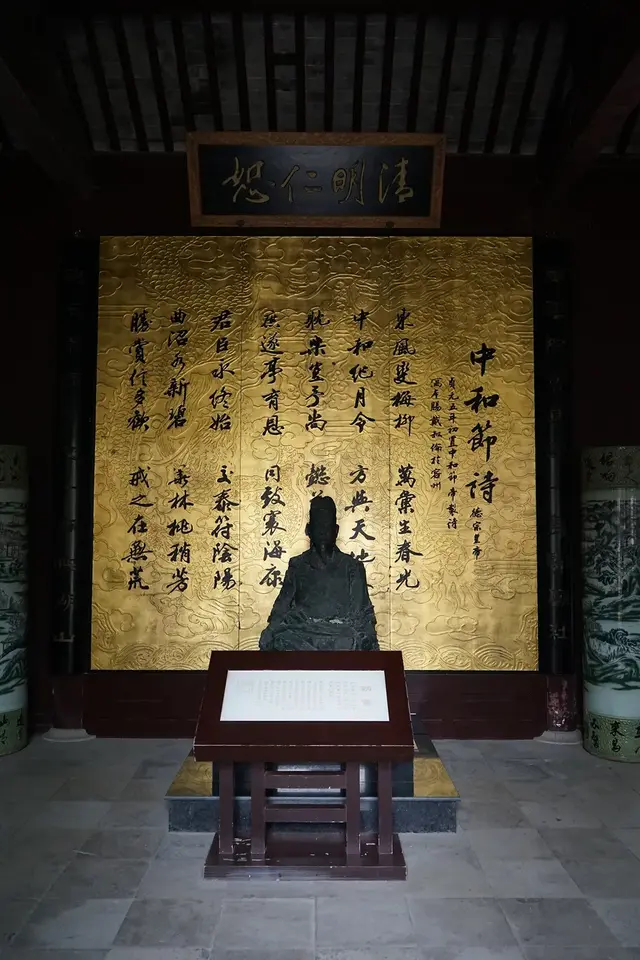
戴叔伦
Dai Shulun (732–789), courtesy name Yougong (幼公) and also known as Cigong (次公), was a native of Jintan in Runzhou (present-day Jintan, Jiangsu). He was an eminent poet of the Mid-Tang period and an exemplary Confucian upright official. Born into a distinguished family of Jiangnan recluses, both his grandfather Dai Xiuyu and his father Dai Shenyong lived as unswerving scholar-hermits without seeking civil office. In his youth,…
Dai Shulun (732–789), courtesy name Yougong (幼公) and also known as Cigong (次公), was a native of Jintan in Runzhou (present-day Jintan, Jiangsu). He was an eminent poet of the Mid-Tang period and an exemplary Confucian upright official. Born into a distinguished family of Jiangnan recluses, both his grandfather Dai Xiuyu and his father Dai Shenyong lived as unswerving scholar-hermits without seeking civil office. In his youth, Dai Shulun studied under the renowned Jiangnan literary master Xiao Yingshi, displaying an astonishing memory, intellectual agility, and thorough mastery of the Confucian classics and the Hundred Schools of Thought. In 756, to escape the chaos caused by Prince Yong Li Lin's uprising during the An Lushan Rebellion, he fled with his clan to Poyang in Jiangxi. In 762, recommended by the imperial financial director Liu Yan, who served as Vice Minister of Revenue, Dai Shulun was appointed Proofreader in the Palace Library. He soon joined Liu Yan's Transport Commission and was stationed in Hunan as Retainer for Transport. While escorting state revenues up the Yangtze River near Yun'an, his convoy was hijacked by the mutinous warlord Yang Zilin. Facing drawn blades, Dai Shulun declared fearlessly that his life could be taken but imperial wealth could never be seized, preserving the state treasury through heroic defiance, which earned him the post of Investigating Censor. Subsequently, Dai Shulun served as Tax Supervisor of Fuzhou and Prefect of Fuzhou, achieving outstanding administrative results. During his tenure in Fuzhou, he empathized deeply with the common people, restored the historic Qianjin Embankment, and devised the famous Water Equalization Law (Junshuifa), resolving decades of fierce irrigation disputes and securing bountiful harvests throughout the prefecture. Around the Xingyuan and Zhenyuan eras, he was elevated to Military Commissioner of Rongguan and Prefect of Rongzhou, with the concurrent title of Vice Censor-in-Chief, pacifying the diverse indigenous tribes of the Lingnan frontier with civil governance and military dignity. In 789, he submitted a memorial requesting retirement due to severe illness. On his journey home, he passed away in Qingyuan Gorge in Sichuan at the age of fifty-eight and was buried in his native Jintan. During the Ming dynasty, a commemorative stele was erected at his tomb honoring him as the Master of Poetry. Dai Shulun's poetry encompassed broad social themes, demonstrating mastery across diverse poetic forms while excelling particularly in five-character regulated verse. His language was natural, clear, vivid, and deeply poignant; works such as Song of Women Ploughing the Fields, Ballad of the Military Agricultural Colonies, and Song of the Frontier Fortress offered heartfelt compassion for suffering laborers. His masterpieces Staying at Shitou Post Station on New Year's Eve and The Shrine to the Three Ministers have been celebrated through centuries. His profound aesthetic maxim—that the imagery of genuine poetry is like warm sunlight upon Lantian jade giving rise to mist, visible from afar but elusive when held before one's eyes—exerted an enduring influence on the Shenyun (Spirit and Tone) and Xingling (Native Sensibility) poetic schools of later dynasties.
Born into a prominent scholarly recluse family in Jintan, gifted in learning, studied under literary master Xiao Yingshi.
Escaped Prince Yong's rebellion with his clan to Poyang, Jiangxi, living in hardship and contemplating official career.
Recommended by financial statesman Liu Yan, appointed Proofreader in the Palace Library, joined Transport Commission.
Transporting state revenue near Yun'an, captured by rebel Yang Zilin, defended public treasury with fearless integrity, promoted to Investigating Censor.
Appointed Prefect of Fuzhou, reconstructed Qianjin Embankment, enacted Water Equalization Law, achieving stellar agricultural progress.
Promoted to Prefect of Rongzhou and Military Commissioner of Rongguan with title of Vice Censor-in-Chief, pacifying Lingnan tribes.
Permitted to retire due to illness, passed away in Qingyuan Gorge on his journey home at fifty-eight, buried in Jintan.
Dai Shulun was born in Yaocun southwest of Jintan County, Runzhou. His family was a renowned scholar-recluse lineage in the Jiangnan region. His grandfather Dai Xiuyu and father Dai Shenyong upheld lofty moral integrity, dedicating their entire lives to classical study and education without pursuing bureaucratic honors. Nurtured by this profound domestic scholarship, Dai Shulun displayed exceptional intelligence and literary agility from childhood, effortlessly composing paired antithetical couplets. As an adolescent, he studied under Xiao Yingshi, the prominent Jiangnan master of literature and pioneer of the Classical Prose movement. Dai Shulun absorbed the Confucian classics, historical chronicles, philosophical treatises, and literary collections, capable of reciting texts after a single reading and emerging as one of Xiao's most accomplished disciples. A celebrated anecdote relates that while walking in the countryside, Master Xiao noticed a rooster crowing at noon and challenged him with the line: "White inn, white rooster crows at white daylight." Dai Shulun quickly matched it at dusk: "Yellow village, yellow dog barks at yellow twilight."
Following the outbreak of the An Lushan Rebellion, Emperor Xuanzong fled to Sichuan, Emperor Suzong ascended the throne at Lingwu, and northern China descended into turmoil. In the late winter of 756, Emperor Xuanzong's sixteenth son, Prince Yong Li Lin, raised troops to carve out an independent base in the Jianghuai region, throwing the southern heartland into disorder. Approximately twenty-five years old, Dai Shulun escorted his elder relatives aboard boats to seek refuge in Poyang, Jiangxi. Faced with impoverished exile and lack of patronage, he abandoned his ancestors' pastoral seclusion to pursue an official career for the salvation of the realm. While Xin Wenfang's Yuan dynasty work Biographies of Tang Talents erroneously recorded that he passed the imperial examinations in the sixteenth year of Zhenyuan, Quan Deyu's contemporary epitaph confirms that Dai Shulun had passed away in the fifth year of Zhenyuan at age fifty-eight. This firmly proves that he entered official service not through the standard examinations, but via provincial staff recruitment and high-level recommendation.
In 762, the brilliant financial administrator Liu Yan was appointed Vice Minister of Revenue, supervising national salt monopolies, iron taxes, and grain transport. Seeking capable administrative talent across Jiangnan, Liu Yan learned of Dai Shulun's practical administrative prowess and profound erudition. Liu Yan submitted an imperial memorial recommending Dai Shulun, resulting in his appointment as Proofreader in the Palace Library. In the early Dali era, Dai Shulun formally entered Liu Yan's Transport Commission and was deployed to Hunan as Retainer for Transport, directing fiscal transport across the middle Yangtze basins.
During his tenure with the Transport Commission, Dai Shulun led a river convoy escorting massive quantities of tax grain and treasury funds westward along the Yangtze River. Upon reaching Yun'an County within the Three Gorges, the fleet encountered a mutiny staged by the regional commander Yang Zilin. Rebel soldiers surrounded the boats and took Dai Shulun captive. Yang Zilin brandished a sword before him, threatening: "Hand over all the imperial gold, silk, and money on your vessels, and I shall spare your life!" Dai Shulun remained utterly unperturbed, replying with solemn dignity: "My body may be slain, but the state's taxes and grain can never be stolen!" Yang Zilin was deeply awed by his unyielding courage and righteous spirit. Recognizing that coercive seizure would yield no submission and fearing popular outrage, the rebel commander dared not harm him and released the convoy. Dai Shulun safeguarded the immense imperial treasury with unwavering devotion. The court praised his heroism and promptly elevated him to Investigating Censor within the Censorate.
Between the Jianzhong and Xingyuan eras, Dai Shulun served as Tax Supervisor of Fuzhou and other administrative posts, earning wide acclaim for integrity and equitable governance. In 784, the court promoted him to Prefect of Fuzhou. Located in western Jiangxi, Fuzhou had suffered severe neglect due to warfare and administrative apathy. Farmlands lay parched, and violent communal clashes frequently erupted among local clans over water distribution. Upon arrival, Dai Shulun conducted extensive investigations among the villagers, eradicating illicit extortions by corrupt clerks.
Recognizing that agricultural water conservancy was the paramount foundation for public welfare, Dai Shulun personally led officials and villagers to survey the river systems. He spearheaded a major reconstruction of the ancient Qianjin Embankment, repairing and dredging dozens of reservoirs, dikes, and irrigation channels. To resolve longstanding water conflicts, he formulated and proclaimed the celebrated Water Equalization Law, strictly regulating water rotation according to land acreage and planting calendars while severely penalizing powerful landlords who hoarded irrigation resources. Following the implementation of this system, irrigation flowed smoothly, and thousands of hectares of arable land yielded consecutive bumper harvests. The prefecture attained exceptional peace, and Dai Shulun's administrative assessment ranked first among all prefectures in Jiangxi. Although corrupt local officials fabricated slanderous charges against him during his term, the accusations were swiftly discredited, further highlighting his moral purity.
In the early Zhenyuan era, recognized for his stellar administrative record, the imperial court elevated Dai Shulun to Prefect of Rongzhou and Military Commissioner of Rongguan, concurrently conferring the title of Vice Censor-in-Chief. He thus became a frontline regional leader governing eight southern border prefectures. Rongguan was an arduous frontier inhabited by numerous ethnic groups with martial customs, presenting complex administrative challenges. Assuming his post, Dai Shulun balanced leniency with firm discipline. He reformed civil institutions, enforced military integrity, prohibited abusive tax levies, and maintained respectful, conciliatory relations with neighboring indigenous chieftains. Under his governance, local tribes voluntarily offered tribute, border turmoil ceased, and social stability flourished, winning widespread acclaim across the empire.
However, decades of arduous bureaucratic travel, the harsh southern climate, and unrelenting administrative toil severely undermined Dai Shulun's health. He had married the daughter of Wei Cai, Prefect of Yongzhou, and later wed the daughter of Cui Yin, Palace Censor. When Lady Cui passed away in 787, she left behind a six-year-old daughter. The loss of his wife in his declining years brought profound sorrow, prompting his poignant poem reflecting on his daughter's birthday and mourning his solitary old age.
In 789, approaching sixty and afflicted with chronic illness, Dai Shulun submitted a memorial requesting retirement to his ancestral homeland, which Emperor Dezong granted. Accompanying his young daughter along the waterways, he succumbed to illness at a post station in Qingyuan Gorge (north of modern Chengdu, Sichuan) at the age of fifty-eight. His remains were subsequently transported to his native soil and interred south of Jintan. In 1618, during the late Ming dynasty, Jintan Magistrate Zhang Hanzhong relocated and refurbished his tomb, inscribing the commemorative stele with the words "Master of Poetry in the Underworld."
While governing Fuzhou, Dai Shulun prioritized water conservancy, leading local communities to reconstruct the ancient Qianjin Embankment and excavate extensive canal networks. His innovative Water Equalization Law instituted an equitable, transparent rotation schedule for irrigation water, banishing agrarian drought and conflict for centuries and serving as an enduring model of benevolent provincial governance in the Tang dynasty.
Confronted with the mutinous warlord Yang Zilin and facing death threats, Dai Shulun stood firm and proclaimed that his life could be ended but public revenues could never be surrendered. His righteous resolve deterred the mutineers and safeguarded vital imperial tax funds, exemplifying the unbending moral integrity expected of a true Confucian scholar-official.
Governing the crucial southern frontier as Military Commissioner of Rongguan, Dai Shulun abolished oppressive practices, comforted indigenous populations, encouraged agriculture and trade, and secured comprehensive border harmony without military friction, establishing an exemplary standard for frontier administration.
Dai Shulun possessed deep Confucian humanitarian concern for the plight of the common people. His famous poem Song of Women Ploughing the Fields vividly depicted the desperate agony of peasant women forced to break ground with hand tools due to exorbitant taxation and the loss of draft cattle. In Song of the Frontier Fortress, he lamented the bitter suffering of garrison troops enduring freezing blizzards, while Ballad of the Military Agricultural Colonies exposed the tyranny of officials compelling displaced refugees to harvest timber until plow oxen perished from exposure, demonstrating an intense humanitarian spirit.
Dai Shulun achieved preeminent mastery in five-character regulated verse, highly lauded in Tang anthologies including Anthology of Mid-Tang Splendor, Anthology of Supreme Mystery, and Anthology of Outstanding Talents. His celebrated masterpiece Staying at Shitou Post Station on New Year's Eve captured the poignant solitude of an isolated traveler confronting a flickering cold lamp on the final night of the year. Its brilliant parallel couplet contrasting boundless space and passing time has been revered by generations of literary critics as an absolute pinnacle of classical Chinese travel poetry.
His five-character quatrain The Shrine to the Three Ministers stands as an immortal monument of nostalgic historical verse. Drawing upon the aesthetic atmosphere of the Songs of Chu, the poem seamlessly blends the eternal churning currents of the Yuan and Xiang rivers with Qu Yuan's unyielding sorrow, concluding with the solitary chill of autumn winds sweeping through maple groves without a single overt moral judgment, evoking boundless melancholy.
Dai Shulun bequeathed to Chinese aesthetics the celebrated poetic maxim that authentic poetic beauty resembles the radiant sunlight over Lantian and the delicate mist rising from fine jade—something that can be perceived in spiritual contemplation from afar but cannot be grasped directly before one's eyes. This insight emphasized spiritual resonance over rigid ornament, serving as a primary theoretical wellspring for Sikong Tu's poetic aesthetics, Yan Yu's Canglang Poetry Talks, and the later Spirit and Tone school. Furthermore, his composition to the tune of Tiaoxiaoling (Border Grass) represents one of the earliest and most accomplished literary lyric poems (Ci) authored by Mid-Tang literati.
FIGURES ASSOCIATED WITH THIS DYNASTY