Birth in Qiantang
Born into an artisan painter family in Qiantang, learning drawing and silversmithing from childhood.
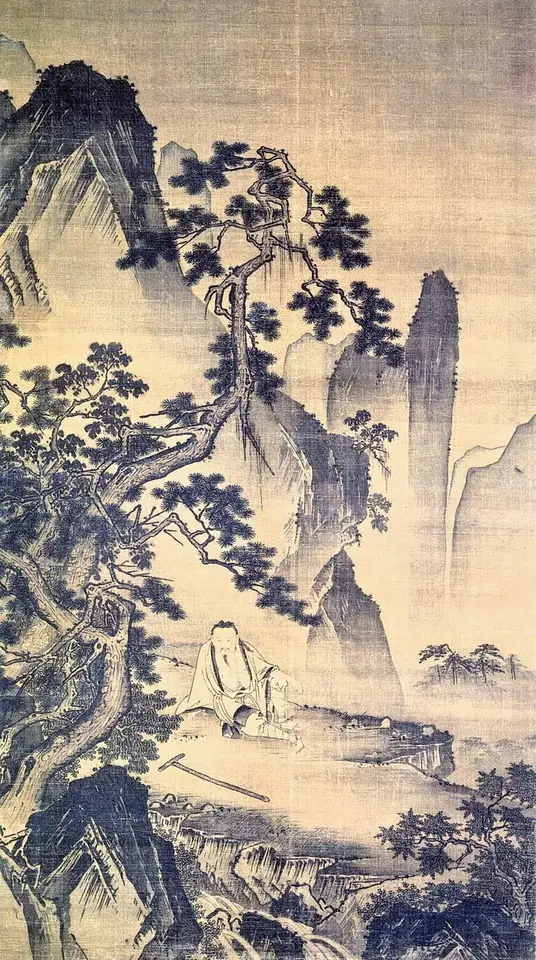
戴进
Dai Jin (1388–1462), courtesy name Wenjin and art names Jing'an and Yuquan Shanren, was a native of Qiantang, Hangzhou Prefecture, Zhejiang (modern Hangzhou, Zhejiang). He was a seminal master of Chinese art and the founding patriarch of the celebrated Zhe School in Ming dynasty painting history. Early in his career, Dai Jin worked as a silversmith crafting fine gold and silver jewelry before abandoning metalwork to master…
Dai Jin (1388–1462), courtesy name Wenjin and art names Jing'an and Yuquan Shanren, was a native of Qiantang, Hangzhou Prefecture, Zhejiang (modern Hangzhou, Zhejiang). He was a seminal master of Chinese art and the founding patriarch of the celebrated Zhe School in Ming dynasty painting history. Early in his career, Dai Jin worked as a silversmith crafting fine gold and silver jewelry before abandoning metalwork to master painting under his father's guidance, achieving virtuosity across landscapes, figures, and birds and flowers. During the Xuande era, he was summoned to the imperial palace upon high-ranking recommendations to serve as a Painter-in-Attendance in the Hall of Benevolence and Wisdom (Renzhi Hall). Court intrigue and jealousy from entrenched painters, particularly Xie Huan who denounced Dai Jin's depiction of a common fisherman wearing a red official robe in Solitary Angler on an Autumn River, resulted in imperial displeasure and his expulsion from the court. Escaping south, Dai Jin wandered between Nanjing and Hangzhou, eventually retiring near West Lake, supporting himself through selling scrolls and instructing disciples. He passed away in poverty in 1462 at seventy-four. Blending the structural rigor of Southern Song masters Ma Yuan and Xia Gui with the moist ink richness of Yuan literati like Zhao Mengfu, Dai Jin established the dynamic, ink-splashed Zhe School, dominating the Ming art world for over a century and exerting profound influence on Muromachi ink painting in Japan.
Born into an artisan painter family in Qiantang, learning drawing and silversmithing from childhood.
Witnessing his crafted silver ornaments being melted down in market furnaces, he resolved to abandon artisan craft for fine brush painting.
Traveled across Southern provinces, copying Song and Yuan masterpieces and winning high acclaim among Jiangnan elites.
Upon Emperor Xuanzong's ascension and call for master painters, Dai Jin received recommendations to enter the capital.
Appointed Painter-in-Attendance in the Renzhi Hall, executing grand imperial murals and landscape scrolls.
Slandered by court painter Xie Huan over the red robe in his painting, causing imperial reprimand and flight assisted by Xia Zhi.
Resided in Nanjing, teaching students and selling paintings, maturing his vigorous Zhe School brush style.
Returned to Hangzhou, living near Yuquan Mountain where disciples gathered and the Zhe School flourished.
Died in poverty and illness in Hangzhou at age seventy-four, buried by devoted pupils and friends.
Dai Jin was born in 1388 in Xiangpolong, Qiantang County, Hangzhou Prefecture. His father, Dai Jingxiang, was a local professional artisan painter who executed Buddhist-Daoist temple murals and portraiture. From early childhood, Dai Jin displayed extraordinary observational talents amidst paper, ink, and mineral pigments. Due to household economic hardship, however, he initially entered an apprenticeship as a goldsmith and silversmith, fashioning intricate ornaments.
His inventive intellect allowed him to craft hairpins, floral brooches, and animal figures of astonishing realism, attracting eager buyers among Hangzhou's wealthy merchant elite. Yet a chance occurrence altered his path. Visiting a smelting workshop one day, Dai Jin observed an artisan tossing his painstakingly chased silver hairpins directly into a glowing charcoal crucible to melt into raw bullion. Dai Jin was profoundly shaken and lamented that his utmost creative labor was treated merely as disposable currency rather than an enduring art form that might survive through generations. Resolving never to return to jewelry hammering, he broke his metalwork tools and dedicated his life entirely to painting.
Following his departure from artisanal craftsmanship, Dai Jin trained under his father to grasp structural drawing and chromatic composition before embarking on extensive travels across Jiangnan cultural centers. He visited notable private collections throughout Jiangsu and Zhejiang, rigorously copying classical Song and Yuan handscrolls and hanging scrolls. He deeply studied the atmospheric ink washes of Five Dynasties masters Dong Yuan and Juran, the Monumental Northern Song landscapes of Li Cheng, Fan Kuan, and Guo Xi, and the crisp, angular stroke vocabulary of Southern Song Academy masters Li Tang, Ma Yuan, and Xia Gui.
Blessed with exceptional painterly intuition and steady execution, Dai Jin synthesized the structural grandeur of the Northern Academy with the moist literati sensibilities of Yuan masters such as Zhao Mengfu, Gao Kegong, Huang Gongwang, and Wu Zhen. Between the Yongle and Hongxi reigns, his reputation resounded across Suzhou, Hangzhou, and the lower Yangtze basin. His landscapes manifested vast panoramas and turbulent weather; his figure portraits exhibited fluid garment contours and vibrant psychological depth; his bird-and-flower compositions glowed with delicate naturalism. Scholar-officials throughout Jiangnan considered securing an authentic Dai Jin scroll a mark of distinction.
In 1426, Emperor Xuanzong (Zhu Zhanji) ascended the imperial throne. Xuanzong was an accomplished painter and connoisseur who sought to expand court ateliers, commanding provincial governors and palace eunuchs to scout premier artists nationwide for the Forbidden City. Due to his immense prestige in the southern provinces, Dai Jin received glowing endorsements from senior ministers and local administrators, prompting an official summons to Beijing.
By 1432, having passed rigorous practical tests evaluated by court examiners, Dai Jin was formally commissioned as Painter-in-Attendance in the Renzhi Hall. Tasked with executing architectural murals, decorative folding screens, and grand landscape scrolls celebrating imperial leisure and state harmony, Dai Jin surpassed his peers in ease of execution and dramatic scale. Senior Grand Secretaries including Yang Shiqi and Yang Rong openly lauded his compositions. However, his preeminence aroused profound resentment and bitter rivalry among entrenched academy veterans.
At the time, favored palace painters included Li Zai, Ni Duan, Shi Rui, and Xie Huan, an influential portraitist serving in the Imperial Embroidered Uniform Guard. Xie Huan, recognizing Dai Jin's superior versatility and fearing the eclipse of his own palace favor, continually watched for an opportunity to undermine his rival.
The turning point arrived during an imperial inspection of recent academy works. Dai Jin presented a majestic long scroll entitled Solitary Angler on an Autumn River. The composition depicted mist-shrouded mountain ridges overlooking vast waters, where an elderly fisherman sat in a skiff attentively angling, his red outer robe billowing gently in the river breeze. Xuanzong initially admired the sweeping atmospheric depth and meticulous ink modeling.
Observing the emperor's interest, Xie Huan stepped forward and maliciously pointed out what he framed as a severe breach of ritual hierarchy. He declared that under Ming dynastic statutes and sumptuary codes, bright vermilion robes were reserved exclusively for high-ranking ministers of the third rank and above, asking how a lowly common fisherman wandering the marshes dared to wear official scarlet robes while holding a fishing rod. He accused Dai Jin of satirizing imperial rank decorum and demonstrating insolent disrespect toward the dynasty. Dismayed and angered by the political insinuation, Emperor Xuanzong turned away in silence and refused any reward.
Xie Huan and his associates capitalized on the incident to spread further denunciations, hinting that Dai Jin harbored subversive intentions. Sensing imminent arrest and peril within the treacherous court, Dai Jin consulted his devoted student Xia Zhi while staying at Qingshou Temple. Acting decisively, Xia Zhi plied temple monastics with wine to borrow an ordination certificate, shaved Dai Jin's head into a mendicant monk's tonsure, and escorted him out through the city gates under cover of darkness to escape south.
Having evaded immediate palace capture, Dai Jin did not immediately flee to the far south, but spent several transitional years lodging discreetly in Beijing as an independent urban painter, operating from a humble quarters known as the Bamboo Snow Studio (Zhuxue Xuan). In this period, he produced private commissions for sympathetic scholar-officials. Grand Secretaries Yang Shiqi and Wang Zhi, mourning his unfair treatment, covertly extended material patronage and commissioned private landscape albums.
Dai Jin possessed an uncompromising and proud disposition, refusing to fawn over arrogant nobility. When a haughty imperial noble demanded that Dai Jin paint portal guardians upon his estate gates, Dai Jin regarded the demand as an insult to his scholarly calling and flatly refused. Enraged, the nobleman dispatched henchmen to seize Dai Jin and publicly parade him in wooden cangue collars. Only after prominent scholar-officials interceded was Dai Jin released. This humiliating episode extinguished any lingering hopes of imperial patronage, hardening his determination to return to the southern cultural heartland.
Departing from the north, Dai Jin traveled along the Yangtze river basin and briefly visited the southwestern frontier of Yunnan and Guizhou. During the Zhengtong era, he settled in Nanjing, earning a livelihood through painting sales and studio instruction along the Qinhuai River. Freed from rigid court restrictions, his brushwork gained unmatched dynamism and freedom.
During the Jingtai era, reaching his sixties, Dai Jin returned permanently to his hometown of Hangzhou. He constructed a modest dwelling near Gushan and the slopes of Yuquan Mountain overlooking West Lake, assuming the moniker Yuquan Shanren (Hermit of Jade Spring). Throughout his final decade in Hangzhou, he welcomed aspiring painters into his studio. His brush technique combined the structural strength of Ma Yuan and Xia Gui with explosive axe-cut texture strokes (daxupi cun) and rapid sweeps of saturated black ink to render wind, driving rain, and precipitous rock faces.
This invigorating style swept across Zhejiang and southern artistic circles. Young talents flocked to Hangzhou to master his methods. Exceptional painters such as Wu Wei, Zhang Lu, Jiang Song, and Wang Zhao absorbed his stylistic innovations, coalescing into an extensive and technically dazzling painting community. Because Dai Jin originated from Qiantang in Zhejiang and centered his career around West Lake, later art historians christened this influential movement the Zhe School, unanimously revereing Dai Jin as its founding master.
Although celebrated throughout the empire, Dai Jin remained generous and indifferent to material accumulation. When poor scholars or impoverished neighbors requested scrolls, he frequently refused payment. Any honoraria he received were shared generously with needy disciples struggling to purchase pigments and silk. Consequently, he accumulated no personal savings.
In his final years, he endured deep poverty, once facing the embarrassment of being unable to afford a dowry for his daughter without relying on emergency painting sales. In 1462, worn down by relentless physical exertion and chronic rheumatism, Dai Jin passed away in his Hangzhou dwelling at the age of seventy-four. He died destitute, lacking even the means for burial garments and a wooden coffin. His grief-stricken disciples and close companions pooled their modest resources to give their master a dignified burial along the foot of Xixi near West Lake.
Dai Jin's most enduring historical contribution was founding the Zhe School. Following the late Yuan dynasty, when masters like Zhao Mengfu and Huang Gongwang established literati landscape painting as the artistic orthodoxy, pictorial styles had gradually drifted toward ethereal gentility, occasionally descending into frail delicacy. Dai Jin courageously reintroduced the solid structural bones and monumental vigor of the Southern Song Imperial Painting Academy into the Ming art world, reviving the heroic, masculine aesthetic of Song masters.
The Zhe School championed sharp calligraphic contours, commanding axe-cut texture strokes, and bold washes of saturated monochrome ink. Emerging during the Xuande and Zhengtong eras, the school swept through northern and southern artistic centers, dominating court painting workshops and popular artistic taste for more than a century until Dong Qichang articulated the Northern and Southern School theory in the late Ming.
Dai Jin was a consummate master possessing rare versatility across all major painterly disciplines. In landscape painting, masterpieces such as Travelers in Mountain Passes, Returning by Boat in Wind and Rain, Spring Mountains Piled with Verdure, Late Return from a Spring Outing, Spring Clouds over Linggu, Snowscape Landscape, and Nanping Gathering showcased expansive structural grandeur, soaring peaks, cascading cataracts, and trees whipped by howling gales executed with unbridled brush energy.
In figure painting, Dai Jin inherited the undulating draftsmanship of Tang master Wu Daozi and Northern Song master Li Gonglin's monochrome line drawing (baimiao), uniting fine detail with expressive spontaneity. He introduced calligraphic energy into his lines, perfecting the nail-head rat-tail stroke (dingtou shuwei miao), characterized by weighted initial presses tapering into slender terminal flicks. Works like Six Patriarchs from Bodhidharma to Huineng, Zhong Kui on Night Patrol, Three Visits to the Thatched Cottage, The Four Graybeards of Mount Shang, and Returning to the Fields to Celebrate Longevity presented psychological vitality and dramatic movement. In bird-and-flower painting, he synthesized Huang Quan's refined outlines with Xu Xi's uninhibited boneless wash, seen in Hollyhocks, Rocks, and Butterflies and Three Egrets.
The artistic legacy of Dai Jin and the Zhe School extended far beyond China's borders, profoundly transforming ink painting traditions across East Asia, especially in Japan.
Between the Xuande and Chenghua reigns, Japanese tribute missions regularly visited China. In 1467, Sesshu Toyo, the foremost master of Japanese ink painting, accompanied a trade mission to China on a study journey. Sesshu traveled extensively through Jiangnan and Beijing, eagerly acquiring and copying paintings by Dai Jin and his followers, assimilating the Zhe School's dynamic ink washes and structural composition. Upon returning to Japan, Sesshu established the Unkoku School, while the Kano School (founded by Kano Masanobu and developed by Kano Motonobu) adopted Dai Jin's brush methods as classical models. Consequently, Dai Jin's style became a foundational cornerstone of Muromachi and early Edo period suibokuga (ink wash painting).
Records of Ming Painting (Minghua Lu, Volume 2) records: "Dai Jin, courtesy name Wenjin, native of Qiantang. In landscape painting he captured the marrow of Ma Yuan and Xia Gui, yet introduced divine variations with transcendent brushwork that absorbed various masters. In the Shenzong reign, even when Dong Qichang championed the Four Masters of late Yuan, he could not help but sigh in admiration that Wenjin was a true master of painting. In figure and bird-and-flower painting he was exquisitely peerless; among Ming painters, he must be ranked foremost."
Ming scholar Lang Ying observed in Categorized Manuscripts of Seven Categories (Qixiu Leigao): "Among the painters of our dynasty, Dai Jin ranks first. His landscapes are divine and unrestrained, his birds and flowers delicate and exquisite, his figures peerless, with none preceding him and none surpassing him since."
Dong Qichang remarked in Essays from the Painting Chan Studio (Huachanshi Suibi): "Wenjin's painting technique possessed deep classical foundations; its vigorous bones and expansive spirit far exceeded ordinary academy products, marking him as an authentic master of the early Ming."
Ming dramatist and literary scholar Li Kaixian assessed Dai Jin in Zhonglu Painting Criticisms (Zhonglu Huapin) as the consummate synthesizer of Ming art, praising his ability to integrate Song and Yuan traditions while establishing an independent school of divine quality.
FIGURES ASSOCIATED WITH THIS DYNASTY