Born in Jintan
Born into a prominent scholar-official clan in Jintan County, Zhenjiang Prefecture, Jiangsu.
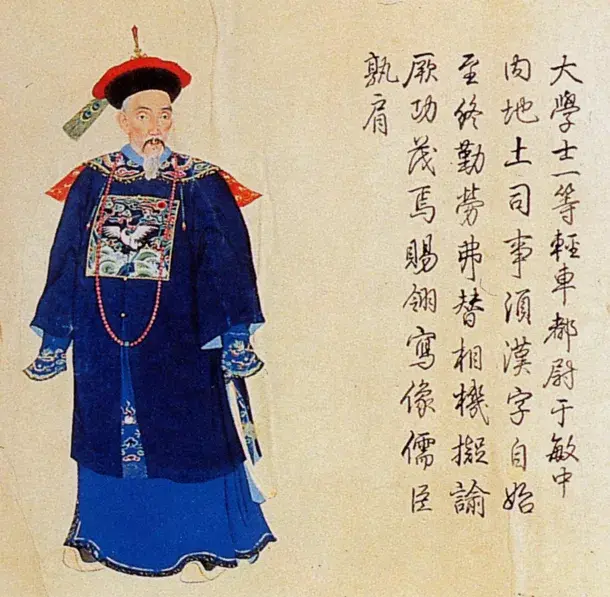
于敏中
Yu Minzhong (于敏中, 1714–1780), courtesy name Shuzi or Chongtang and art name Naipu, was a native of Jintan County in Zhenjiang Prefecture, Jiangsu, and a leading statesman and scholar of the Qianlong reign in the Qing dynasty. Taking first place as Optimus (Zhuangyuan) in the 1737 imperial examination, he was appointed Senior Compiler in the Hanlin Academy, entered the Southern Study (Nan Shufang), served as Education…
Yu Minzhong (于敏中, 1714–1780), courtesy name Shuzi or Chongtang and art name Naipu, was a native of Jintan County in Zhenjiang Prefecture, Jiangsu, and a leading statesman and scholar of the Qianlong reign in the Qing dynasty. Taking first place as Optimus (Zhuangyuan) in the 1737 imperial examination, he was appointed Senior Compiler in the Hanlin Academy, entered the Southern Study (Nan Shufang), served as Education Commissioner in Shandong and Zhejiang, and held vice-ministerial posts in the Ministries of War, Justice, and Revenue. Appointed to the Grand Council in 1760, he rose to Minister of Revenue in 1765, Assistant Grand Secretary in 1771, and Grand Secretary of the Wenhua Hall in 1773. Following the deaths of Fuheng and Liu Tongxun, Yu Minzhong served as Chief Grand Councilor, Director-General of the Complete Library of the Four Treasuries (Siku Quanshu), and Chief Preceptor of the Upper Study. Renowned for his extraordinary memory, rapid literary composition, and mastery of court precedents, Yu Minzhong attended the Qianlong Emperor daily to transcribe oral edicts and draft confidential court letters, participating in major decisions including the Second Jinchuan Campaign and having his portrait hung in the Pavilion of Purple Splendor (Ziguangge). When he died in the twelfth month of the forty-fourth year of Qianlong (January 1780), he was posthumously promoted to Grand Guardian, canonized as Wenxiang, and enshrined in the Temple of Eminent Statesmen. Soon after his death, however, investigations exposed his acceptance of massive bribes from Gansu Financial Commissioner Wang Danwang in the Gansu grain-donation fraud, his illicit leaks of imperial rescripts to the eunuch Gao Yuncong, and a bitter inheritance lawsuit among his grandsons over his vast fortune, prompting the Qianlong Emperor in 1786 to remove his spirit tablet from the Temple of Eminent Statesmen.
Born into a prominent scholar-official clan in Jintan County, Zhenjiang Prefecture, Jiangsu.
Placed first in the palace examination as Optimus (Zhuangyuan) at age twenty-four and was appointed Hanlin Senior Compiler.
Served as Chief Examiner in Shanxi, then as Education Commissioner of Shandong in 1745, and entered the Southern Study.
Served as Education Commissioner of Zhejiang and was promoted to Academician of the Grand Secretariat with the rank of Vice Minister of Rites.
Promoted to Right Vice Minister of War, subsequently serving as Left Vice Minister of Justice and Vice Minister of Revenue.
Appointed to serve on the Grand Council in the eighth month, entering the inner decision-making core of the Qing court.
Promoted to Minister of Revenue, overseeing the empire's fiscal administration.
Promoted to Grand Secretary of the Wenhua Hall and Director-General of the Siku Quanshu, succeeding Liu Tongxun as Chief Grand Councilor.
Awarded a double-eyed peacock feather and honored with a portrait in the Pavilion of Purple Splendor following the pacification of the Jinchuan chieftains.
Died in Beijing, canonized as Wenxiang and enshrined in the Temple of Eminent Statesmen; expelled from the temple in 1786 after his corruption in the Gansu scandal was exposed.
Yu Minzhong was born in 1714 into an illustrious gentry family in Jintan County, Zhenjiang Prefecture, Jiangsu; his great-grandfather Yu Sichang, grandfather Yu Hanxiang, and uncle Yu Fang were all Palace Graduates. Gifted from youth, Yu Minzhong passed the Jiangnan provincial examination in 1735.
In 1737, at the age of twenty-four, Yu Minzhong excelled in the metropolitan and palace examinations, winning first place in the first class (Zhuangyuan) through his erudition and refined calligraphy, and was appointed Senior Compiler in the Hanlin Academy. In 1744 he served as Chief Examiner for the Shanxi provincial examination, in 1745 he became Education Commissioner of Shandong, and in 1747 he was transferred to serve as Education Commissioner of Zhejiang before being summoned into the Southern Study (Nan Shufang) as a close literary attendant to the Qianlong Emperor. In 1750, he was promoted to Academician of the Grand Secretariat with the concurrent rank of Vice Minister of Rites.
In 1754, Yu Minzhong was appointed Right Vice Minister of War, returning home in 1756 to observe mourning for his stepmother. Recalled in 1757 as Acting Right Vice Minister of Justice and soon promoted to Left Vice Minister of Justice, he suffered the loss of his adoptive father Yu Shufan in 1758. Rather than allowing him to take the customary twenty-seven-month mourning leave, the Qianlong Emperor issued a special edict ordering him to return to Beijing after one hundred days to serve as Vice Minister of Revenue.
In the eighth month of 1760, the Qianlong Emperor appointed Yu Minzhong to serve on the Grand Council. Possessing an exceptional memory and swift brush, Yu attended the emperor daily to take down oral instructions and immediately drafted lengthy court letters (tingji) and public edicts that captured the monarch's exact intent without omission. Promoted to Minister of Revenue in 1765 and granted the title of Junior Guardian of the Heir Apparent in 1768, he became Assistant Grand Secretary in 1771.
In the eighth month of 1773, Yu Minzhong was promoted to Grand Secretary of the Wenhua Hall while retaining his post as Minister of Revenue. Following the sudden death of Chief Grand Councilor Liu Tongxun that winter, Yu Minzhong succeeded him as Chief Grand Councilor, concurrently serving as Chancellor of the Hanlin Academy, Chief Preceptor of the Upper Study, Director-General of the State Historiography Office, and Director-General of the Complete Library of the Four Treasuries (Siku Quanshu).
During the arduous Second Jinchuan Campaign (1771–1776) in western Sichuan, Yu Minzhong worked day and night alongside the Qianlong Emperor to draft confidential military dispatches and coordinate troop and grain movements for front-line commander Agui. Upon the final victory in 1776, the emperor praised Yu for his tireless precision in drafting military edicts, conferring upon him a hereditary minor noble title, a double-eyed peacock feather, a yellow riding jacket, and inclusion among the fifty meritorious officials whose portraits were hung in the Pavilion of Purple Splendor (Ziguangge).
When the Qing court established the commission to compile the Complete Library of the Four Treasuries in 1773, Yu Minzhong served as its executive Director-General. Working with Chief Editors Ji Yun and Lu Xixiong, he formulated editorial guidelines, oversaw the recovery of lost texts from the Ming Yongle Encyclopedia, and supervised the Wuying Hall movable-type printing project (Wuyingdian Juzhenban). He also compiled and edited tens of thousands of the Qianlong Emperor's imperial poems and essays.
During the literary inquisitions of the mid-to-late Qianlong era, Yu Minzhong frequently enforced strict censorship. In 1777, when Jiangxi Provincial Graduate Wang Xihou compiled the dictionary Ziguan, which critiqued the Kangxi Dictionary and printed the taboo personal names of the Kangxi, Yongzheng, and Qianlong Emperors without proper avoidance, Jiangxi Governor Haicheng initially recommended only stripping Wang of his degree. Reviewing the memorial, Yu Minzhong pointed out to the emperor that printing imperial taboo names constituted high treason, prompting the Qianlong Emperor to order Wang Xihou's immediate execution and the dismissal and punishment of Governor Haicheng.
In the winter of 1779, Yu Minzhong suffered a severe relapse of asthma; despite treatment by imperial physicians and gifts of ginseng from the throne, he died in Beijing on the fourteenth day of the twelfth month of the forty-fourth year of Qianlong (January 20, 1780) at the age of sixty-six. The emperor bestowed a Dharani sutra shroud, promoted him posthumously to Grand Guardian, conferred the posthumous name Wenxiang, and ordered his spirit tablet placed in the Temple of Eminent Statesmen.
Within two years of his death, however, major scandals exposed Yu Minzhong's covert corruption. In 1780, inquiries revealed that he had colluded with the executed palace eunuch Gao Yuncong over private land litigation and leaked confidential imperial rescripts. In 1781, the massive Gansu grain-donation fraud broke open, revealing that former Gansu Financial Commissioner Wang Danwang and dozens of officials had embezzled millions of taels of silver under the guise of famine relief; confessions established that Wang Danwang had paid huge bribes to Yu Minzhong to secure approval for opening the Gansu contribution system and to shield the fraud from central scrutiny.
Simultaneously, a bitter family lawsuit erupted in Jintan when Yu Minzhong's collateral grandson Yu Deyu seized tens of thousands of taels from Yu's young adoptive grandson Yu Shihe. When Jiangsu Governor Min Eyuan inventoried the estate, he discovered that Yu Minzhong had amassed a personal fortune between one and two million taels of silver. Outraged by the hypocrisy of a trusted chief minister who had feigned frugality while amassing illicit wealth, the Qianlong Emperor issued stern edicts declaring that had Yu Minzhong still been alive he would have been executed, and in the third month of 1786 ordered Yu's tablet expelled from the Temple of Eminent Statesmen.
Serving on the Grand Council for twenty years and as its leading minister for seven, Yu Minzhong was the most powerful Han official of the mid-Qianlong reign. Throughout the Burma War and the Second Jinchuan Campaign, he accompanied the emperor at the Yuanmingyuan, the Chengde Mountain Resort, and the Mulan hunting grounds, translating oral strategic directives into precise court letters (tingji) and coordinating front-line campaigns under General Agui with multi-provincial fiscal and grain transfers.
Heading the Ministry of Revenue from 1765 until his death nearly fifteen years later, Yu Minzhong managed imperial finances at the height of the Qianlong treasury surplus. He organized the rotating schedules for empire-wide land-tax and tribute-grain exemptions, coordinated salt-merchant contributions from Lianghuai and Changlu, and allocated tens of millions of taels for river conservancy, imperial southern tours, and frontier military expeditions, though his monopoly over fiscal approvals also enabled provincial officials like Wang Danwang to secure illicit authorization for the Gansu grain-donation scheme through bribery.
As Director-General of the Siku Quanshu commission from 1773 until his death, Yu Minzhong managed the institutional framework, scholarly staffing, and financial operations of the massive bibliographic project. He directed the extraction of hundreds of lost ancient works from the Yongle Encyclopedia, promoted the Wuying Hall wooden movable-type editions (Juzhenban), and co-directed major imperial compilations including the Rixia Jiuwen Kao (Research on Old Hearsay of the Capital) and the History of the Imperial Palace (Guochao Gongshi).
From his entry into the Southern Study in 1747, Yu Minzhong served for over three decades as the primary editor and annotator of the Qianlong Emperor's vast corpus of imperial poetry and prose. Familiar with classical allusions as well as Inner Asian geographical terms, he supervised the compilation of the first three collections of the Imperial Poems (Yuzhi Shi), the Researches on Manchu Origins (Manzhou Yuanliu Kao), and the Illustrated Gazetteer of the Western Regions (Xiyu Tuzhi), while leaving behind his own literary collection Suyutang Ji.
Before and during his tenure on the Grand Council, Yu Minzhong served three terms as Education Commissioner in Shandong and Zhejiang and repeatedly presided over the Shuntian provincial examination, the metropolitan examination, and palace examination grading. Enforcing strict examination discipline while promoting talented scholars versed in classical philology, he mentored numerous Hanlin academicians and ministerial officials across the mid-Qianlong bureaucracy.
FIGURES ASSOCIATED WITH THIS DYNASTY