Born in Lujiang
Born into an esteemed scholar-gentry lineage in Wan County, Lujiang Commandery, endowed with grace and beauty.
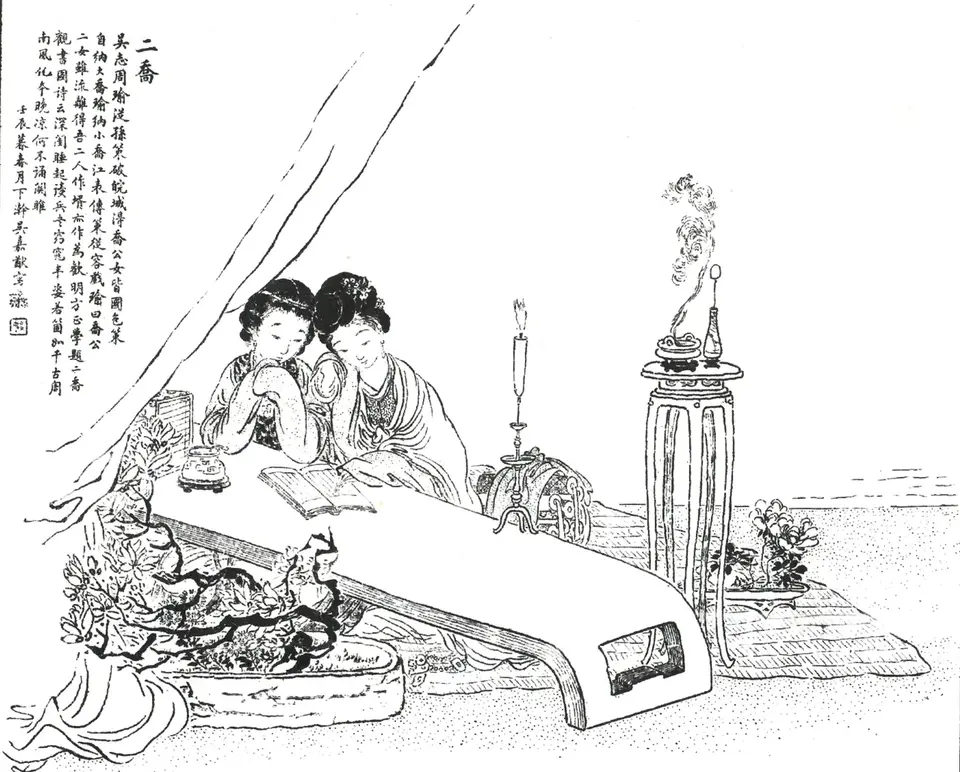
大乔
Da Qiao (dates of birth and death unrecorded in historical annals), originally surnamed Qiao (historically written with both radical variants), was a native of Wan County, Lujiang Commandery, Yang Province (modern Qianshan, Anhui Province). She was a prominent aristocratic lady of the late Eastern Han dynasty, the wife of General Who Overturns the Rebellious and Marquis of Wu Sun Ce (the foundational architect of the Eastern…
Da Qiao (dates of birth and death unrecorded in historical annals), originally surnamed Qiao (historically written with both radical variants), was a native of Wan County, Lujiang Commandery, Yang Province (modern Qianshan, Anhui Province). She was a prominent aristocratic lady of the late Eastern Han dynasty, the wife of General Who Overturns the Rebellious and Marquis of Wu Sun Ce (the foundational architect of the Eastern Wu state), and the elder sister of Xiao Qiao. Together celebrated as the "Two Qiaos of Jiangdong," the sisters endure as preeminent icons of feminine beauty and classical cultural motifs in Chinese history. In December 199 (12th month of the 4th year of the Jian'an era), Sun Ce joined forces with his close friend and Palace Commandant of the Central Guard Zhou Yu to storm Wan County, the capital of Lujiang Commandery. At that time, a respected local gentleman named Lord Qiao had two daughters of peerless beauty and poise, celebrated as the most exquisite maidens throughout the Yangtze River delta. Sun Ce took the elder daughter, Da Qiao, as his wife, while Zhou Yu married the younger daughter, Xiao Qiao. Sun Ce playfully remarked to Zhou Yu that although the two daughters of Lord Qiao were caught in the upheavals of civil warfare, securing the two of them as husbands was enough reason for them to be joyful. In 200 (5th year of the Jian'an era), while hunting in Dantu, Sun Ce was ambushed by retainers of the former Administrator of Wu Commandery Xu Gong and mortally wounded, dying shortly thereafter in his youth. After only several months of marriage, Da Qiao endured the devastating loss of her husband; her subsequent life remained unrecorded in official histories. Through Tang dynasty poet Du Mu's immortal verse in Red Cliff—"Had the east wind not aided Young Master Zhou, spring in the Bronze Sparrow Terrace would have locked away the two Qiaos"—and Ming dynasty author Luo Guanzhong's dramatic portrayal in Romance of the Three Kingdoms (featuring Zhuge Liang's clever incitement of Zhou Yu over Cao Cao's desire to capture the sisters), Da Qiao's cultural image was continuously enriched, establishing her as an enduring symbol of grace, romantic melancholy, and dynastic vicissitude amid the turmoil of the Three Kingdoms.
Born into an esteemed scholar-gentry lineage in Wan County, Lujiang Commandery, endowed with grace and beauty.
Sun Ce and Zhou Yu captured Wan County; Sun Ce married Da Qiao and Zhou Yu married Xiao Qiao, hailed as the Two Qiaos.
Sun Ce was assassinated, leaving Da Qiao a young widow; she withdrew into private life to raise descendants, disappearing from records.
Du Mu composed his famous quatrain Red Cliff, immortalizing the sisters with the line regarding the Bronze Sparrow Terrace.
Luo Guanzhong codified the dramatic scene of Zhuge Liang inciting Zhou Yu in Romance of the Three Kingdoms, popularizing Da Qiao across the realm.
Da Qiao was born into the prominent Qiao lineage during the tumultuous final decades of the Eastern Han dynasty, an era marked by the decline of imperial central authority and the rise of contending regional warlords. Her native town was Wan County in Lujiang Commandery, Yang Province (modern Qianshan, Anhui Province). Bordered by the Yangtze River to the south and backed by Mount Tianzhu to the north, Wan County had long served as a prosperous commercial and cultural center bridging the Yangtze and Huai river basins.
Da Qiao's father, Lord Qiao, was a revered local scholar-gentry figure. Amid the spreading chaos of the late Han wars, the Qiao household maintained strict family discipline and scholarly cultivation. Lord Qiao raised two daughters, the elder known as Da Qiao and the younger as Xiao Qiao. Contemporary chronicles record that both sisters possessed extraordinary physical charm, refined deportment, and literary virtue, earning the title of the finest beauties across the entire southern delta. Throughout Jianghuai, the fame of the two Qiao sisters spread widely, arousing immense admiration among southern scholars and chivalric warriors alike.
In 199 (4th year of the Jian'an era), dramatic upheavals reshaped the political landscape of Jiangdong. Following warlord Yuan Shu's ill-fated imperial usurpation and death, his subordinate Liu Xun seized Wan County and entrenched himself in Lujiang. Sun Ce, then serving as General Who Overturns the Rebellious and Governor of Kuaiji, was vigorously consolidating his southern base and considered Lujiang an indispensable stepping stone for subduing Jiangdong and marching westward into Jing Province.
In the twelfth month of that year, Sun Ce coordinated an offensive with his intimate companion and Palace Commandant of the Central Guard Zhou Yu. Employing a deceptive diversion that drew Liu Xun's main force away on an expedition to Haihun, Sun Ce led elite forces on a forced night march to strike Wan County. Eastern Wu amphibious forces breached the defenses in a swift assault, capturing Liu Xun's family retainers and over thirty thousand troops.
While inspecting the pacified town, Sun Ce and Zhou Yu learned of Lord Qiao's two daughters, whose beauty was famed as transcendent. Sun Ce, then twenty-four years of age, was celebrated across the realm as a fearless military genius nicknamed the "Little Conqueror of Jiangdong," while Zhou Yu was equally renowned for his handsome valor and strategic brilliance. Captivated by their reputation, Sun Ce took the elder sister Da Qiao as his bride, while Zhou Yu married Xiao Qiao. The double marriage of two peerless heroes with two transcendent beauties became an instant legend. In camp, Sun Ce casually teased Zhou Yu: "Although Lord Qiao's two daughters have suffered dislocation during this war, having the two of us as their husbands should be sufficient joy for them in these turbulent times!"
Although the union between Da Qiao and Sun Ce was celebrated as a harmonious match of heroes and beauties, it proved heartbreakingly fleeting. In the spring of 200, Da Qiao accompanied Sun Ce's household to Wu Commandery. At that time, Cao Cao and Yuan Shao were locked in confrontation at the Battle of Guandu. Sun Ce contemplated exploiting the northern military vacuum to launch a surprise strike against Xuchang to welcome Emperor Xian, massing his armies at Dantu for rigorous naval and land maneuvers.
In the fourth month of 200, however, while riding alone on a hunt in the hills of Dantu, Sun Ce was ambushed by three vengeful retainers of the deceased Administrator of Wu Commandery Xu Gong. Sun Ce was struck in the face by a poisoned arrow and severely injured. Brought back to his headquarters, his condition deteriorated rapidly. Aware that his life was slipping away, he summoned his younger brother Sun Quan in the middle of the night, personally transferring the insignia of command to him with the famous charge: "In deploying the hosts of Jiangdong, maneuvering between battle lines, and contending with rivals across the empire, you are not my equal; in elevating the worthy and employing the capable, winning hearts to preserve Jiangdong, I am not your equal!" With these words, Sun Ce passed away at the age of twenty-six.
Having been wed to Sun Ce for fewer than five months, Da Qiao was plunged into devastating grief. Following the state funeral, eighteen-year-old Sun Quan succeeded his brother as master of Jiangdong. To maintain court stability and protect Sun Ce's surviving household, the Eastern Wu administration provided for Sun Ce's widow and orphans. From that moment forward, Da Qiao secluded herself within inner chambers, scrupulously adhering to traditional wifely virtue, nurturing Sun Ce's progeny, and shunning public affairs. Official dynastic records such as Records of the Three Kingdoms make no further mention of her subsequent years or burial site, leaving her final decades shrouded in the silence of history.
Although authentic historical accounts of Da Qiao were exceedingly brief, she gained everlasting cultural life through Chinese classical literature and popular imagination. Together with Xiao Qiao, the "Two Qiaos of Jiangdong" became the supreme archetype of classical feminine beauty in Chinese civilization.
During the Huichang era of the Tang dynasty, the renowned poet Du Mu passed by the Red Cliff bluff in Huangzhou and composed the immortal quatrain Red Cliff: "A broken halberd sinks in sand, its iron not yet decayed; polished and ground afresh, it recalls dynasties past. Had the east wind not aided Young Master Zhou, spring in the Bronze Sparrow Terrace would have locked away the two Qiaos." Du Mu deployed a striking counterfactual premise, using the hypothetical captivity of Da Qiao and Xiao Qiao to symbolize the total defeat of Eastern Wu and the fall of the southern state. Following Du Mu, hundreds of poets across the Tang and Song dynasties composed verses honoring the sisters, intertwining the personal fates of women with the rise and fall of empires.
In the late Yuan and early Ming dynasties, Luo Guanzhong codified this tradition in chapter 44 of Romance of the Three Kingdoms. The novel dramatized Cao Cao's construction of the Bronze Sparrow Terrace as an endeavor to conquer the south and capture the two Qiaos for his leisure. In a famous literary invention, Zhuge Liang incited Zhou Yu to war by quoting Cao Zhi's Rhapsody on the Bronze Sparrow Terrace, falsely claiming that Cao Cao had written of "gathering the two Qiaos of the southeast to enjoy mutual delight day and night." Through the immense reach of the historical novel, Da Qiao became a household name across China.
Scholars and philologists have examined several historical questions surrounding Da Qiao:
First, the textual variation in the surname between the characters. In Chen Shou's Records of the Three Kingdoms and Pei Songzhi's citations of Jiangbiao Zhuan, the surname was originally written with the wood radical, denoting the noble Qiao family. From the Southern and Northern Dynasties onward, phonetic loan practices evolved, and literary writers gradually adopted the simplified poetic character without the radical for aesthetic elegance. Modern convention accepts both forms, though historical fidelity confirms the original radical.
Second, regarding Da Qiao's later years and passing. Because official histories fall silent, subsequent unofficial miscellanies generated diverse anecdotes. For instance, Xue Fucheng's Qing dynasty work Notes of Yong'an recorded a legend claiming that Da Qiao wept inconsolably day and night for months after Sun Ce's death before dying of heartbreak; folklore also suggested she lived out her days in quiet seclusion in Buddhist study. Modern historians recognize these accounts as later literary embellishments born of popular sympathy for tragic beauties in chaotic times. The historical silence itself highlights the marginalization of women in traditional dynastic histories while underscoring how literature resurrected their memory into timeless cultural emblems.
Grew up in a prominent family in Wan County, Lujiang Commandery, celebrated alongside her younger sister Xiao Qiao for literary poise and matchless grace as the premier beauty of the Yangtze region.
Married Sun Ce in December 199 following the fall of Wan County, while Zhou Yu married Xiao Qiao, creating one of the most famous romantic alliances between heroes and beauties in Three Kingdoms history.
Following Sun Ce's assassination in 200, Da Qiao lived in dignified retirement within the inner quarters, maintaining moral integrity and raising descendants away from political strife.
Her fame and historic fate inspired Tang poet Du Mu to write the immortal poem Red Cliff, whose line on the Bronze Sparrow Terrace inextricably linked her destiny to the geopolitical survival of the state.
Amplified by Romance of the Three Kingdoms through the famous plotline of Zhuge Liang inciting Zhou Yu, Da Qiao became an indelible cultural archetype of feminine beauty and historical poignancy.
FIGURES ASSOCIATED WITH THIS DYNASTY