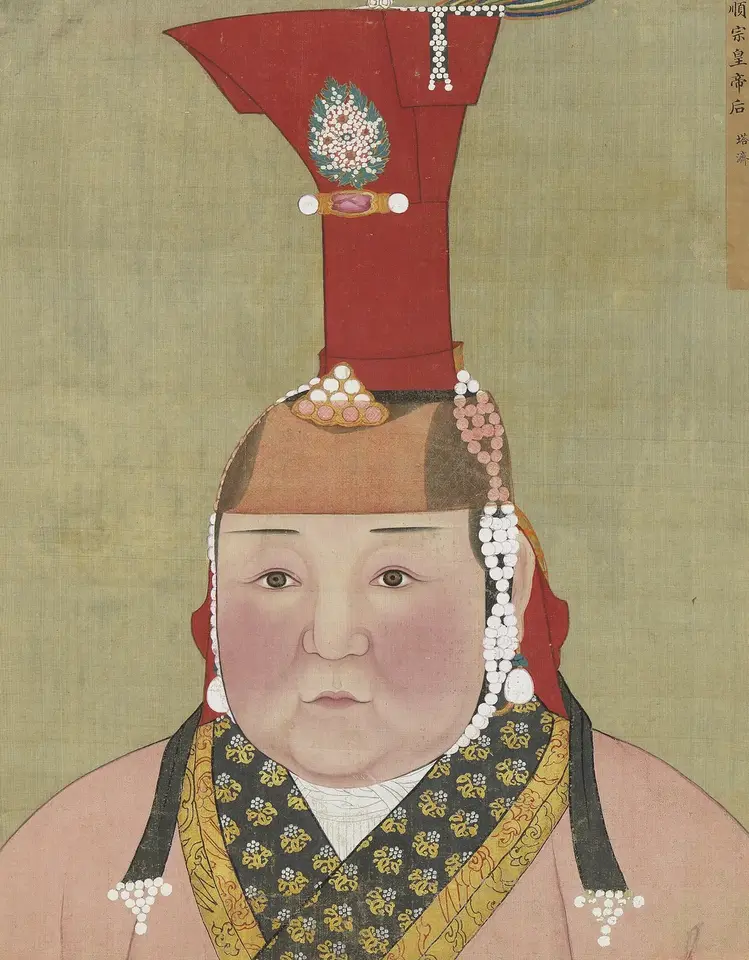
Life and Career
Marital Alliance and Early Dynastic Turbulence
Dagi was born into the prestigious aristocratic Khongirad clan, a Mongolian tribe that held institutional hereditary marital alliances with the Borjigin imperial house since the days of Genghis Khan. Her father was Ondurchar, son of Anchen, the Prince of Jining. Dagi was wed in early youth to Darmabala, the second son of Crown Prince Zhenjin and grandson of Kublai Khan. She was widely renowned within the imperial camp for her prudence, intelligence, and sharp political comprehension.
In 1292, Darmabala passed away prematurely at the age of twenty-eight, leaving Dagi with young sons Khayishan and Ayurbarwada. Following the accession of Emperor Chengzong (Temur Khan), Khayishan was dispatched north to command imperial armies on the Mongolian steppe against Kaidu and the Chagatai princes, while Dagi remained at court with Ayurbarwada, carefully preserving her family's prestige amidst shifting court factions.
The Coup of 1307 and Double Imperial Accession
When Emperor Chengzong died without an heir in early 1307, a fierce dynastic crisis erupted. Empress Bulugan and the Left Grand Councilor Agutai conspired to enthrone Prince Ananda of Anxi, who commanded significant military power in the northwest. Recognizing the imminent danger to her lineage, Dagi acted with decisive tactical speed. Cooperating closely with the Right Grand Councilor Harghasun, she secretly summoned Ayurbarwada from Huaiqing to Dadu.
In a swift palace coup, Ayurbarwada and Dagi seized control of the imperial palace, arrested Bulugan and Ananda, and eliminated their faction. Shortly thereafter, Khayishan marched south with his northern frontier armies. Through delicate negotiation orchestrated by Dagi, the brothers reached an accord: Khayishan mounted the throne as Emperor Wuzong, while Ayurbarwada was invested as Crown Prince. In recognition of her extraordinary statecraft, Emperor Wuzong elevated Dagi to Empress Dowager and expanded the institutional authority of the Huizheng Bureau to support her court.
The Regency Network and Huizheng Bureau Control
Following the death of Emperor Wuzong in 1311, Ayurbarwada ascended the imperial throne as Emperor Renzong. Throughout Renzong's reign, Dagi commanded immense backstage political authority. She converted the Huizheng Bureau into an autonomous executive apparatus that controlled vast crown domains, salt monopolies, private treasuries, and palace manufacturing.
To maintain dynastic supremacy for the Khongirad lineage, Dagi strongly promoted her political confidant Temuder to the office of Grand Councilor of the Central Secretariat. Despite repeated impeachments by upright Han Chinese censors over Temuder's venality and corruption, Dagi repeatedly intervened to shield and reappoint him. Her private court effectively rivaled the official Secretariat in state decision-making, shaping senior ministerial appointments across the realm.
Final Conflicts and Posthumous Reverence
In 1320, Emperor Renzong died, and his young son Shidibala ascended the throne as Emperor Yingzong. Dagi was elevated to Grand Empress Dowager. Emperor Yingzong, eager to reassert central imperial authority, allied with reformist Grand Councilor Baiju to curb the rampant corruption of Dagi's inner circle.
Although Dagi successfully reinstated Temuder as Right Grand Councilor, the growing rift between the reformist monarch and Dagi's conservative network created intense palace friction. In November 1322, Dagi died at Dadu. Her passing cleared the way for Emperor Yingzong to immediately strike at the Temuder faction, posthumously stripping Temuder of his titles and confiscating his family estates. Dagi was interred with full imperial honors and granted the solemn posthumous title of Empress Zhaosheng Shuntian Ruiyi Guangxian.
Key Achievements
Safeguarding the Lineage of Darmabala
During the succession emergency of 1307, Dagi demonstrated exceptional courage and decisiveness by coordinating with loyal grand councilors to crush the Bulugan-Ananda conspiracy. Her decisive leadership preserved the central imperial line of Kublai Khan and successfully installed two of her sons as emperors of the Yuan dynasty.
Institutional Autonomy through the Huizheng Bureau
Dagi transformed the Huizheng Bureau into an extraordinarily powerful imperial agency that oversaw crown assets, regional agricultural estates, and taxation reserves. Through this independent fiscal institution, she sustained a vast network of imperial retainers, military officers, and court bureaucrats that shaped state policy for over a decade.
Championing the Dynastic Position of the Khongirad Clan
Leveraging her position as matriarch, Dagi firmly reinforced the traditional marriage alliance between the Khongirad clan and the imperial Borjigin dynasty. She ensured that the imperial consorts of both Emperors Wuzong and Renzong hailed from her maternal clan, safeguarding the clan's political dominance throughout the mid-Yuan period.