Birth in Ningguo
Born into the prominent Xi lineage in Ningguo County, Xuanzhou.
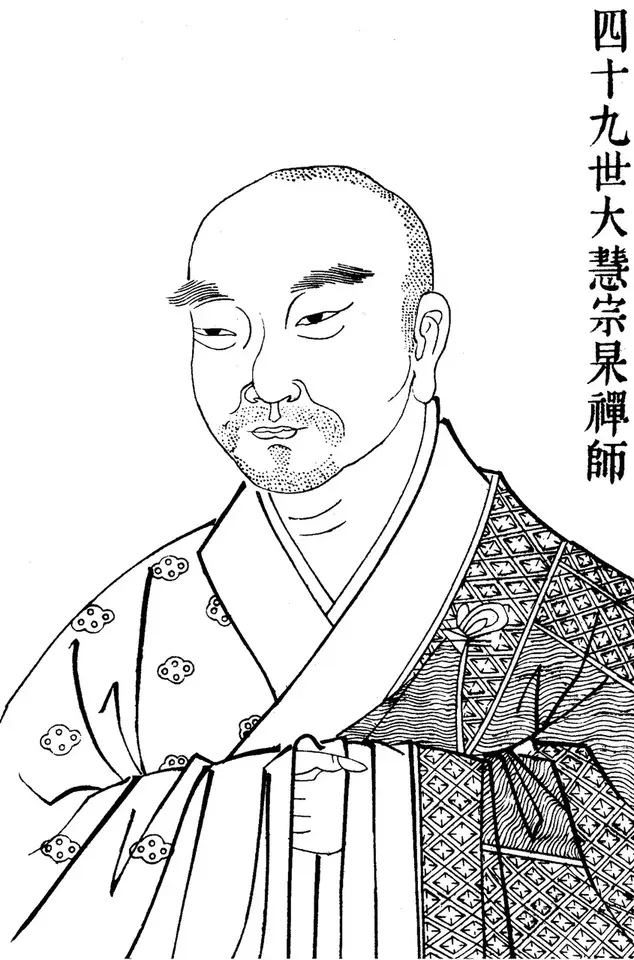
大慧宗杲
Dahui Zonggao (大慧宗杲, 1089–1163), lay surname Xi (奚), courtesy name Tanhui (昙晦), and dharma name Zonggao (宗杲), was a native of Ningguo in Xuanzhou (present-day Ningguo, Anhui Province). He was an illustrious Southern Song Chan master, the fifth-generation patriarch of the Yangqi branch of the Linji School, and the revolutionary founder of Koan Introspection Chan (Kanhua Chan). Renowned from his youth for bold intellectual…
Dahui Zonggao (大慧宗杲, 1089–1163), lay surname Xi (奚), courtesy name Tanhui (昙晦), and dharma name Zonggao (宗杲), was a native of Ningguo in Xuanzhou (present-day Ningguo, Anhui Province). He was an illustrious Southern Song Chan master, the fifth-generation patriarch of the Yangqi branch of the Linji School, and the revolutionary founder of Koan Introspection Chan (Kanhua Chan). Renowned from his youth for bold intellectual independence, he renounced lay life in his teens and investigated Caodong and Yunmen lineages before attaining sudden enlightenment under Yuanwu Keqin at Tianning Monastery in Kaifeng. Appointed to share the abbot's seat to instruct assembly monks, he was granted the honorific title "Master Fori" by Emperor Huizong. During the early Southern Song, Zonggao assumed the abbacy of Nengren Monastery on Mount Jingshan near Lin'an, gathering over 1,700 monastic and lay disciples to establish the foremost Chan sanctuary of southern China. In 1141, his close association with anti-Jurchen patriotic minister Zhang Jiucheng and his satirical verses opposing the peace faction incurred the wrath of despotic chancellor Qin Hui, resulting in the stripping of his monastic robes and fifteen years of exile in Hengzhou and Meizhou. Following Qin Hui's death, he was pardoned and reinstated by Emperor Gaozong to revive Mount Jingshan, while Emperor Xiaozong granted him the title "Chan Master Dahui." Championing the meditation on critical phrases such as Zhaozhou's "Wu" (Mu), Zonggao authored Treasury of the True Dharma Eye (Zhengfa Yanzang) and shaped lay Buddhist spirituality throughout East Asia. He passed away at age seventy-five, posthumously honored as "Chan Master Pujue."
Born into the prominent Xi lineage in Ningguo County, Xuanzhou.
Entered Dongshan Huiyun Monastery at age seventeen under Master Qi, taking full monastic precepts five years later.
Studied under Caodong master Shimen Yuanyi and Yunmen master Zhantang Wenzhun at Baofeng.
Attained sudden enlightenment under Yuanwu Keqin at Tianning Monastery; granted the title "Master Fori" by Emperor Huizong.
Escaped the Jin siege of Kaifeng, following master Keqin to Mount Jinshan and Mount Yunju as head monk.
Appointed abbot of Mount Jingshan at the petition of Grand Chancellor Zhang Jun, gathering over 1,700 practitioners.
Implicated in political satire with minister Zhang Jiucheng, stripped of monastic status, and exiled to Hengzhou.
Transferred to malarial frontier regions of Meizhou in Guangdong; compiled Treasury of the True Dharma Eye while in exile.
Following Qin Hui's death, pardoned by imperial decree, regaining his monastic ordination certificate.
Recalled to Mount Jingshan by Emperor Gaozong; Emperor Xiaozong subsequently conferred the title "Chan Master Dahui."
Passed away serenely at Mingyue Hall at age seventy-five; posthumously honored as "Chan Master Pujue."
Dahui Zonggao was born in 1089 into an esteemed literary household of the Xi family in Ningguo County, Xuanzhou. From childhood, he displayed exceptional intelligence and an untamed, heroic spirit. At age thirteen, while studying at a local school, he witnessed his teacher beating a fellow pupil. Deeply offended by petty pedantry, young Zonggao threw his inkstone aside, declaring that a true gentleman should dedicate himself to transcending the fundamental riddle of life and death rather than wasting his youth parsing superficial secular lines. In 1105, at the age of seventeen, he renounced lay life at Dongshan Huiyun Monastery under Master Qi, taking full monastic vows five years later.
Following ordination, Zonggao was consumed by an unquenchable thirst for spiritual realization. He embarked upon wide-ranging monastic pilgrimages across Jiangnan, first studying under Master Shimen Yuanyi of the Caodong School. While Zonggao quickly memorized the Caodong doctrine of the Five Ranks of Lord and Vassal, he remained dissatisfied, perceiving that intellectual taxonomy could not pierce through existential doubt.
He subsequently journeyed to Mount Baofeng in Hongzhou to apprentice himself to Chan Master Zhantang Wenzhun of the Yunmen School. Recognizing Zonggao's towering intellect and penetrating speech, Zhantang appointed him as his personal attendant. Yet Zhantang frequently rebuked Zonggao for relying on conscious intellectual deduction, warning that equating clever conceptualization with authentic enlightenment would only trap him in the quagmire of cognitive obstruction. On his deathbed, Zhantang instructed Zonggao that his spiritual fulfillment could only be achieved under the guidance of Yuanwu Keqin of the Yangqi branch of Linji.
In 1124, Yuanwu Keqin arrived in Kaifeng by imperial summons to assume the abbacy of Tianning Wanshou Monastery. Having long revered Keqin's reputation, Zonggao traveled to the capital and enrolled at Tianning Monastery.
During his studies under Keqin, Zonggao listened intently to the master's daily lectures. One day in the abbot's quarters, Keqin presented an ancient koan regarding spiritual parity between master and disciple. Listening to Keqin's incisive pointer, Zonggao experienced a sudden breakthrough, completely shattering his remaining intellectual doubts. Validating his realization, Keqin declared that Zonggao was a great Bodhisattva returned to the world, formally transmitting the Linji dharma to him and granting him the rare privilege of sharing the high seat to instruct assembly monks.
With his razor-sharp wit and profound spiritual penetration, Zonggao became the preeminent master of the capital. Hearing of his spiritual attainments, Emperor Huizong awarded him the honorific title "Master Fori." In 1127, as Jurchen armies besieged Kaifeng, Zonggao relocated southward under Keqin's instructions, residing temporarily at Mount Huqiu before joining Keqin at Mount Yunju in Jiangxi as the monastic community's head monk (shouzuo).
Following the establishment of the Southern Song court in Hangzhou, Grand Chancellor Zhang Jun, an ardent patron of Buddhism, petitioned the throne in 1137 to appoint Zonggao abbot of Nengren Monastery on Mount Jingshan.
Located northwest of Lin'an, Mount Jingshan had long been a scenic monastic retreat, but its institutional vigor had languished. Upon assuming the abbacy, Zonggao reorganized monastic regulations and vigorously promoted the Yangqi Linji tradition. His fiery sermons and penetrating dialogues magnetized scholars and practitioners from across the empire. Within a few years, the resident monastic community swelled to more than 1,700 monks.
At Mount Jingshan, Zonggao extended his pedagogical mission to the scholar-official elite. Leading ministers, including Grand Chancellor Zhang Jun, Vice Minister of Rites Zhang Jiucheng, Hanlin Academician Wang Zao, and Minister Fu Zhirou, regularly climbed Mount Jingshan to seek spiritual instruction. Mount Jingshan was recognized as the foremost Chan monastery of southern China, and Zonggao emerged as the moral and spiritual pillar of the Southern Song.
However, Zonggao's uncompromising moral integrity brought him into direct confrontation with court despotism. Deeply patriotic, Zonggao detested the Jurchen invaders and maintained intimate intellectual solidarity with anti-appeasement ministers like Zhang Jiucheng. At that juncture, authoritarian chancellor Qin Hui was enforcing a humiliating capitulation policy, purging heroic generals like Yue Fei and silencing court opposition.
In May 1141, Zhang Jiucheng visited Mount Jingshan to consult Zonggao on Buddhist philosophy and current affairs. Reflecting upon the crisis of the realm and General Han Shizhong's development of the armor-piercing divine crossbow, Zonggao composed a spirited verse: "When the divine bow shoots its bolt, it pierces through heavy armor; viewed from beneath the monk's gate, it resembles a worn-out sock!" The poem celebrated martial defiance against the Jurchen threat.
Informed by secret informants, Qin Hui suspected that Zonggao and Zhang Jiucheng were mobilizing political opposition to the peace treaty under the guise of religious retreats. In the autumn of 1141, amidst the purge of Yue Fei, Qin Hui fabricated charges that Zonggao was slandering the court. Zonggao was arrested, stripped of his purple robe and ordination certificate, and exiled to Hengzhou in Hunan. For ten years in Hengzhou, Zonggao lived in impoverished quarters with unshakeable resolve. In 1150, Qin Hui's faction intensified their persecution, exiling the sixty-two-year-old master to the malarial wilderness of Meizhou in Guangdong. Living in severe deprivation for five years, Zonggao maintained his serene equanimity, completing his monumental three-volume treatise Treasury of the True Dharma Eye.
In October 1155, chancellor Qin Hui died of a virulent carbuncle. Two months later, the imperial court issued a general amnesty, and Zonggao was permitted to return north from Guangdong. In the spring of 1156, the court restored his monastic status and purple robes, appointing him abbot of King Asoka Monastery in Ningbo.
In 1158, Emperor Gaozong issued an edict summoning Zonggao back to Mount Jingshan. Upon hearing the news, monks and lay followers flocked to the mountain, instantly restoring the monastery's former grandeur.
When Emperor Xiaozong ascended the throne, he summoned Zonggao to the palace for private audiences on Buddhist philosophy, deeply impressed by the master's unbending character and spiritual depth. Xiaozong personally inscribed an imperial tablet conferring the title "Chan Master Dahui." In his final years, Zonggao retired to Mingyue Hall on Mount Jingshan to guide his closest disciples. On the tenth day of the eighth lunar month in 1163, Zonggao passed away peacefully in the seated meditation posture at the age of seventy-five, having completed fifty-eight monastic years. Emperor Xiaozong expressed profound grief, conferring the posthumous name "Chan Master Pujue" and dedicating his funerary pagoda as "Baoguang."
Dahui Zonggao's paramount contribution to world Buddhism was his creation of Koan Introspection Chan (Kanhua Chan), which revitalized traditional meditation practice and became the primary mode of Zen cultivation throughout East Asia for over seven centuries.
During the Song Dynasty, Chan had largely degenerated into "Literary Chan," where practitioners treated koans as literary poetry to be intellectually dissected, reducing living spiritual realization to pedantic word games. Zonggao recognized this intellectual decadence and championed a direct method of cutting through conceptual proliferation by focusing relentlessly on a single "critical phrase" (huatou).
Zonggao particularly championed the "Wu" (Mu) phrase originating from master Zhaozhou Congshen's response to whether a dog possesses Buddha-nature. He likened the single character "Wu" to a razor-sharp sword that severes all conceptual thinking. By concentrating all awareness upon this impenetrable barrier without intellectualizing, a practitioner builds up a massive "ball of doubt" that suddenly detonates, completely shattering delusion and unveiling innate Buddha-nature. This direct, highly accessible method became the hallmark of the Linji School worldwide.
To establish the primacy of Koan Introspection Chan, Dahui Zonggao launched a vigorous philosophical critique against the Caodong School's practice of Silent Illumination Chan (Mozhao Chan).
Zonggao criticized contemporary Caodong teachers who reduced meditation to silent, thoughtless sitting, denouncing such practices as "ghostly work in the dark caves beneath the black mountain." He argued that passive quietism merely suppressed conscious thoughts without severing the root of delusion, mistaking sterile lifelessness for awakening.
Simultaneously, Zonggao displayed extraordinary intellectual courage by challenging the abuse of the Blue Cliff Record, compiled by his own teacher Yuanwu Keqin. Seeing that students memorized its literary glosses to display superficial cleverness rather than pursuing genuine awakening, Zonggao burned the printing blocks of the Blue Cliff Record to force practitioners to abandon textual dependency and seek direct realization within their own minds.
During his long years of political banishment in the remote wilderness of Meizhou, Zonggao compiled his monumental three-volume treatise Treasury of the True Dharma Eye (Zhengfa Yanzang).
Transcending sectarian rivalries, Zonggao selected 661 core encounters and dialogues spanning from Bodhidharma down through the Northern Song, encompassing all Five Houses of Chan: Linji, Caodong, Yunmen, Guiyang, and Fayan.
In his preface, Zonggao articulated his ecumenical standard: "Without regard to faction or school, whether Yunmen, Linji, Caodong, Guiyang, or Fayan, wherever there is authentic wisdom that leads practitioners to direct awakening, it has been included." The collection established an authoritative canon of authentic Chan transmission, serving as an indispensable navigational compass for generations of monastic practitioners.
Zonggao was not only a master for monastics, but the central architect of Song Dynasty lay Buddhist culture (jushi fojiao). He skillfully adapted Koan Introspection Chan to the active everyday realities of scholar-officials.
Recognizing that government ministers and scholars could not abandon secular duties to live in mountain monasteries, Zonggao taught that spiritual practice must occur within daily administrative affairs. He asserted that the Dharma is fully present in eating, drinking, conversing, writing memorials, and fulfilling familial responsibilities, declaring that "if one's daily life is free from attachment, that very place is the sacred assembly of Vulture Peak."
His extensive correspondences with scholars and statesmen were assembled into the celebrated Letters of Dahui (Dahui Shu). Guiding leading figures like Zhang Jun, Zhang Jiucheng, and Wang Zao, Zonggao infused Southern Song Confucian literati with profound spiritual resilience and moral courage, anchoring Buddhism deeply into the secular fabric of Chinese civilization.
FIGURES ASSOCIATED WITH THIS DYNASTY