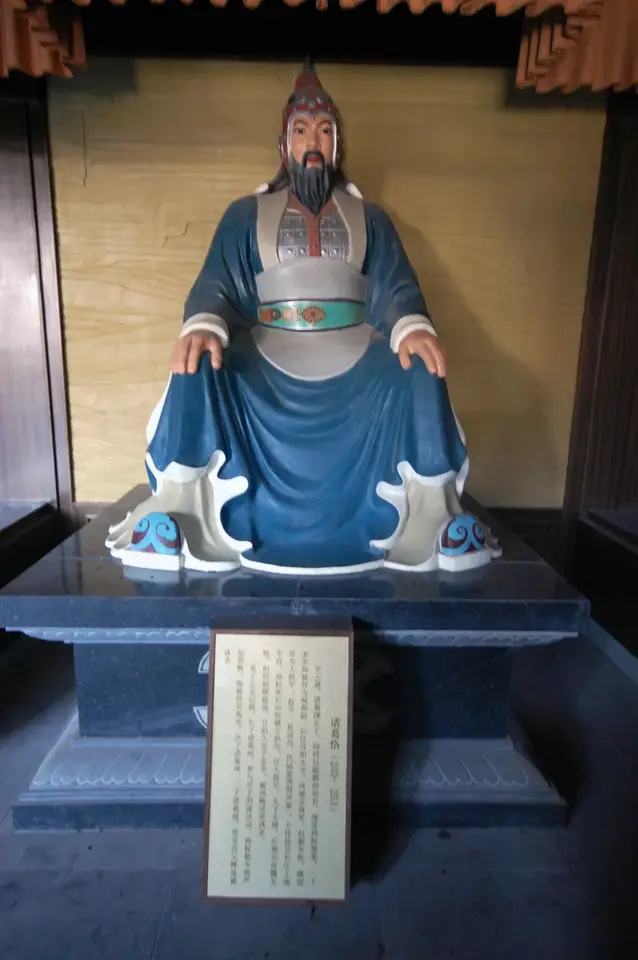
Biography
Youthful Precociousness and Court Witticism
Zhuge Ke was born in 203 into the illustrious Zhuge family of Yangdu in Langya. His father Zhuge Jin stood as one of the founding pillars and Grand General of Eastern Wu, enjoying Sun Quan's unwavering esteem, while his paternal uncle Zhuge Liang governed Shu Han as Chancellor. Zhuge Ke possessed an imposing physical stature, an expansive forehead, and a resonant voice, distinguished from an early age by his quick-witted intellect and rhetorical brilliance.
Numerous anecdotes regarding his verbal agility became renowned court lore. Zhuge Jin possessed an unusually elongated facial structure resembling that of a donkey. During a grand imperial banquet, Sun Quan jestingly had a donkey brought into the hall with a placard hung from its snout reading "Zhuge Ziyu." While the assembled ministers fell silent in embarrassment, young Zhuge Ke immediately knelt before the throne and requested a brush to add two characters. Granted permission, he swiftly appended "zhi lü" (the donkey of) underneath, transforming the text into "The Donkey of Zhuge Ziyu." The hall erupted in laughter, and Sun Quan, profoundly impressed, bestowed the beast upon him.
On another occasion, Sun Quan asked Zhuge Ke whether his father or his uncle Zhuge Liang was the more virtuous. Without hesitation, Zhuge Ke answered that his father was superior. When Sun Quan pressed for an explanation, Zhuge Ke explained that his father knew whom to serve faithfully in enlightened sovereignty, whereas his uncle served in an exterior court, thereby demonstrating his father's greater wisdom. Later, when an envoy from Shu Han visited, Sun Quan remarked that Zhuge Ke was fond of horses and told the envoy to ask Chancellor Zhuge to select a fine horse for his nephew. Zhuge Ke promptly bowed to offer gratitude. When Sun Quan asked why he offered thanks before the horse had arrived, Zhuge Ke retorted that Shu was the emperor's outer pasture and that imperial words were absolute decree, meaning the horse was already as good as received.
Recognizing his extraordinary talents, Sun Quan sought to test his administrative capabilities by appointing him Acting Controller of Provisions following the death of Xu Xiang. The role required meticulous fiscal accounting and grain distribution. Hearing of this, Zhuge Liang in Shu sent a concerned letter to Eastern Wu Chancellor Lu Xun, noting that his elder brother was advanced in age and that Zhuge Ke possessed a negligent and sweeping temper unsuited for the handling of vital grain supplies. Upon Lu Xun's discreet representation, Sun Quan relieved Zhuge Ke of grain oversight and reassigned him to military commands.
In 222, at the age of twenty, Zhuge Ke was appointed Cavalry Commandant, serving alongside Gu Tan and Zhang Xiu as the four intimate companions and mentors to Crown Prince Sun Deng, subsequently advancing to Palace Cadet and Senior Commandant of the Left.
Subjugation of the Shanyue and Ascendancy
Yearning for active military command rather than palace civil service, Zhuge Ke repeatedly petitioned Sun Quan to entrust him with an expedition into the perilous mountain ranges of Danyang Commandery to permanently pacify the Shanyue tribes. The Shanyue people had long exploited the rugged terrain to establish fortified mountain enclaves, fiercely resisting imperial corvee and tax levies. Previous military expeditions had only secured fringe lowlands while failing to eradicate the deeply entrenched mountain settlements. Veteran ministers such as Chancellor Gu Yong deemed any deep incursion excessively perilous, yet Zhuge Ke boldly pledged that within three years he would pacify the territory and enlist 40,000 crack troops for the state.
Sun Quan admired his daring resolve and appointed the thirty-two-year-old Zhuge Ke as General Who Pacifies the Yue and Administrator of Danyang in 234, honoring him with an armed escort of three hundred armored cavalry. Upon reaching his headquarters, Zhuge Ke eschewed reckless mountain skirmishes in favor of a comprehensive strategy combining economic blockade, defensive fortifications, and systemic pacification. He instructed the magistrates of the four neighboring commanderies—Wu, Kuaiji, Xindu, and Poyang—to erect border outposts, sealing off every mountain ravine to sever the trafficking of grain, salt, and iron into the peaks.
During each autumn harvest, Zhuge Ke deployed swift cavalry detachments to reap the lowland grain, starving out the mountain redoubts. When famine gripped the mountains, tens of thousands of desperate Shanyue residents descended into the plains to surrender. Zhuge Ke enforced strict orders that all submitting families be treated equitably, given grain relief, and settled into agricultural colonies, strictly prohibiting magistrates from treating them with suspicion or enslaving them. When a belligerent chieftain named Zhou Yi surrendered under duress while secretly planning renewed rebellion, local commanders swiftly detained him under Zhuge Ke's disciplinary codes and dispersed his band without bloodshed.
By 237, the three-year pacification concluded in complete triumph. Over 100,000 Shanyue individuals surrendered and were integrated into imperial census registers. From these, Zhuge Ke selected 40,000 elite, hardened warriors to reinforce Eastern Wu's armed forces, commanding 10,000 personally and distributing the remainder across frontline armies. Danyang was converted into the realm's foremost reservoir of grain and seasoned troops. Sun Quan rewarded him with the title General of Pacifying the North and the noble fief of Marquis of Duxiang, propelling him into the uppermost echelons of military leadership.
Regional Defense and Imperial Regency
In 241, upon the passing of his father Zhuge Jin, Zhuge Ke inherited his father's troops and defensive sector. In 245, following the demise of Lu Xun amidst the bitter political turmoil of the Succession Struggle, Sun Quan promoted Zhuge Ke to Grand General with an imperial tally, stationing him at the strategic fortress of Wuchang to govern the defense of Jing and Yang provinces.
During his tenure at Wuchang, Zhuge Ke demonstrated sound vigilance, repelling probing maneuvers by Wei forces under Sima Yi and maintaining stable defensive lines along the Yangtze River. As Sun Quan fell critically ill in the winter of 251, the court overwhelmingly viewed the accomplished Grand General as the singular figure capable of guiding the realm. Sun Quan summoned Zhuge Ke to the capital, naming him Grand Tutor to the Crown Prince. On his deathbed in 252, Sun Quan formally entrusted the ten-year-old heir Sun Liang to Zhuge Ke, designating him senior regent alongside Teng Yin, Sun Hong, Lü Ju, and Sun Jun.
Immediately following Sun Quan's passing, Secretariat Supervisor Sun Hong plotted to conceal the emperor's death and forge an edict to eliminate Zhuge Ke. Warned of the conspiracy by Sun Jun, Zhuge Ke summoned Sun Hong under the pretext of deliberating state affairs and had him summarily executed, smoothly solidifying his unchallenged regency.
The Triumph at Dongxing and National Hubris
Ascending to the regency under the child emperor Sun Liang, Zhuge Ke initially governed with remarkable wisdom and benevolence. He dismantled the hated network of imperial secret informers and eavesdropping officers, abolished delinquent tax debts, and lowered trade tariffs across all internal water routes. These populist measures won him immense adulation from both the gentry and common people.
In late 252, Zhuge Ke ordered the reconstruction of the ancient strategic dike at Dongxing, erecting two fortified citadels on adjacent hills and garrisoning them with elite troops under Liu Lüe and Quan Duan. Viewing this fortification as an intolerable provocation, Cao Wei regent Sima Shi dispatched a massive invading force of 70,000 troops under Hu Zun and Zhuge Dan to besiege Dongxing.
Zhuge Ke personally led a 40,000-man relief army to Dongxing. In freezing winter blizzards, vanguard commander Ding Feng executed a brilliant surprise assault, shedding heavy armor and scaling the snowy heights with 3,000 light infantry to overrun the drunken Wei camp at Xutang. Zhuge Ke's main body arrived in force, routing the panicked northern army. Thousands of Wei soldiers drowned in the icy waters or were cut down, yielding an astonishing haul of military banners, armor, and livestock. Upon his triumphant return, Sun Liang invested Zhuge Ke as Marquis of Yangdu, bestowed the Governorates of Jing and Yang Provinces, and made him Supreme Commander of Internal and External Military Affairs, lifting his authority to an unprecedented peak.
The Debacle at Hefei and Downfall
The resounding success at Dongxing, however, fostered fatal pride and unbridled arrogance in Zhuge Ke. Convinced that his military genius surpassed even that of his uncle Zhuge Liang, he resolved to launch an all-out northern offensive to overthrow Cao Wei in a single campaign. Veteran commanders and court officials, including Danyang Administrator Nie You and Minister of Ceremonies Teng Yin, vehemently advised against the expedition, arguing that the nation was exhausted and that southern troops were unsuited for protracted inland warfare.
Refusing all counsel, Zhuge Ke penned an extensive essay titled On the Expedition Against Wei to silence dissent, and mobilized 200,000 troops—virtually the entire standing military power of Eastern Wu—in the spring of 253. Marching into Huainan, Zhuge Ke bypassed open maneuvering and laid siege to Hefei Xincheng, which was defended by only 3,000 Wei soldiers under the resolute commander Zhang Te.
Despite month-long bombardments and tunneling operations, Zhang Te held fast. Sensing the imminent breach of the walls, Zhang Te orchestrated a deceptive ruse, sending word that according to Wei military law, a commander who held out for one hundred days without relief could surrender without his kin facing execution; since ninety days had passed, he requested a three-day truce before capitulating. Zhuge Ke credulously halted the assault. Zhang Te exploited the pause to tear down timber from government buildings, repairing the breaches overnight and taunting the Wu army the following morning.
As midsummer arrived, brutal heat and contaminated water triggered severe dysentery and epidemic fevers across the congested Wu encampments. Over half of the soldiers fell ill or died. Enraged by the failure and terrified of losing face, Zhuge Ke dismissed General Zhu Yi for advising retreat and alienated Colonel Cai Lin, who defected to Wei and revealed the full extent of the sickness afflicting the Wu army. Facing the impending arrival of a 200,000-man relief army under Wei Grand Commandant Sima Fu, Zhuge Ke was forced to order a humiliating withdrawal in July. Tens of thousands of sick and wounded soldiers perished along the retreat routes, and the populace's former admiration turned into universal hatred.
Palace Massacre and Posthumous Vindication
Returning to Jianye in humiliation, Zhuge Ke refused to acknowledge error and instead instituted despotic measures to suppress growing domestic discontent. He replaced palace guards with his private troops, severely berated Secretariat Director Sun Hei until the latter resigned in terror, and drew up blacklists to purge dissenting court officials.
Observing the widespread outrage, imperial kinsman and Palace Commandant Sun Jun conspired with the young emperor Sun Liang to eliminate the regent. In the winter of 253, Sun Liang and Sun Jun staged an imperial banquet in the palace, summoning Zhuge Ke to attend. Despite forebodings and warnings from Teng Yin, Zhuge Ke donned concealed light armor and entered the palace hall.
Midway through the feast, Sun Liang excused himself, and Sun Jun briefly left before returning in battle regalia, shouting an imperial decree to execute the traitor. Caught off guard, Zhuge Ke attempted to draw his sword but was hacked down by Sun Jun and his conspirators at the age of fifty-one. Sun Jun's cavalry subsequently intercepted and executed Zhuge Ke's sons Zhuge Song and Zhuge Jian, slaughtering his extended clan. A contemporary nursery rhyme had predicted his grim fate: wrapped in plain reed mats tied with bamboo withes, his corpse was discarded at Shizigang outside the capital.
In 258, following the execution of the despotic Sun Chen, Emperor Jing of Wu (Sun Xiu) officially exonerated Zhuge Ke. Recognizing his monumental achievements in pacifying the Shanyue and triumphing at Dongxing, Sun Xiu issued an imperial edict granting Zhuge Ke a proper noble reburial, restoring his enduring legacy in Chinese historiography.