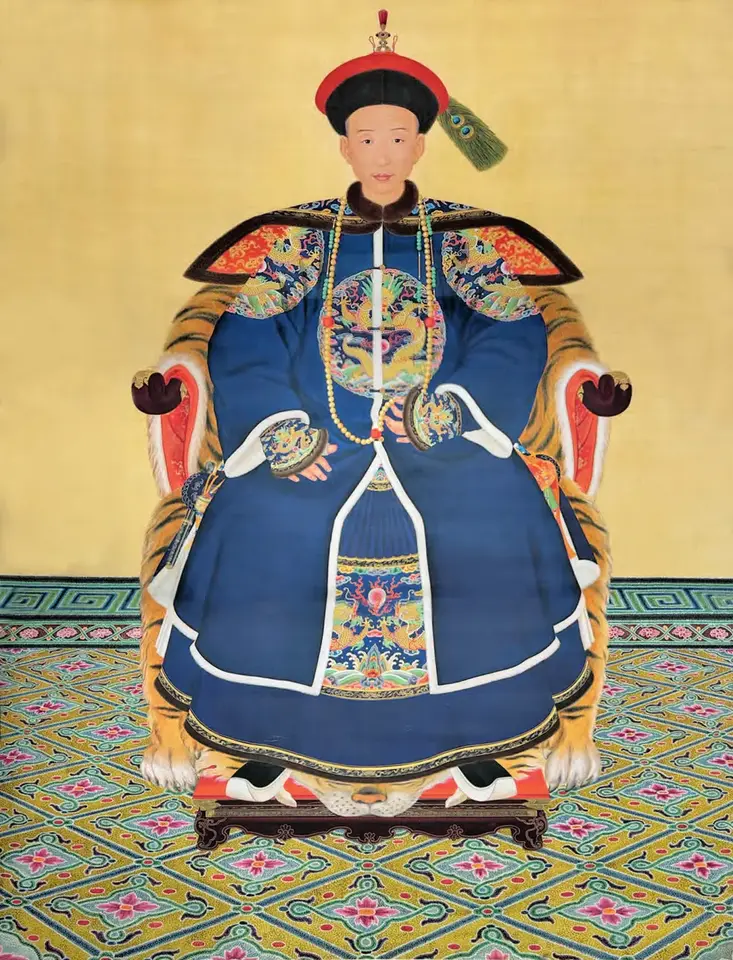
Life and Career
Aristocratic Lineage and Western Expeditions
Mingrui belonged to the Shaji Fuca clan, one of the most prominent aristocratic families of the Bordered Yellow Banner of the Manchu Military. His ancestor Wangjinu had joined Nurhaci during the foundation of the Later Jin state. His grandfather was Chahar Captain-General Li Rongbao, his father Fuwen was a First Class Duke of Chengen, his uncle was Grand Secretary Fuheng, and his paternal aunt was Empress Xiaoxian Chun. Despite his high birth, Mingrui possessed a sturdy, compact physique, an unyielding martial temperament, and a deep interest in military treatises. Upon completing his studies as an imperial student, he inherited his father's First Class Duke of Chengen.
In 1756, the Dzungar chieftain Amursana rebelled against the Qing dynasty, igniting conflict across northern Xinjiang. The Qianlong Emperor dispatched expeditionary columns, and Mingrui was appointed Senior Brigade Commander with the nominal rank of Deputy Lieutenant General under General Zhaohui. Operating across the barren steppes and rugged canyons of the Tian Shan, Mingrui repeatedly led frontline cavalry charges, demonstrating fearless tactical aggression. In recognition of his combat merits, he was promoted to Vice Minister of Revenue, appointed Assistant Minister, and granted the honorific title "First Class Duke of Chengen Yiyong."
In 1759, the rebellion of the Khoja brothers (Burhan al-Din and Jahan Khoja) erupted across southern Xinjiang. Mingrui volunteered for frontline service, leading Solon cavalry squadrons across the high Pamir Mountains in pursuit of the rebels. At the Battle of Lake Yashilkul, he engaged in ferocious close-quarters combat, inflicting heavy losses on the insurgent army. Following the pacification of the western regions, the emperor awarded him the Double-Eyed Peacock Feather and a hereditary Yunqiwei title. Upon returning to the capital, his portrait was placed among the foremost heroes in the Hall of Purple Splendor, and he was promoted to Commander-in-Chief of the Plain White Banner of the Han Military.
Inaugural General of Ili and Pacifying Ush
In 1762, following the complete pacification of Dzungaria and Altishahr, the Qing court established the military governorship of Xinjiang to integrate civil and military governance north and south of the Tian Shan. The headquarters was established at Huiyuan Fortress in the Ili River valley. Setting aside bureaucratic seniority, the Qianlong Emperor appointed the thirty-year-old Mingrui as the inaugural General of Ili, conferring upon him a hereditary Qiduwei title.
Assuming office, Mingrui exhibited remarkable administrative acumen. Recognizing that the vast frontier required economic self-sufficiency, he organized Eight Banners garrisons and civilian immigrants from China proper to open extensive agricultural colonies across the Ili River basin, bringing tens of thousands of mu under cultivation. He directed the construction of Huiyuan and Huining fortresses, established permanent border watchposts (kalun), improved courier networks, and pursued conciliatory policies toward local Uighur and Kazakh communities.
In February 1765, local residents in Ush rebelled against the despotic rule of local Qing Deputy Lieutenant General Sucheng. After Sucheng committed suicide, the insurgents proclaimed regional chieftain Rahimtulla as their leader, fortifying the district seat with several thousand fighters. Mingrui reacted with swift resolution, dispatching Deputy Lieutenant General Guanyinbao with cavalry while he brought up the main army. Confronting two thousand insurgents drawn up outside the walls, Mingrui personally led a frontal assault under heavy fire, capturing seven artillery redoubts and surrounding the fortress. After a multi-month siege that cut off supplies, Mingrui breached the walls and executed Rahimtulla. He subsequently reformed local garrison discipline and secured imperial approval for a more equitable beg administrative system.
Commanding the Expedition to Burma and Breaking War Elephants
From 1765 onward, the Konbaung dynasty of Burma expanded aggressively into southwestern China, invading border districts in Yunnan. Initial Qing counteroffensives under Viceroy Liu Zao resulted in disaster, driving Liu to suicide; his successor, Grand Secretary Yang Yingju, fabricated reports of non-existent victories and was ordered to commit suicide by the emperor. With the southwestern border in peril, the Qianlong Emperor appointed Mingrui as Viceroy of Yun-Gui concurrent Minister of War and Imperial Commissioner in February 1767, entrusting him with overall command of the campaign.
Arriving in Yunnan, Mingrui surveyed the tropical borderlands and devised an ambitious operational plan: he would personally lead the southern main column consisting of over ten thousand elite Manchu guards, Solon horsemen, and Green Standard veterans from Wanting directly toward Hsenwi, while Assistant Minister Erdenge led a northern secondary column from Mongmit to Old Gwan, converging upon the Burmese capital of Ava.
In November 1767, Mingrui crossed the border at Wanting and swept through Hsenwi. To protect his logistical lifelines, he garrisoned Hsenwi with three thousand men under Assistant Minister Zhulune and Judicial Commissioner Yang Zhongying, while personally leading ten thousand troops across the Shweli River toward the fortified Burmese base at Manjie. The Burmese occupied sixteen interlocking wooden palisades flanked by deep ditches and concealed war elephant detachments. Mingrui divided his forces into three columns, deploying Guanyinbao and Zharafeng'a on the flanks while leading the center himself. When Burmese war elephants charged, Mingrui was wounded in the face and eye by an arrow. Binding his wounds without hesitation, he formed his infantry into twelve fire teams, directing coordinated volleys of musket and jingal fire into the elephants' eyes. The panicked beasts turned and trampled through their own barricades, allowing the Qing infantry to breach the stockades, slaughtering hundreds of defenders and capturing thirty-four prisoners. An overjoyed Qianlong Emperor elevated Mingrui to First Class Duke of Chengjia Yiyong, awarding him the imperial yellow sash, ruby cap insignia, and four-dragon court robes.
Isolated Deep Penetration and Encirclement at Maymyo
Following the victory at Manjie, Mingrui pressed relentlessly forward. In December, his army reached the vital river crossing at Gelong. Burmese defenders occupied the heights behind wooden stockades. Employing a deceptive diversion along the main road, Mingrui led a light detachment along mountain trails under morning fog, crossing upstream to capture the high ground. The Burmese collapsed in panic, leaving over two thousand casualties, and Mingrui advanced toward Mengla, within striking distance of Ava.
However, deep inside tropical jungle territory, catastrophic operational failures unravelled the campaign. In the north, Assistant Minister Erdenge encountered stubborn resistance at Old Gwan; instead of pressing the attack or maintaining his position to tie down Burmese reserves, Erdenge hesitated for a month and retreated toward the Yunnan border without notifying Mingrui. Meanwhile, large Burmese detachments bypassed Mingrui's advance and assaulted Hsenwi. The complacent Zhulune was overrun and committed suicide, and the imperial supply depot at Hsenwi was burned to the ground.
Mingrui's column was left completely isolated hundreds of li inside enemy territory without rations or reinforcements. Relief detachments dispatched by Yunnan Governor Ening were ambushed and forced back. Taking advantage of the situation, the Konbaung court concentrated fifty thousand troops from Ava and the northern fronts, encircling Mingrui's exhausted army at Maymyo. The Qing troops ran entirely out of grain, slaughtering their pack mules and horses for sustenance, while their gunpowder and ammunition were completely depleted by continuous skirmishes.
Self-Sacrificing Rearguard Action and Heroic Martyrdom
In early March 1768, over fifty thousand Burmese troops closed the cordon around Maymyo. Recognizing that the position was hopeless, subordinate officers urged Mingrui to break out with his personal cavalry guard while paths remained open. Mingrui adamantly refused: "I was entrusted with the supreme command by the Son of Heaven. Having failed to crush the enemy and led my army into destruction, how could I face my sovereign again? If you commanders escape, you may yet serve the dynasty; I shall hold the rearguard with my life!"
On March 18, 1768, Mingrui ordered generals Daxing'a and Ben Jinzhong to lead the remaining infantry in a desperate breakout, while Mingrui, accompanied by Guanyinbao, Zharafeng'a, and several dozen bodyguards, took up rearguard positions with drawn blades. As tens of thousands of Burmese troops closed in, Mingrui fought fiercely in hand-to-hand combat, cutting down dozens of attackers. In the desperate melee, officers Guanyinbao and Zharafeng'a fell in action.
Mingrui sustained multiple bullet wounds, with musket balls piercing his left shoulder and right chest. Despite severe bleeding, he held the enemy at bay until the breakout columns had cleared the defile. Supported by trusted servants, Mingrui retreated into a secluded mountain forest ten li from the battlefield. Determined to preserve dynastic honor and prevent his body from being desecrated by the enemy, Mingrui sat beneath an ancient tree, cut off his braided queue with a dagger, and handed it to his servant Shuwengke, commanding: "Deliver this queue to the Emperor, and report that Mingrui did not dishonor his sovereign's trust!" He then hanged himself from a branch, dying at the age of under forty.
When surviving officers returned to Beijing bearing Mingrui's queue and final report, the Qianlong Emperor was overcome with grief, weeping openly and suspending imperial audiences. The emperor granted him the posthumous rank of Grand Master of Splendid Happiness, designated his dukedom as perpetually hereditary, and constructed the Jingyong Shrine inside the Dong'an Gate of Beijing to commemorate Mingrui and his fallen officers. The cowardly Erdenge was executed by slow slicing (lingchi) for abandoning the army. The emperor composed an elegiac poem celebrating Mingrui: "Through over a hundred battles he led from the front; who could imagine an aristocratic scion possessed such courage... Fighting without reinforcement until giving his life; to you there is no regret, but to me only profound sorrow!"
Major Achievements
Pacifying the Western Regions and Hall of Purple Splendor Honors
During the western campaigns of the 1750s, Mingrui distinguished himself as one of the most daring young commanders of the Qing empire. Rejecting the easy life of the capital, he marched across the vast deserts of Xinjiang to fight against Amursana and the Khoja brothers.
In engagements across northern Dzungaria and the high Pamir Mountains, his fierce cavalry leadership broke enemy formations, earning him enshrinement among the foremost heroes in the Hall of Purple Splendor and establishing his reputation as a premier field general.
Pioneering Administration as First General of Ili
Appointed the inaugural General of Ili in 1762, Mingrui established the military and administrative framework for the Qing governance of Xinjiang.
He directed extensive agricultural colonization across the Ili valley, constructed administrative fortresses, established border watchposts, and quelled the Ush rebellion with decisive firmness, laying the institutional foundation for Qing rule over the western territories.
Breaching Barricades and Routing War Elephants at Manjie
During the 1767 invasion of Burma, Mingrui executed one of the deepest strategic penetrations in Qing military history. Confronting twenty thousand Burmese troops behind sixteen fortified timber stockades at Manjie, he faced the shock assault of war elephant phalanxes.
Despite sustaining an arrow wound to his face, he maintained tactical composure, directing disciplined infantry firepower to blind the elephants and breach the stockades, achieving the most brilliant tactical victory of the Sino-Burmese War.
Sacrificing Life in Rearguard Defense
Surrounded by fifty thousand enemy troops at Maymyo following the failure of friendly northern columns and the collapse of rear supply depots, Mingrui refused to save himself.
He ordered his subordinate commanders to lead surviving troops to safety while personally commanding a handful of retainers in a ferocious rearguard stand. After suffering mortal wounds, he cut his queue to report his loyalty and ended his own life to preserve imperial dignity, establishing a legendary standard of military honor.