Birth in Guangdong
Born into an impoverished Hakka farming family in Guanlubu Village, Hua County, Guangdong; exhibited early literary talent.
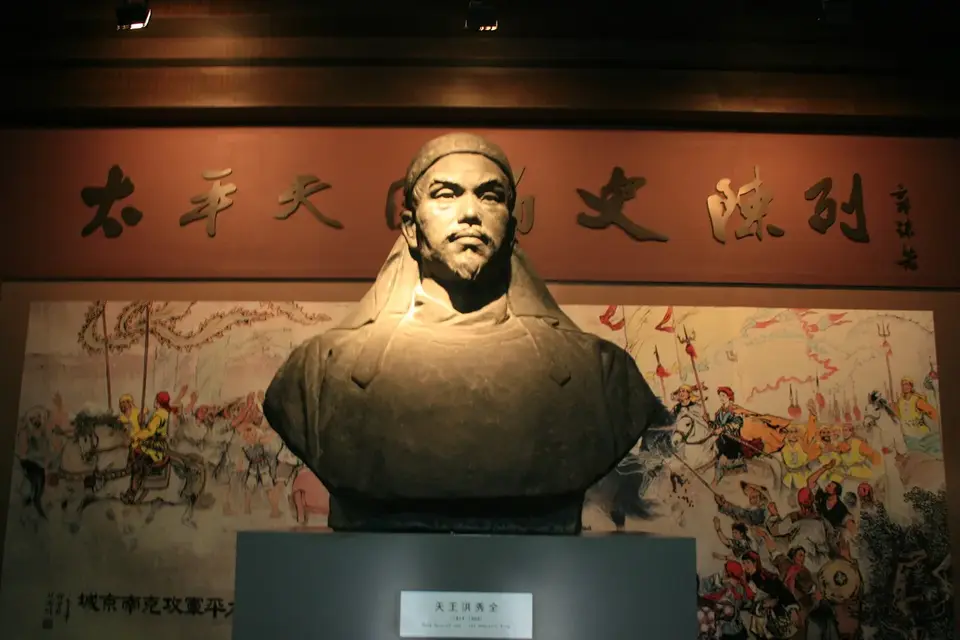
洪秀全
Hong Xiuquan (洪秀全, 1814–1864), original name Hong Renkun (洪仁坤), childhood name Hong Huoxiu (洪火秀), was a Hakka native of Guanlubu Village in Hua County, Guangzhou Prefecture, Guangdong (modern Huadu District, Guangzhou). He was the supreme leader, religious prophet, and monarch of the Taiping Heavenly Kingdom, which shook the foundations of the Qing Empire during the nineteenth century. Originating from an impoverished peasant…
Hong Xiuquan (洪秀全, 1814–1864), original name Hong Renkun (洪仁坤), childhood name Hong Huoxiu (洪火秀), was a Hakka native of Guanlubu Village in Hua County, Guangzhou Prefecture, Guangdong (modern Huadu District, Guangzhou). He was the supreme leader, religious prophet, and monarch of the Taiping Heavenly Kingdom, which shook the foundations of the Qing Empire during the nineteenth century. Originating from an impoverished peasant household, Hong Xiuquan studied the Confucian classics from youth, but failed the preliminary civil examinations in Guangzhou four times. The repeated failures and deep social crises of the era triggered a severe illness in 1837, during which he experienced vivid religious visions. Combining these visions with the Protestant Christian tract Good Words to Admonish the Age, he founded the God Worshipping Society, synthesizing Western monotheism with ancient Chinese egalitarian ideals into a revolutionary religious ideology against the Qing Dynasty. In 1843, Hong Xiuquan, Feng Yun Shan, and Hong Rengan formally launched the God Worshipping movement in Hua County before moving into the rugged mountains of Guangxi, where they mobilized thousands of impoverished Hakka, Miao, and Yao charcoal burners, miners, and dispossessed peasants. On January 11, 1851, Hong Xiuquan launched the Jintian Uprising in Guiping, proclaiming the founding of the Taiping Heavenly Kingdom and assuming the title of Heavenly King. Mobilizing a massive force that swept across eighteen provinces, the Taipings captured Wuchang and advanced down the Yangtze River, capturing Nanjing in 1853, renaming it Tianjing (Heavenly Capital) and establishing an egalitarian revolutionary state. In Tianjing, he promulgated the Land System of the Heavenly Dynasty, instituted the communal Sacred Treasury system, mandated gender equality, and dispatched armies on Northern and Western Expeditions. However, following the establishment of the capital, internal political corruption and religious factionalism intensified, culminating in the bloody Tianjing Incident of 1856, in which Yang Xiuqing and Wei Changhui were slain and Shi Dakai deserted with his army, gravely crippling the regime. Hong Xiuquan promoted young commanders such as Chen Yucheng and Li Xiucheng to stabilize the frontiers, appointed his kinsman Hong Rengan to direct state affairs, and endorsed China's first modernizing program, A New Treatise on Aids to Administration. In 1862, Zeng Guofan's Xiang Army laid siege to Tianjing with Western military backing. Relying on religious mysticism, Hong Xiuquan refused strategic evacuation and fell fatally ill during the protracted famine, passing away in his palace on June 1, 1864, at the age of fifty-one. Weeks later, Tianjing fell and the rebellion was brutally suppressed. Despite its tragic conclusion, Hong Xiuquan's uprising dealt a shattering blow to feudal rule and foreign colonial expansion, standing as an epic milestone in modern Chinese revolutionary history.
Born into an impoverished Hakka farming family in Guanlubu Village, Hua County, Guangdong; exhibited early literary talent.
Sat for the preliminary civil examinations in Guangzhou at age fifteen, but failed; began teaching in village schools to earn a livelihood.
Traveled to Guangzhou for the examinations; met Western missionaries on the streets and received Liang Fa's Good Words to Admonish the Age.
Fell gravely ill after failing the examinations for the third time, experiencing forty days of visions of ascending to Heaven and receiving a divine sword.
Failed the civil examinations a fourth time; read Good Words to Admonish the Age, baptized himself, and smashed the village Confucian tablet.
Traveled with Feng Yun Shan to Guangxi; Feng established deep bases among impoverished miners in the Zijing Mountains of Guiping.
Authored Instructions on the Original Way to Save the World, Instructions on the Original Way to Awaken the World, and Instructions on the Original Way to Make the World Realize.
Formally launched the uprising on January 11 at Jintian Village, Guangxi, proclaiming the Taiping Heavenly Kingdom and assuming the title Heavenly King.
Captured Yong'an and issued imperial statutes, enfeoffing Yang Xiuqing, Xiao Chao Gui, Feng Yun Shan, Wei Changhui, and Shi Dakai as kings.
Captured Nanjing and renamed it Tianjing, establishing the capital of the Taiping Heavenly Kingdom and promulgating the Land System of the Heavenly Dynasty.
Internal factional slaughter erupted; Yang Xiuqing and Wei Changhui were killed, and Shi Dakai left with his army, crippling state unity.
Enfeoffed Hong Rengan as Prince Gan and approved the publication of A New Treatise on Aids to Administration, China's first modernization program.
Directed Chen Yucheng and Li Xiucheng to destroy the Qing Jiangnan Great Camp, conquering Suzhou and Hangzhou to establish the southeastern base.
Zeng Guoquan's Xiang Army forces besieged Tianjing; Li Xiucheng failed to break the blockade, leaving the capital isolated.
Succumbed to illness and starvation on June 1, 1864, at the age of fifty-one; Tianjing fell forty-eight days later following a mine explosion.
Hong Xiuquan was born on January 1, 1814 (tenth day of the twelfth lunar month of the eighteenth year of Jiaqing) in Fuyuanshui Village, Hua County, Guangzhou Prefecture, Guangdong, later moving with his family to Guanlubu Village (modern Huadu District, Guangzhou). The Hong lineage were Hakka migrants originally from Shikengbao, Jiaying Prefecture, who had farmed in Hua County for generations. Hong Xiuquan was the fourth child in his family. His father, Hong Jingyang, was an industrious farmer and village headman; his mother, Lady Wang, was an upright and diligent matriarch. Endowed with a robust physique and retentive memory, Hong Xiuquan entered the village tutorial school at seven, mastering the Three Character Classic, Thousand Character Classic, Analects of Confucius, and the Five Classics within a few years.
Recognizing his scholastic aptitude, his family sacrificed their meager resources to support his education, hoping he would pass the imperial examinations and elevate the clan. In 1828, at fifteen, Hong Xiuquan sat for the county licensing examinations, placing among the top candidates. However, when taking the prefecture examinations in Guangzhou, he failed to make the honors list due to systemic examination corruption and fierce competition. Unable to afford full-time study, sixteen-year-old Hong Xiuquan became a village schoolmaster, alternating between classroom instruction and arduous field labor.
Over the following decade, Hong Xiuquan persisted in his examination ambitions. In 1836, at twenty-three, he sat for the provincial licensing examinations in Guangzhou. Outside the examination hall, he encountered two Western Christian missionaries and their Chinese assistant distributing tracts. Hong Xiuquan accepted a nine-volume set titled Good Words to Admonish the Age, written by early Chinese evangelist Liang Fa. The tract summarized biblical passages and called on sinners to repent and worship the one true God. Engrossed in eight-legged essay writing, Hong Xiuquan placed the books on his shelf without reading them. In the spring of 1837, he journeyed to Guangzhou for his third examination attempt, but failed once again.
In the third lunar month of 1837, the devastation of failing for the third time shattered Hong Xiuquan's hopes. Stricken with guilt toward his family, he fell gravely ill upon returning to Guanlubu, remaining delirious for over forty days in what became known as the Dingyou Visions. In his delirium, he perceived heavenly messengers conducting him to a celestial palace, where divine maidens cleansed him with sweet waters and heavenly surgeons replaced his heart with a pure organ.
In this celestial palace, an elder with a flowing golden beard and black robe—whom he later identified as the Heavenly Father, the Sovereign God—sat enthroned, weeping over mankind's enslavement by demonic idols. The Heavenly Father presented Hong Xiuquan with a divine demon-slaying sword and a golden seal, commanding his eldest son—the Heavenly Elder Brother Jesus—to instruct him in celestial warfare. After vanquishing demons in heaven, the Heavenly Father bestowed upon Hong Xiuquan the royal title Heavenly King, Great Way, Sovereign King Quan, commanding him to descend to the terrestrial world to eradicate demons and establish a righteous kingdom.
Following his physical recovery, Hong Xiuquan appeared solemn and aloof, speaking often of his divine mission, though he continued teaching in village schools. In the spring of 1843, he sat for the imperial examinations for the fourth time, suffering yet another rejection. Infuriated, he swore never to take a Qing examination again, vowing to hold his own examinations. That summer, his cousin Li Jingfang visited and noticed Good Words to Admonish the Age on the shelf. The two men read the work together, and Hong Xiuquan realized that the biblical God, Jesus Christ, and the prohibition against idolatry matched his visions of six years prior.
Convinced that he was the second son of God and the younger brother of Jesus Christ, Hong Xiuquan baptized himself and his companions Feng Yun Shan and Hong Rengan in a basin of water. He then removed the ancestral tablet of Confucius from his schoolroom, forbidding pupils from reading traditional classics. This iconoclasm scandalized his conservative clan, leading to his dismissal from teaching and leaving his household completely destitute.
Ostracized by his clan, Hong Xiuquan and Feng Yun Shan departed Guangdong in the fourth lunar month of 1844, traveling into Guangxi, where ethnic tensions between Hakka and Punti, as well as economic misery, ran high. They arrived at Cigu Village in Guixian, staying with Hong's cousin and gaining several dozen converts. That autumn, Hong Xiuquan returned to Guangdong to write, while Feng Yun Shan ventured alone into the Zijing Mountains of Guiping, laboring as a woodcutter and tutor among Hakka charcoal burners and indigenous Miao and Yao villagers to organize the God Worshipping Society.
Between 1845 and 1847 in Hua County, Hong Xiuquan composed his core ideological treatises: Instructions on the Original Way to Save the World, Instructions on the Original Way to Awaken the World, and Instructions on the Original Way to Make the World Realize. Adopting the persona of the Heavenly Father, he condemned official oppression, drug abuse, and idolatry, proclaiming that all men were brothers and all women sisters under God. In early 1847, he studied Christian scriptures in Guangzhou under the American missionary Issachar Jacox Roberts for two months before rejoining Feng Yun Shan in Guangxi.
By 1847, the Zijing Mountains held over two thousand committed converts. When Feng Yun Shan was imprisoned on charges of heresy, charcoal burner Yang Xiuqing claimed possession by the Heavenly Father, and farmer Xiao Chao Gui claimed possession by the Heavenly Brother Jesus, speaking with divine authority to hold the congregation together. Hong Xiuquan recognized their divine trances upon his return, integrating Yang and Xiao alongside wealthy landowners Wei Changhui and Shi Dakai to form an unbreakable six-man leadership council.
In the seventh lunar month of 1850, Hong Xiuquan issued the mobilization order to assemble at Jintian Village. Over twenty thousand believers sold their homes, gathered their families, and assembled with weapons. On January 11, 1851, on Hong Xiuquan's thirty-eighth birthday, the host launched the Jintian Uprising, declaring the founding of the Taiping Heavenly Kingdom, abandoning Manchu clothing and queues, and acclaiming Hong Xiuquan as Heavenly King.
Following the outbreak of the uprising, the Taipings repelled imperial assaults and marched northward. In the ninth lunar month of 1851, they captured Yong'an, where Hong Xiuquan instituted formal royal statutes. He enfeoffed Yang Xiuqing as East King (Nine Thousand Years), conferring upon him supreme executive and military command; Xiao Chao Gui as West King (Eight Thousand Years); Feng Yun Shan as South King (Seven Thousand Years); Wei Changhui as North King (Six Thousand Years); and Shi Dakai as Wing King (Five Thousand Years). He also enacted the Taiping Army Regulations, mandating strict separation of male and female camps and directing all private property into the communal Sacred Treasury.
In the fourth month of 1852, the Taiping army broke through Qing sieges at Yong'an and advanced into Hunan. During the march, South King Feng Yun Shan was mortally wounded at Quanzhou, and West King Xiao Chao Gui was killed by artillery fire while attacking Changsha. Despite these losses, hundreds of thousands of dispossessed peasants, boatmen, and miners joined the ranks. In late 1852, the army captured Yuezhou, acquiring imperial armories and thousands of transport vessels, sailing down the Yangtze River to capture Wuchang in early 1853 through subterranean mining.
In the second month of 1853, Hong Xiuquan led a river armada of several thousand vessels eastward, capturing Jiujiang and Anqing. On March 19, 1853, Taiping forces detonated explosive mines under the walls of Nanjing, breaching the city and slaying Viceroy Lu Jianying. On March 29, Hong Xiuquan entered the city in a golden sedan chair amid cheering soldiers. He proclaimed Nanjing the Heavenly Capital (Tianjing) of the Taiping Heavenly Kingdom, establishing an independent revolutionary state that defied Qing imperial authority for over a decade.
Following the founding of Tianjing, Hong Xiuquan issued the Land System of the Heavenly Dynasty in late 1853. Grounded in the principle that all lands under heaven belong to all people to farm together, the policy mandated the equal distribution of land among men and women based on household numbers. It established the Sacred Treasury system, decreeing that all harvest surpluses beyond personal subsistence be surrendered to the state, projecting a society where all possessed land to till, food to eat, clothes to wear, and money to spend. Although military exigencies prevented full civilian implementation, the document stood as an extraordinary challenge to landlordism.
To secure Tianjing, Hong Xiuquan and Yang Xiuqing dispatched simultaneous Northern and Western Expeditions. In May 1853, Lin Fengxiang and Li Kaifang led twenty thousand veteran soldiers north, advancing through Henan and Shanxi to reach the outskirts of Tianjin, throwing the court in Beijing into panic. However, lack of cavalry and winter provisions isolated the expedition, which was annihilated after two years of warfare. Concurrently, the Western Expedition conquered major portions of Anhui, Jiangxi, and Hubei, securing control over the middle Yangtze River.
Between 1854 and 1856, the Western Expedition clashed fiercely with Zeng Guofan's newly created Xiang Army. At the Battle of Hukou in 1855, Wing King Shi Dakai trapped and destroyed the Xiang Army fleet on Poyang Lake, driving Zeng Guofan to attempt suicide by leaping into the water. In the spring of 1856, Taiping armies broke both the Qing Jiangbei and Jiangnan Great Camps besieging Tianjing, killing imperial commander Xiang Rong. The Taiping Heavenly Kingdom attained its zenith of territorial power and military prestige.
At the peak of military triumph, class limitations and internal corruption crippled the regime. Hong Xiuquan retreated into the secluded Heavenly King's Palace, devoting himself to theological writings and religious isolation while leaving state governance to East King Yang Xiuqing. Yang grew overbearing, repeatedly invoking the voice of the Heavenly Father to humiliate fellow commanders and even threatening Hong Xiuquan with public corporal punishment.
In the eighth month of 1856, Yang Xiuqing staged a trance demanding that Hong Xiuquan bestow upon him the royal salutation of Myriad Years, challenging the supremacy of the Heavenly King. Alarmed, Hong Xiuquan dispatched secret missives summoning North King Wei Changhui, Wing King Shi Dakai, and Qin Rigang to return to Tianjing. On the night of September 2, Wei Changhui launched a surprise assault on the East King's Palace, slaying Yang Xiuqing and butchering his entire household. Over three days of bloodshed, Wei slaughtered more than twenty thousand unarmed followers and veteran soldiers.
When Shi Dakai arrived from Hubei and condemned the massacre, Wei Changhui attempted to murder him as well. Shi Dakai fled over the city wall by night, and Wei executed Shi's wife, children, and mother in vengeance. Shi Dakai raised an army in Anqing, demanding Wei's execution. Supported by general outrage, Hong Xiuquan arrested and executed Wei Changhui, sending his severed head to Shi Dakai. In November, Shi Dakai returned to manage state affairs, winning widespread acclaim. However, haunted by the coup, Hong Xiuquan promoted his brothers Hong Renfa and Hong Renda to princely titles to monitor Shi Dakai. Disillusioned by this suspicion, Shi Dakai led over one hundred thousand elite troops away from Tianjing in May 1857, an army that was eventually annihilated along the Dadu River. The Tianjing Incident severed the core leadership, marking the tragic turning point of the Taiping Heavenly Kingdom.
Left without experienced leadership, Hong Xiuquan restructured the command hierarchy, stripping his brothers of administrative offices and promoting young commanders Chen Yucheng as Brave Prince (Ying Wang), Li Xiucheng as Loyal Prince (Zhong Wang), and Li Shixian as Attendant Prince (Shi Wang).
In November 1858, Chen Yucheng and Li Xiucheng surrounded and crushed six thousand elite Xiang Army soldiers under Li Xubin at the Battle of Sanhe in Anhui, slaying imperial commanders and stabilizing the central front. In April 1859, Hong Xiuquan's cousin Hong Rengan arrived in Tianjing after years of residence in British Hong Kong. Hong Xiuquan immediately appointed him Prince Gan and prime minister. Hong Rengan submitted A New Treatise on Aids to Administration, proposing modern banks, railways, steamships, mining, patent rights, and diplomatic relations. Hong Xiuquan endorsed the treatise, establishing the earliest modernization blueprint in modern China.
In the spring of 1860, with the Qing Jiangnan Great Camp re-established outside Tianjing, Li Xiucheng and Hong Rengan executed a strategy to capture Hangzhou, drawing imperial forces away before returning to smash the ten-thousand-man camp outside Tianjing. Taiping forces swept through southern Jiangsu, capturing Changzhou, Wuxi, Suzhou, and Jiaxing, establishing the prosperous southeastern base that funneled revenue and grain into Tianjing.
The prosperity of the southeastern base could not halt the worsening strategic balance. Following the Second Opium War, the Qing government concluded treaties with Britain and France, securing foreign support against the Taipings. Western powers deployed mercenaries, forming the Ever-Victorious Army under Frederick Townsend Ward and later Charles Gordon to assault Taiping positions with modern artillery. Concurrently, Zeng Guoquan's Xiang Army captured Anqing in late 1861, capturing and executing Chen Yucheng in 1862.
In May 1862, Zeng Guoquan's Xiang Army dug massive encirclement lines around Yuhuatai outside Tianjing. Hong Xiuquan issued urgent commands recalling Li Xiucheng from the Shanghai front. Li Xiucheng led three hundred thousand troops in a furious forty-six-day assault on the Xiang Army redoubts, but could not break the lines amid winter snow and epidemic disease.
By late 1863, Suzhou and Wuxi were lost, and Xiang Army forces sealed all nine gates of Tianjing, cutting off all supplies. As famine consumed the garrison, Li Xiucheng urged Hong Xiuquan to evacuate Tianjing and break through toward northwestern China. Blinding himself with religious fatalism, Hong Xiuquan refused, declaring that the Heavenly Father and Heavenly Brother would dispatch celestial armies to defend his throne. When food was exhausted, he commanded the inhabitants to gather weeds, dubbing them sweet dew and consuming them daily.
On June 1, 1864, broken by malnutrition and chronic illness, Hong Xiuquan passed away in the Heavenly King's Palace at the age of fifty-one. His teenage son Hong Tianguifu succeeded him. On July 19, 1864, Xiang Army engineers detonated thousands of pounds of gunpowder beneath the city wall at Taiping Gate, breaching the fortifications. Taiping soldiers engaged in ferocious street fighting until the last defenders fell. Xiang Army troops exhumed and incinerated Hong Xiuquan's corpse, bringing an end to the fourteen-year revolutionary movement.
Hong Xiuquan's foundational ideological contribution was creating the God Worshipping Society, which challenged the theological and ethical pillars of the imperial order. Synthesizing Christian monotheism with ancient Chinese communal values, he authored Instructions on the Original Way to Save the World, Instructions on the Original Way to Awaken the World, and Instructions on the Original Way to Make the World Realize. By publicly smashing the Confucian tablet and denouncing the Mandate of Heaven, he dismantled the myth of the divine right of emperors, furnishing the impoverished peasantry with a powerful ideological weapon of resistance.
His theology centered on the unity of the Heavenly Father, Jesus Christ, and himself as the second son of God. He preached that all men were brothers and all women sisters under God, denying the absolute hierarchy of Confucian feudalism and creating an ideological framework that mobilized millions across regional and ethnic lines.
In January 1851, Hong Xiuquan launched the Jintian Uprising, establishing an independent state that governed southern and central China for fourteen years. His armies marched across eighteen provinces, captured hundreds of cities, and established the Heavenly Capital at Nanjing. This shattered the military apparatus of the Eight Banners and Green Standard Army, accelerating the decentralization of Qing authority and striking a historic blow against feudalism.
The Taiping regime introduced an integrated administrative, civil, and military hierarchy, organizing households into military units governed by corporals and lieutenants. In warfare, his commanders perfected tunneling, explosive mining, and riverine warfare, demonstrating military innovations unprecedented in earlier peasant conflicts.
In 1853, Hong Xiuquan promulgated the Land System of the Heavenly Dynasty, elevating peasant demands for land equality to a formal revolutionary charter. It established that all land belonged to the people collectively, mandating equal per-capita distribution regardless of gender and establishing the communal Sacred Treasury to distribute provisions equally, aiming for a society where all possessed land, food, clothing, and wealth in common.
The system established the Liang Sima as local administrative and military officers, each overseeing twenty-five families to supervise farming, militia drills, arbitration, and religious services. Although ongoing warfare prevented full implementation, the charter remains the ideological high point of peasant agrarian demands in Chinese history.
In 1859, Hong Xiuquan endorsed A New Treatise on Aids to Administration, drafted by his kinsman Hong Rengan. This document was the first modernization proposal in Chinese history that advocated adopting Western industrial institutions. It proposed railways, steamships, modern mines, banks, insurance agencies, and patent laws, alongside diplomatic parity with foreign nations.
Hong Xiuquan inscribed approving notations alongside its provisions, demonstrating an openness toward modern industrial development that preceded the Qing Self-Strengthening Movement by several years, marking an important transitional milestone in modern Chinese reformist thought.
Across Taiping territory, Hong Xiuquan enacted radical social reforms that emphasized gender equality. Declaring that all men were brothers and all women sisters, the Taiping state established female military battalions and permitted women to take state examinations, producing China's first female zhuangyuan, Fu Shanxiang.
He outlawed concubinage, slave-girl holding, arranged child marriages, foot-binding, and prostitution. Furthermore, he enforced severe bans on opium smoking, gambling, and shamanistic practices. These policies granted millions of lower-class women unprecedented freedom and reshaped social customs across the Lower Yangtze.
Confronted with Western colonial powers, Hong Xiuquan maintained an unyielding stance on national sovereignty. When British, French, and American envoys arrived in Tianjing seeking treaty privileges and open opium markets, Hong Xiuquan rejected their demands, prohibiting the opium trade and repudiating unequal treaties signed by the Qing.
When Western powers deployed the Ever-Victorious Army to crush the rebellion, Taiping forces fought fiercely in Shanghai, Qingpu, and Cixi, killing mercenary commander Frederick Townsend Ward in 1862. This resistance delayed the colonial subjugation of China and demonstrated anti-imperialist defiance.
Hong Xiuquan's career embodies both heroic rebellion and tragic failure. Constrained by the historical limitations of a peasant movement, he could not formulate a scientific revolutionary theory, relying instead on religious mysticism. After capturing Tianjing, the leadership indulged in palace luxury and nepotism, appointing relatives to high office and sparking the fratricidal Tianjing Incident. His stubborn reliance on mystical fatalism during the siege of Tianjing doomed the movement, proving that traditional peasant rebellions alone could not secure national liberation in modern China.
FIGURES ASSOCIATED WITH THIS DYNASTY