Birth
Born in Chang'an into an elite naturalized Sogdian immigrant family from Kangju.
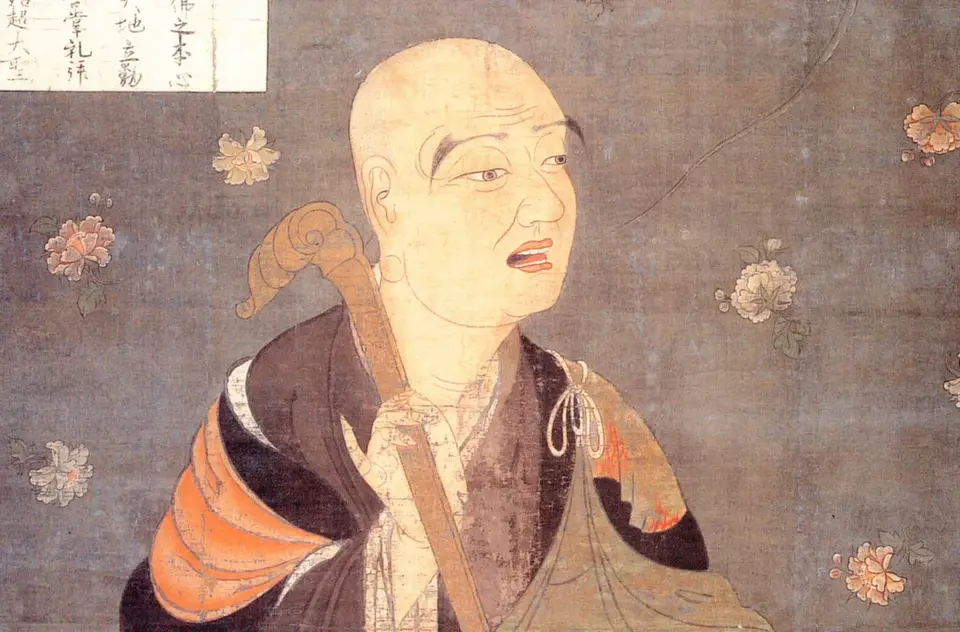
法藏
Fazang (法藏, 643–712), secular surname Kang, honorific name Xianshou, was of Sogdian descent from the Kingdom of Kangju whose grandfather settled in the Tang capital Chang'an. He was a renowned Buddhist monk, philosopher, master translator, and the de facto founder and theoretical synthesizer of the Huayan school (Avatamsaka tradition) of Chinese Buddhism. Venerated within the lineage as the Third Patriarch of Huayan, the…
Fazang (法藏, 643–712), secular surname Kang, honorific name Xianshou, was of Sogdian descent from the Kingdom of Kangju whose grandfather settled in the Tang capital Chang'an. He was a renowned Buddhist monk, philosopher, master translator, and the de facto founder and theoretical synthesizer of the Huayan school (Avatamsaka tradition) of Chinese Buddhism. Venerated within the lineage as the Third Patriarch of Huayan, the tradition itself is widely termed the "Xianshou School" after the prestigious honorific title conferred upon him by Empress Wu Zetian. In his youth, Fazang studied under Zhiyan, the Second Patriarch of Huayan, receiving the direct transmission of profound doctrinal insights. In 670, when Empress Wu Zetian converted her mother Lady Yang's estate into Taiyuan Temple, the eminent monks of the capital jointly petitioned for Fazang to be officially ordained as a monk; he received the full monastic precepts (upasampada) from ten leading elders and was granted the imperial title "Xianshou" (Foremost of Worthies). Revered as Preceptor to Five Emperors across the reigns of Gaozong, Wu Zetian, Zhongzong, Ruizong, and Xuanzong, he enjoyed unmatched imperial patronage. In 695, he assisted Siksananda at the Dabiangong Temple in Luoyang in retranslating the 80-scroll Avatamsaka Sutra (New Huayan), acting as chief scribe and collating missing Sanskrit sections with earlier translations to produce the definitive Chinese edition. Within the imperial palace, he famously elucidated the abstruse Huayan metaphysics of the "unimpeded interpenetration of principle and phenomena" to Empress Wu Zetian using the cast-bronze golden lion guarding the hall, composing the immortal philosophical masterpiece Treatise on the Golden Lion. In 705, Fazang aided the ministers Zhang Jianzhi and Cui Xuanwei in executing the Shenlong Coup that deposed the Zhang brothers and restored Emperor Zhongzong; though offered third-rank court honors, Fazang steadfastly declined political titles, prompting the emperor to transfer the prestige to his younger brother Kang Baozang. Throughout his life, Fazang established the canonical "Five Teachings and Ten Sects" classification system, articulated the doctrine of the "Four Dharmadhatus," refined the "New Ten Profound Gates," and formulated the "Perfect Harmony of the Six Characteristics," propelling Chinese Buddhist philosophy to its zenith and profoundly shaping Song Neo-Confucianism as well as the Buddhist traditions of Korea and Japan. He passed away peacefully at Dajianfu Temple in Chang'an in 712 at the age of seventy, receiving the posthumous title of Chamberlain for Ceremonials and burial at Huayan Temple on Shenhe Plateau.
Born in Chang'an into an elite naturalized Sogdian immigrant family from Kangju.
Burned a finger in front of the Ashoka Buddha relic stupa at Famen Temple to demonstrate unwavering faith.
Entered Mount Taibai as a hermit to study Buddhist scriptures and Confucian classics.
Heard Zhiyan expounding the Avatamsaka Sutra at Yunhua Temple, becoming his primary disciple.
Received Zhiyan's deathbed testament designating him as the sole worthy inheritor of the Huayan teaching.
Ordained at Taiyuan Temple following Lady Yang's demise; received full ordination and the imperial title "Xianshou."
Commenced retranslation of the 80-scroll Avatamsaka Sutra with Siksananda, serving as chief scribe and collator.
Completed the 80-scroll translation and lectured at Foshouji Temple; an auspicious earthquake accompanied his discourse.
Dispatched to Famen Temple to escort the sacred Buddha finger bone relic to the Mingtang in Luoyang.
Aided the Shenlong Coup restoring Emperor Zhongzong; declined high administrative titles in favor of his younger brother.
Passed away at Dajianfu Temple in Chang'an at age seventy; posthumously granted the title Chamberlain for Ceremonials.
Fazang was born in 643 during the seventeenth year of the Zhenguan reign of Emperor Taizong. His ancestral lineage originated in the Kingdom of Kangju, one of the prominent Sogdian states of Central Asia. During his grandfather's generation, the family entered the Tang heartland, adopting the Chinese surname Kang and establishing a distinguished merchant-noble household in Chang'an. Immersed in the cosmopolitan cultural milieu of the imperial capital, Fazang developed fluency in both Chinese classical literature and Central Asian and Sanskrit idioms from boyhood.
Fazang exhibited an extraordinary spiritual yearning from his youth. In 658, at the age of sixteen, he walked to the Ashoka Stupa at Famen Temple in Qizhou (modern Fufeng, Shaanxi), where he performed the extreme ascetic act of burning one of his fingers before the sacred Buddha relic to solemnize his vow to dedicate his life to the Dharma. At seventeen, he departed from his family to seek enlightenment in the secluded ravines of Mount Taibai, enduring physical hardships while delving deeply into Mahayana treatises.
During the Longshuo era, Fazang learned that Master Zhiyan of Zhixiang Temple on Mount Zhongnan was lecturing on the Avatamsaka Sutra at Yunhua Temple in Chang'an. Recognizing his karmic opportunity, Fazang emerged from Mount Taibai to enter Zhiyan's monastic assembly. Endowed with profound intellectual acumen, Fazang rapidly mastered the intricate metaphysics of the Avatamsaka doctrine, distinguishing himself above hundreds of monastic peers. Zhiyan treasured him as a genius destined to become a great patriarch.
In October 668, anticipating his impending departure, Master Zhiyan composed deathbed letters to leading monastic dignitaries including Daocheng and Baochen, formally entrusting the continuity of the Huayan school to Fazang, who was still a lay upisaka. Zhiyan wrote: "After my passing, this man alone is capable of continuing and glorifying the transmission of the Dharma. I pray that you venerable masters will protect and guide him!" This solemn endorsement definitively established Fazang's legitimacy as the sole doctrinal heir of the Huayan lineage.
In 670, Lady Yang, the mother of Empress Wu Zetian, passed away. To generate spiritual merit for her deceased mother, Empress Wu converted her residences in Chang'an and Luoyang into Taiyuan Temple (later renamed Chongfu Temple) and ordered that eminent scholars of virtuous character be recruited into the monastic order. Leading monks of Chang'an jointly submitted a memorial highly recommending Fazang.
Emperor Gaozong and Empress Wu accepted the petition, issuing an imperial decree for Fazang to undergo tonsure and take novice vows at Taiyuan Temple. As Fazang lectured extensively on the Avatamsaka Sutra at Taiyuan and Yunhua Temples, Empress Wu commanded ten leading monastic dignitaries of the capital to confer upon him the full monastic precepts (upasampada) and bestowed upon him the prestigious religious title "Xianshou" (Foremost of Worthies). From that moment, Fazang became known throughout the empire as Master Xianshou, and the Huayan school became known as the Xianshou School.
Since the Eastern Jin dynasty, when Buddhabhadra translated the 60-scroll Avatamsaka Sutra (the Old Translation), Chinese Buddhist scholars had recognized that the text suffered from significant lacunae. Upon learning that a complete Sanskrit manuscript existed in Khotan, Empress Wu dispatched envoys to invite the Khotanese master Siksananda to the eastern capital Luoyang. In 695, imperial edicts initiated the monumental translation project at Dabiangong Temple, with Fazang appointed as chief scribe (bi shou) and doctrinal verifier.
Commanding both Sanskrit and classical Chinese, Fazang compared the new translations against both the Jin and earlier Tang fragments sentence by sentence. Recognizing that despite Siksananda's additions the new translation still lacked sections of the Gandavyuha, Fazang integrated the missing Sanskrit passages that he had previously translated with the Central Indian master Divakara (Rizhao). Completed in October 699 as the 80-scroll Avatamsaka Sutra (the New Translation), this edition became the definitive, authoritative text preserved throughout East Asia.
Following the completion of the 80-scroll translation, Empress Wu ordered Fazang to expound the new scripture at Foshouji Temple in Luoyang. In the winter of 699, when Fazang reached the passage in the chapter "The Avatamsaka World" describing the cosmic shaking of the earth, a massive earthquake suddenly shook the temple hall, prompting the gathered multitude of monks to memorialize the event as an auspicious celestial resonance. Empress Wu personally penned an imperial commendation celebrating the extraordinary event.
Nevertheless, the boundless metaphysics of the Avatamsaka Sutra remained intellectually inaccessible to the empress. To facilitate her comprehension of non-obstruction and interpenetration, Fazang utilized a cast-bronze golden lion standing before the palace steps as a teaching aid. By equating the immutable gold to the underlying Buddha-nature (principle) and the lion form to the transient manifest phenomena, he lucidly explained how emptiness and form, the one and the many, and principle and phenomena interpenetrate without impediment, producing the concise philosophical masterpiece Treatise on the Golden Lion. Empress Wu was enlightened and deeply convinced.
In 697, the Khitan leaders Li Jinzhong and Sun Wanrong revolted, routing imperial forces and threatening northern cities. As court anxiety reached panic, Empress Wu summoned Fazang to the palace, commanding him to employ Buddhist teachings to suppress the invasion.
Fazang requested permission to establish an esoteric protective mandala. Purifying himself, he consecrated an altar dedicated to Guanyin (Avalokiteshvara) in the palace, chanting dharanis with a rosary of shadow-stone. Shortly thereafter, battlefield couriers reported that the rebel Khitan troops were seized with terror upon seeing countless divine warriors and a colossal apparition of Avalokiteshvara hovering above the Tang imperial lines. The Khitan army dissolved in panic and was crushed. Empress Wu rewarded Fazang with an imperial edict commending his spiritual protection of the realm.
In the winter of 704, during an assembly at the inner palace chapel in Luoyang, the eighty-one-year-old Empress Wu fell gravely ill. Fazang informed her that the Ashoka Stupa at Famen Temple in Qizhou enshrined the authentic finger bone relic of Shakyamuni Buddha. Seeking spiritual healing and longevity, Empress Wu commissioned Fazang to escort the holy relic to Luoyang.
Fazang performed devotional practices before the stupa for seven days and nights before opening the subterranean chamber to retrieve the relic. On New Year's Eve, the relic arrived at Chongfu Temple in Chang'an, and on the eleventh day of the first month in 705, it was welcomed into the Mingtang of Luoyang amidst solemn music played by the Court of Imperial Sacrifices. Fazang also presented a rosary of 108 cloud-sea stones sent by Japanese envoys to pray for the monarch's recovery, marking an era of supreme state religious veneration.
To provide students with an immediate visual understanding of the "non-obstruction of phenomena" and the "Realm of Indra's Net," Fazang designed an ingenious optical device. He arranged ten polished bronze mirrors facing one another in the eight cardinal directions, zenith, and nadir, placing a gilded Buddha image and a burning lamp in the center. The infinite reflections multiplied across every mirror, demonstrating how a single object contains all reflections while being simultaneously contained by every other mirror, concretely illustrating the boundless mutual containment of phenomena.
During the Shenlong Coup in early 705, Fazang aided Chancellor Zhang Jianzhi in restoring Emperor Zhongzong. The grateful emperor offered Fazang third-rank administrative honors as Chamberlain for Ceremonials, which Fazang steadfastly declined; the emperor consequently conferred the secular honors upon his younger brother Kang Baozang. Having served five successive monarchs as imperial preceptor, Fazang passed away peacefully in the auspicious reclining posture at Dajianfu Temple in Chang'an on December 16, 712, at the age of seventy. Emperor Xuanzong mourned his death, posthumously granted him the rank of Chamberlain for Ceremonials, and funded his funeral with 1,200 bolts of silk. He was interred south of Huayan Temple on Shenhe Plateau, with a commemorative epitaph composed by Imperial Secretarial Vice Director Yan Chaoyin.
Although designated the Third Patriarch, Fazang was the true institutional and intellectual founder of the Huayan school as an independent Buddhist tradition. He synthesized the doctrine of "Dharmadhatu Dependent Origination" into the foundational framework of the "Four Dharmadhatus": the Dharmadhatu of Phenomena (the diverse realm of empirical things), the Dharmadhatu of Principle (the uniform ultimate reality or Suchness), the Dharmadhatu of Non-Obstruction between Principle and Phenomena, and the supreme Dharmadhatu of Non-Obstruction between Phenomena and Phenomena.
This metaphysical vision resolved the dualism between absolute truth and empirical reality, establishing an organic, non-dual cosmic continuum that profoundly influenced subsequent Chinese thought, particularly the Song Neo-Confucian formulations of "principle and material force" (li and qi) developed by Zhang Zai, the Cheng brothers, and Zhu Xi.
In the Treatise on the Golden Lion, Fazang condensed the entire Huayan system into ten analytical perspectives: First, elucidating dependent origination by showing that gold has no intrinsic shape of its own and becomes a lion only through the craftsman's intervention; second, distinguishing form and emptiness by demonstrating that the lion's shape is empty while the gold reality remains immutable; third, expounding the Three Natures (imagined, dependent, and perfected); fourth, revealing signlessness; fifth, articulating non-arising; and six through ten, systematically deducing the Six Characteristics and Ten Profound Gates through the gold and lion metaphors, translating elusive Buddhist ontology into accessible terms.
Fazang reformulated the "Ten Profound Gates" into a definitive pedagogical tool for understanding cosmic interpenetration: the Gate of Simultaneous Complete Correspondence, the Gate of Mutual Containment of One and Many, the Gate of Mutual Identity of All Phenomena, the Gate of Indra's Net (where every entity reflects all other entities like jewels in a celestial net), the Gate of Mutual Ingestion and Establishment in Minute Entities, the Gate of Secret Concealment and Manifestation, the Gate of Purity and Diversity Possessing Virtue, the Gate of Ten Time Periods Differently Accomplished, the Gate of Good Accomplishment by Mind Only, and the Gate of Relying on Phenomena to Elucidate the Dharma.
Drawing from the Dashabhumika-sutra-shastra, Fazang systematically articulated the doctrine of the "Perfect Harmony of the Six Characteristics," creating a timeless dialectical theory of parts and wholes. He organized existence into three complementary pairs: Overall Characteristic (the entity as an integrated whole) and Particular Characteristic (the discrete components); Identical Characteristic (the collaborative function of components toward a single result) and Different Characteristic (the distinct properties retained by each part); and Accomplishing Characteristic (the synthesis forming a functioning entity) and Disintegrating Characteristic (the individual parts remaining in their respective intrinsic conditions). This framework demonstrated that unity and diversity coexist in dynamic harmony.
To categorize the vast corpus of Buddhist sutras introduced to China, Fazang formulated the comprehensive "Five Teachings and Ten Sects" classification. The Five Teachings progressed from the Hinayana, the Initial Mahayana (Fa-hsiang Yogacara and Madhyamaka Emptiness), the Final Mahayana (Tathagatagarbha and Awakening of Faith), the Sudden Teaching (Vimalakirti and Chan direct enlightenment), to the Perfect Teaching (the Avatamsaka One Vehicle). In his Ten Sects classification, he designated Huayan as the supreme "Sect of Complete Brightness Possessing All Virtues," creating an exhaustive intellectual taxonomy for East Asian Buddhism.
Fazang authored dozens of treatises, with his 20-scroll Tanxuan Ji standing as the crowning masterpiece of Huayan scholasticism. His Huayan Wujiao Zhang served as the foundational textbook for doctrinal classification, while Zhigui, Wangjin Huanyuan Guan, and the Golden Lion were revered as the "Three Essentials of Xianshou." His major scriptural commentaries, known collectively as the "Ten Commentaries of Xianshou," included landmark expositions on the Brahmajala Sutra, the Heart Sutra, the Awakening of Faith, and the Lankavatara Sutra.
Beyond the 80-scroll Avatamsaka Sutra, Fazang collaborated with international masters to translate hundreds of scrolls of Buddhist scriptures. He translated the Maharatnakuta Sutra with Xixue at the Linguang Hall, co-translated the 7-scroll Lankavatara Sutra with Siksananda in 700, and translated twenty-four scrolls of foundational works including the Ghanavyuha Sutra with Divakara, serving as the foremost literary editor and doctrinal verifier of the Tang court.
In Cultivating the Bodhicitta According to Huayan, Fazang synthesized meditative practice with metaphysics. Grounding his analysis in the Awakening of Faith, he identified the three foundational minds of a bodhisattva: the Sincere Mind (contemplating Suchness), the Deep Mind (delighting in cultivating virtues), and the Great Compassionate Mind (liberating all sentient beings). Expanding these into thirty detailed spiritual faculties, he provided a practical methodology connecting initial aspiration with ultimate enlightenment.
In his Commentary on the Heart Sutra, Fazang presented his famous "Three Pairs of Six Negations" regarding the phrase "neither produced nor destroyed, neither defiled nor pure, neither increasing nor decreasing." He systematically explained these negations across three dimensions: the spiritual stages of beings (ordinary beings, bodhisattvas, and Buddhas), the ontological nature of phenomena, and contemplative practice, uniting emptiness and dependent origination.
Fazang's scholarship profoundly shaped East Asian cultural history. His close friend and fellow student Uisang returned to Silla to establish the Korean Huayan (Hwaeom) tradition, maintained through ongoing correspondence with Fazang. Later, Fazang's disciple Shenxiang transmitted his treatises to Japan, lecturing on the Huayan Wujiao Zhang at Todai-ji in Nara and inspiring Emperor Shomu to construct the Great Buddha of Todai-ji, establishing the Kegon sect of Japan.
FIGURES ASSOCIATED WITH THIS DYNASTY