Apprenticeship under Gongsun Guang
Studies herbal pharmacology, decoction formulas, and pathology under Gongsun Guang.
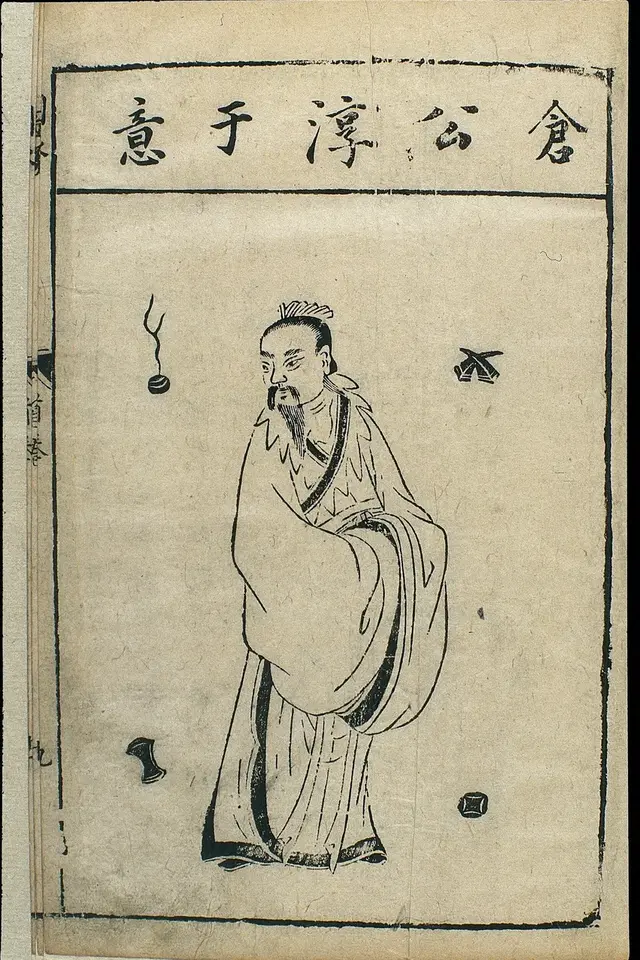
淳于意
Chunyu Yi (淳于意, c. 215–140 BCE), widely venerated in Chinese history as Master of the Granary (Cang Gong), was a preeminent physician of the early Western Han dynasty from Linzi in the State of Qi. Appointed as Director of the Granary of Qi (Taicang Ling), he achieved universal renown for his diagnostic accuracy and clinical breakthroughs. In his youth, Chunyu Yi studied pharmacology under Master Gongsun Guang of Zichuan…
Chunyu Yi (淳于意, c. 215–140 BCE), widely venerated in Chinese history as Master of the Granary (Cang Gong), was a preeminent physician of the early Western Han dynasty from Linzi in the State of Qi. Appointed as Director of the Granary of Qi (Taicang Ling), he achieved universal renown for his diagnostic accuracy and clinical breakthroughs. In his youth, Chunyu Yi studied pharmacology under Master Gongsun Guang of Zichuan before being recommended to the elderly master Gongcheng Yangqing, from whom he received the secret pre-Qin pulse treatises (Mai Shu) of the Yellow Emperor and Bian Que. Chunyu Yi possessed extraordinary diagnostic skill, determining patient lifespans and pathogen progressions through tactile examination of radial pulses and facial hues. However, his unyielding moral independence led him to reject permanent retainers under regional princes like the King of Zhao and King of Jiaoxi, earning the enmity of wealthy magnates. In 176 BCE, false allegations by a resentful merchant led to his arrest and sentencing to corporal mutilation punishments in Chang'an. His youngest daughter, Chunyu Tiying, accompanied his prison cart to the capital and submitted a famous memorial to Emperor Wen, offering to become an imperial slave to redeem her father. Deeply moved, Emperor Wen pardoned Chunyu Yi and formally abolished ancient mutilation punishments across the empire. Summoned to court, Chunyu Yi presented twenty-five clinical case histories known as Records of Examination (Zhenji), creating the world's earliest systematic clinical case histories in medical science.
Studies herbal pharmacology, decoction formulas, and pathology under Gongsun Guang.
Studies under Master Gongcheng Yangqing, receiving the ancestral pulse manuals of Bian Que.
Serves as Granary Master of Qi while traveling broadly to heal both aristocrats and commoners.
Falsely accused by wealthy elites; daughter Tiying submits her memorial, prompting Emperor Wen to abolish mutilation.
Emperor Wen questions Chunyu Yi on medicine; presents twenty-five case records (Zhenji).
Retires to Linzi to train disciples and compile medical texts, dying at over seventy years of age.
Chunyu Yi grew up in the historic metropolis of Linzi, the ancient capital of Qi, which had long been a thriving center of botanical lore and philosophical debate. Reared in the Confucian classics, he felt a profound calling to alleviate human suffering through the healing arts. In his twenties, he enrolled under physician Gongsun Guang of Zichuan, studying acupuncture, meridians, and botanical properties. Impressed by his diligence and keen analytical intellect, Gongsun Guang predicted he would become a supreme master, bequeathing him his private collection of secret empirical remedies.
In 180 BCE, recognizing that Chunyu Yi had outgrown his instruction, Gongsun Guang introduced him to Gongcheng Yangqing of Linzi. Yangqing, then over seventy years old, was the sole remaining torchbearer of the authentic Bian Que pulse tradition. Testing Chunyu Yi's moral fiber, Yangqing instructed him to discard unscientific magical recipes, presenting him with his ancestral bamboo scrolls: the Pulse Treatises of the Yellow Emperor and Bian Que, doctrines on five-color facial inspection, and pharmacological treatises. For three years, Chunyu Yi immersed himself in these texts, mastering the correspondence between arterial pulse rhythms and visceral pathologies.
Upon completing his apprenticeship, Chunyu Yi was appointed Director of the Granary of Qi (Taicang Ling), overseeing state reserves. Utilizing his free time, he practiced medicine extensively across Qi, Jinan, and Jiaodong.
Chunyu Yi's diagnostic precision seemed supernatural to contemporaries. Merely by palpating the radial pulse at the wrist and observing subtle chromatic changes in skin tone, he could pinpoint internal abscesses, visceral necrosis, and the precise day of critical turns. He treated kings and slave-girls alike: curing the King of Qi's court physician of malignant ulcers, healing King of Jibei's maidservants of lumbar inflammation, and successfully restoring peasants suffering from severe typhoid fevers. However, Chunyu Yi possessed an uncompromising, austere temperament. He adamantly refused permanent employment in the princely palaces of regional kings, and occasionally declined to treat corrupt magnates who refused to follow medicinal regimens. His unbending integrity inevitably provoked deep resentment among powerful local elites.
In 176 BCE, a wealthy family whose sick relative Chunyu Yi had declined to treat died of disease. The merchant clan conspired with corrupt magistrates to falsely indict Chunyu Yi for medical negligence and homicide. Under the harsh legal codes inherited from the Qin dynasty, the local magistrate condemned Chunyu Yi to severe corporal mutilation (rouxing), ordering him chained in a cage and transported to Chang'an for imperial execution.
As he was being placed into the prison cart, having fathered five daughters but no sons, Chunyu Yi sighed in despair: "Fathering daughters but no sons means in times of mortal danger, there is none to aid me!" His youngest daughter, fifteen-year-old Chunyu Tiying, was heartbroken by his words. Braving public ridicule, she marched alongside the prison wagon for thousands of li to Chang'an.
Upon reaching the capital, Tiying submitted a memorial directly to Emperor Wen: "Once a man is executed, he cannot be brought back to life; once a limb is amputated, it cannot be rejoined. Even if a punished man wishes to reform and renew himself, there is no path left to him. Your humble handmaid wishes to surrender herself as a government slave to redeem her father's criminal penalty, so that he may reform his conduct and begin anew."
Emperor Wen was profoundly moved by Tiying's filial devotion and moral lucidity. The Emperor issued an edict pardoning Chunyu Yi. Furthermore, reflecting upon the cruelty of statutory codes that permanently maimed citizens, Emperor Wen promulgated a historic decree formally abolishing ancient corporal punishments—such as facial tattooing (qing), nose-cutting (yi), and foot amputation (yue)—replacing them with labor terms and corporal floggings. This reform marked a monumental watershed in Chinese legal history, directly catalyzed by Tiying and Chunyu Yi.
Following his pardon, Emperor Wen summoned Chunyu Yi to Weiyang Palace, interrogating him regarding his medical lineage, diagnostic criteria, and clinical successes.
In response to imperial commands, Chunyu Yi presented a comprehensive clinical dossier documenting twenty-five detailed medical cases (Zhenji). Each case meticulously recorded the patient's full name, social rank, native place, initial symptoms, tactile pulse analysis, pharmacological diagnosis, exact drug dosages, and clinical outcomes, even noting the exact day of recovery or death. Importantly, he also recorded instances where his prognostications had proven mistaken, reflecting upon therapeutic errors.
Emperor Wu's grand historian Sima Qian transcribed this entire dossier verbatim into Chapter 105 of the Records of the Grand Historian. These twenty-five cases represent the world's earliest systematic, standardized clinical case histories, preceding Greek and Roman casebooks by centuries and establishing empirical clinical methodology for East Asian medicine.
Declining a permanent post as imperial court physician, Chunyu Yi retired to Linzi, spending his final decades instructing disciples and collating texts. He died at over seventy years of age.
Chunyu Yi's presentation of twenty-five medical records to Emperor Wen established the clinical case history (Zhenji) as an indispensable genre of Chinese medicine. By standardizing the five structural elements of clinical reporting—patient profile, pathology, pulse analysis, prescription formulation, and prognostic follow-up—he emancipated Chinese medical science from mystical divination, steering it toward empirical observation.
During an era when archaic pre-Qin medical knowledge was endangered, Chunyu Yi preserved the authentic tradition of Bian Que. His systematic analysis of pulse dynamics and organic pathology provided the essential clinical bridge that allowed traditional Chinese diagnostics to flourish throughout imperial antiquity.
Chunyu Yi's unjust imprisonment inspired his daughter Tiying's famous memorial, directly motivating Emperor Wen to abolish corporal mutilation punishments. This transformative reform initiated a profound humanization of the imperial Chinese legal system that reverberated across two millennia.
FIGURES ASSOCIATED WITH THIS DYNASTY