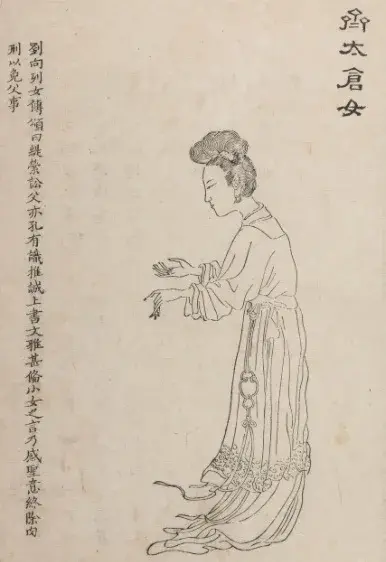
PROFILE
Chunyu Tiying (淳于缇萦, active early 2nd century BCE during the reign of Emperor Wen of Han), a native of Linzi in Qi Kingdom (modern Linzi District, Zibo, Shandong Province), was an exemplary filial daughter of the Western Han dynasty and the youngest daughter of the celebrated physician Chunyu Yi, known as the Grand Granary Master. In the thirteenth year of Emperor Wen of Han (167 BCE), Chunyu Yi was falsely accused of medical malpractice and official misconduct, subsequently sentenced by local judicial authorities to mutilating corporal punishment. According to Han administrative statutes, former officials sentenced to corporal punishment were required to be transported to the imperial capital of Chang'an for punishment. Lacking sons and having only five daughters, Chunyu Yi lamented in despair before his departure: "Bearing daughters rather than sons means having none to rely upon in times of emergency!" Moved to sorrow and determination by her father's grief, the young Tiying accompanied the prison transport cart on foot for thousands of li to Chang'an, submitting an impassioned petition to Emperor Wen at the risk of her own life.
In her memorial, Tiying articulated a profound critique of bodily mutilation: "When someone dies, they cannot return to life; when someone is mutilated by punishment, their severed limbs can never be rejoined. Even if they wish to reform and renew themselves, no path remains open to them." She offered to surrender her own freedom to become an official government bondservant to redeem her father's corporal sentence. Profoundly moved by Tiying's supreme filial devotion and lucid legal reasoning, Emperor Wen issued an imperial pardon releasing Chunyu Yi without requiring Tiying's enslavement. The episode prompted Emperor Wen to reflect on the cruelty of ancient statutes, culminating in his historic imperial edict of 167 BCE that formally abolished bodily mutilations—including tattooing, nose amputation, and foot severing—replacing them with caning and hard labor. Tiying's petition not only saved her father's life, but also marked a humanitarian turning point in Chinese jurisprudence, initiating the transition from mutilating penalties toward custodial labor sentences. She remains venerated as an enduring paragon of female courage, filial devotion, and philosophical clarity.
- Alternative Names
- Tiying
- Native Place
- Linzi, Qi Kingdom (modern Linzi District, Zibo, Shandong Province)
- Identity
- Celebrated Western Han filial daughter, pioneer of humanitarian legal reform in Chinese legal history
BIOGRAPHY
Chronology
- c. 180s BCE (Reign of Empress Dowager Lu to early Emperor Wen) | Birth in Qi | Born into a prominent medical household in Linzi of Qi Kingdom as the youngest daughter of Chunyu Yi.
- 167 BCE (Spring, 13th year of Emperor Wen of Han) | Father's Imprisonment | Chunyu Yi was implicated by dissatisfied patients and sentenced to corporal punishment, loaded into a transport cart bound for Chang'an.
- 167 BCE (Summer, 13th year of Emperor Wen of Han) | March to the Capital | Shaken by her father's lament over lacking sons, Tiying accompanied the prisoner cart across thousands of li to the capital gates.
- 167 BCE (May, 13th year of Emperor Wen of Han) | Imperial Petition | Submitted a memorial to Emperor Wen, arguing that mutilation foreclosed moral redemption and offering herself as a bondservant.
- 167 BCE (May, 13th year of Emperor Wen of Han) | Pardon and Exemption | Emperor Wen praised her filial virtue, pardoned Chunyu Yi, and excused Tiying from enslavement, permitting their safe return.
- 167 BCE (June, 13th year of Emperor Wen of Han) | Legal Transformation | Inspired by Tiying's plea, Emperor Wen promulgated the historic edict abolishing corporal mutilation across the empire.
Biography
Youngest Daughter of a Medical Family and Her Father's Lament
Chunyu Tiying was born into a respected family of medical practitioners in Linzi, Qi Kingdom, as the youngest daughter of the early Han physician Chunyu Yi. Her father had served as the Chief of the Grand Granary for the Kingdom of Qi, managing public grain stores. Passionate about pulse theory and therapeutics, he studied under the master physician Gongcheng Yangqing of Yuanli, mastering esoteric pulse manuscripts and treatises attributed to the Yellow Emperor and Bian Que. Chunyu Yi became renowned for diagnosing complex internal illnesses by analyzing five-color complexions and pulse variations, discerning the boundaries between life and death.
Chunyu Yi was unyielding in character and indifferent to official flattery. Traveling frequently among the feudal realms to examine the common populace, he prioritized medical ethics and dialectical treatment. When treating patients who were terminally ill or affluent nobles who refused to moderate their indulgence and diet, he spoke candidly and occasionally declined to administer treatments. Due to the limitations of ancient medicine and the wounded pride of local grandees, aggrieved families harbored resentment against him, circulating malicious accusations within Linzi.
Chunyu Yi took no concubines, raising five daughters with his principal wife. In the early Han period, patrilineal ancestral customs placed paramount emphasis on male heirs to maintain lineage sacrifices and defend the household. Lacking a son was a constant source of regret for Chunyu Yi. As the youngest child, Tiying was perceptive, compassionate, and observant. Witnessing her father's selfless medical labor and the unfair criticisms leveled against him, she developed a deep sense of filial duty and familial solidarity.
Father's Legal Peril and the Long Journey Accompanying the Prison Cart
In the thirteenth year of Emperor Wen of Han (167 BCE), a wealthy merchant family in Linzi whose relative had died under medical care colluded with local judicial underlings to accuse Chunyu Yi of accepting bribes and causing death through malpractice. Local magistrates investigated harshly, applying strict statutes inherited from the Qin legal code, and sentenced Chunyu Yi to severe corporal mutilation—a category encompassing tattooing of the face, amputation of the nose, and severing of the left or right foot.
Under early Han procedural statutes, any former official sentenced to mutilation had to be remanded to the imperial capital under military custody, subject to final review by the Commandant of Justice and public execution in the Chang'an marketplace. Imperial guards locked Chunyu Yi into a wooden barred cart, preparing to convey him over two thousand li westward along the postal highway. On the morning of departure, his household dissolved into weeping; his four older daughters surrounded the cart, wailing in helpless terror.
Overcome by dread of permanent disability and impending disaster, and lamenting the absence of male heirs to petition authorities, Chunyu Yi vented his bitter despair from inside the transport cage: "Bearing daughters rather than sons means having none to rely upon in times of emergency!" While her older sisters covered their faces in tears, the young Tiying was shaken by her father's words. Recognizing that weeping could not alter his fate, she resolved to intervene. Drying her tears, Tiying bade farewell to her mother and sisters, determined to follow the prison cart on foot all the way to Chang'an.
Submitting the Petition at Risk of Life and Moving the Sovereign
The route from Linzi to Chang'an stretched across two thousand li of rivers, mountains, and dust. Lightly clad, the young Tiying walked behind the jolting prison wagon, enduring hunger, exhaustion, and seasonal rain alongside the transport guards. Arriving at Chang'an, Chunyu Yi was consigned to the imperial prison of the Commandant of Justice to await final sentence. In the capital, where high officials held immense authority, an ordinary girl faced overwhelming odds in seeking to challenge judicial decisions.
Rather than resorting to futile public lamentation, Tiying recognized that only reasoned argumentation grounded in filial sincerity and jurisprudence could influence the emperor. Sitting beneath the lamp of a modest inn, she drafted a memorial in her own hand. At the risk of summary execution for insolence, she submitted the document through the Office of Imperial Transmission directly to the Weiyang Palace desk of Emperor Wen.
Her memorial presented a concise yet unassailable moral and legal argument: "My father served as an official, and the people of Qi praised his honesty and fairness. Now he has fallen into legal infraction and faces corporal mutilation. What grieves your handmaid most deeply is that once someone dies, they cannot return to life; once someone is mutilated by punishment, their severed limbs can never be rejoined. Even if they wish to reform and renew themselves, no path remains open to them. Your handmaid is willing to enter public servitude as a government bondservant, offering my own body to redeem my father's corporal sentence, so that he may preserve his limbs, rectify his conduct, and begin life anew."
Abolition of Corporal Punishment and Historical Immortality
Emperor Wen of Han was an enlightened and compassionate monarch, noted for his frugality, benevolence, and judicial restraint. When reading the petition submitted by this commoner girl, he was moved by her willingness to sacrifice her personal freedom for her father, and impressed by her critique of corporal punishment. Tiying had identified the cruelty of ancient penal codes: mutilation inflicted permanent physiological ruin and lifelong social disgrace, cutting off any possibility of rehabilitation.
Deeply stirred, Emperor Wen issued an imperial pardon granting Chunyu Yi immediate release and excusing Tiying from bonded servitude, permitting father and daughter to return home unharmed. Furthermore, in May of 167 BCE, Emperor Wen promulgated his famous Imperial Edict on the Abolition of Corporal Punishment.
The edict echoed Tiying's reasoning, declaring that the purpose of the law was to restrain misconduct and encourage moral self-renewal, whereas cutting limbs and carving flesh inflicted irremediable harm, contradicting the benevolent duties of a ruler toward his people. Emperor Wen directed Chancellor Zhang Cang and Censor-in-Chief Feng Jing to revise the imperial penal codes. Tattooing, facial amputation, and foot severing were abolished, replaced by caning and terms of bonded labor, such as wall-building and grain-milling. Although the initial scale of strokes resulted in severe physical trauma that required further reduction under Emperor Jing, Tiying's petition initiated the historic transition of Chinese law away from bodily mutilation toward humanitarian, custodial penalties. Her name was preserved in historical memory as an exemplar of moral agency and legal reform.
Major Achievements
Rescuing Her Father Through Supreme Filial Piety
In traditional Chinese ethical culture, the story of Tiying rescuing her father represents an enduring celebration of filial devotion and personal courage. Prior to the Han dynasty, historical accounts of filial piety predominantly emphasized male protagonists fulfilling ancestral rites, achieving official honors, or defending patriarchal prestige, while women remained peripheral. Tiying stepped forward at a moment of familial catastrophe when no male heirs existed, overturning societal assumptions regarding female incapacity.
Her actions combined moral dedication with practical fortitude. Rather than succumbing to despair, she undertook an arduous journey of thousands of li on foot, approached the highest administrative apparatus of the empire, and submitted an official petition to the emperor. She did not seek arbitrary leniency or deny legal culpability; instead, she offered to exchange her personal freedom and labor to redeem her father's corporal penalty.
This fusion of familial love, moral rectitude, and personal sacrifice resolved her father's despair over lacking sons and won the respect of high imperial ministers. Recorded in Sima Qian's Records of the Grand Historian, Tiying's deed became a standard exemplar in historical anthologies and moral primers for centuries, epitomizing the capacity of individual virtue to overcome institutional inertia.
Questioning Legal Philosophy and Driving Humanitarian Legal Reform
Tiying's principal contribution to Chinese and world jurisprudence lay in her incisive critique of the foundational philosophy of punishment, which catalyzed the Western Han reform of corporal penalties. Ancient Chinese penal law had long preserved the Five Punishments (tattooing, nose amputation, foot severing, castration, and capital execution), which were rooted in retributive mutilation of the human body.
In her memorial, Tiying formulated the principle: "When someone dies, they cannot return to life; when someone is mutilated by punishment, their severed limbs can never be rejoined. Even if they wish to reform and renew themselves, no path remains open to them." This argument exposed the fundamental flaw of physical mutilation: its irreversible destruction of bodily integrity. Once an individual suffered facial tattooing or foot amputation, they were physically disabled and socially outcast, permanently barred from reintegration into lawful society.
Emperor Wen integrated this insight into his historic edict, asking: "When punishment extends to severing limbs and carving skin, causing lifelong suffering, how can such painful cruelty be called virtuous? How does it accord with the duty of parents to the people?" Under his direction, tattooing was replaced by bonded labor under the collar, nose amputation was converted to three hundred strokes of the cane, and left-foot severing was replaced by five hundred strokes. While excessive caning strokes were later moderated under Emperor Jing, this structural overhaul eradicated mutilating corporal punishments from the mainstream statutory codes of imperial China, setting legal development on a path toward custodial sentences and labor service.
Shattering Gender Prejudices as a Pioneer of Female Agency
Beyond its legal and familial dimensions, Tiying's deed carries cultural significance in challenging patriarchal prejudices. Ban Gu remarked in the "Treatise on Penal Law" in the Book of Han that her petition not only preserved her father, but also spared countless subsequent generations from physical mutilation. Later writers repeatedly cited her example to contest the preference for male heirs over female children.
In his celebrated poetic cycle Singing of History, the Eastern Han historian and poet Ban Gu reflected on the episode: "The three ancient kings saw their virtue wane, and later ages applied corporal pain. The Prefect of the Grand Granary incurred offense, remanded to Chang'an under guard immense. Lamenting his lack of male issue to aid, he stood solitary, by fortune betrayed. His youngest daughter mourned her father's plight, knowing severed flesh could never unite. Her memorial reached the capital high, offering her body in servitude to ply. What use are a hundred sons in vain distress, compared to one Tiying's noble address?"
Ban Gu's memorable verse contrasted the helplessness of many sons with the decisive courage of a single daughter, challenging traditional gender assumptions. In his Biographies of Exemplary Women, Western Han scholar Liu Xiang classified Tiying among women distinguished for reasoned eloquence and filial virtue. Popular drama and oral literature celebrated her courage for centuries, demonstrating that moral authority, intellectual clarity, and historical agency transcend gender boundaries.
Personal Relationships
- Father: Chunyu Yi (Chief of the Grand Granary of Qi, renowned early Han physician who pioneered case histories; spared from corporal punishment following Tiying's petition).
- Eldest Sister: Lady Chunyu (eldest daughter of Chunyu Yi, wept at the departure of the prison cart in Linzi).
- Sovereign: Emperor Wen of Han (Liu Heng, fifth emperor of the Western Han dynasty, who accepted Tiying's memorial, pardoned her father, and abolished corporal mutilation).
- Legal Architect: Zhang Cang (Chancellor of Western Han, instructed by Emperor Wen to draft substitute penalties replacing corporal mutilations).
- Legal Architect: Feng Jing (Censor-in-Chief of Western Han, collaborated with Zhang Cang in enacting the legal reform statutes).
Historical Appraisals
- Sima Qian, Records of the Grand Historian, "Biographies of Bian Que and the Grand Granary Master": "Though the Grand Granary Master was austere in temperament, his compassion for the people endured. When he fell into legal offense punishable by mutilation, his young daughter Tiying submitted a memorial; Emperor Wen commended her intent and abolished the statutes of corporal punishment. She may truly be called extraordinary among women!"
- Ban Gu, Book of Han, "Treatise on Penal Law": "In the thirteenth year of Emperor Wen, Chunyu Yi, Prefect of the Grand Granary in Qi, was convicted of an offense and remanded to Chang'an. Having five daughters, they wept as they followed him. Yi shouted in anger: 'Bearing daughters rather than sons means having none to rely upon in times of emergency!' The young daughter Tiying grieved at his words and followed her father west to Chang'an, submitting a petition... The Son of Heaven took pity on her intent, and in the fifth month issued an edict abolishing corporal punishment."
- Ban Gu, Singing of History: "The three ancient kings saw their virtue wane, and later ages applied corporal pain. The Prefect of the Grand Granary incurred offense, remanded to Chang'an under guard immense. Lamenting his lack of male issue to aid, he stood solitary, by fortune betrayed. His youngest daughter mourned her father's plight, knowing severed flesh could never unite. Her memorial reached the capital high, offering her body in servitude to ply. What use are a hundred sons in vain distress, compared to one Tiying's noble address?"
- Liu Xiang, Biographies of Exemplary Women, "Biographies of the Eloquent and Competent": "Tiying submitted her petition and moved the enlightened sovereign. Her father was spared mutilation, and the statutes eliminated bodily disfigurement. Her supreme filial devotion and pure intent are honored for ten thousand generations."
- Su Shi, Collected Works of Su Dongpo: "Emperor Wen was benevolent, and Tiying was deeply filial; the bond between father and daughter moved Heaven and Earth. The abolition of corporal punishment was initiated by a young maiden; the humane spirit of Chinese jurisprudence reached its zenith here."
Related Entries
- Chunyu Yi
- Emperor Wen of Han
- Corporal Punishment
- Rule of Wen and Jing