Lineage Birth
Born in the Suksuhu River valley of Jianzhou Jurchen as the eldest son of Nurhaci and Lady Tunggiya.
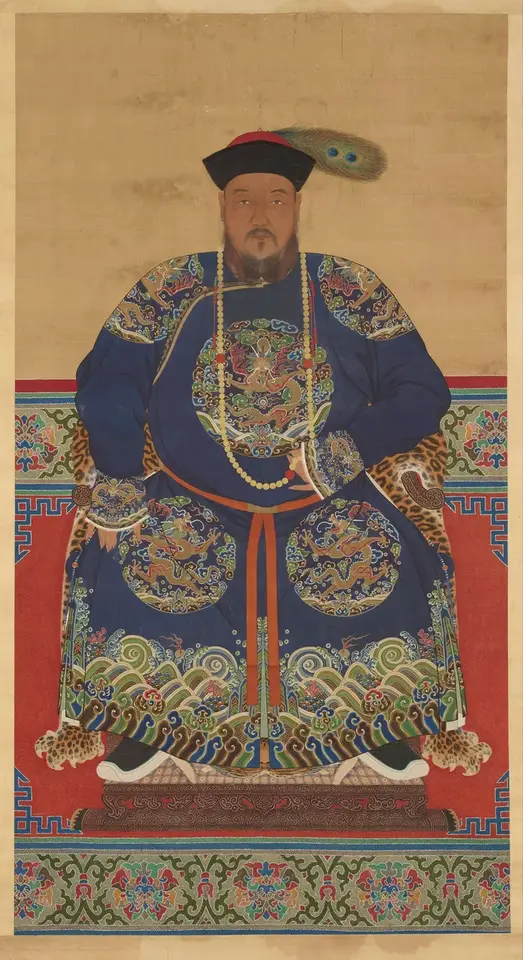
爱新觉罗·褚英
Aisin Gioro Cuyen (爱新觉罗·褚英, 1580–1615), courtesy name Cuyen, was the eldest son of Nurhaci, the founding sovereign of the Later Jin Dynasty, born to his primary consort Lady Tunggiya (Hahana Jacing). Raised during the tumultuous dawn of the Jianzhou unification wars, Cuyen displayed exceptional battlefield bravery and equestrian archery from early youth. Leading campaigns against rival Jurchen factions, he achieved major…
Aisin Gioro Cuyen (爱新觉罗·褚英, 1580–1615), courtesy name Cuyen, was the eldest son of Nurhaci, the founding sovereign of the Later Jin Dynasty, born to his primary consort Lady Tunggiya (Hahana Jacing). Raised during the tumultuous dawn of the Jianzhou unification wars, Cuyen displayed exceptional battlefield bravery and equestrian archery from early youth. Leading campaigns against rival Jurchen factions, he achieved major victories at Anculaku and the fortress of Ihan Ala, earning from Nurhaci the honorary titles "Hong Baturu" and "Arhatu Tumen Bayan" (meaning a resourceful and wealthy chieftain). In 1607, alongside his younger brother Daišan, Cuyen routed the superior Ula cavalry at the decisive Battle of Mount Wujie, earning the noble rank of Beile Guanglve. Recognizing his military prowess, Nurhaci appointed thirty-two-year-old Cuyen to manage state governance as senior regent in 1612. However, Cuyen's autocratic arrogance, erratic temperament, and coercive demands that his brothers swear oaths of absolute subservience alienated the "Four Senior Beiles" (Daišan, Amin, Manggūltai, and Hong Taiji) as well as Nurhaci's "Five Founding Ministers". Accused of treasonous conspiracy and fraternal tyranny, Cuyen was stripped of power and placed under perpetual house arrest in 1613, before being executed by Nurhaci's order in 1615 at the age of thirty-six.
Born in the Suksuhu River valley of Jianzhou Jurchen as the eldest son of Nurhaci and Lady Tunggiya.
Following the accidental killing of his grandfather and great-grandfather by Ming forces, accompanied Nurhaci in early military campaigns.
Led an expedition at age nineteen against the Anculaku settlements, capturing twenty fortresses and earning the title Hong Baturu.
Intercepted the superior Ula host at Mount Wujie; routed the enemy and was invested as Beile Guanglve.
Personally directed the assault against the fortified Ula stronghold of Ihan Ala, capturing over ten thousand prisoners.
Appointed by Nurhaci to supervise central civil administration and military affairs as designated heir.
Denounced by the Senior Beiles and Five Ministers for tyranny and treasonous oaths; stripped of office and confined behind high walls.
Curses and seditious utterances during confinement were reported to Nurhaci; executed on October 14 at age thirty-six, and his son Dudu was later confirmed as Beile Anping under Hong Taiji.
Cuyen was born in 1580 into the Suksuhu River department of the Jianzhou Jurchens. His father, Nurhaci, was then an emerging chieftain, and his mother, Lady Tunggiya (Hahana Jacing), was Nurhaci's primary wife.
In 1583, Ming general Li Chengliang attacked Gule Fortress, inadvertently killing Nurhaci's father Taksi and grandfather Giocangga. The four-year-old Cuyen grew up amidst sudden family displacement, military raids, and constant survival struggle as Nurhaci launched his unification campaigns with thirteen sets of inherited armor.
Trained in rigorous mounted archery and physical endurance from childhood, Cuyen participated in hunting expeditions and frontier marches. These experiences forged an unyielding martial character characterized by aggressive audacity and physical fearlessness.
In the first month of 1598, nineteen-year-old Cuyen received his first independent military command. Accompanied by his uncle Bayara, he led a force of one thousand elite cavalry north of the Changbai Mountains to subdue settlements along the Anculaku route.
Executing swift cavalry maneuvers, Cuyen launched aggressive assaults, overrunning more than twenty stockades and accepting the submission of over ten thousand tribesmen. Delighted by his son's decisive tactical competence, Nurhaci bestowed upon him the honorific title "Hong Baturu" (Great Hero in the Manchu tongue).
In 1607, Cemuhe, chieftain of the Fio Fortress of the Donghai Warka Jurchens, requested Jianzhou military protection to relocate his population. Nurhaci dispatched a three-thousand-man column led by Šurhaci, Cuyen, and Daišan. Hearing of the migration, Bujantai, Beile of the powerful Haixi Ula tribe, dispatched his uncle Bokdo with over ten thousand cavalry to intercept them at Mount Wujie.
Confronting the enemy amidst severe blizzards, senior commander Šurhaci hesitated. Enraged by this timidity, Cuyen and Daišan took command of the flanks, leading headlong cavalry charges into the Ula formations. Cuyen broke the enemy center while Daišan slew Bokdo. The Jianzhou forces routed the opposing host, taking three thousand heads and five thousand horses.
For this decisive feat of arms, Nurhaci promoted Cuyen to Beile Guanglve and conferred the prestigious title "Arhatu Tumen Bayan", hailing him as a sagacious chieftain of myriad followers.
In 1608, Cuyen led the assault against the strategic Ula bastion of Ihan Ala. Climbing the siege ladders under heavy arrow fire, Cuyen breached the walls and captured the fortress along with ten thousand inhabitants, decisively compromising Ula's defensive perimeter.
In 1612, acknowledging Cuyen's senior status and extensive military laurels, the aging Nurhaci entrusted the thirty-two-year-old prince with daily civil governance and troop allocation, effectively installing him as regent and crown prince.
However, Cuyen lacked political maturity and emotional moderation. Intoxicated with absolute authority, he attempted to rule through coercion rather than consensus.
He systematically pressured his younger brothers to surrender control over their household banners and companies (niru). Furthermore, he demanded that the four senior princes—Daišan, Amin, Manggūltai, and Hong Taiji—swear solemn oaths of unquestioned personal loyalty, declaring that anyone who disobeyed his dictates should be struck down by Heaven.
Simultaneously, Cuyen alienated the "Five Founding Ministers" (Eidu, Fiongdon, Hūrhada, Anfiyanggū, and Hohori), asserting that upon his eventual ascension he would execute any noble or minister who had ever crossed him.
Terrified of impending persecution, the four Senior Beiles and the Five Ministers forged an unprecedented political alliance. In the spring of 1613, while Nurhaci was absent on campaign against Ula, they drafted a comprehensive petition documenting Cuyen's administrative excesses, extortion, and plans for bloody vengeance.
Upon returning from the front, Nurhaci convened an assembly of imperial princes and ministers to confront Cuyen. Confronted with overwhelming testimony, Cuyen maintained a hostile demeanor, refusing to acknowledge any wrongdoing.
Recognizing that Cuyen's conduct threatened to fracture the newly unified Jianzhou confederation into civil war, Nurhaci removed him from administrative office and redistributed his banners among the other princes.
Deprived of his authority, Cuyen harbored intense bitterness. Rather than reflecting upon his actions, he burned incense within his private estate, praying for his father's defeat in battle and declaring that should Ming forces attack, he would shut the capital gates against his own clan.
Alarmed by these treasonous utterances, Cuyen's personal retainers reported the conspiracy to Nurhaci. Facing overt defiance, Nurhaci ordered Cuyen confined behind heavy walls, cutting off all communication with the outside world.
Over the next two years of confinement, Cuyen's resentment remained unyielding. Fearing that his eldest son would orchestrate a violent succession crisis upon his own death, Nurhaci reached a grim resolution.
On October 14, 1615 (the twenty-second day of the eighth month of the forty-third year of Wanli), Nurhaci dispatched executioners to strangle the thirty-six-year-old prince with a bowstring. Subsequent official imperial chronicles, including the Veritable Records of Qing and the Old Manchu Archives, recorded his demise with brief euphemism, stating simply that he died for severe crimes.
Cuyen was among the foremost shock-cavalry commanders of the early Later Jin state.
His deep penetration during the Anculaku expedition established control over the eastern frontier, while his battlefield courage at Mount Wujie reversed a dangerous strategic ambush, shattering the military prestige of the Ula confederation.
His successful storming of the formidable stone fortress of Ihan Ala demonstrated advanced tactical mastery in siege warfare, clearing the geographic path for the definitive annexation of the Haixi Jurchens.
As the first designated heir and regent in Manchu history, Cuyen's tragic downfall revealed the incompatibility of personal autocratic primogeniture with the traditional collective aristocratic customs of early Jurchen society.
His attempt to impose unmediated despotic command triggered a collective defensive reaction among the princes and tribal elders.
His elimination prompted Nurhaci to abandon direct linear succession in favor of the "Eight Banners Collective Council", wherein the Eight Beiles jointly consulted on state affairs and selected the supreme ruler, establishing the institutional foundation that shaped early Qing imperial politics.
The Draft History of Qing (Qing Shi Gao) evaluated his military career and institutional demise: "When Taizu took up arms, Cuyen fought with unmatched bravery in the battle formations, repeatedly crushing formidable adversaries to earn the title Hong Baturu. Yet when entrusted with the regency, he failed to conciliate his brothers and ministers, indulging in wanton tyranny until public indignation mounted, bringing severe statutory punishment upon himself."
The Old Manchu Archives (Manwen Laodang) recorded the internal crisis in unvarnished detail, noting that his malice toward his kin destroyed the foundational harmony of the realm.
Modern historians view Cuyen as an extraordinary warrior who lacked the diplomatic tact and institutional vision required to govern a multi-tribal coalition, serving as a tragic casualty of the structural transition from tribal aristocracy to centralized imperial monarchy.
FIGURES ASSOCIATED WITH THIS DYNASTY