Birth in Southern Chen
Born into an illustrious scholarly family in Qiantang, displaying extraordinary memory and literary talent.
褚亮
Chu Liang (褚亮) (560–647), courtesy name Ximing (希明), was an illustrious scholar, literary master, and founding statesman who lived through the Southern Chen, Sui, and early Tang dynasties, originating from Qiantang, Hangzhou (present-day Hangzhou, Zhejiang Province), with ancestral roots in Yangdi, Henan. Celebrated as one of the core figures among the Eighteen Scholars of the Institute of Literature, Chu displayed precocious…
Chu Liang (褚亮) (560–647), courtesy name Ximing (希明), was an illustrious scholar, literary master, and founding statesman who lived through the Southern Chen, Sui, and early Tang dynasties, originating from Qiantang, Hangzhou (present-day Hangzhou, Zhejiang Province), with ancestral roots in Yangdi, Henan. Celebrated as one of the core figures among the Eighteen Scholars of the Institute of Literature, Chu displayed precocious literary gifts, achieving widespread fame across Jiangnan at age eighteen after being commended by Xu Ling, Vice Director of the Department of State Affairs under Southern Chen. Following the Sui conquest of Chen, he served as Erudite of the Court of Imperial Sacrifices, but was banished in 613 to remote Xihai Commandery in Qinghai due to his literary association with rebel minister Yang Xuangan. In 617, Western Qin ruler Xue Ju seized him as a palace counselor. In 618, Li Shimin (the Prince of Qin) defeated Xue Rengao and recruited Chu Liang into his strategic headquarters. In 621, when Li Shimin established the Institute of Literature, Chu Liang was appointed among the revered Eighteen Scholars, accompanying the prince on campaigns and drafting vital military decrees and portrait encomiums. Following Taizong's ascension, Chu served as Scholar of the Hongwen Academy, maintaining regular night duty within the palace to provide policy counsel. He died in 647 at eighty-eight, honored with burial at Zhaoling Mausoleum and the posthumous title Kang. His second son, Chu Suiliang, inherited his intellectual mantle, rising to become chancellor and a supreme master of Chinese regular script calligraphy.
Born into an illustrious scholarly family in Qiantang, displaying extraordinary memory and literary talent.
Visited literary patron Xu Ling at eighteen and composed impromptu poems before Chen Shubao, winning wide renown.
Entered Sui service following Chen's fall, appointed Eastern Palace Scholar and Erudite of the Court of Imperial Sacrifices.
Implicated in the rebellion of Yang Xuangan due to social ties and exiled to Xihai Commandery in Qinghai.
Forced into service as Vice Director of the Chancellery by rebel ruler Xue Ju in Jincheng.
Captured by Li Shimin following the defeat of Xue Rengao, recruited into Qin headquarters as Armor Administrator.
Inducted into the Institute of Literature as one of the Eighteen Scholars, authoring panegyrics for Yan Liben's portraits.
Appointed Companion and Administrator to Crown Prince Li Shimin following the Xuanwu Gate Incident.
Appointed Scholar of the Hongwen Academy, providing continuous counsel on statecraft and classical rituals.
Promoted to Cavalier Attendant-in-ordinary and enfeoffed as Marquis of Yangdi with seven hundred households.
Passed away in Chang'an at eighty-eight, honored with court mourning, posthumous office, and burial at Zhaoling.
Chu Liang descended from the prominent Chu lineage of Yangdi in Henan, which migrated south to Danyang and eventually settled in Qiantang of Hangzhou during the Six Dynasties. His fourth-generation ancestor Chu Xuan served as Cavalier Attendant-in-ordinary under Southern Qi; his great-grandfather Chu Meng was Heir Apparent's Companion under the Liang; and his grandfather Chu Jie served as Censor-in-Chief under Southern Chen. Raised within this venerable tradition of classical scholarship, Chu Liang showed exceptional precocity, reading widely across canonical histories and memorizing extensive texts with effortless ease.
In 577, at age eighteen, Chu traveled to the Chen capital of Jiankang to visit Xu Ling, Vice Director of the Department of State Affairs and undisputed leader of the southern literary establishment. Xu Ling discussed ancient and modern rhetoric with the youth, marveling at his depth of judgment and breadth of expression. Word of the interview reached Chen Shubao (the future Last Emperor of Chen), who summoned Chu to the palace for an impromptu poetic audition. In the presence of Chancellor Jiang Zong and the gathered literati of the court, Chu composed elegant verses with rhythmic cadence, winning unanimous acclaim across the southern capital.
Following the Sui conquest of Southern Chen in 589, Chu Liang transitioned to northern service, appointed Scholar in the household of the Crown Prince. In 605, upon the accession of Emperor Yang of Sui, Chu was elevated to Erudite of the Court of Imperial Sacrifices (Taichang Boshi). Renowned for his command of ancient precedent, Chu collaborated with Vice Minister of Rites Xu Shanxin to memorialize on restoring the ancient Seven Temples imperial ancestral system, which was adopted by the court. In 606, he was commissioned alongside scholars Lu Congdian and Ouyang Xun to assist Duke of Yue Yang Su in compiling the History of Wei, an endeavor cut short by Yang Su's death.
In the sixth month of 613, Minister of Rites Yang Xuangan launched an armed rebellion at Liyang while Emperor Yang was campaigning against Goguryeo. Because Yang Xuangan had long admired literature and maintained frequent literary correspondence with Chu Liang, Chu was implicated in the purge following the revolt's collapse. Stripped of all offices, he was banished to remote Xihai Commandery (modern Gonghe County, Qinghai Province) as Revenue Officer. Enduring the freezing gales and barren deserts of the Qinghai frontier for years, Chu maintained his scholarly dignity and literary pursuits undisturbed.
In 617, Xue Ju, a military garrison officer at Jincheng, rebelled and declared himself Western Qin Hegemon King at Lanzhou. Aware of Chu's scholarly reputation, Xue Ju brought him from Xihai and appointed him Vice Director of the Chancellery to manage sensitive correspondence. In the eleventh month of 618, Li Shimin, Prince of Qin, crushed Xue Rengao at the Battle of Qianshuiyuan. Having long respected Chu's learning and strategic intellect, Li Shimin searched out Chu immediately upon entering the city, welcoming him into his princely retinue as Armor-Section Administrator (Kaicao Canjun).
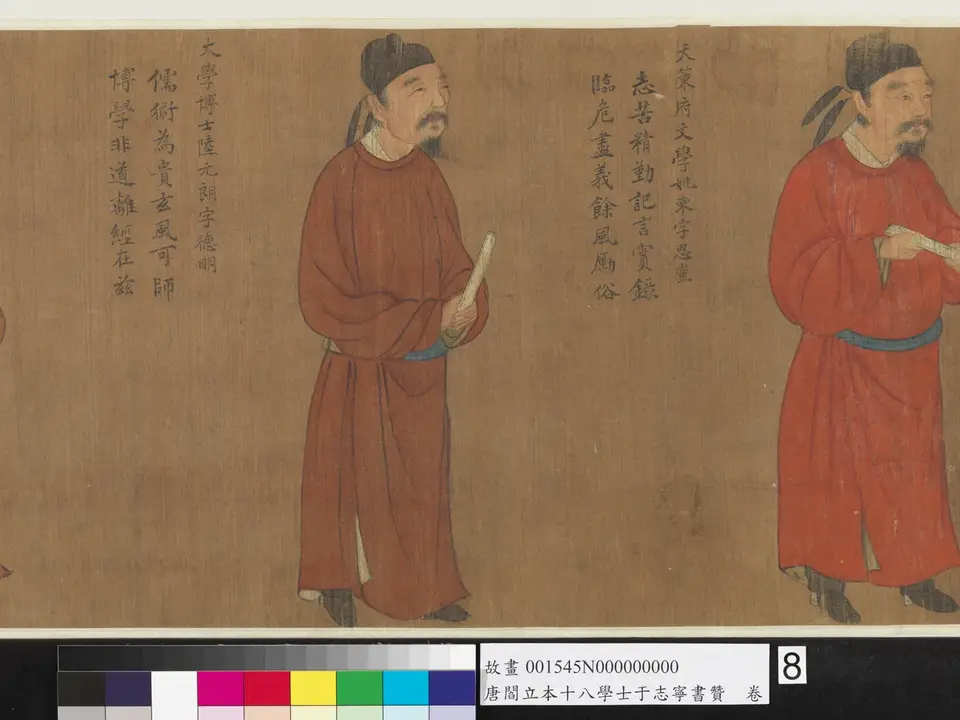
Throughout subsequent unification campaigns, Chu accompanied Li Shimin across the empire, participating in expeditions against rival warlords Wang Shichong, Dou Jiande, and Liu Heita. Possessing extensive knowledge of historical geography and past dynastic strategy, Chu provided valuable counsel within the prince's inner tent and received lavish rewards during military victory banquets. In 621, after subverting Wang Shichong at Luoyang, Li Shimin founded the Institute of Literature (Wenxueguan) in Chang'an to cultivate policy advisers outside the old aristocratic clans. Chu Liang was appointed among the core Eighteen Scholars alongside Du Ruhui, Fang Xuanling, and Yu Shinan. Li Shimin commissioned court master Yan Liben to paint the Portrait of the Eighteen Scholars and ordered Chu Liang to compose the official poetic panegyrics for each scholar, an honor contemporary intellectuals celebrated as "Ascending the Fairy Isle of Yingzhou."
Following the Xuanwu Gate Incident in 626, Li Shimin was installed as Crown Prince, and Chu Liang was made Heir Apparent's Companion and Administrator. In the eighth month, Li Shimin ascended the throne as Emperor Taizong. In 627, Taizong expanded the literary institute into the Hongwen Academy, appointing Chu as Scholar of the Hongwen Academy. Academicians took turns sleeping on night duty within the palace so that the emperor could summon them at any hour to discuss classical statecraft, moral philosophy, and legal codes.
In 635, Chu was promoted to Supernumerary Cavalier Attendant-in-ordinary and ennobled as Baron of Yangdi, later advancing to Cavalier Attendant-in-ordinary and Marquis of Yangdi with a fief of seven hundred households. In his eighties, Chu requested retirement, which Taizong granted with special honors, pensions, and seasonal gifts. When Taizong led the eastern campaign against Goguryeo, Chu's second son, Chu Suiliang, accompanied the emperor as Secretariat Drafter; Taizong frequently dispatched palace messengers to inquire after the elder Chu's health and provide imperial physicians. In 647, Chu Liang passed away peacefully in Chang'an at the age of eighty-eight. Deeply grieved, Taizong halted court business for an entire day, posthumously promoted him to Chief Minister of the Court of Imperial Sacrifices, granted the posthumous name Kang, and bestowed the supreme privilege of an accompanying tomb at Zhaoling Mausoleum.
In 621, following his triumphs over Wang Shichong and Dou Jiande, Li Shimin established the Institute of Literature in Chang'an to assemble an independent intellectual brain trust. Chu Liang, celebrated for his age, ethical stature, and encyclopedic erudition, stood as the senior cultural figure among the Eighteen Scholars.
Within the institute, Chu engaged in regular policy debates and classical collations, assisting Li Shimin in formulating post-civil war stabilization programs. When Taizong commanded court painter Yan Liben to execute the Portrait of the Eighteen Scholars to be preserved in the imperial archives, he selected Chu Liang to draft the panegyrics for all eighteen members. Chu's elegant prose and discerning characterizations created an immortal cultural benchmark for Chinese scholars, initiating the tradition of imperial patronage of Confucian scholarship known as "Ascending Yingzhou."
During the founding civil wars of the Tang Dynasty, Chu Liang served as an active wartime secretary and strategic counselor to Li Shimin. Beginning with the pacification of Xue Ju and Xue Rengao in 618, Chu marched with the Prince of Qin across Longyou, the Central Plains, and Hebei.
Possessing thorough knowledge of military topography and ancient dynastic precedents, Chu was tasked with drafting campaign proclamations, tactical directives, and pacification amnesties. Whenever Tang armies captured rebel centers, Chu oversaw the preservation of regional archives and comforted surrendered populations, allowing Tang civilian administration to take root rapidly. Li Shimin recognized his military counsel with repeated battlefield commendations.
In 627, Emperor Taizong transformed the Institute of Literature into the Hongwen Academy, assigning Chu Liang as a core scholar on permanent night duty. During the formative years of the Zhenguan reign, Taizong frequently summoned Hongwen academicians late at night to examine classical precedents from the Han, Wei, and Jin dynasties and refine governing statutes.
Chu's mastery of Six Dynasties ritual traditions and court protocol provided vital historical evidence for formulating Tang dynastic ceremonies, imperial ancestral music, and the five categories of classical rites (auspicious, felicitous, guest, military, and mournful rites). Advocating that moral harmony should guide legal discipline, Chu helped purge the superficial extravagances of earlier southern dynasties and laid the Confucian institutional foundations for the Zhenguan Reign.
Spanning the Chen, Sui, and Tang dynasties, Chu Liang was a key literary figure who bridged the ornamental elegance of the southern dynasties with the vigorous ethos of the northern empire. In his youth in Jiankang, he mastered parallel phrasing and delicate sensory descriptions. Following his harsh exile in Qinghai and his years on military campaign with the Prince of Qin, his poetry acquired expansive vision and structural strength.
In celebrated verses such as Harmonizing on Midday, Evening Parting with Record Keeper Le Yan, and Lamenting Scholar Pan on the Longyou Heights, Chu synthesized Six Dynasties prosodic refinement with early Tang grandeur. Qing dynasty critic Guan Shiming noted that early Tang literature successfully transformed the decadent tones of the southern courts into noble dynastic poetry primarily through the bridge formed by southern masters like Chu Liang, Yu Shinan, and Li Baiyao.
FIGURES ASSOCIATED WITH THIS DYNASTY