Birth in Jiangnan
Born into an educated scholar-official household in Yanling, studying Confucian classics and agrarian customs.
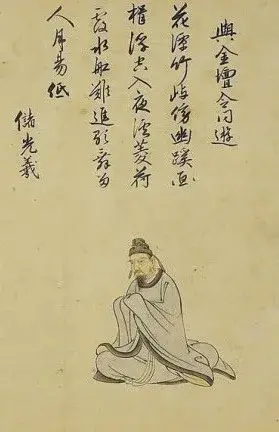
储光羲
Chu Guangxi (储光羲, 706–760), a native of Yanling in Runzhou (southwest of modern Danyang, Jiangsu) with ancestral roots in Yanzhou (modern Shandong), was an illustrious poet of the High Tang and a foremost master of the classical pastoral and landscape poetry tradition. Endowed with exceptional literary gifts from his youth, he achieved the jinshi degree in 726 alongside eminent literati Cui Guofu and Qiwu Qian. He was…
Chu Guangxi (储光羲, 706–760), a native of Yanling in Runzhou (southwest of modern Danyang, Jiangsu) with ancestral roots in Yanzhou (modern Shandong), was an illustrious poet of the High Tang and a foremost master of the classical pastoral and landscape poetry tradition. Endowed with exceptional literary gifts from his youth, he achieved the jinshi degree in 726 alongside eminent literati Cui Guofu and Qiwu Qian. He was initially assigned as magistrate defender of Fengyi and subsequently served in Sishui, An'yi, and Xiagui. Disillusioned with bureaucratic corruption and factional strife, he resigned to live in rural seclusion in the Zhongnan Mountains, dedicating himself to agrarian labor, poetic exploration, and classical statecraft treatises. During the Tianbao era, Chu returned to civil service, sequentially serving as Court Sacrificer in the Court of Imperial Sacrifices—earning the popular designation "Court Sacrificer Chu"—and subsequently advancing to Investigating Censor. In late Tianbao, on an imperial mission to Fanyang, he astutely observed An Lushan's military machinations and the suffering of frontier peasants, composing poignant poems of political forewarning. When the An Lushan Rebellion erupted and Chang'an fell in 756, Chu was captured and coerced into accepting an office under the rebel regime. Following the restoration of the capital by imperial forces, he was imprisoned for collaboration and exiled to the distant, malarial regions of Lingnan, where he died in grief. Influenced deeply by Tao Yuanming, Chu's poetry is revered for its unadorned simplicity, moral gravity, and profound rustic truth, standing alongside Wang Wei and Meng Haoran as an enduring pillar of High Tang verse.
Born into an educated scholar-official household in Yanling, studying Confucian classics and agrarian customs.
Passed the imperial jinshi examination in Chang'an alongside Cui Guofu and Qiwu Qian.
Appointed magistrate defender of Fengyi and transferred to Sishui, administering local penal and tax registries.
Served as defender in An'yi and Xiagui; weary of bureaucratic monotony and political patronage.
Resigned from provincial office to retire to the Zhongnan Mountains, cultivating fields and exchanging verse with Wang Wei.
Completed the fifteen-volume treatise Zhenglun and twenty volumes of classical commentaries during his mountain retirement.
Re-entered bureaucratic service in Chang'an as Court Sacrificer of the Court of Imperial Sacrifices.
Elevated to Investigating Censor, supervising official discipline and inspecting regional governance.
Dispatched on an inspection tour to Fanyang; witnessed An Lushan's military buildup and composed prophetic verses.
An Lushan rebelled; Chu remained in Chang'an participating in defensive deliberations.
Chang'an fell to rebel troops; captured and compelled under duress to accept a bureaucratic post in the rebel administration.
Tang forces recaptured Chang'an; Chu surrendered to imperial authorities and was imprisoned in the censorate jail.
Convicted of holding rebel office; stripped of all titles and sentenced to permanent exile in Lingnan.
Succumbed to illness and grief in Lingnan at age fifty-five, leaving a celebrated legacy of pastoral verse.
Chu Guangxi was born in 706 in Yanling, Runzhou, into a scholar-gentry lineage tracing its ancestry to Yanzhou. Immersed in the tranquil rural landscape of the southern Yangtze basin, Chu absorbed both rigorous Confucian moral teachings and the daily rhythms of agrarian cultivation. Unlike aristocratic poets who observed peasant existence from a distance, Chu developed an intimate, lifelong empathy for farming communities that became the spiritual wellspring of his pastoral verse.
In 726, at age twenty-one, Chu journeyed to the metropolitan capital of Chang'an and passed the prestigious jinshi examination in the same cohort as celebrated poets Cui Guofu and Qiwu Qian. Following his success, he was posted as defender of Fengyi county, subsequently moving to Sishui, An'yi, and Xiagui. For more than a decade, he remained confined to subordinate county duties, collecting agricultural tributes and adjudicating local litigation. Unwilling to court powerful ministers such as Li Linfu, and dismayed by institutional corruption, Chu found his administrative ideals thwarted by reality.
In the closing years of the Kaiyuan reign, exhausted by low-level administrative drudgery, Chu resigned his commission and retired to his country estate in the Zhongnan Mountains south of Chang'an. Embracing rural labor, he led a simple agrarian life reminiscent of Tao Yuanming. In this pastoral setting, he forged deep literary friendships with Wang Wei, Pei Di, and Chang Jian. Their poetic dialogues and mountain excursions produced Chu's most celebrated pastoral masterpieces, including Occasional Verses on Farm Life, Miscellaneous Poems on Farm Life, and Song of the Shepherd Boy.
Crucially, Chu's retreat was not an abandonment of social responsibility. In the quietude of the Zhongnan hermitage, he reflected deeply on statecraft and imperial governance. During these years, he authored Zhenglun (On Correct Governance) in fifteen volumes, analyzing fiscal reform, agrarian relief, and administrative accountability. He also compiled twenty volumes of Jiujing Waiyishu (Expository Commentary on the Nine Classics). Contemporary critics lauded these treatises for their profound pragmatic wisdom, demonstrating that Chu was not merely an aesthetic poet, but a scholar-statesman capable of imperial governance.
Recognized for his moral integrity and classical erudition, Chu was summoned back to officialdom during the Tianbao era. In 750, he was commissioned as Court Sacrificer of the Court of Imperial Sacrifices, presiding over ancestral rites and imperial liturgies. His peers revered him as "Court Sacrificer Chu." In 753, he was promoted to Investigating Censor, tasked with inspecting administrative performance and maintaining judicial oversight across provincial commands.
In 754, the court dispatched Censor Chu on an official inspection tour of Fanyang in the northeastern frontier. There, Military Commissioner An Lushan was amassing veteran horsemen, grain stores, and weaponry in preparation for insurrection, while Emperor Xuanzong and Prime Minister Yang Guozhong in Chang'an remained oblivious to the looming catastrophe. Traveling through Handan, Chu observed state requisitions devastating peasant villages, families torn apart by conscription, and farmlands laid waste. Troubled by the impending crisis, he composed the famous Imitations of Ancient Ballads and Watching the Fanyang Prisoners. In these verses, he exposed An Lushan's ambition and warned that civil disaster was imminent, lamenting his inability to penetrate the corrupt imperial court with his counsel.
In late 755, An Lushan launched his rebellion, driving southward with frontier cavalry. In mid-756, Tongguan fell and Emperor Xuanzong fled to Sichuan. Chang'an fell into anarchy, and Chu was trapped in the capital. To manufacture legitimacy, the rebel leaders coerced respected scholar-officials into accepting administrative posts. Subject to house arrest and the threat of execution, Chu failed to commit suicide and reluctantly accepted a bureaucratic appointment in the rebel administration.
In late 757, Tang loyalist forces under Guo Ziyi and the Prince of Guangping liberated Chang'an. Chu and other compromised officials turned themselves in for imperial trial. Emperor Suzong took a severe stance toward collaborators, executing high ministers and sentencing others to hard labor or exile. Although Chu had committed no atrocities and had been coerced, he was found guilty of compromising imperial loyalty. In 758, his life was spared, but he was stripped of all bureaucratic status and banished to the remote, disease-ridden frontier of Lingnan.
Shattered by political disgrace and remorse over his failure of political fidelity, Chu endured the harsh journey south. In 760, isolated and stricken by illness in Lingnan, he passed away at the age of fifty-five. While much of his extensive prose and commentary was lost in later wars, his poetic corpus survived in Ming compilations, cementing his reputation as one of the most poignant and ethically profound voices of the High Tang.
Chu Guangxi ranks among the preeminent founders of the High Tang landscape and pastoral poetry tradition, celebrated alongside Wang Wei, Meng Haoran, and Wei Yingwu. Rooted directly in the rustic ethos of Tao Yuanming, his verse transcended detached aristocratic contemplation to depict authentic agricultural labor, seasonal rhythms, and communal solidarity.
In masterpieces such as Occasional Verses on Farm Life, Song of the Shepherd Boy, and The Fishing Cove, Chu employed direct, lucid language and unadorned diction, discarding six dynasties ornamentation. Critics celebrated his style as lofty, tranquil, and deeply resonant with nature. His unvarnished portrayals of rural homesteads established a timeless aesthetic paradigm in classical Chinese literature.
Far from being a disengaged recluse, Chu possessed keen political foresight and deep social conscience. During his inspection mission to Fanyang on the eve of the An Lushan Rebellion, he was among the few imperial officials who recognized the gathering storm.
His Handan poems, particularly Imitations of Ancient Ballads, captured the ominous atmosphere of frontier militarism, the plight of impoverished peasants, and the folly of court sycophancy with documentary precision. Anticipating the monumental realist "poetic history" of Du Fu, these verses remain indispensable literary records of the structural collapse of the High Tang golden age.
In addition to his poetic fame, Chu was an insightful classical commentator. During his Zhongnan seclusion, he composed the fifteen-volume political treatise Zhenglun and the twenty-volume exegetical work Jiujing Waiyishu. Yin Fan, compiler of the High Tang anthology Heyue Yingling Ji, personally reviewed the manuscripts and praised Chu as a profound intellect equipped to govern the empire.
In these writings, Chu integrated Confucian moral virtue with pragmatic administrative reforms, examining tax equity, agrarian revitalization, and bureaucratic oversight. This intellectual breadth distinguished him from contemporary literati who focused solely on poetic composition.
FIGURES ASSOCIATED WITH THIS DYNASTY