Birth at Drakmar
Born in the Drakmar Palace in the Yarlung Valley; reared in the imperial court under royal patronage.
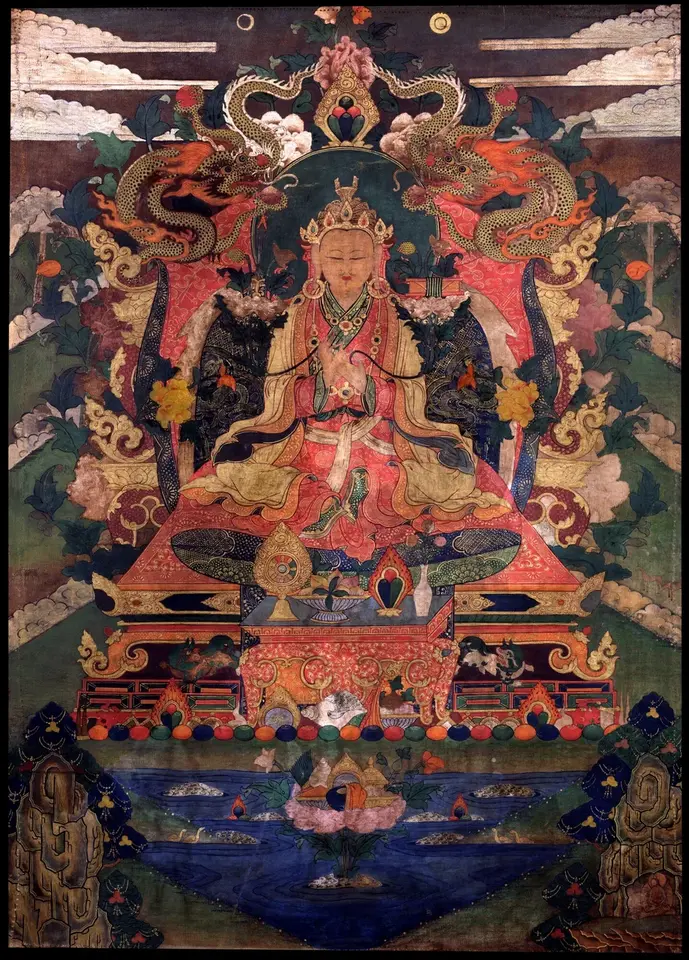
赤松德赞
Trisong Detsen (742–797), recorded in classical Chinese dynastic histories as Qisong Detsen, Qilizang, or Saxilonglazan, was the 37th Tsenpo of the Tibetan Empire, reigning from 755 to 797. The son of Tsenpo Tride Tsuktsen, Trisong Detsen ruled for forty-two years, presiding over the longest reign and the zenith of Tibetan imperial power, territorial expansion, and cultural flourishing. Ascending the throne during the…
Trisong Detsen (742–797), recorded in classical Chinese dynastic histories as Qisong Detsen, Qilizang, or Saxilonglazan, was the 37th Tsenpo of the Tibetan Empire, reigning from 755 to 797. The son of Tsenpo Tride Tsuktsen, Trisong Detsen ruled for forty-two years, presiding over the longest reign and the zenith of Tibetan imperial power, territorial expansion, and cultural flourishing. Ascending the throne during the turmoil of the An Lushan Rebellion in Tang China, Trisong Detsen suppressed domestic noble conspiracies, reorganized tribal military administration, and exploited the military vacuum in the Hexi Corridor and Longyou. In 763, his armies captured the Tang capital of Chang'an, subsequently annexing extensive territories across modern Gansu, Qinghai, and the Western Regions. In religious and cultural affairs, Trisong Detsen overcame fierce aristocratic Bon opposition by inviting eminent Indian masters Santaraksita and Padmasambhava to Tibet. He founded Samye Monastery, the first monastery in Tibet housing the Triple Gem, ordained the "Seven Chosen Ones," and presided over the Lhasa Council (Council of Samye), establishing Buddhism as the state religion. Along with Songtsen Gampo and Ralpacan, he is venerated in Tibetan tradition as one of the Three Dharma Kings (Chogyal).
Born in the Drakmar Palace in the Yarlung Valley; reared in the imperial court under royal patronage.
Succeeded as the 37th Tsenpo following his father's assassination; executed conspirators of the Lang and Me clans with the aid of Nganlam Takdra Lukhong.
Exploited post-rebellion chaos in Tang China; deployed Takdra Lukhong with 200,000 troops to capture Chang'an, occupying the capital for fifteen days.
Invited Indian masters Santaraksita and Padmasambhava; completed Samye Monastery, ordained seven Tibetan monks, and instituted Buddhism as the state religion.
Concluded the Treaty of Qingshui with the Tang court, formalizing boundaries and consolidating Tibetan territorial gains across Longyou and Hexi.
Presided over the three-year philosophical debate between Indian gradualist Madhyamaka and Chinese sudden Chan traditions, validating Indian orthodoxy.
Abdicated in favor of his eldest son, Muni Tsenpo; retired to Songka Nyimaka Palace and passed away at age 56, entombed at the Muridrong royal necropolis.
Trisong Detsen was born in 742 at the Drakmar Palace in the fertile Yarlung Valley. In 755, violent dynastic turmoil erupted at the imperial court: ministers Lang Maise and Me Dongtsar, ardent adherents of indigenous Bon shamanism, executed a bloody conspiracy that resulted in the assassination of Tsenpo Tride Tsuktsen. The thirteen-year-old prince Trisong Detsen survived only through the resolute protection of loyalist commanders, led by General Nganlam Takdra Lukhong (known in Chinese records as Ma Zhongying).
Displaying swift military decisiveness, Takdra Lukhong mobilized the royal imperial guard, arrested the conspiratorial leaders of the Lang and Me aristocratic clans, and executed them alongside their extended families. Concurrently, imperial forces suppressed an opportunistic insurrection by the Supi tribe, restoring domestic stability across the Yarlung heartland. Following the suppression of the rebellion, the adolescent Trisong Detsen was formally enthroned as the 37th Tsenpo of the Tibetan Empire.
In the early years of his reign, governmental affairs were overseen by regents Mazhang Drompakye and Takdra Lukhong. Mazhang, a conservative aristocrat championing traditional Bon rites, attributed the late Tsenpo's untimely demise to Buddhist sacrilege. He enacted anti-Buddhist decrees, proscribed Buddhist services, and expelled foreign monks. Trisong Detsen exercised patient dissimulation, outwardly complying with his conservative elders while secretly allying with reformist noble factions to eliminate Mazhang and restore the Dharma.
In the very year of Trisong Detsen's enthronement, Tang China was plunged into the cataclysmic An Lushan Rebellion. Desperate to defend the dynastic heartland, the Tang court recalled its elite frontier garrisons from Anxi, Beiting, Hexi, and Longyou, leaving the northwestern borderlands entirely defenseless. Recognizing this unprecedented geopolitical opportunity, Trisong Detsen banished Mazhang and initiated an aggressive eastward military offensive.
In the autumn of 763, exploiting bureaucratic blindness orchestrated by Tang court eunuch Cheng Yuanzhen, Takdra Lukhong commanded a formidable allied host of over two hundred thousand troops through the Longshan mountain passes, sweeping through Jingzhou and Binzhou. Emperor Daizong fled in panic to Shanzhou, allowing Tibetan cavalry to march unopposed into Chang'an in October. Trisong Detsen enthroned Li Chenghong, Prince of Guangde, as a client emperor, maintaining Tibetan garrison control over the Tang capital for fifteen days until Guo Ziyi rallied loyalist garrisons, compelling the Tibetan army to withdraw with extensive imperial treasures.
The Chang'an campaign shattered Tang defensive hegemony in the northwest. Over the subsequent two decades, Trisong Detsen methodically overran eighteen commanderies in Longyou, gradually conquering critical Hexi oases including Liangzhou, Ganzhou, Suzhou, and Shazhou (Dunhuang). These conquests severed overland communications between Chang'an and the Western Regions Protectorates, pushing Tibet's eastern border directly to the Longshan ridge within immediate striking distance of the Guanzhong plains.
While cementing imperial hegemony across Central Asia, Trisong Detsen pursued a profound ideological transformation at home. Recognizing that the entrenched Bon priestly aristocracy exercised excessive political leverage that curtailed central monarchical authority, the Tsenpo resolved to dismantle conservative clan hegemony by establishing Buddhism as the unifying institutional ideology of the realm.
During the Dali era, Trisong Detsen dispatched emissaries to Nepal and India to invite the venerable Santaraksita, preeminent scholar of the Yogacara-Svatantrika-Madhyamaka school from Nalanda University. When natural pestilence and localized disasters prompted Bon nobles to blame Buddhist teachings, the Tsenpo further invited the celebrated esoteric tantric adept Padmasambhava to tame indigenous hostile spirits. Harmonizing exoteric doctrine with esoteric ritual, Trisong Detsen selected a site on the north bank of the Yarlung Tsangpo River to construct the monumental Samye Monastery.
Completed in 779, Samye was modeled on the tantric mandala universe, integrating Tibetan, Chinese, and Indian architectural styles into a three-storied complex. It stood as the first complete Buddhist monastic complex in Tibet housing the Buddha, Dharma, and Sangha. Trisong Detsen personally selected seven intelligent noble youths, headed by Ba Salnang, to be ordained into the monastic order, known in history as the "Seven Chosen Ones," marking the formal inception of an indigenous Tibetan monastic sangha.
Facing escalating administrative expenditures across overextended frontier garrisons, Trisong Detsen balanced military coercion with diplomatic engagement. In 783, after extended negotiations, Tibetan and Tang plenipotentiaries convened at Qingshui to conclude the historic Treaty of Qingshui. This treaty legally demarcated the frontier according to existing military spheres of control, requiring the Tang court to formally acknowledge Tibetan sovereignty over the Hexi Corridor and Longyou in return for Tibetan non-aggression in the Guanzhong lowlands.
However, endemic geopolitical friction soon eroded the peace. In 787, Tibetan Prime Minister Shang Jiezan, suspecting secret Tang-Uyghur collaboration against Tibetan interests, executed a surprise armed ambush at Pingliang, capturing Tang chief envoy Hun Jian and dozens of imperial officers, an event known as the Pingliang Treachery. While scoring an immediate tactical blow, the ambush alienated regional powers. Tang Prime Minister Li Mi orchestrated an expansive containment coalition encompassing the Uyghurs, Nanzhao, and the Abbasid Caliphate, burdening Trisong Detsen's final decade with multi-front frontier warfare.
To reconcile profound doctrinal fractures among Buddhist practitioners in Tibet, Trisong Detsen convened the historic Council of Samye (Council of Lhasa) between 792 and 794. The theological contest pitted the Chinese Chan school of Master Moheyan, who preached sudden enlightenment and the transcendence of mental concepts, against Indian master Kamalasila, disciple of Santaraksita, who maintained the systematic, gradual path of ethical precepts, intellectual inquiry, and Madhyamaka dialectics.
After two years of rigorous public disputation, Trisong Detsen issued an imperial decree judging Kamalasila victorious. He ordered that Buddhist practice across Tibet must conform exclusively to the Nagarjuna-Santaraksita Indian Madhyamaka lineage, proscribing quietist sudden teachings. This decisive arbitration cemented the Indian scholastic-tantric synthesis as the eternal bedrock of Tibetan spiritual civilization.
In 797, experiencing declining health after four decades of tireless rule, Trisong Detsen abdicated the imperial throne to his eldest son, Muni Tsenpo, retiring to the quietude of Songka Nyimaka Palace. He passed away later that year at the age of fifty-six. His mortal remains were entombed in the royal necropolis at Muridrong, remembered forever as a sublime Dharma King who transformed an empire.
Ascending the throne amid regicidal chaos and court treason, Trisong Detsen demonstrated exceptional maturity and political acumen. Relying on loyalist general Nganlam Takdra Lukhong, he eradicated the rebellious Lang and Me aristocratic clans, protecting the dynastic integrity of the royal lineage. Confronting an opportunistic revolt by the Supi tribe, he mobilized decisive campaigns that crushed the insurrection and reincorporated its territory under direct crown governance.
To dismantle feudal clan autonomy, Trisong Detsen curtailed the judicial and taxation immunities historically enjoyed by tribal nobles, implementing standardized household censuses and thousand-district (tongkhor) military registers. He instituted a specialized Privy Council answering directly to the Tsenpo, concentrating legislative, fiscal, and military authority within the crown, thereby converting a decentralized tribal confederacy into a unified bureaucratic empire.
Trisong Detsen was one of the most formidable geopolitical strategists in Central Asian history. Seizing upon the systemic devastation of the An Lushan Rebellion, he launched coordinated eastward offensives into the Tang frontier. In 763, Tibetan shock cavalry under Takdra Lukhong stormed through the Guanzhong plains and captured the imperial capital of Chang'an, forcing Emperor Daizong to evacuate to Shanzhou.
Over the subsequent quarter-century, Trisong Detsen commanded systematic sieges that dismantled Tang military dominance across Longyou and the Hexi Corridor, annexing crucial oasis cities such as Dunhuang, Liangzhou, and Guazhou. These campaigns expanded Tibetan territory from the snow peaks of the Qinghai-Tibetan Plateau to the Tarim Basin, maintaining immense strategic pressure against Tang China for generations.
In Tibetan cultural history, Trisong Detsen's most sublime achievement was the institutional foundation of Tibetan Buddhism. Undaunted by conservative Bon resistance, he sponsored the epic journeys of Santaraksita and Padmasambhava, providing royal patronage that integrated exoteric scholastic philosophy with esoteric spiritual defense.
The construction of Samye Monastery established the first self-sustaining monastic complex in Tibet. Trisong Detsen inaugurated vast translation bureaus, assembling Tibetan, Indian, and Chinese scholars to render canonical Sanskrit scriptures into classical Tibetan, laying the documentary groundwork for the future Kangyur and Tengyur canons. By sponsoring the ordination of the first seven Tibetan monks, he established the institutional continuity of the sangha, propelling Tibet into the ranks of great Buddhist civilizations.
Confronting deep doctrinal divisions between Chinese Chan and Indian scholasticism, Trisong Detsen acted not as an autocratic despot, but as an enlightened philosopher-monarch. Rather than resorting to violent suppression, he established a structured open forum in Samye Monastery that lasted for years.
His imperial decree upholding Kamalasila's gradualist Madhyamaka philosophy preserved the moral discipline of the Vinaya while providing a rigorous analytical framework for Buddhist study. This landmark decision averted sectarian fracture within Tibetan society and charted the philosophical trajectory that subsequently gave rise to the Sakya, Kagyu, and Gelug traditions of Tibetan Buddhism.
In external diplomacy, Trisong Detsen demonstrated consummate dexterity, combining overwhelming military strikes with treaty negotiations. The Treaty of Qingshui, signed in 783, formalized Tibetan sovereignty over Longyou and Hexi, forcing the Tang court to acknowledge Tibet's status as an equal sovereign power.
Despite late-reign geopolitical friction following the Pingliang ambush, Trisong Detsen guided the Tibetan Empire to its greatest historical territorial expanse, administrative competence, and cultural prestige. Under his visionary leadership, Tibet stood as an unassailable third superpower in medieval Eurasia alongside the Tang Empire and the Abbasid Caliphate.
FIGURES ASSOCIATED WITH THIS DYNASTY