Birth in Southern Anhui
Born in Chakou, Xiuning County, Huizhou Prefecture.
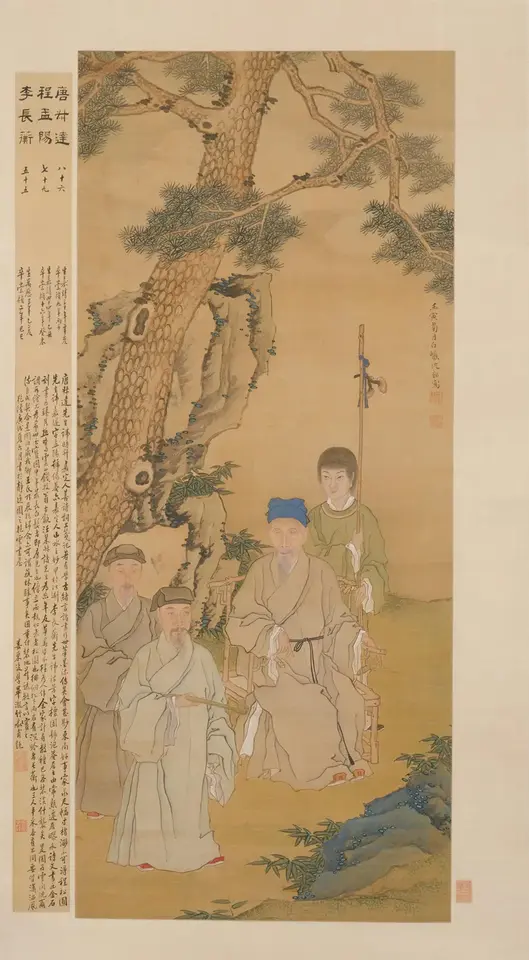
程嘉燧
Cheng Jiasui (程嘉燧, 1565–1643), courtesy name Mengyang, art name Songyuan and later known as the Old Poet of Songyuan, was an eminent commoner scholar, poet, painter, and calligrapher of the late Ming dynasty. Originating from Xiuning in Huizhou Prefecture, he resided for decades in Jiading in the Jiangnan cultural heartland. After experiencing early disappointment in civil service examinations, he briefly took up…
Cheng Jiasui (程嘉燧, 1565–1643), courtesy name Mengyang, art name Songyuan and later known as the Old Poet of Songyuan, was an eminent commoner scholar, poet, painter, and calligrapher of the late Ming dynasty. Originating from Xiuning in Huizhou Prefecture, he resided for decades in Jiading in the Jiangnan cultural heartland. After experiencing early disappointment in civil service examinations, he briefly took up swordsmanship before turning completely to rigorous classical studies, mastering Confucian canons, musical theory, connoisseurship, and ink manufacturing. Alongside fellow scholars Tang Shisheng, Lou Jian, and Li Liufang, he formed the celebrated Four Masters of Jiading, standing as a moral and aesthetic compass for Southeastern intellectuals. In literature and visual arts, Cheng Jiasui championed the principle that moral integrity must precede poetic form, fiercely opposing the sterile mechanical archaism popularized by the Earlier and Later Seven Masters. His poetry was marked by profound stillness, crystalline clarity, and contemplative elegance, prompting literary leader Qian Qianyi to acclaim him as a paramount master of his generation. In landscape painting, he synthesized the sparse dry-brush techniques of Ni Zan and Huang Gongwang, establishing an ethereal, austere aesthetic that led Wu Weiye to celebrate him among the Nine Friends of Painting. As a founder of the Tiandu School and a crucial precursor to the Xin'an Painting School, his influence echoed across generations of early Qing painters.
Born in Chakou, Xiuning County, Huizhou Prefecture.
Accompanied family elders on commercial and scholarly travels, eventually settling in Jiading.
Abandoned early aspirations in martial swordsmanship to commit himself to profound classical study.
Forged a deep intellectual alliance with Tang Shisheng, Lou Jian, and Li Liufang as the Four Masters of Jiading.
Established an enduring friendship with literary arbiter Qian Qianyi, exchanging poetry and scholarship.
Refused association with court eunuch cliques and maintained scholarly seclusion during political purges.
Resided as an honored guest at Qian Qianyi's Fushui Villa on Mount Yu, leading cultural gatherings.
Bid farewell to Jiangnan peers and returned to southern Anhui to live among native hills.
Died peacefully at age seventy-nine in She County, mourned by intellectuals across the empire.
Cheng Jiasui was born in 1565 in Chakou, Xiuning County, nestled within the mountainous landscapes of Huizhou Prefecture. Huizhou was renowned for its unique combination of merchant commerce and deep Confucian reverence. Coming from a household of modest means that blended trade and scholarship, Cheng Jiasui demonstrated rapid intellect and keen artistic perception as a boy. However, the path through the imperial examinations proved intensely frustrating. Suffering consecutive setbacks in the preliminary civil exams, the passionate young scholar felt alienated from bureaucratic routines.
Frustrated by academic confinement, he briefly abandoned his writing brushes to study swordsmanship and equestrian archery, harboring romantic ambitions of defending frontier borders and winning martial renown. Yet as his maturity deepened and he witnessed the political turbulence of the mid-Ming court, he realized that physical valor alone could not resolve the spiritual and social crises of his era. He resolutely returned to literary scholarship, shutting his doors to idle companions and devoting sleepless nights to reading the Thirteen Classics, the Songs of Chu, and ancient histories. Following his family's relocation, he stayed briefly in Hangzhou before establishing permanent residence in Jiading, where he immersed himself in the sophisticated scholarly circles of the lower Yangtze Delta.
Upon settling in Jiading, Cheng Jiasui quickly attracted the admiration of local literati through his dignified demeanor, broad learning, and unbending integrity. He forged an extraordinary bond of brotherhood with fellow residents Tang Shisheng and Lou Jian. Tang was celebrated for rigorous classical exegesis and moral austerity, while Lou was revered for his balanced prose and graceful calligraphy. Cheng Jiasui brought philosophical detachment, musical refinement, and innovative painting. Boating along the Lianqi River to compose verses, the three elders were celebrated as the Three Elders of Lianchuan. When the brilliant painter and poet Li Liufang joined them, they became universally acclaimed as the Four Masters of Jiading.
During the Wanli era, the Chinese literary sphere was largely subjugated to the dogmatic imitation promoted by the Later Seven Masters, whose disciples produced hollow verses patched together from ancient lexicons. Cheng Jiasui and his Jiading colleagues mounted a formidable defense of literary honesty, arguing that true verse must spring from authentic inner character rather than empty verbal acrobatics. Beyond literature, Cheng Jiasui achieved supreme renown in aesthetic connoisseurship. He possessed rare expertise in assessing ancient zithers, evaluating fine teas, and refining pine-soot ink. His custom-made ink cakes were coveted by collectors across Jiangnan as priceless studio treasures.
By the close of the Wanli era and throughout the Tianqi reign, Cheng Jiasui's artistic stature was recognized throughout the empire. Grand Secretary and literary luminary Qian Qianyi regarded Cheng Jiasui with boundless reverence, treating the commoner hermit as his foremost intellectual mentor and dearest friend. Whenever Qian Qianyi was relieved of official duties and lived in retirement in Changshu, he invited Cheng Jiasui to stay at his Fushui Villa beneath the slopes of Mount Yu. The two scholars spent months together editing ancient anthologies, collating rare editions in the Jiangyun Tower, and engaging in poetic dialogues.
During these years, Cheng Jiasui maintained fruitful correspondences with cultural giants such as Dong Qichang, Chen Jiru, and Wu Weiye. Poet Wu Weiye composed his renowned Nine Friends of Painting, placing Cheng Jiasui in the company of Dong Qichang, Li Liufang, Wang Shimin, and Wang Jian, praising his landscapes as celestial and untouched by mundane dust. Despite being courted by influential grandees, Cheng Jiasui steadfastly rejected official patronage, guarding his independence as an unattached commoner scholar amid scenic hills and waters.
In the late Chongzhen period, with peasant rebellions raging across northern China and Manchu armies pressing upon the northern borders, Jiangnan society grew increasingly turbulent. Longing for tranquility and weary of fame, the aging scholar felt an overwhelming pull toward his ancestral homeland. In 1641, he took leave of Qian Qianyi and his lifelong Jiangnan companions, packed his zither and manuscript scrolls, and traveled westward back to southern Anhui.
Settling between Xiuning and She County, he spent his final years in a secluded thatched retreat among pine groves, styling himself the Old Poet of Songyuan. Even in his late seventies, his eyesight remained clear and his mind serene. He wandered along rocky streams in the company of mountain monks, sketching rocky precipices and composing verses until his peaceful death in late 1643 at the age of seventy-nine. Upon learning of his passing, Qian Qianyi wept bitterly in Changshu, composing an impassioned eulogy that hailed Cheng Jiasui as the moral pillar and literary sovereign of their generation.
Cheng Jiasui spearheaded a crucial movement of literary liberation in late Ming intellectual history. Reacting against the stifling archaism of the Earlier and Later Seven Masters, who insisted on rigid mimicry of High Tang poetry and Qin-Han prose, Cheng Jiasui championed the principle of establishing character before establishing poetic form. He asserted that poetry is the natural resonance of an author's authentic soul; without noble moral grounding, the most ornate borrowed vocabulary remains lifeless veneer.
Aesthetically, Cheng Jiasui harmonized the understated philosophical depth of Song dynasty poetry with the haunting serenity of late Tang verse. His poems stripped away all decorative pretense, embracing crystalline lucidity, melancholic restraint, and evocative simplicity. Qian Qianyi celebrated his verses as resembling solitary mountain peaks rising in frozen air or lonely cranes gliding over barren plains, exalting him as a true spiritual leader of late Ming letters whose ideas deeply informed the later Yushan School of poetry.
In the realm of Chinese pictorial art, Cheng Jiasui was a revolutionary master who stood at the forefront of the shift toward minimalist scholar-painting. Along with his compatriot Li Yongchang, he established the aesthetic foundations of the Tiandu School and acted as the direct herald of the renowned Xin'an School of painting. While early in life he drew inspiration from the Wu School, he subsequently devoted himself to the sparse, contemplative brushwork of Yuan dynasty masters Ni Zan and Huang Gongwang.
Cheng Jiasui was celebrated for his mastery of the dry-brush and scorched-ink technique. He constructed craggy mountains, lonely thatched pavilions, and leafless autumn groves using faint pale ink washes layered with dry, raspy linear strokes, applying ink with extreme frugality. His compositions conveyed an aura of pristine chill, detached solitude, and lofty stillness. In Nine Friends of Painting, Wu Weiye celebrated his art with the phrase the Old Poet of Songyuan stands aloof in noble tranquility. This ascetic ink aesthetic directly inspired early Qing individualist masters such as Hongren (Jianjiang) and Zha Shibiao.
The collective cultural influence exerted by the Four Masters of Jiading was extraordinary. Living as commoners who spurned official advancement, Cheng Jiasui, Tang Shisheng, Lou Jian, and Li Liufang transformed Jiading into a vibrant epicenter of scholarly resistance against bureaucratic venality. They established rigorous standards of literary criticism and civic morality, mentoring brilliant younger scholars such as Huang Chunyao and Hou Dongzeng, who would later sacrifice their lives defending Jiading against the Qing conquest.
Within this circle, Cheng Jiasui served as the aesthetic coordinator and philosophical heart. His intellectual open-mindedness and discerning taste elevated their literary gatherings from local societies into assemblies of imperial significance. Whenever moral or literary disputes divided Jiangnan intellectuals, the pronouncements of the Jiading Masters carried definitive authority, injecting a spirit of lofty rectitude into a society sliding toward decadence.
In addition to his literary and pictorial triumphs, Cheng Jiasui was a master of traditional acoustics and craft arts. He was a virtuoso performer of the ancient guqin zither, renowned for a playing style marked by delicate tonal inflections and profound stillness, frequently performing for Buddhist recluses deep into the night.
Furthermore, drawing upon the venerable craft traditions of Huizhou ink making, he mastered the complex chemistry of burning pine resin, blending animal glues, and incorporating rare herbal perfumes. The custom pine-soot ink cakes produced under his personal direction were celebrated for their jet-black density, purplish metallic sheen, and remarkable permanence on xuan paper. Elite calligraphers including Dong Qichang and Chen Jiru prized Cheng Jiasui ink above all others, showcasing his rare ability to unite esoteric craftsmanship with the highest forms of scholar-amateur art.
FIGURES ASSOCIATED WITH THIS DYNASTY