Birth in Shanyin
Born into the prominent Xiahou family, displaying early devotion to sacred Buddhist scriptures.
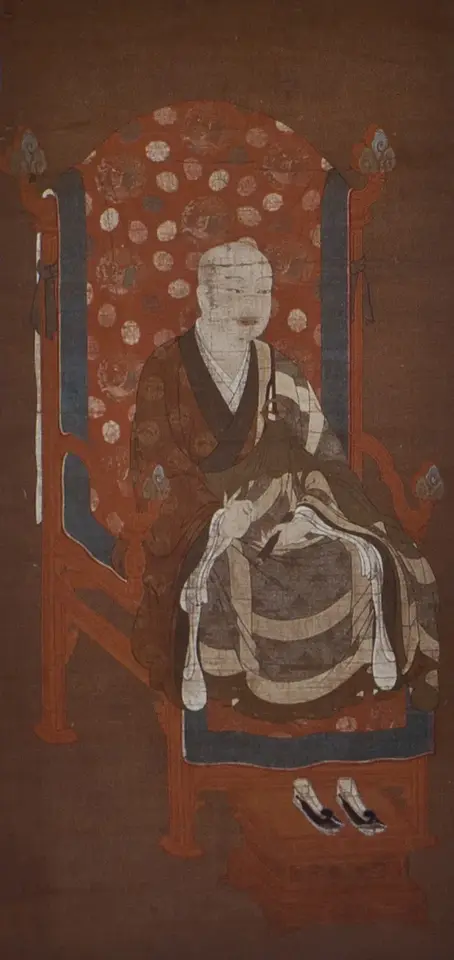
澄观
Chengguan (澄观, 738–839), courtesy name Datong, secular surname Xiahou, was an illustrious Buddhist master of the Tang dynasty, venerated as the Fourth Patriarch of the Huayan school and honored with the title "National Preceptor Qingliang." Born into a prominent family in Shanyin, Yuezhou, Chengguan entered the monastic order at the age of eleven under Chan Master Pei at Baolin Temple and received full ordination in 757…
Chengguan (澄观, 738–839), courtesy name Datong, secular surname Xiahou, was an illustrious Buddhist master of the Tang dynasty, venerated as the Fourth Patriarch of the Huayan school and honored with the title "National Preceptor Qingliang." Born into a prominent family in Shanyin, Yuezhou, Chengguan entered the monastic order at the age of eleven under Chan Master Pei at Baolin Temple and received full ordination in 757 (Zhide 2) under Vinaya Master Changzhao at Miaoshan Temple. Blessed with extraordinary intellectual capacity and profound spiritual dedication, he traveled extensively across southern China, Luoyang, and Mount Wutai, mastering the Vinaya, Madhyamaka (Sanlun), Tiantai meditation, and both the Southern and Northern lineages of Chan Buddhism. In 776 (Dali 11), Chengguan secluded himself at the Great Huayan Temple on Mount Wutai, vowing to compose a definitive commentary on the eighty-fascicle Avatamsaka Sutra. Over five years of rigorous scholarship, he authored the monumental twenty-fascicle Da fangguang fo huayan jing shu and followed it with the forty-fascicle sub-commentary Da fangguang fo huayan jing sui shu yanyi chao, collectively celebrated as the Huayan shuchao. Integrating the holistic doctrines of Tiantai, Yogacara, and Chan, he established the fourfold Dharmadhatu (Four Dharma Realms) and the philosophy of the unobstructed interpenetration of all phenomena, elevating the Huayan school to its historical zenith. In 796 (Zhenyuan 12), Emperor Dezong summoned him to lecture in the Linde Hall and commissioned him alongside the Gandharan master Prajna to translate the newly arrived Sanskrit text from Udra, producing the forty-fascicle Forty-Fascicle Huayan. Living across nine imperial reigns from Xuanzong to Wenzong, he served as personal preceptor to seven Tang emperors, earning the title "Preceptor to Seven Emperors." He entered Nirvana in 839 at the extraordinary age of one hundred and two, honored with a state funeral ordered by Emperor Wenzong.
Born into the prominent Xiahou family, displaying early devotion to sacred Buddhist scriptures.
Entered the monastic order as a novice under Master Pei at Baolin Temple at age eleven.
Received full monastic ordination under Vinaya Master Changzhao at Miaoshan Temple.
Studied Vinaya at Qixia Temple, Sanlun Madhyamaka in Jinling, and Mahayana treatises in Suzhou.
Mastered Tiantai meditation under Zhanran; investigated Southern Chan under Huizhong and Fakin.
Made pilgrimage to Mount Wutai and settled at the Great Huayan Temple to begin his magnum opus.
Commenced the composition of the great commentary on the Avatamsaka Sutra, finishing in 787.
Summoned by Emperor Dezong to lecture on Dharma, honored as National Preceptor Qingliang, and directed translation of the Forty-Fascicle Huayan.
Appointed Sangha Leader by Emperor Xianzong, overseeing monastic affairs across the empire.
Passed away peacefully at age one hundred and two; buried with state honors at Mount Zhongnan.
Chengguan was born into the prestigious Xiahou clan in Shanyin, Yuezhou. Endowed with singular intellectual clarity, he showed an instinctive reverence for Buddhist images and texts as a child. In 748 (Tianbao 7), at the age of eleven, he renounced secular life, placing himself under the tutelage of Chan Master Pei at Baolin Temple, memorizing sacred texts with astonishing speed.
In 757 (Zhide 2), upon reaching the age of twenty, he traveled to Miaoshan Temple in Runzhou, receiving full monastic ordination from Vinaya Master Changzhao. Amidst the chaos of the An Lushan Rebellion, Chengguan embarked on a comprehensive pilgrimage of learning across southern China. At Qixia Temple, he studied the Xiangbu Vinaya under Master Li; returning to Kaiyuan Temple, he mastered the Nanshan Vinaya under Master Tanyi. Journeying to Jinling, he studied the Three Treatises (Sanlun) under Elder Xuanbi, grasping the profound Mahayana philosophy of emptiness.
In 772 (Dali 7), Chengguan climbed Mount Tiantai, receiving transmission in Tiantai Zhi-guan meditation and the doctrines of the Lotus and Vimalakirti sutras from Master Zhanran. Subsequently, he visited prominent Chan masters, investigating the Niutou lineage under Huizhong, Southern Chan under Jingshan Fakin, and Northern Chan under Master Wuming in Luoyang. Through more than two decades of rigorous training, Chengguan achieved complete mastery over Vinaya, Chan, and doctrinal philosophy, while also becoming deeply conversant in the Confucian classics and Daoist thought.
In 776 (Dali 11), Chengguan concluded that the Avatamsaka Sutra represented the ultimate teaching of the Buddha, yet the existing commentaries were fragmented and discordant following the passing of Master Fazang. He set out on a pilgrimage to Mount Wutai (Qingliang Mountain), the earthly seat of Manjusri Bodhisattva, establishing his residence at the Great Huayan Temple.
In January 784 (Xingyuan 1), Chengguan formally commenced his commentary on the eighty-fascicle Avatamsaka Sutra. According to monastic tradition, on the eve of his writing, he was blessed with an auspicious vision of golden light. Applying his encyclopedic learning, Chengguan articulated ten gates of doctrinal exposition: the causal conditions of the teaching, the canonical classification, the scope of doctrine, and the capacities of disciples. Over four years of unremitting toil through bitter winters and blazing summers, he completed the twenty-fascicle Da fangguang fo huayan jing shu in December 787.
The great commentary was greeted with boundless reverence by the monastic community of Mount Wutai. As he began lecturing on the text, disciples found its metaphysical depths difficult to fathom, prompting Chengguan to compose an extensive sub-commentary, the forty-fascicle Da fangguang fo huayan jing sui shu yanyi chao. The two masterworks were combined into the unified Huayan shuchao, which became the definitive, supreme commentary on Huayan philosophy throughout East Asia.
In 796 (Zhenyuan 12), the King of Udra in southern India presented a Sanskrit manuscript of the final portion of the Avatamsaka Sutra to Emperor Dezong. Hearing of Chengguan's unsurpassed doctrinal reputation, Dezong summoned him to Chang'an, housing him at the prestigious Daxingshan Temple. On the imperial birthday, Chengguan was invited to lecture in the Linde Hall before the emperor and court ministers. Transported by his eloquence, Emperor Dezong remarked: "Listening to the master is like receiving ambrosial dew; my body and mind feel cool and purified!" The emperor immediately bestowed upon him the title "National Preceptor Qingliang" along with the purple robe.
Following imperial command, Chengguan collaborated with the Gandharan master Prajna to translate the Sanskrit manuscript into Chinese. Over two years, they produced the forty-fascicle Forty-Fascicle Huayan in 798 (Zhenyuan 14). Emperor Dezong personally authored the imperial preface, commissioning Chengguan to compose a comprehensive ten-fascicle commentary at Caotang Temple on Mount Zhongnan, establishing him as the undisputed doctrinal patriarch of Tang Buddhism.
Chengguan lived across nine Tang imperial reigns, serving as personal preceptor to seven successive emperors: Dezong, Shunzong, Xianzong, Muzong, Jingzong, and Wenzong. When Emperor Shunzong ascended the throne, he summoned Chengguan to the palace to receive the Bodhisattva precepts. In 810 (Yuanhe 5), when Emperor Xianzong welcomed the sacred finger relic of the Buddha to the capital, he appointed Chengguan Supreme Sangha Leader (Sengtong) and Grand Master of the Clergy, placing all Buddhist monasteries across the empire under his oversight.
During this period, Chengguan composed seminal treatises including the Huayan fajie xuanjing, elucidating the Four Dharma Realms: the realm of phenomena (Shi), the realm of principle (Li), the realm of the non-obstruction between principle and phenomena (Lishi Wu'ai), and the supreme realm of the non-obstruction between phenomena and phenomena (Shishi Wu'ai). Monks from Silla and Japan crossed the sea to study under his lineage. His foremost disciple, Guifeng Zongmi, inherited his teachings and became the Fifth Patriarch of the Huayan school.
Despite enjoying the highest imperial honors, Chengguan lived with monastic asceticism throughout his life, observing strict vows never to part with his robes, never to abandon his books, and never to break his meditation posture. On April 24, 839 (Kaicheng 4), Chengguan passed away peacefully in meditation at Huayan Temple on Mount Zhongnan, at the age of one hundred and two, having spent eighty-three years in the monastic order. Emperor Wenzong suspended court business for three days in national mourning and ordered a state funeral, raising an imperial stupa on Mount Zhongnan and conferring the posthumous title "Grand Master of the State."
Chengguan's most enduring monument was his revitalization and philosophical culmination of the Huayan school through the Huayan shuchao. Overcoming decades of sectarian discord following Fazang's passing, Chengguan synthesized Huayan dependent origination with the Tiantai doctrine of inherent nature and Chan sudden awakening. His systematic formulation of the Fourfold Dharmadhatu established the apex of East Asian Buddhist metaphysics, earning him universal acclaim as the Fourth Patriarch and the second founder of the Huayan tradition.
Chengguan played an indispensable role in Sino-Indian cultural exchange through his co-translation of the Forty-Fascicle Huayan. His commentaries on this newly translated scripture completed the textual canon of Huayan Buddhism in China. Furthermore, by serving as spiritual mentor to seven successive Tang monarchs during a turbulent period of political instability, he safeguarded the institutional stability of the Buddhist Sangha and provided a profound ethical framework that influenced imperial governance.
FIGURES ASSOCIATED WITH THIS DYNASTY